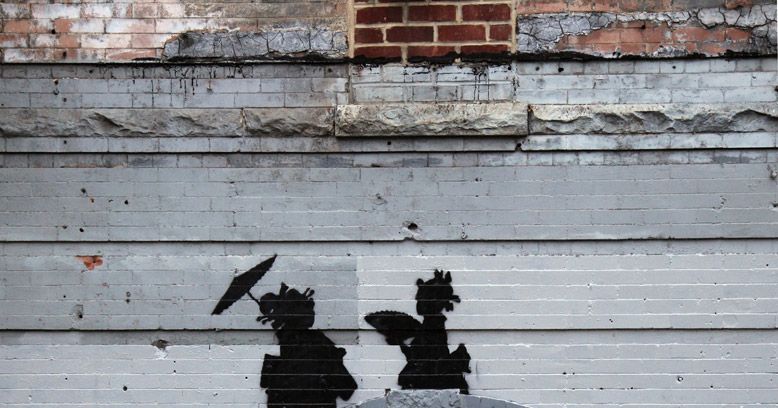
I’m the Accidental Owner of a Banksy
A landlord faces vandals, tourists, and questions of what to do next.
Intelligencer
189 points · by c0riander · 13y ago · 168 comments
Stop valuing it so much - it's meant to be weathered and destroyed. Enjoy the art for what it is and let urban nature take its course.
The whole point of these works is to bring out this drama and highlight the absurdity of it all. It's not absurd in the sense that people are acting irrationally, but absurd in how our culture treats art as some mystical thing that has to be set on a pedestal behind protective glass. We've elevated "art" into something that supposedly only highly-cultured people can appreciate, and shut it away from the layperson.
By doing his art in the cheap and fragile form of graffiti, intimately accessible to everyone, he's giving art back to the people. It's just a simple creative expression for a creator to enjoy sharing. Yet, as Banksy surely predicted, we've tried to apply our weird notions of art onto it, that it should be locked up, cut out of the wall, sold for millions, viewable only to the elite.
There's no easy way out, because no individual is incentivized to change, yet society as a whole needs to change.
I upvoted it because I was going to write essentially the same thing.
I've been thinking about it since Colbert publicly non-invited Banksy to paint the wall outside his studio. I don't believe that dollars are an appropriate unit of measurement for life experiences. I do believe that graffiti and others forms of street art are intentionally impermanent and functions of their location.
I would support trying to sell it if the building owners were living hand to mouth, but that's obviously not the case. The author's already monetized the "inheritance" by selling a literary "piece" to NY Magazine. She doesn't need to sell it so leaving it as part of the gestalt the artist created is the greater good. If it gets defaced by some other graffiti artist or the police/Bloomberg (who are only feeding the frenzy with their attitude) then so be it, the limited lifespan of graffiti is an inherent part of the art. Like making sandcastles.
I would probably set up a hidden video cam in case someone else came along and tried to steal it. Not that the stealing is necessarily a problem for street-art, but taking it would involve damage to the building itself and that would be unacceptably outside the scope of screet-art.
But Banksy isn't graffiti in general or something other people decided was worth money after someone just did it for joy. Banksy's shtick is calculated to generate publicity and a whiff subversion specifically as a part of him maintain his position as a highly paid, highly valued, highly publicized. Banksy could have gone to NYC and done anonymous graffiti for year and no one would have notice if there wasn't any publicity.
Just because some rich people feel like attaching monetary value to most art doesn't mean Banksy's art has to fall in line. It's not like you're going to take down a section of wall and sell it, and someone did, he would also be missing the entire point.
Just be happy that cameras exist and take a picture.
[1] http://www.independent.co.uk/incoming/article8886934.ece/ALT...
http://www.nytimes.com/2013/08/14/arts/design/another-banksy...
As for missing the point, I'll raise you death of the author. A piece of art must stand on its own merits, not the intentions of its creator.
I agree but I'd like to point out that Banksy is as much a part of the "high-art = big money" as the galleries and the press.
And what if the purpose is the absurdity of its monetary value?
I don't believe that Banksy's goal is to have his work be seen as curios. It's getting us to have these conversations.
People want to preserve the paintings, even though they're intentionally transient. They want to cut them out of the wall, even though the environmental context is critical to the piece. They want to sell them for tons of money, even though it's been freely given in a public space, for everyone to appreciate.
In short, people want to destroy the whole artistic value of the piece in order to increase the monetary value. I guess all that remains is the meta-message that predicts this outcome.
In the UK a lot of people are genuinely gutted when a Banksy gets removed or covered - like something (a gift?) has been removed from the community. People who have their buildings 'vandalised' are often incredibly proud. But at the end of the day, it's still graffiti, still vandalism and I can understand Bloomberg's zero tolerance attitude. I wonder how he'd feel if it was on a building he privately owned (not that he needs the money...)?
If he says the city condones Banksy's work then he's going to immediately get asked "Who's job is it to decide which graffiti is art and which will get you arrested?" He's got 10,000 more important things to deal with so he just says it's vandalism and will be treated as such and then moves on to the rest of his day.
"For $41 million — what Citibank paid to sponsor the program for five years — our city bikes became Citi Bikes. To make certain you don’t forget this fact, a Citi Bike sign hangs in front of the handlebars, Citi Bike is printed twice on the frame, and a Citi Bike billboard drapes the rear wheel on both sides. The font is the familiar Citibank font and the Citibank signature decoration floats over the “t.” There is no way to see a Citi Bike without thinking Citibank. The 6,000 bikes so far rolled out, of a possible 10,000, and their signs are a Day-Glo cobalt blue that you see on banks. Nobody wears this color. Nobody paints his or her apartment this color. This blue is bank blue."
http://www.nytimes.com/2013/10/20/opinion/sunday/color-me-bl...?
There is no way to see a Citi Bike without thinking Citibank
If I consider my own experience, I'd say it's pretty easy to miss on that.
When they start asking for permission before painting other people's stuff.
The article is seeping thru with "I have no idea what it means" and so on. Well, what it means is you are not an art owner-type but are suddenly an art owner anyway, so you'd best sell that shack or otherwise get rid of it or remove it from the owners control before screwing it up, probably permanently and certainly very publicly.
The story wouldn't read any differently had someone tied a cow to her fence and run off. "I'm the accidental owner of a heifer" and "I have no idea what it means". Well, you're not going to figure it out quickly so use the magic of the market to hand it off to someone who does know what to do.
Its a popular, overdone trope, think of all the hollywood sequels along the lines of "three men and a baby".
One could argue that if an artist breaks a law to make a statement (about either the law itself or wider sociological issues), then your perspective of the morality of the act could be influenced by whether or not you agree with the artist's statement.
Some would argue that even those now 'breaking rules' have been subsumed by the massive market around art - as soon as the price tag is astronomical, and the method of display only a safe gallery, the rebellion has been captured in aspic and rendered safe.
Banksy is an interesting take on this as much of his work is trying to break out of the confines of the gallery, but he has still been trapped in a system he's at least partly unhappy with by the rising value placed on his work, and has resorted to trying to undermine this with stunts like that $60 sale. It's interesting that the perceived value of the spraypaint with his signature has resisted even that sort of rebellion.
So I don't think saying it must be provocative or break the rules is a very good definition of art, indeed, for most people, even those buying faintly rebellious work in the 20th/21st century, art is decoration (I don't mean that in a derogatory way, but that is how it is consumed), rebellion is an optional extra.
Asking for a transition point makes the assumption that they are mutually exclusive. But Banksy is by any reasonable definitions both a vandal and an artist. Hence Bloomberg is simultaneously cleaning up vandalism and destroying art. Whether you think this is a good thing depends on how you weigh these two aspects. Personally, I think it just makes his work more precious. It is the nature of the medium that his work is temporary.
With Banksy a lot of people (certainly in the UK) don't even think of the vandalism, they jump straight to artist - something they probably wouldn't do for a lot of other graffiti. Why so? Publicity? Celebrity sales? The fact the piece has immediate value?
It's not vandalism if the owners of the buildings are happy to have the piece.
If I scrub a brick wall clean, is it vandalism? No.
If I glue a solid pound of gold to a brick wall and the building owner takes it, is it vandalism? No.
If I have a work painted on my property that draws crowds and will probably have a "market value" of a lot of money, and I'd rather have the work have been painted than not exist, is it vandalism? No.
If I'd be happy or even would actively desire to have a Banksy piece painted on my property, is it vandalism when it does happen? No.
> If I'd be happy or even would actively desire to have a Banksy piece painted on my property, is it vandalism when it does happen? No.
Haha, reminds me of when Banksy would turn up in a van and overalls in the middle of the day, whitewash a wall and then stick up a 'Designated Graffiti Area' sign.. The wall would be covered a few days later... :-)
When they stop vandalizing.
Private property is one of the foundations of market economy, and I can't think of any necessity of art that calls for suspension of it.
On the same vein, the Mayor can't sue on behalf of private owners. If the owners like it, then its OK.
Honestly, he couldn't pay for that kind of publicity, and unless the good Mayor is actually in on it, Banksy must be grinning from ear to ear at the irony.
There ya go...
Why do you think writers use names like ads ? This is a quest for identity by people that have essentialy been made transparent and ignored by society. They reclaim urban space. "This is mine too, it has my name on it". "You can't do as if I didn't exist".
Being the target of such vandalism is no fun, for sure. I have been. When I did, I tried to remind myself tags are scars forgotten kids draw into average and blind people's landscape.
In this world of writers Banksy is a pacifist. He's addressing average people in their own language. He's talking to us with subtlety and good points, he's touching us, instead of shouting on us.
Be it him or any other writer, don't kill the messenger. If tags are pimples, then our society is sick. Would removing the symptoms cure the disease ? I doubt it, and I guess you do too. We know this all too well for a long time but still don't act on it as a group. These are only reminders, or first symptoms, of what is to come if we continue to indebt ourselves to other human beings. They'll reclaim.
Of course, tagging in public, perhaps in a hard to reach place, is a separate skill requiring its own practice... I'd just prefer they did it after having practiced the tag in their backyard first. Like Banksy.
The definition of art is more a philosophical question that varies from person to person, so getting consensus on defining what Banksy is is bound to ask the question. Perhaps that's one of his objectives.
Modern art is usually full of clever subtexts and messages that aren't apparent to outsiders. Like a really complicated and abstract piece of jazz music.
Ask a knowledgeable modern art fan to decrypt some paintings for you sometime, it's quite interesting.
Unfortunately, I think graffiti art will be accepted one funeral at a time.
Also, for reference, My wife is an Art History Professor at a highly respected liberal arts college and she takes Banksy seriously.... though she would not want to be called a critic.
Disclosure: owner of a Mr. Brainwash original
[Goes to play some Weird Al on Spotify ;-)]
Only a few people want these pieces, they are worthless in a vacuum. Only when shown in the context of "These pieces are by legendary artist banksy" do they become valuable treasures, in great demand.
It distresses me the number of things on this planet that are valuable because people think they are valuable, not because they have any actual use.
I suppose their value is in manipulating others. That is a form of utility, I admit.
Sometimes that gets a bit ridiculous but a blanket claim that art has no use (or, even more specifically, that Banksy’s art has no use) seems equally ridiculous.
But an original and a copy of a great picture inspire just as much joy when looking at them. Yet one is treated as far more valuable than the other. So something's funny there.
"A scuffle broke out at the scene of Banksy's latest piece in Williamsburg as a building manager and bystanders manhandled a vandal who tagged over the piece [of graffiti]."
"The building manager grabbed him and threw him down and was calling the cops, but the guy bolted"
On the other hand, the residents may just appreciate the artwork and not consider it to be vandalism, but some guy scribbling over it because "this is his turf" is. Usually pieces tend to remain intact for quite a bit longer but ny vandals seem to have taken a dislike to him. If they actually responded with art (King Robbo[0] as an example) I'd call fair game, but scribbling a quick tag is just vandalism.
[0] http://twistedsifter.com/2012/01/banksy-vs-robbo-war-in-pict...
They also dislike stencil art in general, as it takes far less technical skill and practice to execute. Again, this is seen as yuppie kids ripping off authentic street culture.
The most offensive way to express dislike is to cross out or tag over someone's piece.
[1] http://www.urbandictionary.com/define.php?term=Elements+of+H...
I don't understand how banksy would be cashing in on hiphop culture? I just see him as an artist using a wall as his canvas, I wasn't aware that was reserved for those with a hiphop lifestyle. Was it maybe the "this is my new york accent" piece that draws the association?
Also how do they know he hasn't lives a hiphop lifestyle? I think the same thing exists in London, I have a few co-workers there who seem at least partially attached to it.
It's got more in common with "graffiti on a tasteful outdoor mural" than with typical graffiti-on-graffiti.
theoddfather: Already dissed? Jesus, why are people so ghetto?
bronxflash: how is that 'ghetto?'
theoddfather: Tagging is ghetto bullshit with no redeeming social or artistic value. It's garbage and obviously in this case was meant to simply deface something that clearly has a great deal of value to many people.
bronxflash: while i appreciate the fact that you said 'tagging' and not the all-inclusive 'graffiti,' tagging was the foundation in the early seventies of an entire visual aesthetic that came to be related to the explosion of urban culture; hey, it had to start somewhere and it started with tagging. graffiti was at no point in its origins exclusively 'ghetto': white kids on the upper west side, in south brooklyn, and the east bronx all did graffiti. maybe more kids in the hood did it, because not everyone had the same social outlets by way of moeny and power and social status. banksy wouldn't even exist without what filtered out of upper manhattan and the southern bronx and was known as 'tagging.'
Fair, but we've reached the point where we can discern the difference between something that conveys a message, and what is merely a trademark. A tag is territorial and self serving - a trademark. It might have been what gave birth to other forms of street art, but its value is intrinsically less than something that exists to conjure discussion and consideration, even if the public sentiment towards it is negative.
There is a story in NYC about the French embassy finding they had a Michelangelo in the lobby of their building. (It was there when they bought the building) Once they realized what they had (years later) then they had a problem. They couldn't sell, it, and it required security, so ultimately they gave it to a museum.
http://www.thearttribune.com/The-Cupid-attributed-to.html http://cityroom.blogs.nytimes.com/2009/10/13/a-statue-for-a-...
I would have likely walked by a stand like that and assumed it was a scam. But if you had told me it was real and I could have bought one for $60 bucks, I would have tried to immediately buy them all.
hacking is just like painting and all that - http://www.paulgraham.com/hp.html
imho art like this belongs to the city.
Just clarifying, not disagreeing with your statement :)
Perhaps because they're talking about October?
If you haven't, I'd recommend watching the humorous Banksy-related documentary "Exit Through the Gift Shop". It's quite interesting and entertaining and not what you'd expect.
He can then go back to the phone companies and get the billing details for Banksy and his entourage. He could also ask them to let him know exactly where they are, follow them and catch them red handed doing their next piece.
Personally I see Banksy as a cartoonist rather than as a graffiti artist. He does not have a formal arrangement with the papers to syndicate his work, he does not even have to churn something out every day. Instead he gets his work prominently shown in all of the British papers, reaching an audience that no other cartoonist can. He has Robin Hood grade street cred. due to this audience reach.
Whereas other cartoonists use pen and paper, Banksy uses the side of some house or another wall as the medium. It is an intermediate form much like the conventional cartoonist's paper is. Although of value to the crazies that go mad for such things it is of no value to Banksy if his aim is to get his work into the paper, to reach a mass audience.
As for the people who have inherited the work, they could just let the boring 'tag' graffiti artists vandalise the Banksy masterpiece as quickly as possible, whilst there is still the media interest. It will then be known that it has been destroyed and the troublesome visitors will cease to turn up. They can then paint it over, to restore their property back to normal and get on with life.
Getting back to the mayor, if the trick works for catching Banksy then it will probably work for all of the inane tagging losers out there. So long as citizens report new tag-vandalisms in a timely fashion then the police should be able to get a reasonable sized list of phone numbers to work with.
I have known and known of 'tag' graffiti artists in my time. I still don't see why they are so determined to do what they do and for so late into adult life. I feel sorry for them not having any meaning to their 'art'. The strangest thing to me are the 'tags' put up in some foreign town. Imagine going to another country, a place you do not live, just to paint your tag up on some walls that you are not going to see again.
With a Banksy it cannot be said to truly exist until the papers report the new birth. With small time tedious tagging types they get Facebook instead of the media to show off their efforts. Invariably those that tag post their tags online somewhere. The phones can lead the authorities to where this is and get the evidence needed for prosecution.
That is a bit like saying that those that use a sewing machine for embroidery cannot sew. Or musicians that use a computer cannot perform live. Or writers that use word processors 'cant' use punctuation.
Banksy has a style, technique and message that makes his work his, and highly regarded by untold millions of people. People that do gormless tags (most graffiti 'artists') have just the tag.
There is a difference between art and craft. So what if you have learned the craft, i.e. how to hold a spray can, it does not make it art. There is more to it than that. You have to find a voice deeper than a tag.
'Opsec' is a confabulated word to describe 'trying not to get caught'. Obviously anyone committing a crime does what they consider prudent to not get caught. However, the intelligence level of a tag 'artist' is not that high, hence, when they do get caught there is invariably pictures of their tags on their mobile phone and facebook-instagram-whatever page. So, the HN reading you might be that clever at 'opsec' to not get caught, but, the rest of those taggers out there - fish in a barrel (if only the police didn't have such small fish to dry).
Denying overly broad warrants that infringe on many people's privacy in order to catch one person who is hurting no one and rather than costing the city is possibly generating value from thin air is what judges are for.