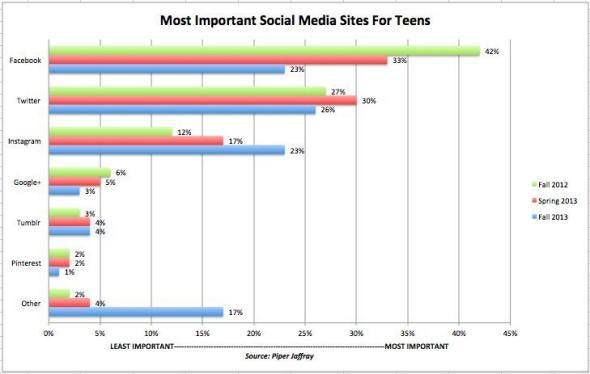
Teens Don't Think Facebook Is Cool Anymore
This post originally appeared in Business Insider.
Slate Magazine
84 points · by cjdrake · 13y ago · 75 comments
Still, it's very significant that Facebook is not the go-to thing for lots of online connective tasks (even if they do own Instagram). People don't want all their interactions to be on one platform for the same reason no one puts all their eggs in the same basket, and in addition, there are nicer baskets out there to try out!
You can only really compare Facebook with services like Google+, Myspace, and Orkut; and even then, many people have active accounts on multiple of those services.
Not really. Twitter is just as good for identity as Facebook, if not more so, since they can more easily verify identity with mobile accounts, which is how most people access twitter.
On top of that, they have a lot of engineers working on how to parse messages with slang and code. So even though there is not purpose-built UIs for events and picture sharing, Twitter and Facebook both solve the same need for 3rd parties.
This means Facebook has essentially reached utility status, which is reflected anecdotally in my life. It's replaced email for a generation. But that's arguably a fine place for them to be: if you own the entire backbone of people's communications, there's a lot of money to be made in that. You'll find a lot more teens who use Facebook but not Twitter than the inverse.
To put it another way, if asked I'd say Hacker News is "more important" to me than Google Search. But Google definitely makes a lot more (potential) money off me.
1. Line works with your telephone number (if you have someones number you can send them a message)
2. Line allows you to send messages (free sms) and voice calls.
3. Line allows you to have friend groups.
But there also reasons specific to Asia (at least Thailand):
1. Line has a "cute look" and has smilie packs which you can buy (big images actually). Thais seem to love that. Westerners would probably find them childish.
2. Line has status messages. These seems to be used in quite an interesting way: to tell people something which you don't really want to tell them directly, e.g. "Stop being jealous. Change your life to make other people jealous.".
The focus is on the content, not the user.
Is it really bookmarking? It seems so different than, say, Delicious is/was.
I never saw a need for any of them. Twitter had potential, but it got overrun by people who somehow felt the need to rant about their opinions on political decisions without being completely educated about any of them, by celebrities, by people who can't spell, and by people who think that @messages are the perfect way to privately communicate on the internet.
I really don't see Snapchat lasting for longer than a year. The others will stay around for a while, but then eventually fade into irrelevance... like all trends that don't provide palpable services, e.g. Google et des autres fournisseurs de recherches.
Do teenagers spend money online? Is there any research on that?
I'll predict that a couple of years from now, the main population left on FB will be 60- somethings who once again are at a stage in their lives where they can afford the time for it.
Truthfully, I don't know why there isn't a K-12 social network that has schools and teachers, and kids were grouped by class, and teachers could moderate all posts and (have the option to) see all messages (with a notice to the parties that it had been looked at). That would alleviate any concerns I had about inappropriate content, and online bullying (there's a record, kids would be accountable for what was said), and provide immediate benefit to students and parents (who could maybe have accounts that were read-only for public discussions and their own children's correspondence).
Edit: As numerous replies have pointed out, there apparently is one, edmodo.com. I guess it's just not used around (or at least not in my district).
Kids might also want and indeed use other social networks, but I would feel much more comfortable as a parent telling them no if I knew they had this to fall back on.
I've seen a large implementation (around 1/3 schools in my area) that technically could do all that, but you can only 'mandate' a horse to the water but can't make it drink - in the end, they were used for parents to look up grades communicate with teachers, while kids used only the absolutely practical things rarely, and since they couldn't be mandatory (as not 100% can afford a computer at home) it sort of died out. It would be fun to ask the developers what percent of kids sent even a single message to another kid... All at the same time, the ten year olds are extremely active online elsewhere.
So essentially, no one uses it as a social tool. I doubt young children would be that interested either. It would be hard to take seriously as a "fall back", either. The real fall-back is email and SMS.
At least when I was her age, I didn't want to pass time where teachers were.
I've come out of the cave just a while ago. Children are sneaky little demons.
I highly doubt the veracity of these numbers.
(emphasis mine)
(emphasis mine)
A difference of ~3 points in a group as fickle as teenagers isn't very significant.
Compare that to twitter's new onboarding experience, which is (arguably) very well done.