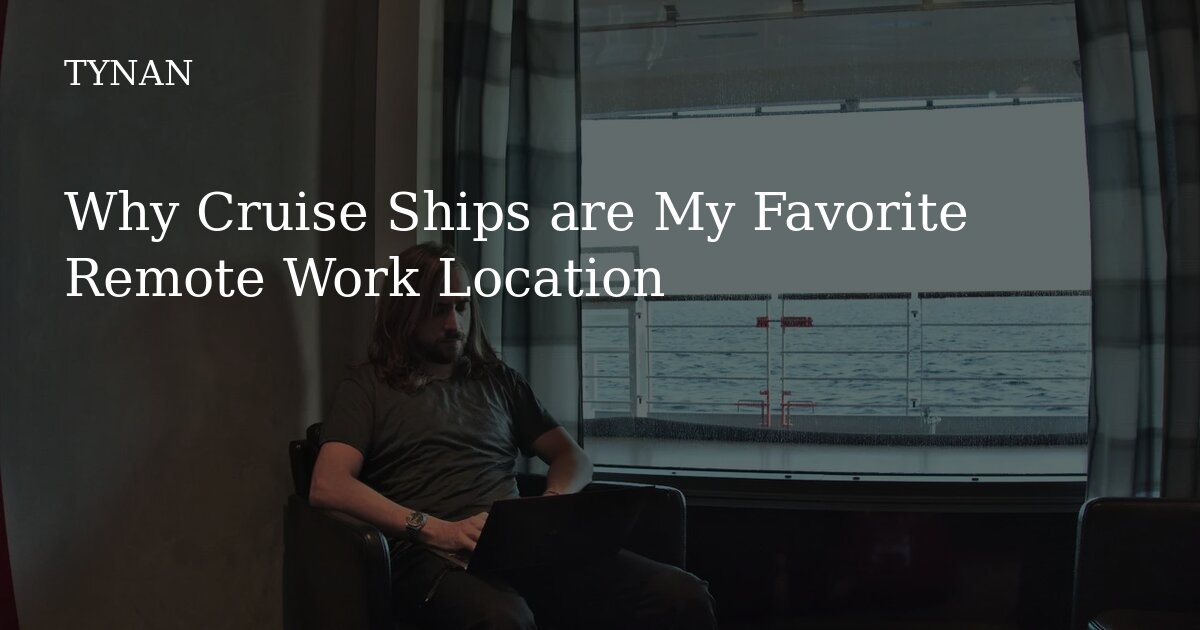
Why Cruise Ships are My Favorite Remote Work Location
I'm currently on a cruise ship somewhere in the Mediterranean sea, en route from Barcelona to Casablanca. Most people here are either retirees enjoying the easy life or younger fol...
Tynan
355 points · by bradly · 13y ago · 311 comments
My favourite places to work are all-inclusive holiday resorts. Lanzarote and the Algarve most recently. Being all inclusive means there is no thought process in eating or drinking. Nor any need to shop, clean, cook.
The most difficult thing is finding out what the internet situation is in hotels - but this has vastly improved even in the last year. I generally call up reception, and travel with an ethernet cable.
Incidentally for an individual or a couple, Airbnb is generally far more expensive than a reasonable half-board hotel. I've only ever found Airbnb type stuff useful in capital cities.
I've been at my most productive working in:
- Wetherspoons in Slough
- An apartment in Cairo
- A bungalow in Lanzarote
- The lobby of the Apex hotel in Dundee (current)
Downsides are seeing a laptop screen in the sun (wear a dark shirt) and being surrounded by happy couples while on one's own.
(I'm back to Lanzarote for a week at the start of December if anyone fancies a coffee)
That'd help the people wanting to turn off the Internet.
EDIT: And, if you really need it, you can get Internet on a ship. It's hideously expensive, but that's okay. You just need to think before going online.
https://itunes.apple.com/de/app/stackstash-stackoverflow-off...
It works but the experience is terrible. I'd be happy to throw money at a better app, in case anyone here is bored... :)
Might head down for the winter again, would be my my 4th I think, and I still only grok about 5% of the language (Brazilian Portuguese is worlds easier for me to comprehend).
My remote work setup is simple: rent an apartment with high speed internet for a few months and dive in.
Finding that apartment is the tricky bit, you have to dig around on the net -- odd given that there are great swaths of empty apartments everywhere down there in the winter, which is of course the best time to be there, 16-18C, warm-ish water, etc.
In some ways I was more productive than before, but I tended to reuse less code, and use less sophisticated algorithms and data structures to solve problems. Having good code around to read became a lot more important, as did having access to good books, and good man pages. (It reminded me why I loved OpenBSD so much in the 90s)
The most positive thing that came out of it was reading a lot more code; I realized one of the habits that had diminished most since sometime in the last decade was the habit of reading the source code for something when I had a problem with it, instead of immediately googling it.
It made me think that maybe younger programmers should try working without a connection now and then (say, for a week at a time). Also that open source has really changed things; there's so much stuff that I don't even think about writing myself now, because I know someone out there has already written and open sourced.
Books. And if you were lucky you would buy 2 or 3 so you could triangulate something that didn't make sense. At least that is what I did.
Also plenty of trying and iteration.
Try this.
Try that.
For hours on end. (Not sure by your question if you had done this or were just asking btw.).
When I bought a Unix system (mid 80's) it came with a bound set of maybe 10 manuals iirc. Getting other books was difficult I had to drive miles to a University bookstore to even find anything on Unix or C. Software wasn't free of course. It cost real dollars and was pretty expensive and came on floppies.
I did some work for p&o cruises, on a ship that focused on round the world trips. These was one old lady there in her 80s who had swapped a nursing home for the ship - and had been there for 3 years or so. The food was incredible, she had diffent company every night due to other guests coming and going, was treated like royalty by the crew (unlike normal nursing home residents), and had an onboard doctor and nurse when needed. And all this was cheaper than any nursing home. Inspired idea.
Another benefit: take your spouses/partners; so long as they are able to let you work during the day while they hit the gym/spa/bingo etc. Everyone wins.
Only danger I see is eating too much.
If it's not mandatory then you're splitting your team up for 1-3 weeks.
Some startups demand you travel for 2 weeks a year for "hackathons" in remote locations. I don't see the difference.
As for the risks of a cruise ship, if something goes wrong, your options are limited. I say this as a navy veteran that's had to deal with multiple things that go wrong on a ocean vessel. (Fire, flooding, engine failure, etc...) As a civilian, I'm very wary of cruises.
That reminds me of a funny experience I had in Cancun a few years back in Cancun. My wife booked a room at the all-inclusive Temptation resort because it had the best rate. When we got there, we were surprised to find that it was basically clothing optional. Be sure to check out the hotel website first if you want to avoid distractions!
I booked it through Costcotravel.com. It's much cheaper in the low season. Paid $325/night total including tax; that's for two people and it included round-trip airport transfers ($120 value). If we were to have a dinner experience like what they offer in the US, it would easily run $300+ each time.
Better question might be deaths/injuries/etc per day, as compared to living in a city, a cabin in the woods, etc.
"In the event of an emergency, it is the entertainers who are in charge of the lifeboats. Because the rest of the crew has actual nautical duties, the kids from Fiesta Caliente are trained to man the lifeboats. If you ever have to get on a lifeboat, the person in charge of your safety will likely be a nineteen-year-old dancer from Tampa who just had a fight with his boyfriend about the new Rihanna video. James also told me that each lifeboat has a gun on it and that once a lifeboat is in the water, the performer–lifeboat captain is trained to shoot anyone who is disruptive. This is apparently legal in accordance with maritime law."
http://www.cdc.gov/nceh/vsp/surv/gilist.htm
It is important to distinguish among cruise outcomes - I'd rather experience a 24-36 hour power outage than a fire that resulted in passengers at sea in lifeboats, but there appear to be some narratives that conflate "our honeymoon was not what I had dreamed of" with "captured, burned, sunk, and destroyed" without any points on a scale in between.
Third party advice I'd heard on cruising:
avoid the very cheapest lines
choose an operator with a generally nordic background (not flag/registration, more company origin).
That means
-no showers
- no toilets flushing.
- No internet
- no hot meals
Oh god, that sounds nightmarish.
or if you're of a different age:
The whole point of the suggestion is that a Cruise is an entire package of benefits.
I can go from London to San Juan in 14 days, for about £32 / day. That's cheaper than life at home.
Think I'm gonna book myself a cruise soon
Edit: Just exploring this guy's blog, and it turns out he's Herbal from "The Game" - an excellent book if you've not read it.
What is happening to people? When you are insulating yourself from nearly every aspect of day-to-day normality just to be able to concentrate without distraction there is a problem and it's likely you are working to much. I'm all up for travelling but this just seems like an easy way to remove yourself from the world to get more done. Why not just check into a mental health clinic with a wifi dongle - you won't have to cook or clean and they'll be perfectly equipped to deal with you once the monumental burnout hits.
This tactic seems like it could be more of a sanity-booster than anything, if applied responsibly.
All of these places have easily available wifi, good food, great people, and lots to do after work. If you're smart about it, there are even nice places just outside of these towns where you can camp (< 14 days) for free and still have 4G cell service.
I don't think I'd compare the two directly, though. Driving an RV is probably more expensive per-day even discounting the food and services on a ship and assuming very little depreciation on the vehicle (i.e. you got a deal used), and it's a lot more work. Between finding places to park/camp, run the generator or hook up power, empty the toilet, maintain the drivetrain, cooking, and the inevitable RV disaster-breakdowns RVing is a lot of work - a far cry from "saunter to the restaurant, pick a meal, eat it, come back to a freshly cleaned room and more food."
http://www.clearbits.net/creators/146-stack-exchange-data-du...
I do not know what format it is however because I have not gotten around to using it yet.
[1]: http://www.clearbits.net/creators/146-stack-exchange-data-du...
Also... I didn't post either of these... did one of my 2 minute cruise-internet email checks and was pretty surprised to see that I was on the front page twice.
[pdf] http://harpers.org/wp-content/uploads/2008/09/HarpersMagazin...
However, I don't think this (somewhat critical) article should deter any would-be cruise goers, especially if you have work to engage you during the time.
I tend to go full Howard Hughes (not leaving my 2-3 room suite) for a few days, do some limited local exploration, etc. I feel a lot better having a separate bedroom and office. Free breakfast and lounge means effectively unlimited food, although local restaurants, room service, etc are options.
This week I've been at the Le Meridien Bangkok, probably my favorite hotel in town, for 5000 points/night, net, which is essentially $50/night in foregone cash back on credit card purchases, or about $100/night at retail. It cost me $50 to fly here from Singapore, where I couch surfed with friends for a few days, after 10 days in Bali with the girlfriend.
Less risk of fire, norovirus, my hotel is mainly full of nice Japanese people instead of either obnoxious partier spring break types or old dying people, 50M Internet, etc.
(1) Internet access is "limited". I'll stick with "limited" because it's a mixed bag. It's been 5 years since I cruised, though not Mediterranean and was able to find flat rate per-day, however, the one day I broke down and purchased access I found it to be very unreliable (single shared satellite connection for the entire ship). This is the same for phone service. The last ship I was on had a ship-board cell "tower" that showed up as international and I can imagine even T-Mobile doesn't cover that in their zero roaming considering ship to shore calls were $9.00/minute from the suite. This also encourages my coworkers to think long and hard about whether or not to call me in an emergency.
(2) Everything is taken care of, including entertainment. I find it difficult to relax, even on vacation -- it's an exercise of planning what to eat, when to eat, what to see, what to do and when to do it. When "at sea", the cruise director provides a menu of what you can do and when. You pick. Very little energy is expelled in enjoying myself.
(3) When in port, same rules apply. You don't have enough time to plan some grand excursion, so you pick one or two things to do and head back. I always opt for a room with a window and have found that if the ship is oriented with me facing the shore, I can pick up free Wi-Fi from restaurants at shore for a fix (even when the ship is too big and has to be anchored at sea). This provides for a quick fix of internet and stretching.
Because there are many times of the day where there is literally nothing else to do, I find it's the only thing that slows my mind down. By day 7 or so I'm ready to be home again, and the weeks that follow my vacation are usually amazing. The time spent being forced to be alone with my thoughts results in me returning with new ideas, new ways to solve old problems and just a generally more positive outlook. It's the only vacation I take where I truly get the idea of taking time out to decompress.
Anyway, interesting idea if you can live without internet. Technically speaking, if you're in international waters (and not a US citizen, which is a long story), you won't even owe taxes on the work you do aboard.
Basically it just matters what your starting ocean is and if it's round trip or not.
"And then everyone gets out to help carry the ship over the Darien Gap..." or possibly,"Shackleton, the adventure."
I took the Toronto to Vancouver train in 1984, and although I understand the details of that route have changed quite a bit since, it was a wonderful experience.
95% of the trip is through wilderness, with occasional stops in small cities that seem to just spring up in the middle of nowhere (Winnipeg...). Once past Thunder Bay, the train suddenly empties out a bit, so it doesn't feel crowded, and spending all day reading, in comfortable seats, with wilderness streaming by the huge window next to you is just wonderful. I found the other passengers quite interesting—I shared my four-seat "section" with a forestry student off to work in a lumbercamp for the summer, and learned a lot of interesting stuff about Canada, and forests... :]—and the vibe was very amiable and quiet. People were friendly, but there was a distinct lack of "chatterers" and most people seemed content to do their own thing most of the time.
Because the trip took five days, and there was basically no demand on my time, it felt incredibly unrushed, and combined with constant low-level "passive" distraction in the form of scenery, the wonderful light, and the soothing motion and sounds of rail travel, it left me feeling both incredibly relaxed and oddly energetic.
Extreme long-distance train travel is generally way underrated, I think; obviously it's not ideal if you're in a hurry, but if you have a few days, it's often a treat. Although the Canadian trip was the best, I've also traveled by train from Seattle to Boston, and it was a great trip too, for many of the same reasons (Amtrak long-distance seats are just amazingly huge and comfortable though).
I was also well prepared for some isolation, with a big stack of books to read, pads of paper etc for writing on etc.
In a way I also think it was easier alone. Travelling with a friend can great fun, but to some degree it can also detract from the feeling of freedom... Because there were some friendly passengers, I never felt lonely, but I also felt completely free to stare out the window and think for hours on end. No pressure.
1) Listed prices generally DO NOT include gratuities. Low level cruise employees like the cleaning crew, cabin stewards, waiters, cooks, etc. are paid ridiculously low wages, because cruise ships are registered to countries like Panama and the companies do not need to adhere to U.S. standards. I don't recall offhand, but for a 7-day cruise the "automatic" gratuity is, I believe, around $100 or so per person, so take that into consideration. You can remove the charge if you want to, but you'd have to be a pretty big asshole to do that :) Also, prices are based on double-occupancy, so if you go by yourself, double the fares.
2) Internet is expensive, slow, and charges by the minute). However, if you do this a lot, some cruise loyalty programs will give you free internet. I know Princess does this. Also, you're cell phone my work in certain locations. I'm a U.S. AT&T subscriber and I have full service in U.S. ports like San Juan and the U.S. Virgin Islands. If you can tether your phone, you'll get much faster and cheaper service that way than on the boat internet.
3) Don't get sick / injured. My wife stepped on broken glass while wearing open-toed shoes and got cut up pretty bad. The doctor on board used strips instead of stitches, and the cut reopened in two days, by which time we were already off the ship. The crew handled the incident terribly. The problem with the glass was not resolved quickly, my wife had to wait a fair amount of time for someone to show up with a wheelchair to take her to the doctor and the crew went into "don't get sued" mode really quickly. They gave us pushback when we refused to sign a liability waiver before getting treatment and we had some security guy who kept insisting to come into our room to photograph the shoes my wife was wearing at the time. When we complained the next day about the process, a nice woman sat down with us to hear out our complaint, but never really did anything. We were adamant about NOT paying for the care and it never showed up on our bill, so we let well enough alone. Three months later, they sent us a bill for $300 for the care. After we sent their HQ a letter in response, they ended up waiving the fee and giving us $100 credit towards our next cruise. Nice, but it was ridiculous in the first place since.
4) In regards to the above, had something worse happened, or they had refused to waive the fee, good luck fighting the cruise company in court. You're not only bound by typical consumer-crushing stuff like forced arbitration, but you're also getting into international legal difficulties. For big cases like the cruise that tipped over, it's worth the hassle, but for smaller claims, you're pretty limited in what you can realistically do.
All that said, I think this is a pretty cool idea and had always thought about how cruises could be a cool little work/vacation thing.
Does the fact that I didn't know about "tipping culture" when I was first time in the US makes me an asshole?
If you are in the US and received good service, but left crappy or zero tips then yes, you definitely leave a negative impression of yourself. Nobody will understand why you left a bad tip or just think "oh, he's a foreigner, he doesn't understand." They will just think you stiffed them. Or they will perhaps think - "oh he's from country X - they must all be cheap assholes there. I hope I don't get any more tables with people from that country."
Would it not be the same if I visited your country and was rude or insulting regarding some very basic and obvious part of your culture?
(2) People who generalize about an entire class of people being "assholes" ... maybe should look in the mirror.
The whole PUA thing is about manipulating vulnerable people so you can have sex with them. It's definitionally assholish. Assuming that a given PUA is an asshole is like assuming an Englishman speaks English. It's not a perfect correlation, but it's certainly the way to bet.
Why would you suggest that an entire class of people do something?
You should read "The Game", by Neil Strauss. He documents the process of becoming a pickup artist, the people he met, the stages he went through. And as you read it, you will realise something - the only surefire way to becoming a successful PUA is to improve yourself, to become the best version of yourself, and at the end of it all, that's what these guys were trying to do.
Yeah, there are assholes. There's always assholes. But at the end of the day, this so-called "PUA" culture is about turning yourself into the best version of yourself you can be. And isn't that what all us startup types are trying to do? Rising to a challenge? Stepping into those shoes? Pushing ourselves beyond what we thought possible? Closing the deal?
There are more parallels than you think. Read that book. And don't be so eager to judge people. They're more like you than you realise.
That also happens to describe the mob and the serial killers community.
It's strange how half the people who read this book ended up infatuated with the over-glamorized lifestyle of the "pickup artist" and missed the tale of the value of being yourself.
If I found an asshole that does tip, would that destroy your theory?
When I've been on cruises (this dates back to as early as 2002 iirc) I've always been concerned with this.
And there are times as well (when sailing) that you are out of reach by satellite and have no connectivity at all. Unless things have changed you aren't going to be streaming video or doing anything that requires bandwidth. Once again, from my experience, things could have changed as I haven't cruised in at least 4 years.
With respect to internet on cruises it's a totally YMMV. I was concerned enough about access that I actually tracked down and contacted the operator of the service [1] for the particular ship I was on (and they do this for many cruise lines) and spoke to an engineer to ask questions before taking a particular cruise. I wasn't going to rely on what the cruise ship customer service told me. One of the questions I had was "do you block any ports"? The engineer (quite knowledgeable not customer service but engineering) said they didn't but it turned out that (at the time) they blocked anything that carried voice or obviously video (like ichat, skype etc.). Have no idea if that is still the case.
But here is the strangest thing. Back in perhaps 2004 on a particular ship you couldn't (get this) connect by wifi with a Mac!.
That's right you had to have a windows machine to connect to the ships wifi. Made no sense. But true. Nobody on the ship with a mac could connect only PC laptops. Ended up having to use the crap in the "Internet Cafe" which made 1996 using AOL seem quick. Literally couldn't even get email during certain times since all ship traffic went through one pipe.
For the next cruise I also brought a PC laptop. (But on that ship I didn't need it).
[1] It was this company: http://www.mtnsat.com/
On most major lines, the cleaning, etc. staff get reprimanded if they receive reviews from their passengers that are less than 5 stars. Even if it's only 4/5 (or the equivalent), they are expected to keep "perfect" ratings and are punished if they don't.
Cruises end up being a convenient way for my family to take vacations for a number of reasons (not the least being that my grandmother has limited mobility and cannot enjoy other vacation destinations as easily), but I always feel very guilty every time I go, because I see firsthand how badly the staff are exploited.
(Also, if you never want to go on a cruise line again, read the chapter in Tina Fey's "Bossypants" about her experience the one and only time she took a cruise.)
As for the (lack of) connectivity, I actually like this feature. When I go on a vacation, I enjoy being completely disconnected from the "real world". I find that, after a week of this, I wind up completely refreshed and come back to work more productive than if my attention had been split. But YMMV.
You have to consider any situation holistically. What you call exploitation is often a tremendous improvement over the alternatives those folks have in their countries of origin.
Go on the cruise, tip well, and be polite to staff.
To consider the situation holistically would mean to look at the global system of capitalism bootstrapped by years of outright colonization and exploitation that lead to the situation where doing low-skilled manual labour is considered an improvement in lifestyle for otherwise healthy and able individuals -- rather than (say) getting free, high-quality education or vocational training and a reasonable share of the improvements in life style industrialization and science have enabled.
I'm not buying into the idea that not going on a cruise would improve things, and I'm not even saying don't go on cruises -- but why delude yourself that exploiting people is ok, just because someone else have set the stage for doing so? It doesn't stop being exploitation just because someone comes from a worse situation than they're in now. That just makes participating in the exploitation is a rational choice by the one being exploited -- it doesn't make it a moral choice by the exploiter...
I hate this kind of thing. Why do we allow this sort of situation, where fear of lawsuits results in worse response/care?
I don't know exactly what would need to change, but this the legal process at its worst.
2) I'm not an American but I think your legal system is very good and many objective people do too: http://www.quora.com/Litigation-and-Lawsuits/Why-are-America...
3) I'd recommend anyone to watch Hot Coffee [1] which documents the lobbying and spin that encourages American citizens to think there is a problem with "frivolous lawsuits"
I suspect that going into "don't get sued" mode actually encourages lawsuits.
I read an article a while back that indicated the doctors with the highest rate of malpractice suits were not the ones who made the most errors but the ones who were the least empathetic. There has been at least one study that concluded insensitivity and poor communication after the incident was a major factor in the decision to sue.
The service staff work for tips. No wages. No benefits.
I was shocked when I first heard this. I asked around, a lot. Everyone confirmed.
I personally hate the cruise ship experience. The master/servant dynamic makes me very uncomfortable.
That their working conditions are only mostly terrible is sufficient for me to act on my values.
I'll give analogy. WalMart screws their workers, their suppliers, and their host governments (and by extension us tax payers). Not in every case. But enough to piss me off.
So, yea, I'm not shopping at WalMart. Maybe they're not all bad. Sorting it all out is too much work. Especially when I have plenty of options that are mostly good.
I worked remotely from a cruise ship that went around Hawaii for a week in 2007 (long story). I had a small Verizon cellular router that I set up in my room. It worked well enough, and I didn't have to use the ship's (presumably) crappy wi-fi, or pay by the minute or whatever.
Plus, when I'm coding, my bandwidth needs aren't that great.
I'd assume that using your phone as a hotspot today would work equally well in that scenario.
http://www.aplaceformom.com/blog/2013-2-2-cruise-ship-retire...
"According to Dr. Lee Lindquist’s 2004 study comparing assisted living costs and benefits to those offered by cruise ships, “cruises were priced similarly to assisted living centers and were more efficacious.” Lindquist claimed that over a 20-year life expectancy, cruise ships only cost about $2,000 more than the cost of assisted living. And, she says, “when you compare that to the $9,000 a month or more charged by some assisted living facilities,” a cruise ship may seem like a bargain indeed."
Downsides: You'll need a wireless hotspot since hotels charge too much for internet access (ones without resort fees). Starbucks is overpriced and there aren't many other coffee shops on the strip.
I live in San Diego, but a few weeks ago I drove up to NorCal to visit the parents. While there I attended Startup School in the bay area. The next week I flew to Boston and stayed with a friend in Cambridge and attended WordCamp Boston. I attended the Business of Software conference next and stayed at the Seaport Hotel. At the end of the conference I took the short ride to Cape Cod and stayed there for a week or so with some family. It was a little chilly this time of year, but with everyone gone during the day and the tourist season over I could really enjoy the beauty and eat at all of the great restaurants. It's incredibly peaceful. I even spent some time at the Chatham Bars Inn and worked from there...absolutely incredible.
By staying with friends and family and managing costs the whole few weeks probably cost around $1,000 including plane tickets. The most expensive thing was the three nights at the Seaport Hotel, which cost around $500 even though I split the room with someone. It would have been a lot more if my wife was with me since we would have wanted to do more.
So now I'm back in NorCal staying with my parents. I'll probably stay here through Thanksgiving then head back home to San Diego for the winter.
This lifestyle really is incredible. It'll be interesting to see how it works out when my wife and I have kids, I assume it'll be a pain in the ass. I can't believe I had a 'real' job for so long. Sure I work about 2x as much, but I love it. Besides, it's really only work if you'd rather be doing something else.
I order one with my cell phone, it shows up, I hop in, type my destination, and then I can ignore the world while I'm getting stuff done. Or sleeping.
I get to see interesting places, but get stuff done.
On a Friday night, I could order a car from my phone, hop in, fall asleep, wake up in destination city on Saturday morning. On Sunday evening, I go home, waking up on Monday morning right outside my office. It'd be awesome.
Take a train.
That requires that I get from where I am to a train station. That also requires that the train leaves NOW to get to my destination. That also requires that the train has anything like a reasonable route to my destination. That also requires I get from the destination train station to the actual destination.
I'll just take a train to the Grand Canyon.
If you haven't read it, in the book, there are numerous driverless cars that operate a bit like taxis: you can hail one or you can summon one. They take you to your destination, and then rejoin the pool of free cars that are ready to take people places.
There's a minor plot point where one of the characters fights with the embedded logic of the car, which refuses to take him where he wants to go (and indeed refuses to just "stop the damn car so I can get out" since he wants to get out along the shoulder of a freeway on-ramp or something like that).
Vinge's driverless cars are neat (I would be 99% happy with them) but they subvert the automobile's typical role in American society: rather than being an enabler of rugged independence, it only allows you to go where the state says you may go.
Multi-day long-distances are best experienced in a cabin with a shower facility. These cabins get booked out a month or longer in advance. This cuts down on the ability to make short-notice trip decisions.
These cabins are not lockable except by the conductor. You need to be sensible with your gear, and don't draw attention to it. I took my laptop with me when I went to meals in the dining car or to sit in the observation car.
Temperature control is largely set by the conductor or porter. There are thermostats in the cabins, but I never actually have seen them work.
Internet connectivity on most lines is bring-your-own-Internet; Northeast lines have more options, Midwest/Western/Southern lines are the ones that are BYOI. With a Sprint 3G/4G modem, I mostly got 3G except near the major metro areas, and was able to get some work done, but definitely not anything that counted upon heavy connectivity. Web browsing and terminal-based work via SSH and screen (or similar) was easily doable; anything needing RDP or X11 was pretty much out of the question once you left the major metro areas. VPN is a crap shoot; sometimes the connection is not stable enough. There are vast deserts of absolutely zero connectivity out in the Western US.
Voice phone connectivity is surprisingly good, except in those aforementioned deserts.
Passengers keep to themselves if they see you wearing headphones. It is super easy to find a spot on the train, pop on the headphones (you don't actually need to be listening to anything, or even be plugged into anything), then hit your zone and crank some work out.
Trains are almost ideal for traveling young families. If you are on a $100K-type per annum income and live within your means, then the family cabins that include meals are not a stretch on that kind of budget, many young children are utterly enthralled with trains, and you get to introduce the youngsters to people from many walks of life. Though keep the trip to around two days, and break up longer trips with multiple day stays in towns in between if you can; longer than two days and they start to get bored. Use a car service at either end of the train trip, and it becomes a pretty comfortable way to travel with children compared to planes.
Luggage check-in and pick up is far easier than at airports, but there are limits, and Amtrak is far stricter with sticking to those limits than the airlines with their baggage rules. Trip check-in without the security lines is much less time-consuming than at airports.
Any carry-ons you cannot fit into your cabin are stowed out in the open in some storage bays. This has never presented a problem for me, though at times I have used a locking luggage cable when my paranoia got the better of me. Cabins don't have much storage space beyond what can fit underneath the beds.
If you are comfortable with taking a shower inside the tiny closet that the toilet is in, then you'll be fresh and clean on multiple-day trips. This is the same kind of setup that you have on smaller cruising sailboats. If that kind of setup raises your ick factor, reconsider long train trips.
Meals in the dining cars are generally smaller portions than what you get a restaurant. For Europeans, the portions are normal. Frequent diners of an Applebee's or Outback Steakhouse are going to think the portions are on the small side. The snack bar topped off gluttons like me (I generally try to eat low-carb+high-protein, and carry on board my protein bars and a jar of nuts). On a $100K-type income, the meal and snack prices are not a big deal, though the fiscal and nutritional values are generally absent with some offerings. If you book a cabin, meals can be delivered for dining in your cabin, valuable if you are in crunch mode on something.
Motion was not really an issue; I was very pleasantly surprised at the comfort quality of the ride.
If you stay in a cabin, then tip your porter well when they help you board, and they will bend over backwards to make your trip enjoyable. I tip $50 (which is considered huge and extravagant) and our porters always sought to make sure our cabin was secure and comfortable, we had whatever drinks we wanted delivered to our cabin (water bottles, juices and coffees are served at a refreshments station in the middle of the car), our carry-ons got stowed regardless of whether there was room for them or not, and that we got our pick of meal times (dining car service is by time slot reservation).
I really wish Amtrak would expand their Auto Train service everywhere. Think "land ferry".
http://www.amtrak.com/auto-train
If I had serious FU money, then I would get a private railroad car (or two) built, hitch a ride to someplace interesting along Amtrak's routes, divert to a rail siding, and bounce around the US. I looked into it, and it seems Amtrak actually hauls private railroad cars. There is even an association of private railroad car owners (AAPRCO). I could bring along my own automobile, those diesel-electric engines supply a huge amount of high-voltage power, with that kind of platform and money satellite Internet becomes feasible, and there seem to be a lot of interesting stories out there in those towns (if nothing else I could scout for interesting places for offices).
I stayed in a family's house. They cooked, cleaned and made coffee. I had zero responsibilities. Results:
I wrote 50% more than usual. I read 7 novels, including Moby Dick. I socialized more than usual. I exercised and went for long walks every day. I studied for the GMAT.
Not having internet was very helpful, but outsourcing all domestic tasks made a huge difference.
The chairs are usually terrible and anything more than a few hours seated makes me want to move somewhere else. Even when working standing (using a kitchen counter for instance) is bad: the height is sub optimal.
I would love to hear suggestions if anyone has insights or good tips for what you do in cases like this.
Dang!
The cost is also surprisingly low, typically coming out less in total than a typical "big hotel" conference does: when you add up conference-room rental, catering for coffee breaks and lunch, cost of hotel rooms, restaurants for dinner, etc., the cruise ship's all-in group pricing typically ends up cheaper per person, sometimes substantially so.
The downsides:
1. It looks bad externally, like academics wasting taxpayer money on a boondoggle. Even if it's cheaper, the image is too luxurious. It looks better to have a conference at a Marriott in Chicago, even if that costs the taxpayers more. It looks bad enough that some people won't come, because their source of funds won't approve the trip.
2. Flipside of the community tightness aspect is that it can feel claustrophobic to be essentially stuck at the conference, literally unable to leave the floating conference hotel.
3. No internet means certain kinds of demos won't work, or need added preparation. Although this is good practice anyway, because conference-room internet is often flaky even on land.
4. Not being able to come for only part of the conference can also be a disadvantage, since the schedule is inflexible. If you have a hard conflict anywhere in the conference, you have to skip it, since there is no way to arrive half a day late, or leave even 2 hours early.
Last year we experimented with having it in a medium-sized town with a compact city center, in a lower-cost-of-living location [2], to try to get some of the advantages without the disadvantages. I think this worked fairly well, and I personally liked it more than the cruise ship. But there is an added travel disadvantage, because there are few compact towns that also have good international airports.
[2] Chania, Crete: http://www.fdg2013.org/attendees/
I like the floating village concept, though, and I guess everyone would be pretty relaxed overall, maybe bring the family as well, and what a way to combine vacation with work!
The 2009 version of this conference was on a Disney cruise ship, and the keynotes and plenum sessions were in the auditorium/theatre pictured here: http://www.film-tech.com/ubb/f8/t006888.html
I'd do it again in a heartbeat and work if there was a steady internet connection.
I would like to have an app that learn from my browsing usage and from time to time caches my favorite part of the internet (for example in my case it would cache the hacker news site 1 link deep from front page)
Even some co-workers who you can bounce ideas off of.
I find working for long periods on nothing but a laptop challenging.
Interesting idea, although it's going to be a really tough sell to go without the family. :/
I find airports very neutral in-between spaces and thus perfect for concentration and work.