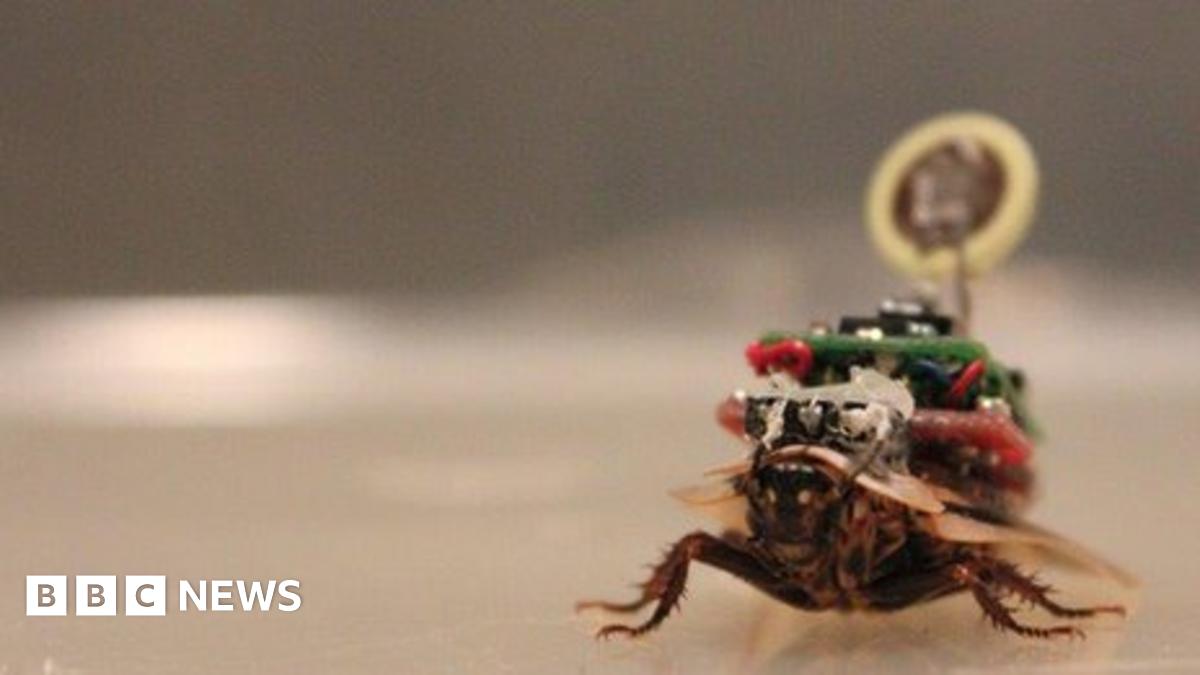
Row over US mobile phone 'cockroach backpack' app
A US company formally launches an "electronic backpack" mobile phone app that controls the movements of cockroaches and defends itself against cruelty claims.
BBC News
63 points · by T-A · 13y ago · 71 comments
Of course, the above is a response based on emotion, maybe aesthetic grounds. I'm sure a bioethicist can create a better argument against this.
Do that in your kitchen and you get labelled a murderer.
Context is everything.
No, you don't. You get labeled a freak, and you may or may not be charged under health-related laws.
To be labelled a murderer, you have to kill someone.
* Thankfully, my work on the dragonfly project was the biotelemetry radio link rather than working with live animals.
[1] http://www.wired.com/wiredscience/2013/06/dragonfly-backpack... => No control of the dragonflies; only neural telemetry.
But beyond that fairly narrow issue, what you're espousing here is an incredibly benighted view. We want "citizen scientists" to be moved by the spirit of inquiry and run the experiments that take their fancy. That's how progress is made. "Novelty and staving off boredom" are a primary motivation for many professional scientists; I still remember the essay I read pointing out that the true scientific mindset was that of an overeager dog who just has to see what's behind that door... and the next one! and the next!
Science-related toys for children have long been felt to promote positive goals, like sparking the interest of a future scientist or just raising awareness of what scientists might do. I see complaints all the time that you can't buy a decent chemistry set anymore. And here you're admitting that exactly this sort of experiment can be published in Nature, but children should keep their hands off? You don't see me crusading to keep Lego Mindstorms in professional hands only. I like it when children share my interests.
Major progress has been made by serendipity and by "citizen scientists" acting without oversight. And, for that matter, by professional scientists acting without oversight. Making the tools more accessible can only get things to happen faster.
You should be ashamed of yourself.
You mention the fear that has caused chemistry sets to be reduced, but that's only part of the problem. The other problem is really bad toys being sold as "science" with nothing sciency about them.
> It's just a toy. There's no science taught here. It's just idle noodling.
This doesn't remind you of, say, a C64? The kit is a tool. You can do different things with it. If, at any point, someone using the kit thinks to themselves "what would happen if I did X?" and then does X to see what happens, that is citizen science.
> The other problem is really bad toys being sold as "science" with nothing sciency about them.
This is a problem, although in my experience it's not a large one. It definitely doesn't apply here, though; witness yourself the people saying they've worked on similar projects.
I've already mentioned several questions about the product that implicate "science" generally:
- can you mount a camera on the roach? If you can, and it acts naturally afterwards (or even naturally with the caveat that it's stopped fitting into cockroach-sized cracks), you'll pick up extremely valuable footage that a biologist studying cockroaches would love to have.
- Will other cockroaches accept one that's had this kit installed? If not, why not?
- Can I use my RC cockroach to influence the behavior of a swarm? Choose for them where they'll sleep? Dictate what left-out food they choose to eat and what they pass by? Cockroaches are social. Using one to manipulate a colony would be huge.
Telling me to be "ashamed of myself" is completely ignorant of all the scientific outreach I've done. Don't project.
As for IRB... it's a pain in the ass. But for good reason: standard ethics training. Just go look at some of the shit that has been done in the name of "research" (eg. Stanford prison experiment, Tuskegee experiment, etc). In this case, IRB approval simply says, "we've thought about the processes and the ethics behind these experiments, and we got the review board to agree to our protocols."
EDIT: Would you be OK if the animal was a mouse? cat? dog? person? Where do you draw the line between "scientific exploration" and "cruelty"? That's why universities use IRB -- because even well-intentioned individuals can be blinded.
> Telling me to be "ashamed of myself" is completely ignorant of all the scientific outreach I've done. Don't project.
I quote those two together because I wrote the things you object to for the same reason.
Your original comment is very heavily flavored with "this is OK... for professionals". I object to that. As biology is your field, so programming is mine; I draw a parallel between my worry that programming is for professionals only and yours that biology is.
I wouldn't let my (they're hypothetical) children probe my (also hypothetical) cat's brain either. But that's because I know my cat. If I thought they stood any chance of accomplishing something (a worry this kit easily satisfies), I'd be happy to get them a cat from an animal shelter or some such.
You state, "Thankfully, my work on the dragonfly project was the biotelemetry radio link rather than working with live animals" (my emphasis). That suggests you're not comfortable with this sort of thing. That's fine, most things aren't for everyone.
But just because it's not for you, doesn't mean it should be for no one. The potential in this general area is obvious; there is no call for you to go around telling people to stay away unless they have ten years of "preparation".
As to your examples of unethical science...
- both of those involve humans
- much, much worse experiments have been done
- the prison experiment in particular has a bunch of methodological issues, but is widely discussed today in support of various ideas. I'd kind of like to see replications; I'm really not comfortable with simultaneously saying "we need to draw these important lessons" and "we must never test the lessons we've drawn, as it's ethically impossible to do so".
EDIT:
Replied without seeing your edit. There is no line between "scientific exploration" and "cruelty"; they are orthogonal concepts. The Nazis gave us invaluable knowledge of how long a human can expect to stay afloat in water at various temperatures by drowning Jews in water of various temperatures. Obviously, that won't (and shouldn't) be getting by any ethics boards. But people in Europe have protested the posting at beaches of signs with the information, because it comes to us from an evil source. That disgusts me. It's still true, and pretty relevant to the beaches where it's posted.
I would be OK with doing this to a person assuming they consented freely. (And I note that very similar things have been done to human subjects.) I'm not worried by whether paying people is in fact coercing them; it's not.
I am not bothered by doing this to a nonhuman regardless of whether they consent. Obviously, they don't consent. I don't care.
Maybe your university was different, but at the University of California, no IRB approval is necessary for invertebrates. This is part of what makes fruit flies such attractive model organisms (nb I am a fruit fly biologist).
This is an animal we purposefully kill by the thousands upon thousands just because they're annoying.
> The spokeswoman insisted that the insects are treated humanely and that the backpack - first developed in 2011 - does not harm them.
Boring a hole in the head, and then another hole in the chest, and then clipping the antennae, so you can attach an apparatus which appears to roughly half the size of the roach itself and which exerts major control over its motion, does not approach "humane". Anyone found doing this to humans could very reasonably be lynched.
I'd prefer to see the company own it. To repurpose an argument I first saw on that bastion of philosophical thought cracked.com, "Cockroaches? Fuck 'em." Focus on the scientific potential of remote-controlled cockroaches.
Cockroaches have no rights that man is bound to respect. [1] There are no conceivable benefits to extending them any rights. And I'm not particularly worried that a child who grows up thinking of insects as something to be used or abused as they see fit will mistreat humans. I burned ants with a magnifying glass. It didn't seem to bother anyone. I went on to burn my sister's name into a block of wood as a gift. That's pretty much where things ended.
If a child of mine showed any interest in this sort of thing, I'd be happy to sponsor it.
The article actually made me wonder whether the cockroach lives through installation; I have read that cockroaches "live on" for a period of weeks after being beheaded. It would be really, really cool to get something like this that
- didn't prevent other cockroaches from accepting the bugged one
- didn't block the roach from fitting through gaps it would normally be able to fit through.
- included a highly miniaturized video camera
> It's the reason people put sickly pets down, rather than letting them suffer for months.
People are generally (there might be exceptions) more attached to their own pets than they are to other people's cockroaches.
[1] http://www.acslaw.org/acsblog/no-rights-which-the-white-man-...
According to the article and the instructions[1] there is only one hole and it is in the thorax (through the exoskeleton), which is the middle section and not the head at all (remember from primary school biology, insects have a head, thorax and abdomen).
Not making a case for or against this method or product, just saying.
That is only the case if it has the concept of suffering. Does it?
What happens in the labs must stop. And one of the sure way to do it is to not let children to grow into torturers.
About 6% of the world population is Buddhist. That's about 350m people who believe cockroaches have rights.
EDIT: mr_luc and thaumasiotes point out my obvious error!
That's like saying that the billion or so nominal Christians are anti-war, because the canonical Christian writings are clearly anti-war, and particularly 'pure' devotees may preach it, and a few may take a principled stand against it ... but in practice, Christians go to war in large numbers. (Exactly like Buddhists, I might add).
In general, the little Laotian mother trying to keep her house clean is not too concerned about the rights of cockroaches.
Like most religious adherents, most Buddhists essentially pay a class of professional adherents to be devout, so they don't have to be. :)
If this would work on a human, how would a human attached to one of these perceive the foreign control? I'd imagine these electrodes would reproduce the brain signals that cause our muscles to move, but not alter our consciousness. So we would be aware that our own bodies were moving and responding to someone else's control. Imagine for example, wanting to stop walking but your body keeps on putting one foot in front of the other. Scary to lose control.
I'm not sure how far fetched that is, but it may be an interesting way to think about the morality of this device on roaches. I'm not sure if we know if roaches have a degree of consciousness, or if they operate 100% on instinct. Either way it's hard not to project or imagine some level of consciousness on the roach.
Once you do that, this device seems diabolical.
There is existing research relevant to this question. It concerns people whose corpus callosum (the cable connecting the brain's right and left hemispheres) has been cut.
It's possible to present such a person with something (here, a sign with words written on it) that is only visible to one of their eyes, and thus one hemisphere of their brain. It is also possible for such a person to be not consciously aware of what one of their eyes is seeing.
If you present, in the field of view which doesn't have conscious awareness, a sign saying e.g. "please stand up", they will. If you then ask them why they did it, they won't know, but they won't say that; they'll make something up like "I was going to get a Coke".
There is no evidence that they're being deceptive. So it's quite possible that you'd perceive your controlled actions as voluntary. (I'm not taking a position as to whether that's more or less horrifying than perceiving the control.)
There's a video of one guy playing an FPS without a fire button on his mouse, every time he goes to shoot someone, his connected partner in another wing of the campus presses the fire button on a keyboard. The man with the fire button can't see anything except for a keyboard.
"I have to turn left because it's my job."
I agree with you about torture, but mitigate that with the lower life form status of cockroaches. I wouldn't support the same thing done to rats, octopus, etc., all things being equal (although I'm ok with less intrusive or more beneficial things done to higher life forms; in the limit, final medical testing on monkeys and humans).
While I tend to the more animal rightsy end of the spectrum I tend to agree that putting this on a cockroach isn't too troubling from the point of view of the bug. But does it lead to beetles in vending machines[1] or live turtles in tiny pouches[2]?
I don't think we're creating a generation of kids who'll go on to re-create ZippoCat, but it's worth some thought.
[1] http://www.theguardian.com/uk/1999/aug/11/jonathanwatts
[2] http://www.geekosystem.com/chinese-turtles-fish-keychains/
This should end well. We definitely don't have enough mass-killings in society today.
I've observed both ways, where the kids were far more sane than the parents, and then there are kids that turn out evil despite the best parents.
On the other hand, most of us had at least a couple dissections under our belt by high school, and it wasn't like those critters willingly offered themselves up towards our erudition, either. A practical education in science did seem to involve doing things we could have just read about in books, even if it caused a few nitric acid stains here and there and dozens of fetal pigs to lay down their lives, so maybe I'm being too quick to judge.
Now, are marketeers in general psychopaths? I don't think it's a hard and fast rule...
Have to say, I think I agree.
If it's possible to effectively control cockroaches, then the real application would be military and espionage. Just think of the places cockroaches can go, especially if it's possible to further reduce the size of the apparatus and/or camouflage it.
This was actually featured on HN back when this project was on kickstarter.
There doesn't seem to be any other control, so you (presumably) cannot make the cockroach go forward, backward, up, down, faster or slower. I imaging to get that sort of control they would need to hijack more sense organs or the brain itself.
I guess the human analogy would be like overriding the inner-ear mechanisms (Vestibular system) to control balance (left and right).
Yeah, found the link: Roborats: http://news.nationalgeographic.com/news/2002/05/0501_020501_...
The horror!
Edit: I once read about the creators of Roboroach defend the idea. I still didn't agree (It's OK for things I disagree with to exist in the world). Their kickstarter is successful so I guess enough people approve the idea.
Also I liked how the kicstarter page made Roboroach creator's words look like they are Mashable's.
On Roboroach Kickstarter
Mashable - "... the RoboRoach is not a toy, but rather a learning tool."
On Masahble
Gage and Marzullo underline the fact that the RoboRoach is not a toy, but rather a learning tool.
The creators are probably truly passionate about their field of work, want it to be just an educational tool and maybe they are right. But I just can't tell this apart from a PR plaster.
We had a company like that over here - huntingdon life sciences (UK) which as awareness of their activities spread, had regular potests at their offices, preventing workers from working. Once scientists addresses started making public appearance, things very quickly escalated.
An abortion is also OK on the same grounds: a fetus before 3 months of gestation is definitely not sentient, and killing it could prevent a great deal of hardship. To be clear, I think abortion is horrible, but it could be the least bad option available.
For this cockroach control toy, it's not clear that it causes the cockroach any pain, but it sure looks like torture. The potentially utility of it looks rather low as well. I can see that it could be useful for learning (and maybe some science as well) but I suspect at lot of people will buy it just for entertainment. That is what makes me very uncomfortable about this device.
[1]: en.wikipedia.org/wiki/Animal_slaughter
I'd have no problem with a device that kills cockroaches faster. I am, however, against cruelty.
If the intent is education, then I condone this, if it is entertainment then I do not.