Why the Rest of the World Is Mad at India
A powerful but unpredictable force is rising in the battle over the future of the climate. It’s the type of powerful force that’s felt when 1.2 billion...
Slate Magazine
50 points · by jseliger · 12y ago · 64 comments
I don't understand how anyone can fault India for its current stance given that the state we are in was caused by the developed countries. The only way anyone can fault India is by asserting that an Indian life is worth less than a life in a developed country.
http://en.wikipedia.org/wiki/List_of_countries_by_greenhouse...
http://en.wikipedia.org/wiki/List_of_countries_by_carbon_dio...
This is like moving into a new house and being forced to pay for the damage caused by the old tenants. And the old tenants are forcing you to pay for the damage while they live across the street in a brand new house constructed by stealing from the old place.
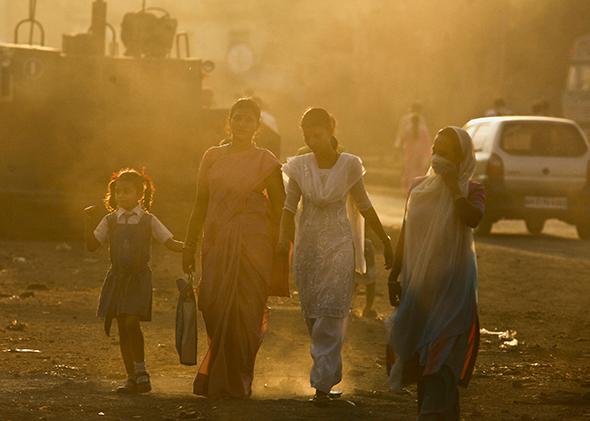
I know that the discussion of general air pollution is slightly off topic here, but it really is very bad in New Delhi, and eventually does reach the subject of climate change.
Another perspective: If India doesn't care about air pollution within India which affects it's own population, it's unlikely they will care about some glaciers melting far away sometime in the future and affecting people in far away countries.
I'm not up with Indian politics, but I rather suspect that the current refusal to deal with emissions is more about climate change denialism mixed in with a sense of anti-colonial defiance than anything else. Don't forget that it's actually easier, politically speaking, for a developing country such as India to adopt renewable energy than it is for the developed world, goodness knows they have the engineers to make it happen! We need baseload power, our society has been constructed expecting it to exist, but as Indian populations get electricity, it's not going to be a major drama if electricity supply is intermittent - that's still way better than no electricity at all.
I don't quite get what you mean by "during their period of industrialization". Industrial progress does not work that way. One can't just pick a number (e.g. 25) and say India is 25 years behind the developed countries in its path to industrialization. Some Indians are still living in the stone age [1]. Others, such as the average Indian commenter on HN, is working on technology that we will all use, a couple of years down the line.
Whatever the case may be, I think you'd learn a great deal if you stayed in India for a couple of years. The recycling I have seen here is, in some ways, better than anywhere else in the world [2]. A few examples that you'll see commonly here: carry-bags and wrapping paper made of old newspapers, shoes re-soled using worn-out tractor tires, peddlers going door-to-door giving big discounts on new vessels, in exchange for old vessels, etc. People at various economic strata of society squeeze out every little bit of economic worth from every little thing.
[1] https://en.wikipedia.org/wiki/Sentinelese_people
[2] On second thought, it's quite likely that many others of the so-called developing countries would recycle about as much as Indians do.
Look over the history of the Industrial Revolution -- roughly 1750 - 1950. At the start of that we had no real working engines, transportation systems, concept of energy or thermodynamics, understanding of evolution or germ theory, and a whole host of other concepts, as well as practical technologies: steam engines, metalurgy, steel, chemicals, electricity, communications, fertilizers, drugs, information technology.
The countries modernizing now do have all of these things, and the possibility of avoiding many of the mistakes which were made by the countries which pioneered the transition (England, the US, Germany, France, and the rest of Western Europe).
As late as 1860, cholera epidemics were killing millions of people throughout Europe and tens of thousands in London alone (imported from India, as it happens). Sewerage systems, water treatment, antisceptics, anesthesia, and eventually antibiotics came out of this -- but the first two alone provided the lion's share of life-expectancy gains in England and the US.
The other thing we're very well aware of now is that 1) continuing to extract fossil fuel resources at the rates we've been doing will drastically change the climate and living conditions on Earth, possibly irrevocably and fatally to no only the economy but humans and most large animal species, and 2) those fossil resources will be too difficult to find and extract for net energy gain within the forseable future regardless. And those are only two of many impinging constraints humans face.
The recycling economy of which you write is only one change which will likely become far more widespread. John Michael Greer's notion of "catabolic collapse" -- which explains both much of the financialization and "software eats everything" aspects of the past two decades -- extends that idea:
http://thearchdruidreport.blogspot.com/2011/01/onset-of-cata...
http://www.ecoshock.org/transcripts/greer_on_collapse.pdf
Look to your own Indus Valley Civilization for an earlier instance (an no, this time is not different).
You aren't being unbiased when you point out medicine and technology, but not colonialism.
I was not attempting to fully describe the differing circumstances surrounding industrialization of different states (, as I do not have the knowledge or ability to write a complete account); instead I tried to show that they have experienced different opportunities and circumstances through a limited example.
Please note that people aren't indifferent. Without technology and the economy, people in India would starve. I would also suggest that in a less developed economy, people are much more likely to be aware of that.
Industry is not bad, it's what humans alive, in the numbers that we have.
There are two other possibilities you don't consider:
1. India could prevail in negotiating for carbon emission reductions elsewhere (the US, EU, Japan). Technology transfers greatly increasing India's GDP/bbl wouldn't hurt either -- it's presently around $400/bbl, the US sees $1000/bbl, most of Europe is in the $1500-$3000/bbl range.
2. Stunning advances in renewable, sustainable, and/or low-carbon energy technologies could allow for growth in India's standard of living without additional carbon emissions. I put the likelihood of this as low.
Long run: there's a balance of population and per-capita resource consumption. The total sustainable rate is fixed. The question is: do you wish for a future with a very high population, or a for one with a high per-capita standard of living? They're at odds.
The earth and the climate don't care who pollutes how much. The total amount of pollution matters and there shouldn't be a privileged few consuming magnitudes higher than the rest. Plain and simple.
I suspect we'll get there.
What I'm less certain of is what that standard of living will be.
1. Suddenly, they're affected by climate change, or claim to be.
2. It's just a ploy to increase energy costs for developing nations and keep them behind.
This may or may not be true but with this kind of perception, such talks will never go through. Also, there are choking levels of pollution in New Delhi [1] and Beijing. The cities are really uncomfortable, and there is a growing body of research to show that air pollution is carcinogenic. [2]
These countries would do well to curb pollution and use clean energy just in the interest of public health. Unfortunately, public health is very low on the agenda.
New Delhi is on the brink of ecological collapse (or maybe beyond that depending on the definition). There is no clean air, clean water, or clean soil. There are no numbers to indicate how many pollution related deaths occur in India annually or what kind of productivity is lost. Frankly, no one cares either. Until someone is personally effected (in a drastic way, like NO2 poisoning and dropping dead..) there will be no change. A very large percentage of children in New Delhi are diagnosed with asthma. [1]
Climate change is a far cry from getting discussed if domestic air pollution isn't a cause for concern.
Source: I am Indian and spend a lot of time there quite often.
[1] - http://bkpk.me/cigarettes-arent-that-bad-after-all/
[2] - http://edition.cnn.com/2013/10/17/health/geneva-air-pollutio...
or this
http://www.indianexpress.com/news/bharat-stage-iii-vehicles-...
There are enough of us trying to change the system from within (notwithstanding the Delhi election day after tomorrow). This has resulted in pollution being one of the main aspects of all three major political parties manifesto ([1] vs [2] vs [3])
So let's not say that "it isn't a cause for concern".
[1] http://www.downtoearth.org.in/content/we-will-work-free-delh... [2] http://www.downtoearth.org.in/content/congress-manifesto-pro... [3] http://www.downtoearth.org.in/content/bjp-manifesto-taps-pub...
That fact of the matter is that every economy goes through this cycle (of growing up). Child labor, poor health-care, now pollution and soon patents.
While not being pertinent to this discussion, the country with the greatest patent lobbying bodies is also the country that committed the greatest IPR violations. More here: http://www.youtube.com/watch?v=jQZJ5Jl41nk
Guess what, the catalytic converter exists now.
Well that's a little disingenuous, no? I know the intellectually lazy like to point out how the west didn't have any restrictions 80-90 years ago during their industrial boom, but you have to keep in mind that 80-90 years ago, they didn't know what a greenhouse gas was. And they certainly couldn't know the long-term impact. We're ALL suffering from those mistakes and ignorance.
The earth is a spaceship and we ride along in it as we travel through our galaxy. It's a spaceship with a finite amount of available resources and a fragile atmosphere. Past ecological abuses are just that, in the past. We need to look forward to the future and protect our spaceship or we all die.
Western countries just want to have more stuff at all costs. The developing countries know this, from direct experience in recent memory. So they are not going to play ball.
It is extremely critical to understand that the reasons the developing countries are not playing ball is different than the reasons developed countries are not playing ball.
1. Suddenly, they're affected by climate change, or claim to be.
2. It's just a ploy to increase energy costs for developing nations and keep them behind.
You're spot on, there.
Last time I checked, both China and India argued that global emissions limits should be done on a per-capita basis, and that therefore China and India should not be obligated to reduce their emissions.
While there are arguments to be made against this claim (e.g. should China and India be rewarded for their large populations?), it would be nice to see these arguments being addressed directly, rather than assuming that non-Westerners are only ever driven by base politics.
Or how about anybody who isn't rich enough to have at least savings sufficient for 6 months without any income (which is probably 98% of the planet) is only ever driven by short-term politics.
From the perspective of India or for that matter any developing nation aspiring to free its people from the shackles of poverty the above argument is commonsensical (sic) while the Slate article is condescending and biased in favour of developed countries.
Excerpts from the above article -
Copenhagen hardly matters. If it doesn’t produce an agreement, it clearly won’t matter. But even if it yields an agreement, that will matter very little.
Why? Because reducing carbon emissions by 80% from the 1990 levels – the target for 2050 for rich countries – depends on technological breakthroughs, not political pledges at Copenhagen.
...
In the Kyoto treaty on climate change, 37 rich countries pledged to reduce their carbon emissions to 5% below their 1990 level. But most actually increased their emissions. These very treaty-breakers now propose another treaty!
...
Despite climate uncertainties, it makes sense to mitigate emissions as insurance against a disaster that may never happen. Treaties are often signed to provide mutual insurance against political and economic risks. But if the insurance premium becomes costly enough to threaten economic distress, governments will abandon the treaties (a la Maastricht). No government will create a recession today to avoid a future disaster that may not happen anyway.
The lesson for Indian strategy at Copenhagen is clear. India should talk tough and not worry about being called a deal-breaker. When a deal’s value is so uncertain, it matters little whether it’s broken or not. India should keep its commitments light, and be ready to jump ship if others do. Never assume that others will actually implement climate pledges.
http://en.wikipedia.org/wiki/List_of_countries_by_carbon_dio...
http://www.wolframalpha.com/input/?i=USA+total+primary+energ...
http://www.wolframalpha.com/input/?i=USA+vs+India+coal+consu...
USA should make do with one gas-guzzling truck less per person, instead of bullshitting their pseudo-intellectual "green" preaching on India and China.
And India is the problem?
The world's per capita emission in 2010 was 3 times that of India. US emits 10 times more than us on a per capita basis. It befuddles me. HN please explain how India is in the wrong here?
https://plus.google.com/104092656004159577193/posts/LyQx8fcv...
You can see the relationship between GDP and energy via Wolfram+Alpha:
China: http://www.wolframalpha.com/input/?i=china+total+primary+ene...
India: http://www.wolframalpha.com/input/?i=india+total+primary+ene...
That said: the entire planet's got a bit of a problem, and the truth is that growing the economies of China and India through yet more increased fossil fuel consumption (much of both nation's energy comes from the worst possible source: coal), will have tremendously bad consequences.
Another factor is that the promise of economic growth has long stood in for efforts to produce greater equity -- with a growing pie, a promise of a better future can be made to all. When the pie stops growing (or even slows markedly) that relief valve is no longer available. Worse, the dynamics of various systems and institutions, including liberal democratic ones (but also "free market" systems) appear to behave pathologically under resource constraint circumstances (not that non-democratic ones behave better in all cases). It's a rather sticky problem (and for the record: I happen to like many of the features of democratic and liberal institutions).