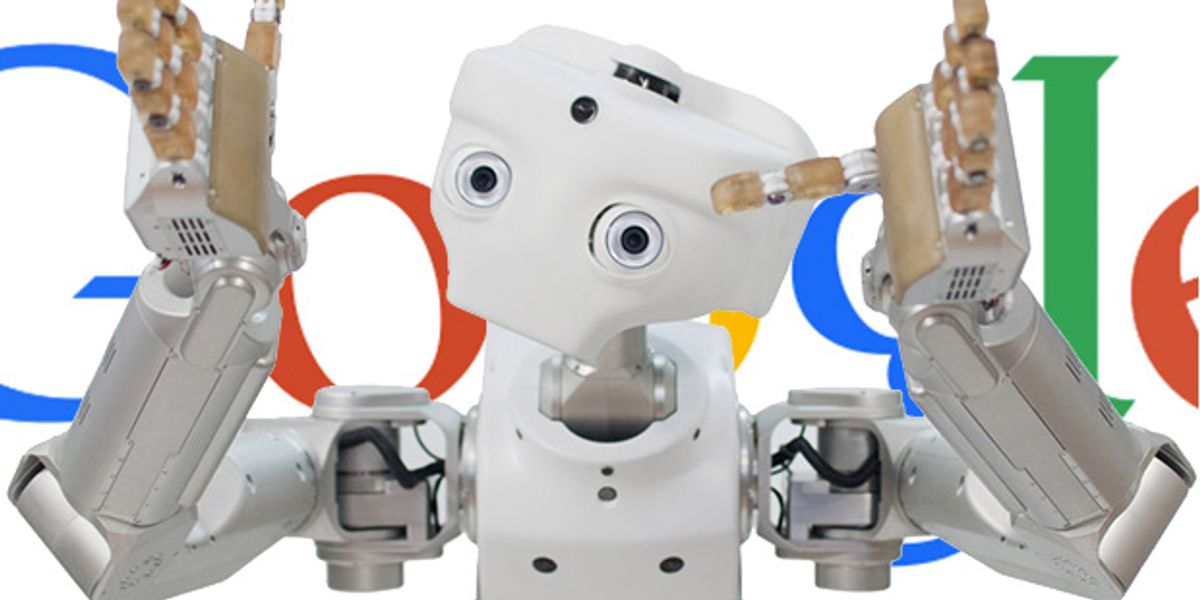
Google Acquires Seven Robot Companies, Wants Big Role in Robotics
The company is funding a major new robotics group and acquiring a bunch of robot startups
IEEE Spectrum
244 points · by eguizzo · 12y ago · 138 comments
Though Atlas is definitely nothing to sneeze at. I've become pretty fond of it since the summer :-)
People like to bring out truisms of horse and buggy drivers, but we're getting to the point where we're thinking of automating entire classes of jobs out of existence rapidly, not just specific tradesmen one at a time. Where in the past manual labor has been automated, it has tended to happen slowly, increasing efficiencies in niches and eliminating some tasks completely. This has freed people to engage in - by and large - other sorts of manual labor, those which were not so trivially automated.
What happens when the very notion of "manual labor" is itself abolished? There's no historical precedent for that.
Automation will likely not eliminate all manual labor in our lifetimes, but I imagine it will eliminate enough of it to break capitalism for large portions of the population. We need to start considering what that means sooner, rather than later.
Take Moore's law for example. The doubling of transistors/halving of their expense first allowed more efficient computation in the original manner, but now that qualitative change has started to alter the very nature of computation- omnipresent computation in all man made devices doesn't mean our spreadsheets run faster, but rather humanity exchanges information and communicates in an entirely different manner than it did a generation ago.
Likewise, I believe we'll see the gradual automation of 'useless' jobs change from an event we can work around by retraining or switching careers to an obsolescence of the vast majority of human labor. There are some nagging statistics about unemployed engineers that I believe back my assumption, especially considering that engineering positions should be the new careers people retrain to.
well that's not quite true. For mankind as a whole, no. For people who's livelihood has been automated ... its been pretty terrifying.
If the maximum work complexity a person can handle is assembling hamburgers, washing dishes, moping floors, sticking one part onto another part then they are in danger of being permanently displaced by robots from ALL job categories.
I don't know how many people this is but as robots improve this number grows. How large would this number have to be, when added to current chronic levels of high unemployment, disability, nonproductive elderly/young, before society breaks down. And if by some chance society did not collapse what would all these people be doing? The mind rapidly slides into what we have previously considered dystopian science fiction.
Starving?
That's the whole reason for needing drastic social changes, to figure out how to distribute resources when the raw labor of many or most of population isn't useful anymore, when paying a bare sustenance wage is more expensive than simply getting a machine to do the same thing better and faster.
Oh, wait.
All that said, there may be a new class of unemployable people that will need to be accounted for in some way. Not sure what that is yet. I can say that I find it unfathomable that government will work on the problem prior to it becoming an issue.
In the past we've mostly been replacing a few skilled workers with lots of unskilled ones. Automation does the opposite.
And if this is possible, can people be freed to do something more useful if there is nothing more useful?
Think back to the Horse & Buggy days, when cars came along, I'm sure people were saying "with all these cars not needing horses, all those people that care for and breed horses will be out of work", but look at all the jobs that were created, and particularly the jobs you're now concerned have been lost in Detroit.
I think Detroit may be a bit of a special case as the population boom there was driven by the growth of the Automotive industry at a time when everything needed to be centralised. Almost everything was decentralised before (with the majority of jobs being in Agriculture I believe), so we had a short period of history with mass centralisation and we are now able to decentralise again, so the places that amassed workers geographically look so much worse off by comparison, while going through massive change.
Unemployment may be high now (tough to get a good number showing the difference over the last century, but at least one of the brilliant people on HN knows how to do it), but I suspect that if you exclude the last 5 years, unemployment was fairly flat as a percentage over the last century.
If you look at history, I believe you'll see that automation of any sort has resulted in the movement of jobs - to lower paying jobs. The destruction of America's middle class should be a testament to that. People think that their middle-class salary factory jobs all moved to China, but in reality most were simply automated.
Unemployment may be high now (tough to get a good number showing the difference over the last century, but at least one of the brilliant people on HN knows how to do it), but I suspect that if you exclude the last 5 years, unemployment was fairly flat as a percentage over the last century.
Unemployment has fluctuated dramatically over the last century as a percentage between nearly zero percent in WW2 to over 20% during the Great Depression.
I've heard that said in different ways in different places over the years. But is it a iron law of nature, or just a thing that goes on until it doesn't?
If it will eventually stop (and I think this is likely), how would you tell when it is going to stop? Would you notice if it is already happening?
Would there be a weird "jobless recovery" after economic troubles or something?
Would the factory owners as class increasingly be doing better and better, but factory employees doing worse and worse?
Is there really a historical precedent for automating the whole manufacturing process, from robotic mining machines to automated factories to delivery drones?
What happens when the car factory doesn't need workers. Who buys the cars?
Anyway, at all the examples of automation you'll find in history, you'll see lots and lots of people losing their job and starving to death because of them (more people the more prevalent is the change). At the long term, society gets into an equilibrium, at the short term, things are quite dark.
That's some very unimaginative thinking there. Large scale industrial automation is a Good Thing for humanity.
This means that a significant proportition of humans can't simply remain competitve. And that proportition is growing year by year. Ultimately the machine beats the man. The social politics around the world need to be adjusted for this rather sooner than later.
Unemployment could be solved tomorrow if we banned large trucks and mandated all goods be transported in little 3wheel delivery vans like they have in little Italian towns. But that would be bad for society as the price of everything skyrocketed to cover the inefficient delivery. Or we could tear down power stations and make people carry buckets of water up a hill to run a hydro electric plant. These are absurd scenarios yet illustrate the reverse of the problem.
Technology happens, and it is generally good for humanity. Only a pessimist can looks at the enormous progress made in productivity through automation, and then confidently declare that from this point forwards, things can only get worse.
Entirely new businesses requiring lots of people are yet to be created. Detroit didn't happen 'just at the right time', Detroit happened precisely because it could - labor was freed up from producing the food supply, and disposable income increased because the cost of food dropped through automation.
It might be uncomfortable - change always is - but the alternatives are horrifying, like regulating new tech away and forcing people to keep those jobs. I for one never want someone metaphorically carrying a bucket of water up a hill for me so I can feel superior about makign sure they are still employed.
This will only be true when we're nearing singularity, and that IMHO won't happen for centuries yet. So there's still time to go.
Automation does reduce the human labor content in the goods we purchase, but at the same time, it reduces the cost of those goods so that more units are sold and more people can afford them. Less human labor per item, but many more items.
The fact that Michigan industry died, is pretty much political. Tech changes helped a little, but in the end, it was all political. I am talking about grants and tax incentives and what not that happens behind closed doors in exchange for campaign support.
The new jobs will be found in entirely new markets and fed by free education.
> Smartphones, Page said, are “relatively expensive,” with the raw material costs — glass and silicon — is “probably like $1, or something like that. I think glass is 50 cents a pound. Phones don’t weigh very much. So I think when I see people in industry making things, I ask this question, how far are you off the raw materials costs. So as an engineer, trying to go to first principles, what is the real issue? What’s the real issue around our power grids, or around manufacturing? I think a lot of people don’t ask those questions, and because of that, we don’t make the progress we need to. If you’re going to make a smartphone for a dollar, that’s almost impossible to do. But if you took a fifty-year view, you’d probably make the investments you need to, and you’d probably even figure out how to make money. So, I encourage non-incremental thinking.”
http://blogs.barrons.com/techtraderdaily/2013/05/15/google-c... (The first transcript I could find)
So ultimately I agree with Page. The cost of manufacturing anything goes on along a 1/x curve over time, and approaches the raw material cost. Its the other costs that don't do that, like engineering talent, marketing spends, warehousing, shipping.
The most likely scenario for that to happen is through pre-fabricated construction, meaning most of the construction happens in a factory. This fits perfectly well with robotics.
[1]http://www.construction-manager.co.uk/news/googles-cloud-bas...
It's already being worked on. Search for "Contour Crafting".
Almost every product and service they do is to sell ads either directly or indirectly. Even Google Apps is about selling ads. How? Well, if small businesses don't have decent tech infrastructure, they aren't likely going to be using AdWords as much are they and they'll use traditional ads like Yellow Pages.
In case you aren't aware, Yellow Page ads and newspaper ads charge hundreds or thousands of dollars per month for minimal effective exposure. Google ads can be much more effective, but good luck selling toe people who can't even get decent email accounts setup for their business. Yeah, $5/user/month is decent money when you have 50+ employees on the system, but that's peanuts compared to the $5,000-10,000+ a month that company is likely paying in advertising.
Google desperately wants those kinds of accounts and whether they are building a browser, an operating system, an email service, a social network, or a self driving car, it's always going to come back to selling advertising to businesses because that is worth far more than just about anything else Google can do to make money.
Google, like Microsoft and Apple completely understands where they make their money and what business they are in, even if they do a lot of things to make techies happy.
It's the ads. Always the ads.
You take away the food, and Einstein can't afford to do physics.
Einstein is a food guy.
Here is a chart taken from their quarterly reports:
        	Paid Clicks	Cost Per Click
        	Q-2-Q	Y-A-Q	Q-2-Q	Y-A-Q
   2011Q1	18	4	8	-1
   2011Q2	18	-2	6	12
   2011Q3	13	28	-5	5
   2011Q4	17	34	-8	-8
   2012Q1	7	39	-6	-12
   2012Q2	1	42	1	-16
   2012Q3	6	33	-3	-15
   2012Q4	9	24	-2	-6
   2013Q1	3	20	-4	-4
   2013Q2	4	23	-2	-6
   2013Q3	8	26	-4	-8
It's like McDonalds. A hamburger company? Not really. It makes a lot more sense to consider them a real estate company. Hamburgers are just the way they create value for the real estate. This is not just my whacked interpretation, but is something the CEO said in an interview awhile ago, and a perspective taught in many MBA programs.
Yes, companies make money from their revenue. It is often far more interesting and useful to look at how they create the value that generates that revenue. In the case of Google, Larry Page has been quite clear about his ambitions for Google, and selling ads is not the end of that ambition, it is merely the current income source.
Therefore, ad company. But not tech company? Why are they mutually exclusive?
I wish I could add sin qua non to the catalog of informal fallacies. Google's existence depends on a number of factors. E.g. I could say "Google is an engineering firm because without engineers, it wouldn't exist. QED." I could say "Google is a web company because without the web, it wouldn't exist. QED."
Sure, Google generates its revenue primarily through advertisements. But since the Page Rank Algorithm is its flagship product, I think it's also fair to call Google a tech company. I.e. the ads per se are made by other company's marketing departments, not Google itself. Calling Google a tech company is useful for distinguishing it from companies which also generate revenue through ads, but make a dissimilar product. Like television for example.
This is so cynical i don't even know where to begin.
I guess i'll start here:
Do you really think Larry Page is so single minded he can't tell someone "hey, that sounds like a really cool idea, go do that" without thinking "gee i wonder how we are going to make money on ads with that"?
Google's ideal world is where you want to use google everything to carry out every transaction. In that world Google Glass, autonomous vehicles, AI, anything that makes commerce more efficient and profitable would benefit google. They want to sit on top of everything rather than just internet white space.
Sometimes they want to sell some techs, but (mostly) nobody wants to pay for their techs except marketers.
But that wasn't always true and there's no reason to assume it will always be true in the future.
They used to be all about search and sold search appliances. They still sell search appliances, in fact, you just don't hear about them because the ad revenue dwarfs it. If cars makes them more money than ads, then they'll be a car company (that also sells ads and search appliances).
"stepped down" is the corporate version of political "to spend more time with his family."
"You don't want me here? Fine! I'll go make my own org with my own cost center and blackjack and subordinates to sleep with. In fact, forget the new org."
IBM has done basic science research like few companies ever have and nobody can claim they're planning to replace their current lines of business with electron microscopes or Watsons.
Perhaps it looks that way to someone who doesn't understand anything about business, but there are easier ways to make money than investing in a lot of long-term research that might not pay off.
That is not to say they do not believe in the ad business. For the ad business the model seems to have moved towards getting more people online and have them do more online. Google put a smartphone into a billion hands. They wire up African and American cities to fiber. They made browsers far more capable and performant. They plan to fly balloons over the whole globe. All investments connected to the online business.
Yes, of course they are, but they have the luxury of telling the ad world, actually you have as much as you can get, there is no more growth there, pay up for a decade till someone beats us, by which time robots and cars and space stuff ...
Google is actually not in the lead (yet).
I agree. It seems to me that robots have the potential to have a greater impact than the internet, social, mobile. And that's not to diminish the profound change those innovations have brought about.
It just seems that the ability to act in the physical world will bring incredible, profound changes.
Robots will certainly bring huge change some day. The problem is that it is definitely going to come before our social structures are ready for it. There's going to be a real hard time adapting to the fact that a very large number of jobs will no longer requires humans to do them.
I'm excited for the parent companies, and mostly find it funny that an acquisition may affect something I would usually think of as totally unrelated.
Google has a lot of things to do. Robots would not be high on my list.
So you don't want GMail to actually collect your email?
> stop cooperating with the NSA
Ah, you mean they should start breaking the US law?