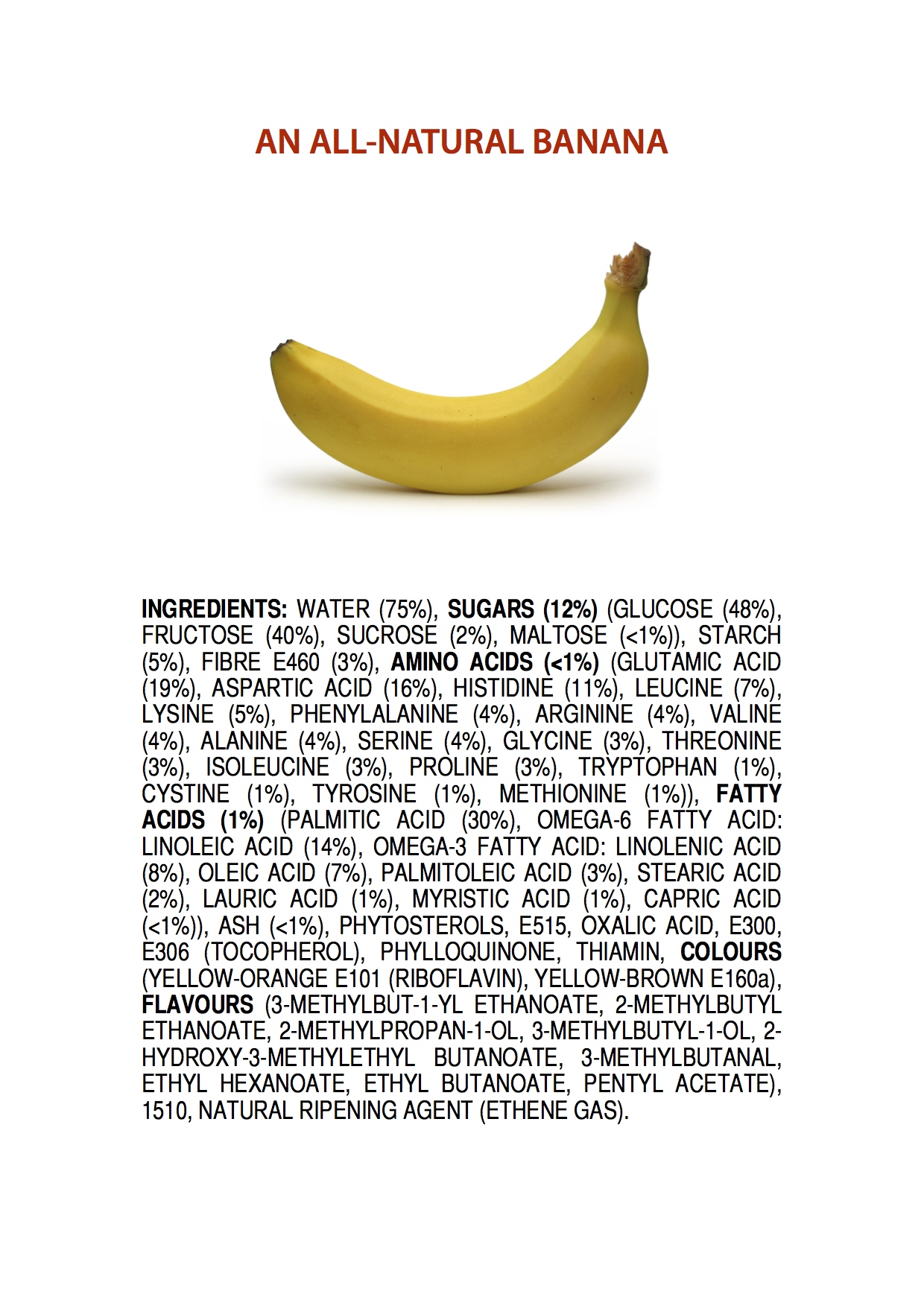
Ingredients of an All-Natural Banana
This visualisation has a short story behind it. I usually care too much about food labels. If something has monosodium glutamate (E621) or high fructose corn syrup (HFCS) in it, I’m probably …
James Kennedy
68 points · by joosters · 12y ago · 46 comments
My part time project has been to try and provide some simple to understand descriptions of the "scary" chemicals at http://foodconstrued.com
I was having this debate with someone and we had a look at the ingredients. My opponent pointed triumphantly at "rehydrated corn starch" (i.e. flour and water). "See, it's processed!", she said.
I wish we could get away from the idea that Stainless Steel Bad, Wood and Leather Good. I suspect a lot of people would be horrified to see the shiny metallic interior of that temple of Natural Goodness the Innocent Smoothie factory!
ps: "out of laziness" - not because there's anything wrong with Quorn as a source of nutrients; it's just a pretty boring way to cook and eat!
Low-fat, high protein - and it's mushrooms! (I like mushrooms...haha).
I might see if it's available here in Australia - how do you find the taste? And do you use it as a major component in your diet?
One form it comes in is frozen "mince". That would probably be the best way for a non-veggie to eat it. You can use it as a replacement for beef in pies/chili con carne/bolognese etc. The lack of fat probably makes it slightly less satisfying but I'd say it's worth it for the health benefits. The actual flavour doesn't suffer at all.
[1]: https://en.wikipedia.org/wiki/Liquid%E2%80%93liquid_extracti...
[2]: https://en.wikipedia.org/wiki/Gas_chromatography%E2%80%93mas...
When I clicked on that link and searched for "banana" and then clicked on "banana, raw", I was hoping to see a list of the scary-looking names I saw on the blog post that started this thread. I only see things I recognize.
I think what would be cool/interesting (and I'm guessing what cing meant to say) would be if there were a way to get that list (the scary-looking one, not the vitamins and minerals one) from some procedure done to a vegetable.
In that sense, the link you provided does not have the same information that the author of the blog post is (apparently) compiling by hand.
Here's what natural bananas look like:
http://cdnimg.visualizeus.com/thumbs/dc/2e/artificial_select...
What you buy in the store is genetically modified (through selection mainly).
It's, by definition, artificial selection.
With your "logic" everything is natural.
BUT, putting selective pressure on a plant to be more delicious and/or possibly nutritious is as natural with humans as it is with much of the animal kingdom. The edible fruit has an evolutionary incentive to taste better, and therefore produce more offspring.
Trying to assign a good or bad grade to this is exactly the naturalistic fallacy.
Probably because organic has a totally different meaning WRT chemistry.
"natural" is very much like the discredited theory of vitalism. Impossible to define such that you exclude twinkies and premade jars of frosting while still including the produce department.
1. http://en.wikipedia.org/wiki/Natural_foods
>>“Natural foods” and “all natural foods” are widely used terms in food labeling and marketing with a variety of definitions, most of which are vague. The term is assumed to imply foods that are minimally processed and do not contain manufactured ingredients, but the lack of standards in most jurisdictions means that the term assures nothing.
2. http://en.wikipedia.org/wiki/Organic_certification
>>In the United States, federal legislation defines three levels of organic foods.[8] Products made entirely with certified organic ingredients and methods can be labeled "100% organic," while only products with at least 95% organic ingredients may be labeled "organic." Both of these categories may also display the USDA Organic seal. A third category, containing a minimum of 70% organic ingredients, can be labeled "made with organic ingredients," but may not display the USDA Organic seal. In addition, products may also display the logo of the certification body that approved them.
3. http://www.huffingtonpost.com/2013/07/26/naked-juices-natura...