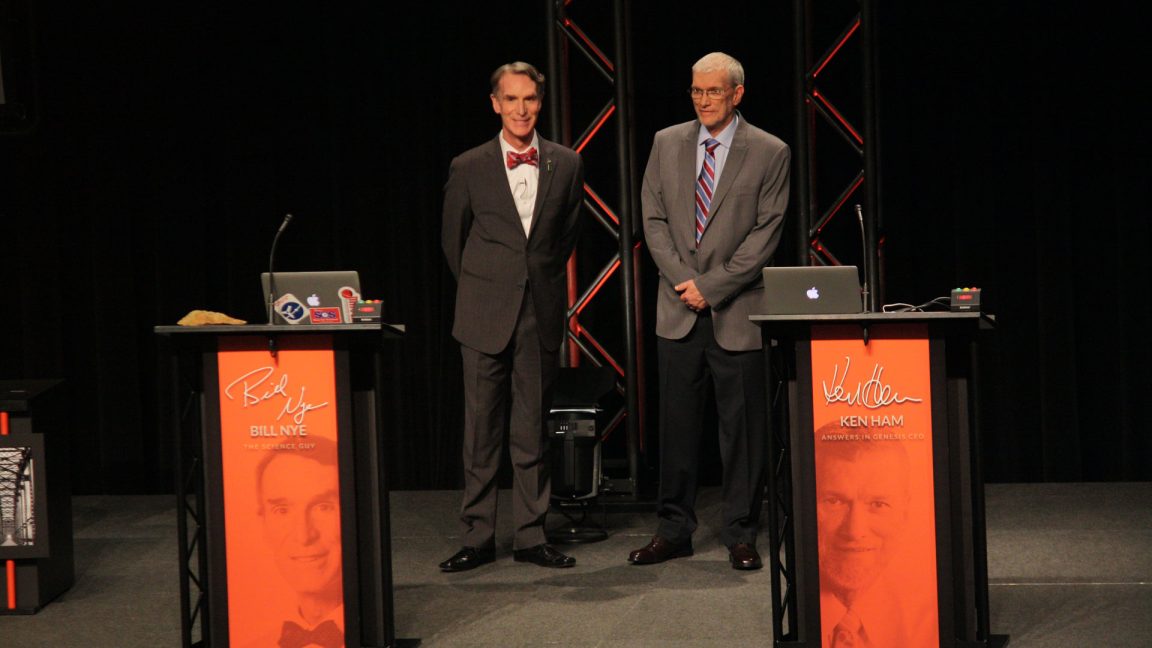
Ham on Nye: The high cost of “winning” an evolution/creation debate
The well-publicized debate at the Creation Museum was not about two minds sparring.
Ars Technica
41 points · by fortepianissimo · 12y ago · 91 comments
Nye should have had it easy. He could have argued that creationists need to demonstrate why their beliefs are any more true than the hundreds of other contradictory creation myths that come from various world cultures (as salgernon mentioned). He also could have argued that science and creationism are not fundamentally incompatible, but instead sort of orthogonal. Creationism can be thought of as a cosmological hypothesis. It happens to be a hypothesis that is basically impossible to test, so scientists instead spend their time evaluating other hypothesis.
Instead, it sounded like he argued the position that "science helps us learn and do cool things, plus you don't need to believe in God to seek answers to life's important question." Weak position. Counter argument: "I don't care about learning or technology because when I die I am going to heaven, and that's ultimately more important than science."
I'm really surprised this didn't come up more as the idea that "science is attacking my religion" tends to be one of the main reasons that people seemed to be adverse to science. It places a false dichotomy in choosing between their faith & science.
There's a dichotomy between science and religion, but it's not false by any means. In the most fundamental sense, and not to oversimplify, the scientific mind assumes ideas to be false until there is evidence to support them (scientists call this the "null hypothesis"), and the religious mind assumes an idea to be true until evidence proves it false -- exactly the opposite outlook.
Why is it a mistake to assume claims are true unless proven false? Easily explained — let's say I'm a True Believer who believes in Bigfoot. According to the True Believer's way of picturing reality, Bigfoot exists unless someone can prove he doesn't exist. But think about this — Bigfoot cannot possibly be proven not to exist somewhere in the universe, hiding under some rock. In formal logic, a disproof would require "proof of a negative", an impossible evidentiary burden. Therefore a skeptical, scientific outlook is essential to avoid wasting time on childish fantasies. Need I add that religious people just don't understand this?
Remember this when you see endless phony TV documentaries about Bigfoot, the Loch Ness monster and ghost hunters. These shows are popular because most people don't have the slightest idea how to process ideas. And only some of them have religious beliefs -- others are simply out in the ozone.
The above is the "big secret", the divide that separates science and religion. And it's not a puddle, it's bigger than the Grand Canyon.
If you want to convince people, it's best to find common ground rather than running to points where you'll know you find contention. Baby steps.
Not saying that creationists (YEC or otherwise) are generally smart, but a lack of "reason" isn't always an excuse.
I was reading this article about a vocal Japanese revisionist. Like creationists, or conspiracy theorists, there is nothing rational about these beliefs. When you reach for the conclusion first, and establish it is the absolute truth and then cherry-pick and twist facts and make excuses to support your conclusion, you are actively engaged in a process of denying reality. These people don't need a TV debate, they need a therapy.
On the other hand, you probably have people who have never really examined why they believe in creationism, and do not suffer from the same disease. These people may be convinced, perhaps, but they are not the ones at the frontline of the movement, frothing at the mouth and being engaged in a public debate as if they had any shred of credibility.
This is quite true -- many very smart people hold onto embarrassing beliefs only because they can (and do) out-argue anyone in their immediate environment. There's a name for this that I have unfortunately forgotten.
Be careful when you say "only theorized." A well-supported scientific theory is the highest form of human knowledge. A scientific theory isn't just a hunch (the everyday meaning of theory), it's a combination of observational evidence, a careful explanation of the evidence, and some predictions based on the explanation that can be researched to expand the domain of the theory. And (very important) a basis for falsifying the theory, an observation that would prove the theory false.
The recent discovery of the Higgs boson is an example of theory confirmation -- it's based on the "standard model", the theoretical structure of modern physics, and the Higgs was predicted on theoretical grounds long before we had any chance to detect it.
As to "smart people only theorized", gravity has an explanation, and a very good one -- general relativity. Relativity is one of the two best-confirmed scientific theories we have (the other one is quantum theory, that makes our computers possible).
Please remember this when you want to say "only a theory".
Agreed. I loved Bill Nye's shows when I was a growing up, and I think he made a positive difference in my life. I don't know if participating in the debate will have had the same effect on anyone there.
I wish Bill would continue the kind of work he did when I was younger, instead of debating creationists, or going on FOX News to be the wacky scientist from that kids show that explains middle school science to the viewers.
Getting children interested in science. In discovery. Fostering a love of learning. That's what I think matters. That will be his legacy.
The idea of tiptoeing around religious fundamentalism may bother you, but ultimately you have to decide if you want to be as "right" as possible or if you want to have a shot at convincing someone. And if you don't care about convincing the kind of person who can be a young earth creationist in 2014, then I don't know why you'd even pay attention to any of this.
I had a revolver held to my head for this when I was 15. Loaded? Dunno. No reason to think that it wasn't. He did this because he wanted me to renounce my beliefs, which I didn't do before someone pulled him away...
My point being that these are not rational people, they cannot be reasoned with or taught reality. They wallow and take pride in their ignorance with a "god said it I believe it that settles it" conviction.
It won't do them by good in the end, since they will die and release their carbon like the rest of us, but to the extent that they hurt society by their insistence that fairy stories should govern our lives, discourage understanding our universe and preach their bigoted filth, we should give them no truck and no platform. They are worthy of our contempt and scorn and public ridicule, but there is no point in debating them.
Then the first substantive statement out of his mouth was: the question tonight is, does Ken Ham's creation story hold up? Is it viable?
No no no! The question is: what is science? And the answer is, as the late great Richard Feynman put it, science is the proposition that EXPERIMENT is the ultimate arbiter of truth. So as soon as you say, as Ken Ham does, that the Bible is the ultimate arbiter of truth, you are not doing science BY DEFINITION.
Now, Ken Ham contends that secularists have "hijacked" the word "science." No. It is Ken Ham who has hijacked the word, because the definition is not arbitrary. There is a REASON for it. That reason is, as Ken Ham himself admitted, it works. Experimental science has produced all of the world's technological progress.
When Ken Ham claims that the central tenet of science -- that experiment is the ultimate arbiter of truth -- cannot be applied to the past because "we weren't there" he is simply, demonstrably wrong. It can be, and it is.
Now, of course one can choose, as Ken Ham does, not to accept the premise that experiment is the ultimate arbiter of truth. There are certainly areas of human endeavor where that standard is not applicable: art, poetry, music. But it can certainly be applied to the past.
The debate should not be about whether Ken Ham's model of the world is "viable", the debate should be about what is the standard by which truth is decided: experiment, or a holy text. You can choose one or the other, but experiment produces better results.
(warning: Stephen Meyer is several notches up the scale of intellectual acuity than Ham)
In short, any set of criteria you choose to demarcate science from non-science will either simultaneously include or simultaneously exclude both intelligent design and 'descent from common ancestor'. [And, in the case of inclusion will also bring in a lot of other non-sensical theories].
It doesn't matter if intelligent design is or is not science. What matters is that when you put ID or YEC to experimental test, it fails. When you put Darwinian evolution to experimental test, it succeeds. Whether or not that makes evolution "true" is a debate over the meaning of the word "true", not the meaning of the word "science." You can choose to believe that the universe is borne on the back of a turtle. You can even call that science if you like. But if you put your turtle cosmology to experimental test, I will bet you any amount of money you care to wager that your predictions will be wrong. In the long run, I will win and you will lose. THAT is what matters.
[Btw, I'm not defending YEC but I definitely do think that ID has a place in the discussion]. We are going to continue to make so many more discoveries at the sub-cellular level of organic life that continued support of the idea of abiogenesis will look rather silly (and honestly it already does).
No, not if you actually understand science. Science requires empirically derived evidence and falsifiability (or tests against reality -- meaning if reality disagrees, the theory must be discarded).
Descent from a common ancestor passes the above test, because there is copious empirical fossil evidence supporting that conclusion as well as present-day tests of evolution and natural selection, derived from both biology and computer science. The idea also could easily be falsified by new empirical evidence, if any existed.
Intelligent design requires the intervention of a supernatural agency, it is therefore not empirical, not falsifiable, therefore it's not science.
Very simple -- one is science, the other isn't.
If you read the essay, all of your points are considered (and refuted). I'm not going to do the work for you, but if you have the courage, you can do it for yourself, pussy!
Apart from the fact that the debate gave the Creationists unearned attention and was therefore a mistake, no, trying to summarize science to these religious people would only have piled one mistake onto another. Consider the basics of science:
1. Skepticism toward everything, and the assumption that an idea without evidence is assumed to be false (the "null hypothesis") -- the opposite of a non-scientist's attitude toward an unsupported idea.
2. The idea that any worthwhile idea must in principle be falsifiable by the right empirical evidence, or, to put this a different way, all ideas must pass muster by means of a reality-test. No reality-test, no validity.
3. The idea that all theories (ideas) are temporary and dispensable, that no scientific theories ever become true or beyond challenge by new evidence.
To simply describe this foundation of modern science would strike religious believers, people whose lives are ruled by blind belief and a severe lack of critical thinking, as monstrous. The scientific outlook cannot possibly be more opposed to the religious outlook, and to simply present it to a group of religious believers would bring down any house of believers.
What science actually consists of is on a long list of things that religious people don't know about the modern world -- it's too painful to contemplate. To try to break through this barrier would be a mistake. Better to do what Nye did -- show a fossil that's obviously older than 6,000 years. Something small and manageable.
But again, I think the debate was a mistake -- it gave the creationists unearned attention.
And it's so utterly unnecessary. For centuries Christians haven't had any problems with science. This stupid biblical literalism movement is a very recent thing, and it thrives on ignorance. It's harmful not just to science, but also to Christianity. It's a false idol.
It wasn't until the Church lost its political power that anti-scientific sentiment diminished.
You clearly do not know what the Galileo case was about. I'm not sure about Bruno, but Copernicus wasn't prosecuted, excommunicated or tortured either. If you believe Galileo or Copernicus were, then you've been fed lies or have jumped to unfounded conclusions (though you wouldn't be the first).
The Church of that day played an active role in science, and was absolutely open to the possibility of a heliocentric system. But they wanted a model that accurately reflected observations, which Galileo's model didn't. Galileo claimed it was correct anyway (which it wasn't), and called the pope a fool, for which he got house arrest, but wasn't tortured or anything. Eventually, Keppler's model was proven correct and was accepted by the church.
Question: What alternative method is there to reach them? Believe it or not, there are some communities where science isn't readily known. What's the alternative? Refusing to engage sounds not only spiteful but not very useful as you're essentially giving up on a segment of the population while simultaneously getting upset that they don't know better.
There seem to be a lot of people here that are angry & not a lot of people willing to educate. It's easy to label & categorize a whole group of people (whether clients or people who may be uninformed), but if you have the ability to inform, educate & change their opinion over time and don't try - don't get mad at people for staying uninformed - it's your fault.
If you attempt and they're hostile, that's a whole different story, but it's definitely worth attempting.
[1] http://99u.com/articles/18303/we-deserve-the-clients-we-get
In reality, there are a ton of creationists who aren't raging fundamentalists. They aren't creationists because they believe so fervently that they cannot accept any contrary evidence. They're simply creationists because that's all they know. Many of these people, when exposed to the truth in a constructive way, will change their minds.
In fact, I was one of those people. My elementary school taught creationism and I believed it because, well, why not? Later on I found out about the scientific explanations, and came to accept them instead.
You'll never convince Ken Ham. Nor will you convince his hardcore supporters. That's not the point. The point is to reach out to people who aren't hardcore about it, but who still believe nonsense simply because they don't know any better. And what better way to convince them to listen at all than to involve a religious figure arguing for the other side? How many of these non-fundamentalist creationists would tune in to "Bill Nye Explains Evolution", versus "Bill Nye Debates Ken Ham"? You'll convince lots of them.
I think this is a great point that a lot of people are missing. It's sort of like trying to lay out the features that you like about your product as a developer when realizing that your customer cares nothing about what you like and you have to present / sell it to them in a way completely different to how you would sell it to yourself.
Oh, that's easy. Instead of confronting their belief system, present them with evidence from the modern world, and carefully guide them from an observation to a scientific conclusion -- but without calling it that.
Instead of saying "science opposes religion, and science is right", instead tell the modern story of Methicillin-resistant Staphylococcus aureus (MRSA). Explain that penicillin used to work, but a handful of bacteria were able to resist the penicillin, and those few bacteria, by surviving and procreating, eventually became all the bacteria. Then explain that we tried a different antibiotic which wiped out nearly all the bacteria again -- but not all of them. Again, the few survivors became the new species, and this entire drama played out over a period of years, not millennia, and we observed it happening with microscopes, not fossils, meaning there were no gaps in the fossil record to argue about.
Wait until your True Believer has grasped the basic idea, then let him visit a clinic filled with dying children. Then say, "To solve this problem, to save these children, we need to understand and accept evolution, because these bacteria prove that evolution by natural selection is real."
There are as many similar examples as there are branches of modern science. Each of the stories can be told in an engaging, narrative way, with real people, in modern times, and it's not even necessary to say "science".
No one has said that. Notable amidst the number of errors you've managed to cram into that one sentence, you seem to have confused "people who want to engage in public 'debate' about creationism" with "people who are familiar with creationism at all". The two groups aren't even approximately the same.
Sure there are your Ken Ham types, but there are others that just aren't familiar with evolution & think it means we came from monkeys. Those are people that I think really benefited from hearing Nye talk about it simply & concisely on their level.
Among them:
• Go Socratic. Sometimes the best way to convince someone is to let them argue their own way out of their position. Ask questions rather than make assertions or pound facts.
• Realize that often the game isn't to convince. I have positions I hold strongly, most on the basis of experience, evidence, or logic that's convincing to me (and I'm occasionally persuaded to change my mind). But in discussing them with others my objective is often to understand what the basis of their position is. I might learn something. Fairly often, I'll find that the views aren't well-founded or aren't convincing (strengthening my own conclusions).
• Distressingly often your'll find that a person's primary argument is "it benefits me to claim this belief despite no rational or factual basis for it" -- it's Upton Sinclair (and Al Gore)'s observation: "It's difficult to get a man to understand something if his salary depends upon his not understanding it."
• Rejection of concepts is often driven by fear. I ran across this passage re-reading Robert Pirsig's Zen and the Art of Motorcycle Maintenance: "You are never dedicated to something you have complete confidence in. No one is fanatically shouting that the sun is going to rise tomorrow. They know it's going to rise tomorrow. When people are fanatically dedicated to political or religious faiths or any other kinds of dogmas or goals, it's always because these dogmas or goals are in doubt."
• Psychology is a hell of a drug. There area all sorts of weird aversions people have. I've met pathological liars. I've met people who simply deny obvious truths. Who feel "it's not a lie if I simply don't say it" (the lie of omission) or "if I only try to draw your attention from it" (lie of distraction). People are rather less rational than you might hope.
And for all of that, I've had some pretty amazing, interesting, and productive exchanges, often in the oddest places. Pulled into a highway rest area in the deep south a few years back, started talking with another man there. We both verbally circled for a few minutes trying to suss each other out, then realize that, actually, our views were fairly similar despite the miles that separated us. That was one of the more interesting 45 minute conversations I've had in years. Possibly decades.
If gradual evolution is true then the book of Genesis must be wrong. If the book of Genesis isn't "true", then the Bible itself is based on a lie. If the Bible is a lie then what's the point of going to church? No one wants to worship a fallacious holy book. And if people stop going to church then they'll lose their sense of community and stop doing all the charity work. The thought is too much to bear. It's better just to believe everything the book says, whole cloth, and defend it against all attacks.
A debate won't change any minds, but a dialogue will. We shouldn't ignore creationists. We should continue to talk to them, even if we spend a lot of time arguing over insignificant details. This kind of argument can't be won with facts and figures, but only through attaining mutual respect. It may not have been a good idea for Bill Nye to accept this debate, but he had the opportunity to change some minds with the the way that he carried himself and presented his beliefs.
Religious beliefs result in adaptive behaviors proven to increase fitness in certain environments. That is, these behaviors enhance the fitness of the genes which make one predisposed to religiosity. This has been hypothesized many times, and is the only rational explanation for the vast and fervent religious behaviors we witness today. In brief, religious behaviors cause individuals to engage in cooperative exchanges which are mutually beneficial to both parties. Iterated over many interactions, in a large population, with reputation, it becomes obvious that these behaviors are adaptive.
What biologists must emphasize is that religious behaviors are distinct from religious mythology. It is the behaviors we are interested in as scientists, not the literary masterpieces that constitute such works as the Bible, Quran, Torah, etc. Although they are linked, from an empirical point of view it is meaningless to analyze the philosophy of religion. We must instead look at the behaviors and their resultant consequences.
For those interested, there is a massive amount of knowledge on this subject. I would recommend beginning with Richard Dawkins' Selfish Gene, and intuitively working through the corollaries thereafter. Further reading can be found here [1].
1. http://evolution-of-religion.com/
EDIT: Removed Wikipedia link as it wasn't very useful upon closer inspection. The research group linked instead is a much better resource. Also reworded for clarity as per comments below.
It's certainly not the only possible explanation.
EX: Religions who's priests avoid reproduction are clearly a net negative on the individual level at least from an evolutionary standpoint.
You know that these are distinctly non-standard (to the point of not having any resemblance to the usual ones) definitions of "dogma" and "theology", right?
If you mean "behaviors" and "mythology", then just say that, rather than saying "dogma" and "theology" with those others in parenthesis, when "dogma" doesn't mean "behavior" and "theology" does not mean "mythology".
There is a very simple explanation for religion: most people conform to the culture of their surrounding.
That's why most people growing up in Muslim country become Muslims, most people growing up in Mormon area become Mormons, most people growing up in atheist countries are atheist and Germany (yes, I'll go there) had a surge of Natzis-ism.
Cultural norm is a powerful thing.
But hey, I'm open to changing my mind given some evidence.
Why don't you sequence a few deceased atheists and a few deceased religious folks and by way of simple diff isolate the "religion" gene. There might be a Nobel prize in it.
It's been established that there's no single religion gene, and there's no single stupidity gene. But I repeat myself.
http://old.richarddawkins.net/articles/119-why-i-won-39-t-de...
That being said, I have yet to read a book which so elegantly describes evolution as The Selfish Gene. This includes Darwin's own works. It is an absolute masterpiece, and was the foundation of my lifelong passion for biology. I consider Dawkins the most influential man in my life. That is why it hurts me to see him behave in such a counter-productive manner.
I appreciate Dawkins' writing, though. If nothing else, it contributed significantly to my shift away from evangelical fundamentalism. One of the benefits of Dawkins' choice of material is that it can communicate new ideas to the very religious (not "always does" but "has the capacity to"), whereas arguments about historical accuracy or studies of religious behaviour can't - because, from a fundamentalist perspective, that sort of evidence is necessarily secondary to communication directly from God.
For me, Dawkins first presented the idea that it might be possible for evidence to be more meaningful than faith, that everyone who wasn't a fundamentalist might not be lying or deceived. I consider that a justification for his work, though perhaps I'm wrong about its effectiveness (though I was a fairly strong believer when I read it). I don't know on what criteria you're basing your own judgement.
(Of course, I'm speaking here from my own experience and observation just of the community where I grew up. I'm glad that he existed at that time, but this is ultimately just an anecdote with a limited perspective.)
What does evolution say ?
Well, if one were to be really blunt, here's the message : First of all, the natural laws generally referred to as "conservation laws", mean that there is a finite carrying capacity of our planet. And even if we find more ... well this explains it far more eloquently than I ever could : http://www.youtube.com/watch?v=umFnrvcS6AQ . Second, evolution can only work with a high growth rate and a high rate of natural selection. Natural selection means you and your family/friends/... die.
Translation : whatever level of comfort, safety and survivability you currently have, evolution means that outside of very short exceptional periods (like the one we're in now : the oil/fossil fuel age, as it will be called when historians finally see the need for sane naming) it will go down. A large portion of humans will die without offspring, and if you allow for a few generations, most people (>90%) will not have any great grandchildren at all. The chances of you dieing without offspring, and without energy to keep you warm and without food to eat, are in reality over 30%. This is masked by currently being in an oil age, in a rich country. Evolution means that it will run out though.
The scientific view on this (which almost no-one accepts as true, especially the fact that evolution MUST stretch resources to the breaking point and the inevitable consequences of doing that) is accepted by almost nobody. I'm willing to bet you'll see plenty of evidence of that in replies to this post. But, for example, if evolution is true, global warming is unstoppable until oil/coal run out or get replaced. That's a trivial consequence of evolution, but nobody accepts it.
Oh and the correct reaction to global warming is to make it worse, as fast as possible. Any economics textbook about nash equilibria will tell you why, as will running computer simulations of actors surviving on limited resources.
Other things are that are beyond obvious make much more sense if viewed in the frame of evolution. Rationality, for example. Aside from the fact that it cannot exist (see your nearest philosophy of logic course, or read a course about the "failure of the AI project"), humans are not rational, they think along evolutionary lines. What does our mind do ? It looks for ideas, ways of doing things, what to do, how to behave. It changes the ones it finds a little bit, then executes them. If you look at the architecture of the human brain, I find it rather obvious that you do not have original thoughts. Some ideas' origins are really hard to trace, because they are a combination of what someone did in a tv show plus something you saw a squirrel do, and slightly modified, making it incredibly hard to see the connection between the "new" idea and the originals, but the same goes for genes. And yes, there are "new" ideas that you saw in a random pattern, but keeping in mind how fast human generations work, there would be no more than 1 of those per year for the entire human population, if that.
This of course means that no matter how convinced you are of the opposite, you are NOT thinking rationally.
There is plenty of proof that this is how it works. For example, kids that get raised by animals (it happens sometimes) do not walk on 2 legs (well except those raised by chimps and even then, I wouldn't call their gaits 2 legged), despite obviously still having a body that's built for walking on 2 legs.
There are fun experiments. Even the very signals we use to control our bodily functions are not actually generated by our brain. Our brain simply finds ways to process it's inputs to generate the correct signal to send, e.g. to your legs to walk. So if you give your brain an overwhelming signal that's explicitly designed to make processing it really hard then you can make the human brain sabotage it's own body because it can't reconfigure the external signal fast enough to make it useful. Result : human incapacitated (heart attack happens after ~2 minutes as was discovered by accident. Note that that figure is based on 2 accidental experiments and is probably not very accurate, but nobody's about to do more testing) [3]
And then you have the other side :
Christianity : good news ! Jesus will save you (and we will help you make the best of it in the meantime). You live in misery anyway ? That's God testing you. Invite more misery and help others and it will help you too[1].
Islam : that's may or may not be true, but you can fight and take richess (and -slaves-) from dar-al-harb (everyone else), in fact that's what those other guys' "God", henceforth called allah, wants you to do to earn your salvation. Oh you live in misery despite fighting ? Well either you're a traitor, or it's the enemy's fault.
Judaism : we have a contract with God, and as long as you follow these 613 rules to the letter, that will not happen. And don't worry, they sound insane, sure, but you can read them a million different ways. It happened anyway ? Look, you violated interpretation 5 of rule 328, you deserve it !
Buddhism : you will live in misery, true, salvation lies in accepting it and making the worst of it.
Socialism : that is true, but if we all pull together and follow the little red book/this charter/hitler/... we can make life comfortable for everyone through research, working together, building everything up, ... [2]. Didn't solve your misery problem ? Must be the bourgoisie/spies/traitors/... screwing it up ! Let's kill them.
I don't mean to be rude, but is anyone truly in doubt why atheism can never win ? Hell, I don't want it to win. If I ever am in real trouble, then I'd like to find a group of Christians in my path if you don't mind. Despite knowing more than 99.9% of hacker news about evolution and how the human mind works.
[1] I would argue that that last part is the essence of our modern states.
[2] I don't mean to make it sound so ridiculous, but it worked for large parts of the world for quite a while in the sense that it improved their situation considerably for up to half a century, so please don't think it can never work. This way of thinking got the first human to space, and collected pretty much the only information we have about the inner solar system.
This is false, quite false. Even a flat growth rate, a population that doesn't change in size at all, supports the mechanisms of natural selection. Examples abound in which one or more species that are pushing against the carrying capacity of their environments continue to evolve, both within and between species.
So it is useless really to argue the facts of Evolution vs Creationism. It's the wrong argument. If the person is capable of scientific thinking at all, you still have deal the emotional question of death.
As there is so much we don't know yet, it seems crazy to say that creationism absolutely cannot be true, even though it's crazy to say that creationism is true.
The rather trivial reconciliation of the two viewpoints is that the material world is a small reflection of the theological world.
Frankly, I find the debate with Nye and Ham regrettable - in that neither seemed to understand their own position well and did a disservice to both viewpoints.
Consider carbon dating. Since it's been observed, we should assume it's observational. carbon dating indicates that dinosaurs existed hundreds of millions of years ago instead of mere thousands. but that's historical and therefore this is a contradiction, so we can't assume the distinction.
the only logical conclusion is that we have a false premise.
Other radioactive isotopes with much longer half-lives are more appropriate for geologic dating. The U-Pb system is really good for most geologic applications.
how can you discuss on this nonsense?
We now understand a LOT of physics and chemistry. That's because it's observational, and because it's observational you can make predictions, perform experiments and get results. Other people can do the same as well, thus enabling not only peer review but actual verifiability.
This is why we understand physics and chemistry extremely well, biology OK but rapidly improving, and economics and public policy much less well. Because we can reproduce results in physics everyone either agrees on the truth or is generally regarded as a crackpot. Biologists can't produce the kinds of extremely clean data physicists can but it's still meaningful. In macroeconomics there's very little ability to perform experiments in a repeatable fashion, which results in everyone observing the world and then arguing about why things happened and nobody can prove that they're right or that others are wrong.
When you're dealing with math or computer science induction is a great tool that allows you to do pretty incredible things. But it does so because the nature of math or algorithms is stationary; the rules are 100% fixed from the beginning of time 'til the end (or so you can assume if you're building the system) and thus any assumptions are by definition correct. It's much harder to do this when you're dealing with things that can change over time (and thus potentially invalidate your assumptions), which is basically everything else. That's not to say that induction is worthless outside of math and computer science but it's use comes with more caveats.
I totally get why serious scientists don't want to even acknowledge that a creationist might raise a good point but once it's made the damage is done. If you don't respond at all they pile on saying "look he doesn't have an answer for X!" and if you do respond with a reasonable statement about "this is the best we know thus far and of course nothing can be known until we observe it directly" then they'll pile on with "see it's not guaranteed!" Both of those outcomes are extremely frustrating when you're dealing with someone who can't be convinced with any amount of evidence.
But failing to acknowledge that there is a difference between direct observation and historical/induction and that they create two classes of certainty which are not identical does the very tedious and difficult work of science a disservice in my opinion.
EDIT: To clarify I think what I'm mostly talking about is certainty. If you can't directly (or indirectly) observe something happening with some kind of experiment you can have a personal opinion about certainty and someone else can have another but neither one can be provably wrong. Once that happens there's real certainty and very little room for opinion anymore. Until then things are a bit more fluid. A well educated person's estimate of certainty might be much more accurate than a plebe's but it's not guaranteed to be right.
There are so many things wrong with this argument that I don't even know where to begin, but let's play along with this ridiculous line of thought anyway. The obvious question that follows is why is the "historical science" given by the bible any more plausible than the "historical science" of any other creation myth (http://en.wikipedia.org/wiki/List_of_creation_myths) ?
Of course there is a difference between circumstantial evidence and direct evidence, but even if you can't guarantee that your interpretation of the circumstantial evidence is true (something which by the way you can't do with direct evidence either), one should strive to find an interpretation that has the highest probability of being true given all the evidence at a given moment.
BUT that doesn't mean that the small point that they raise with regards to repeatedly observing in the now versus observing the record of the past isn't valid.
>one should strive to find an interpretation that has the highest probability of being true given all the evidence at a given moment
Agreed but until the matter is settled via direct observation by multiple people in multiple experiments you have to kind of play Schrodinger's cat with the evidence. Just because you think you've found the highest probability explanation doesn't make it true, and thus alternative explanations aren't "false" but merely "less likely" Others might disagree with your level of certainty and at this point we're all basically spouting opinions, not facts.
"Scientists should not debate creationists. Period."