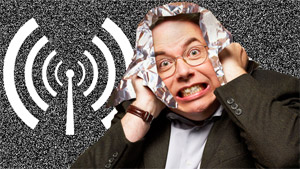
There is no WiFi allergy: newspapers misreport PR as science
Newspapers fall for the PR campaign behind a new album, and credulously repeat …
Ars Technica
45 points · by erikwiffin · 17y ago · 30 comments
As far as I'm concerned the jury is out on this one, but one important thing to remember is that the nervous system is essentially an electrical aparatus using very low powerlevels so interference would be expected by default rather than the opposite.
We're sensitive to exposure by sunlight, we're sensitive to hard radiation, it is not too much a stretch of the imagination that we're sensitive to HF too.
For much interesting reading about one positive sensitivity:
There are all kinds of wonderfully and terribly potent effects that mysteriously disappear in the harsh light of double-blind testing. That's because they are chimeras in the dark. The fault lies with the darkness, not the light.
If more evidence comes along in the future, I'll change my mind, but right now the evidence is of a kind with water dowsing.
A less biased and more useful statement would have been "there have been enough studies done on this to show that wifi 'sensitivity' is unlikely to exist". If that was the case I'd like to know.
A scientist goes into the experiment with an open mind, and is ever mindful of the possibility of future evidence causing the most likely hypothesis to change, but is not obligated to keep their mind so open that they never decide anything, even after the evidence is gathered and the peer review is done.
I think you are criticizing me based on the belief that there were no experiments done, and since that is not true, you would agree your criticism is invalid. If that is not true and you still think these experiments are not adequate, and "science" still has some sort of obligation to continue investigation, I would say, what would discharge that obligation? By which I mean, give me a concrete, immobile standard for what it would take to convince you before the fact that the investigation has been done, regardless of the outcome, not after the experiments. As I referenced in another message, you can always move the goalposts, but this is a sign of weakness in a position, not the strength some people seem to take it to be.
If 1 out of 100,000 people would really suffer from this it would take a major test to figure out who those people are, especially if - like almost every other radiation sensitivity - the effect is cumulative rather than instantaneous.
Let's make an analogy with sunshine:
A person is asked to determine whether sunlight is on a small section of their arm or not. After several guesses we determine that they can't determine this with a probability higher than what you'd arrive at if you guessed.
We can then conclude that 'light sensitivity' is nonsense. But absense of light over longer periods of presense of too much light will definitely have an effect.
If being sensitive to HF is cumulative then we need a completely different test regime than to simply ask people if they can sense a wifi transmitter is on or off.
You'd have to test over periods of days or even weeks.
Signal propagation in neurons is not by electrical conduction, in the wire sense, i believe that this would actually be incredibly slow for the conductivities / currents involved. Rather signals are transmitted by an active chemical process where potassium ions are pulled into and out of the axon in serquence: http://en.wikipedia.org/wiki/Action_potential.
I'm not sure that this has a direct implication for any kind of interference effect, but just wanted to point out that nerves don't really work like metal wires so how external fields effect the internal currents is not trivial. Also skin-depth/screening is going to play a big role in stopping most of the external radiation.
Also, the tests administered which disproved the so-called "wifi allergy" failed to account for the possibility that the effects take time to develop. I could disprove cat allergies easily using the same method, provided the exposure time was less than the time needed for symptoms to set in.
They used the self-reported time for symptoms to develop from the sufferers themselves. It's not actually science's job to exhaustively test the state space here, since that's not possible. Consequently, there's always another goalpost that science didn't hit (no, wait, it's only 64-bit WEP encryption!)... but it's not logical to thus conclude that the problem is the science. When the goalposts are getting shuffled around the field, the logical conclusion is that the problem most likely lies on the side moving the goalposts, not the side that keeps hitting the goals.
Maybe there's a real problem that is actually something else, though at the moment, "psychosomatic symptoms", Luddite-ism, and superstition seems to cover the observed phenomena pretty well. Like I said in another message, if more data comes in I'll examine it, but right now there is no reason to believe there's any reason to believe that such data will be forthcoming.
(Following up on my first paragraph: This is why "more study is needed" is an information-free statement. There's always more state space to examine; the question is, is there any reason to believe there's anything interesting there? There's so many interesting things that studying things extremely likely to be uninteresting is a waste of time. The exceptions that you might think are leaping to mind, like "Well how will we ever discover anything new if we never try new things?", are not exceptions. Things we have no idea about are interesting. Things that we have a very good idea are going to be uninteresting are what I'm talking about.)
What is know is that electromagnetic energy can and does effect the human body, it is just a question of what thresholds we are talking about. It would stand to reason that some people are effected at different levels than others for various reasons. (Hydration, PH balance, even height could be a factor when talking about specific wavelengths).
All that is to say, the wifi thing may very well be bollocks, but I still would love to see more rigorous research done.
Then, when you're done, compare E to the
+2 NAD+ + 2 ADP + 2 Pi -> + 2 NADH + 2 H+ + 2 ATP + 2 H2O
(simple glycolysis reaction and synthesis of NADH and ATP).
Hint: The amount of ionizing energy of a 5GHz signal is noise in the amount of energy created by normal biological processes. Ars is careful not to say "it can't happen," but I'm going to come out and say -- it can't happen.