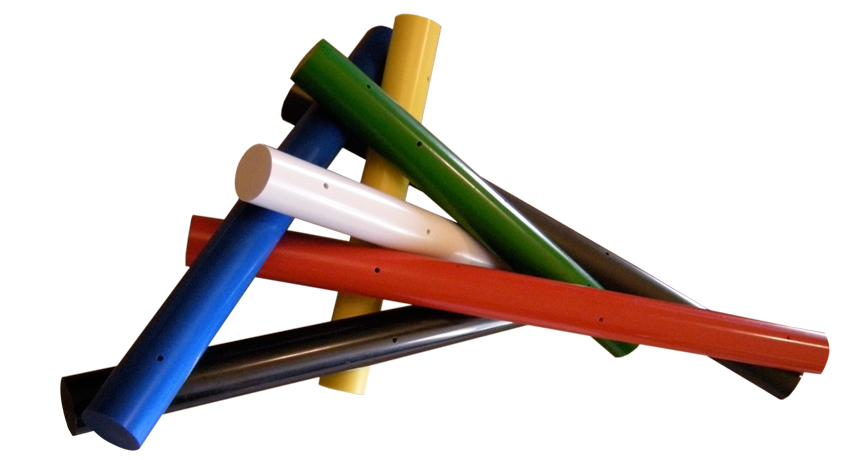
A tale of touching tubes
Mathematicians solve the challenge of putting seven cylinders in contact without using their ends.
Science News
265 points · by ColinWright · 12y ago · 84 comments
The result had the cylinders touching at the end of one with the length of the other, so the question arose, can one arrange to have seven cylinders all mutually touching, without using the ends. The easiest way to say this is to ask for seven infinitely long cylinders mutually touching.
This has only recently been settled, hence this paper. It's believed impossible to arrange eight identical infinitely long cylinders to be mutually touching. I suspect the result is in fact known, but I haven't searched diligently for it.
There is an associated puzzle that uses cylinders that are very short - think coins. How many coins can you arrange to be mutually touching?
Consider that a puzzle. I can do 5. If you can do more, there's a mathematical paper in it for you, should you care.
So there are known solutions for 5 coins, 7 identical infinite cylinders, 7 identical finite cylinders (maybe more), and 9 different infinite cylinders.
    It's possible to have 7 arbitrarily long cylinders
    mutually touching.  Currently it's not possible to
    have more than 5 coins (which are short cylinders)
    mutually touching.  As the cylinder's aspect ratio
decreases, where are the thresholds: 7 -> 6 -> 5 ?Because it is a 3D object that was found using mathematics. Any other examples?
I think there are lots of new objects discovered in higher dimensions, but I like when there is something you can actually build and see. I also like how it appears to be very asymmetrical.
http://en.wikipedia.org/wiki/Klein_bottle
Never heard about the gomboc before, thanks!
Why is this important? Is it just cool, or is there some real world application? Was someone paying for this research for some reason, or was it just a mathematician's hobby?
EDIT: For the record, I don't have any problem with "just cool" research. I do that kind of research often (albeit, not as smart), and totally understand the value in it. Just wondering if this had an application immediately.
Sometimes solving these sorts of problems requires pushing the boundaries of existing techniques, sometimes the techniques required are completely new and are invented specifically for the question at hand.
I'm not sure about this specific instance with regards payment, but sometimes people are paid to play with these sorts of things simply because you don't know what will come from it.
People constantly, constantly ask this question - "What's the point of pure research?" The question has been discussed many, many times over, and there are eloquent and robust defences for pure research to be found in many places. There's no way I could do better than some of the things already out there, so I won't try. However, many of the things you use today and take for granted for first created by people "playing," sometimes in their spare time, sometimes in time paid for by companies (and in some cases individuals) who were willing to let people play and see what came of it.
If we knew what we were doing, it wouldn't be called "Research."
He liked to rail against those "dirtyfilthyphysicists" stealing pure mathematical concepts and finding applications for it.
"Nothing I have ever done is of the slightest practical use"
'A mathematician, native Texan, once was asked in his class: "What is mathematics good for?" He replied: "This question makes me sick. Like when you show somebody the Grand Canyon for the first time, and he asks you `What's is good for?' What would you do? Why, you would kick the guy off the cliff".'
Timothy Gowers - 1998 Fields medalist - gave a lecture in 2000 titled "The Importance of Mathematics". I advice everyone to watch/read it:
Video: https://www.youtube.com/view_play_list?p=3641A12A6ADDB4B1
PDF: https://www.dpmms.cam.ac.uk/~wtg10/importance.pdf
Edit: more philosophically, this question always seems puzzling to me, because we can always ask: whats so important about "real world applications" anyway? We can start from any activity and ask "why is it important?", and then ask the same about the answer, etc'. This chain of "why"s eventually comes to an end: we can still ask the question, but there is no meaningful answer other than the realization that the things which are important are the things people find important - whether it is to get faster from point A to point B, have a baby, go to a party, or to solve mathematical problems. Something isn't more important because it's in the "real world".
Of course, the same could be said of basic research, but it is further removed and so requires more forward thinking to appreciate.
It could be that a certain mathematical research allowed us to develop sturdier pencils, and suddenly everybody is satisfied that we are not wasting our money because now it has "real world applications".
The human drive to discover and invent new things in math is fundamentally no different than the human drive for doing the same in the fields of technology, arts, etc'. But we perceive anything touchable as good, and anything imaginary as useless, because that's the kind of culture we live in: Making a slightly faster smartphone so that the activity of swiping a finger on a capacitive touch screen to play candy crush now takes 0.7 seconds instead of 0.8 doesn't need any justification, but thinking about math does.
What surprised me is that http://arxiv.org/abs/1312.6207 (which gives solutions with 8 and 9 cylinders, if one let's go of the constraint that all cylinders must be of equal radius) claims a connection with physics.
(BTW, I found that link via http://www.mathpuzzle.com. Infrequently updated, but never has uninteresting new items (at least, to my taste))
On the other hand, one might see a paper that expounds a technique, but how do you know if that technique has got any teeth unless you can use it to eat a difficult problem?
So yeah, I think the specific problem is not quite the point of this research.
At least that's a concrete answer you can give to the "man in street" who's going to scoff at explanations about expanding mathematics. But money and fame, well, everybody understands that if it makes money or makes you famous it's justified.
[1] http://www.nytimes.com/1986/08/03/business/hungarian-million...
I'm assuming that was tongue-in-cheek. Whilst many will accept the answer "to be famous" or "to make a profit" those are not justified motivations to others - particular not WRT research funding.
Easy to go everywhere from everywhere.
I'm still going to go with calling it the Villa Straylight, though.
It was great: whether by design or luck, the poles you had to climb got more and more horizontal as you got higher from the ground, then they became inverted in a way that made the topmost part easy and safer. The bottom then was a test: if you failed you had not far to fall, if you succeeded you would likely be ok to the top.
1- The first method finds a constant that guarantees convergence of newtons method to the solution; they then iterate it a few times and verify the result is almost stationary.
2- They use a set with parameter r that is guaranteed to contain a solution if it's contained in a ball of radius r; they then show that a given small ball around the candidate solution contains this set (they were able to do that because this set gets smaller faster than the radius).
Sounds like they used the computer to search for a proposed solution that _could_ have been a false positive due to rounding error, then verified it through exact mathematical methods.
The paper [1] describes a system of 20 polynomial equations with 20 variables (Equations 10--12) and solving them is no trivial task. To the end, authors first numerically found candidate solutions up to some ten decimal digits [2] and used specialized tools to prove (!) that there exists a real solution sufficiently close to given numerical solution. It turns out that there are several ways (and corresponding implementations) to do that, e.g. alphaCertified [3].
[1] http://arxiv.org/abs/1308.5164
[2] 10^-11 to be exact, according to the paper. It would be much easier to find a near-solution with larger errors (say, 10^-5). The physical model of such near-solution would be indistinguishable to the correct model.
[3] http://www.math.tamu.edu/~sottile/research/stories/alphaCert... (that actually does use GMP and MPFR for the obvious reason)
"Finally, they built a _wooden_ model to demonstrate their answer"
Cylinder Length | Max cylinders that can touch | Min cylinders that can touch
Infinite | 7 | 5
Actual | 9 | 7
L=D | 4 | 4
Others believe they have found both an 8 and a 9: http://arxiv.org/pdf/1312.6207.pdf
though this may not be exactly the same problem. In particular, the 9 cylinder problem allows 3 radii to be selected and then the other 6 are calculated as a result (meaning the 9 are probably not all identical.) It appears the 7 result in the initial paper is 7 cylinders of equal radius.
    they built a wooden model to demonstrate their answer — although Bozóki notes
    that the model doesn’t verify the result because manufacturing errors
    are much greater than any errors the computer could have made.
Can you clarify your question? Try to avoid the word "it" because the referent might not be obvious.