Introducing the WebKit FTL JIT
Designed to bring aggressive C-like optimizations to the largest variety of JavaScript programs.
WebKit
491 points · by panic · 12y ago · 96 comments
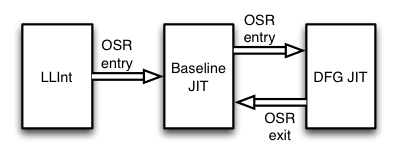
    > Profile-driven compilation implies that we might invoke an optimizing
    > compiler while the function is running and we may want to transfer the
    > function’s execution into optimized code in the middle of a loop; to our
    > knowledge the FTL is the first compiler to do on-stack-replacement for
    > hot-loop transfer into LLVM-compiled code.
I was reminded of the old story about a search engine that tried to supplant JS with a Java bytecode-clone because at the time it was widely believed Javascript had reached its evolutionary limit. How times change!
I know WebKit has tons of tests, but there must be some truly hairy bugs in that code. Does anybody know how they exercise the various optimize/deoptimize steps?
It turns out that instrumentation and optimization is actually a harder problem than one would think, which makes a lot of rather nifty technology farther out of reach than it otherwise should be.
Yup. Another is Open Shading Language[0]. They ended up with performance 25% faster than the previous shaders, which were coded by hand in C. It's used now in Blender's "Cycles" renderer. Yay, open source!
If you mean something else…then I guess not. It's a shader after all, not a general purpose programming language.
I tend to use dynamic in the sense of static vs. dynamic, where dynamic is "happens at runtime" and static is "happens before runtime".
This is the patch point intrinsic documentation: http://llvm.org/docs/StackMaps.html. This is a really significant addition to LLVM, because it opens up a whole world of speculative optimizations, even in static languages. Java, for example, suffers on LLVM for want of an effective way to support optimistic devirtualization.
You're right that you can do some optimizations such as reassociation of pointer arithmetic, but I'm not sure how much they matter in practice—I'd be quite surprised if they outweighed the advantage of being able to allocate in ~5 instructions [1].
That said, in a practical sense I'm certain the advantage of being able to use the mature optimizations in the LLVM JIT outweighs the disadvantages of having to use conservative GC (and as I understand Azul is working on precise GC support for LLVM). Given their constraints I think they did a great job.
[1] Edit: I've been informed that the fast path in JSC is around this for pulling a bin off the free list. I should be more precise: what I mean is that you can stay on the fast path more often. You can always allocate very quickly, only falling off the fast path if the nursery fills up. Of course, falling off a malloc fast path is rare anyhow, so this isn't likely to be that much of a difference in practice…
This is going to be a very very big deal.
http://opensource.apple.com/source/JavaScriptCore/JavaScript...
[1] http://www.webkit.org/blog-files/ftl-jit/four_tier_performan...
I wonder, however, how slow register spilling really is. I will test it when I have time, but logically, it shouldn't take up much time. Under the x64 ABI, 6 registers are used for argument passing [1], and the rest of the arguments are passed on the stack. So, when the runtime calls into GC functions, all but at most 6 pointers are already in the stack, at (in theory) predictable locations. Those 6 registers can be pushed to stack in 6 instructions that take up 8 bytes [2], so the impact on the code size should be minimal, and performance is probably also much faster than most other memory accesses. Furthermore, both OCaml and Haskell use register spilling, and while not quite at C-like speeds, they are mostly faster than JS engines and probably also faster than FTL JIT.
Of course, predicting the stack map after LLVM finishes its optimisations is another thing entirely, but I sincerely hope the developers implement it. EDIT: it seems that LLVM includes some features [3] that allow one to create a stack map, though I wonder if it can be made as efficient as the GHC stack map, which is simply a bitmap/pointer in each stack frame, identifying which words in the frame are pointers and which aren't.
[1] http://en.wikipedia.org/wiki/X86_calling_conventions#x86-64_...
[2] tested using https://defuse.ca/online-x86-assembler.htm#disassembly
All that the GC has to do is force-spill all callee saves onto the stack, or just save them on the side. A typical conservative-on-the-stack (the more general class of collectors to which WebKit's Bartlett-based GC belongs) algorithm for stack scanning looks like:
void scanConservatively(void* begin, void* end); void scanMyStack() { int fake; void* start = &fake; void* end = ... get the address of where you first entered the VM ... jmp_buf buf; setjmp(&buf); scanConservatively(start, end); scanConservatively(&buf, &buf + 1); }
Notice that this uses setjmp() as a hack to extract all callee-save registers.
That is sufficient to: (1) get all of the pointers you're interested in and (2) allow the compiler (in WebKit's case, LLVM) maximum freedom to not spill registers anymore than it would do in an normal C calling convention where no GC is in play.
Bottom line: Bartlett = zero overhead stack accounting.
This project was targeting game code for the register heavy, branch-unfriendly, in-order PowerPC PS3 and Xbox 360. Performance in scalar numerical code was equal to equivalent C++ code.
1. Consistency. You don't have to worry that some critical bit of type information will suddenly start to fail to be propagated all the way through multiple stages. This isn't really a problem for standard benchmarks, which are closely watched for regressions, but can be a problem for random code in the wild. JIT heuristics are complex.
2. Startup speed. AOT does not have to go through all of the various warmup phases, which are needed by JITs both to avoid wasting time on optimizing code that is not important for perf and to get type hints.
(1) It requires a pause to compile a bunch of stuff before you even get going. While in our case LLint would have executed it a few times already.
(2) Even for asm.js-style code, dynamic profiling info can help you optimize things more than you could with pure AOT. For example, you can make inlining decisions on the fly, based on what functions are actually called.
(3) Caching compiled code is a good idea for more than just asm.js, no need to make it a special case.
Hopefully the next Safari in iOS and OSX will get many more improvements
doesnt "use asm" simply skip the initial profiling tiers that gather type stats etc? most of the benefit of compiling to asm.js comes from fast/explicit type coersion.
I imagine even writing a Ruby -> JS transpiler that used the WebKit VM would provide a speedup, similar to how JRuby works on the JVM, but native compilation would be even better.
Moreover, Dropbox is trying roughly similar architecture for their Python implementation.
Rubinius already does Ruby -> LLVM.
dubbed the FTL – short for Fourth Tier LLVM
http://en.wikipedia.org/wiki/List_of_Battlestar_Galactica_ob...
But of course, your point of confusing people with acronyms still stands!
But I bet the engineers like the name.
http://arewefastyet.com/#machine=12&view=breakdown&suite=asm...
http://arewefastyet.com/#machine=12&view=breakdown&suite=asm...
FTL beats v8 on almost all of those.
It would be more interesting to see results for benchmarks such as DeltaBlue or Richards. These would correlate much better with gmail and hipmunk performance, as opposed to in-browser demos of Unreal Tournament.
http://cs.stanford.edu/people/karpathy/convnetjs/demo/mnist....
Safari: 18159 WebKit Nightly: 25141 Chrome Canary: 29962
That's a 38% speedup which is none too shabby.
http://arewefastyet.com/#machine=12&view=breakdown&suite=oct...
There is a discontinuity about a month ago, which is around when FTL was enabled, I believe. There you can see the nice speedups on Mandreel and the others you mention.