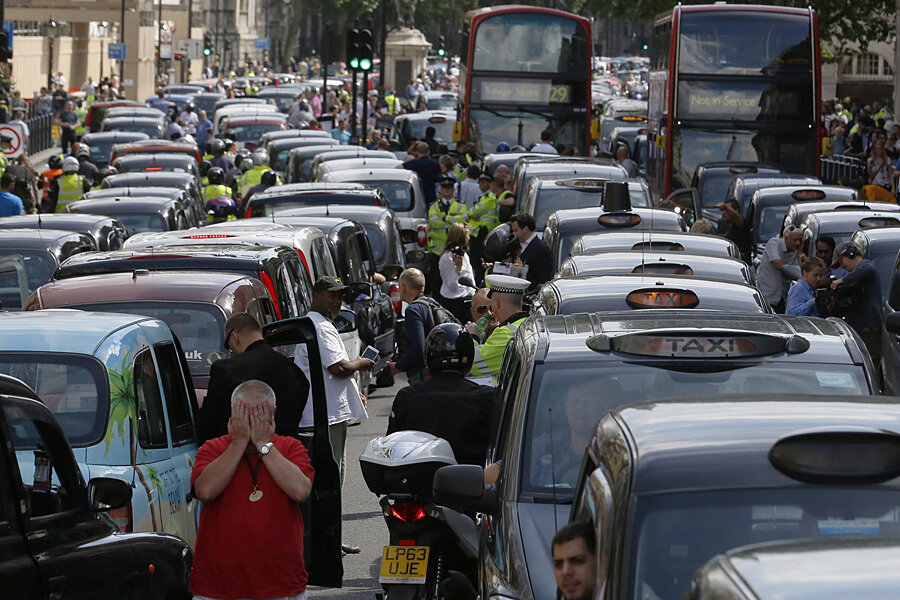
Uber sign-ups soar by 850 percent as cab drivers protest
Uber sees an 850 percent jump in sign-ups, while cab drivers across Europe protest the taxi-hailing app by going on strike. Experts call the strike agains…
The Christian Science Monitor
78 points · by happyscrappy · 12y ago · 72 comments
Taxi drivers are not protesting against the regulation. In fact, in most places taxi drivers and their unions are strong supporters of the said regulations and have worked for decades to get it in place. It's a typical situation where a bunch of "insiders" have striven for years to keep "outsiders" away with the goal of reducing competition.
Another typical aspect to this situation is how technology upends a structure put in place by legalistic means.
Selling medallions, etc. gets the city in which the drivers do business some revenue to pay for the services the city must provide to support the business. Taxes help fund roads, police, administration, etc.
The "situation" is more complex than you describe and the unintended consequences of Uber are nowhere in the discussion.
I'm surprised that Uber hasn't put forth licensing a version of their infrastructure for use by black/yellow cabs for dispatch. They can provide access to customers along with a pretty seamless payment process.
And of course this is true for every country affected.
I think perhaps both are true, though one only accidentally so. Taxi drivers' see themselves as protesting for stronger enforcement of the regulations. I suspect a large portion of the public, though, will recognize the protests as a sort of performance art designed to illustrate that the regulations are problematic and could perhaps stand to be revised.
I also suspect that the taxicab regulations would prohibit taxicabs from using alternative meters, so taxi drivers could not be Uber drivers at the same time.
[1] http://en.wikipedia.org/wiki/Taxicabs_of_the_United_Kingdom#...
Not all unfair regulation, since one could argue that the regulation that protects the taxi drivers from incumbents it's pretty unfair. They are protesting just against unfair regulation that hurts them.
But it is surprising to me that they don't complain about the fact that they laid down serious cash for a medalion, or pay other fees to the city to operate. I would especially think UberX would bother them. I think in the short term they are happy but I suspect they will start to get more upset if uberX starts to take away business. Right now, its earning them more money.
In Florida, they are having issues with UberX for that very reason (http://www.miamiherald.com/2014/06/11/4172680/miami-dade-tax...).
Its interesting to watch a number of industries just get blindsided by these disruptive technologies. Seeing it with crowd-sourced cab rides (uberX), direct autosales instead of dealers (Tesla dealer controversy) and crowd-sourced accommodations (airBnB). Some of the regulations placed on the older players in those spaces were put there to protect the consumer and/or the industry but my take is that consumer choice is providing better options and bypassing the need (or maybe it just hasn't come up yet) for these regulations. But then the people who played by the rules get mad or cling to them if it allows them to maintain their position a little longer.
Hm.
I'm not saying it not true, but it's playing in to an expectation that a lot of people had when they heard about this protest. So until there's independent evidence, I'll take the specifics of this claim with a dose of salt.
Edit: Suggesting that one be reasonably skeptical of unverified company PR is downvote worthy? Come on...
My point is that it is also sensible for Uber to claim that it has resulted in a massive success for their company. It makes themselves seem savvy and the taxi drivers short-sighted.
Of course, the goal of the taxi drivers' protest not really about getting people to not use Uber so much as it is about getting the regulators to change their decision that Uber's app doesn't count as a taximeter.
1 medallion per car per shift [iirc] + the per-trip tax.
It is just they need to pass the laws to do that and haven't yet. Of course, I think Uber is lobbying against being taxed given that they've tried to evade paying taxi-like taxes so far.
Or just coincidence...?
I think it is a direct consequence. When people can so easily access and post information regarding availability of luxuries and commodities it relieves the need for centralization. The question should be, what's the cost? Do I go to the hotel which will be able to put me in another room when there are problems? Or go for the quaint feeling of a person's home. Homes are generally in residential areas, but if I'm touring I might want the luxury of staying in downtown. Hopefully these two industries can live side by side to provide the greatest good for the greatest number of consumers.
(This doesn't even include the possible costs in terms of flimsy insurance guidelines for Uber drivers in some municipalities or locales, or property value depreciation for neighborhoods that become AirBnB traps with many units being turned essentially into mini hotels.)
The valuations are insane, so it looks like these companies are here to stay. It will be interesting to watch.
Deregulation is pretty common: banking, utilities (electricity, gas, telecommunications), railways, jails. States get a phenomenal one-off budgetary windfall from sale of infrastructure assets, and buyers get a government mandated toll-bridge - everybody wins! Though more governmental than "societal" as I previously described it.
Governments aren't driving hotel/taxi deregulation, but the hard-won legal and admin expertise to do it is sitting around with nothing to do...