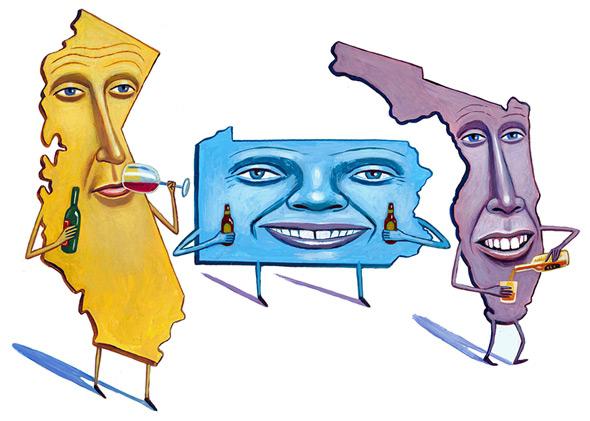
America’s Booze Laws: Worse Than You Thought!
Last week in Slate, Alison Griswold highlighted a costly hurdle for would-be bar owners in Boston. The liquor licensing system in Massachusetts places...
Slate Magazine
139 points · by jseliger · 12y ago · 192 comments
In the UK, if you want to sell booze from your shop, you write to the council and apply for a license. They check you and your shop out, and if you seem okay, they grant it. If you want to drive a taxi around your town, you write to the council and apply for a license. They check you and your car out, and if you seem okay, they grant it. This seems really simple and, frankly, natural. It's how all sorts of licenses work in the private sector too - think about copyright licenses, tenancies, etc. How on earth do you get from there to licenses being a kind of property?
[1] These purposes aren't, on their face, unreasonable. Taxis generate undesirable congestion, and establishments that serve liquor tend to create undesirable drunk people. If you don't believe me, take a walk through Wrigleyville in Chicago on a Friday night, where you can see an endless parade of taxis picking up an endless parade of drunk students.
Jane Jacobs rolls in her grave when you say stuff like that. The overwhelming majority of transportation engineers will tell you that taxis alleviate congestion by raising asset utilization. And they also reduce the need for vast parking facilities and block-circling in search of parking (which turns out to be a large fraction of traffic in some areas). It's a triple-win.
Transport planners i've come across would probably start wittering about modal shift. If introducing more taxis into a city leads to a modal shift from taxis to cars, it's a good thing. But if it leads to a modal shift from buses to taxis, it's a bad thing.
A Machiavellian transport engineer might even consider restricting taxis so as to maximise the available modal shift to buses (or rail etc), to make projects to introduce those easier to sell.
But isn't this supply meeting demand? If there were too many taxis, wouldn't the supply eventually cull itself when nobody can make enough money?
The old politician from the old part of town will argue for historical precedent; the younger, hipper politician might argue that new applicants should be given higher priorities; etc. As soon as you start trying to decide, you start deadlocking and someone gets screwed.
As it is now, all you need is money, rather than money and a friend on the council.
I agree that sometimes this setup (licenses to restrict supply) make sense, but taxis are not a good example of where this provides a net benefit.
I'd rather have a bunch of taxis than a bunch of drunk college students driving. Furthermore, from a city planning perspective the most efficient use of both road space and real estate (parking) is to have cheap, on-demand taxis instead of personal car ownership. If public transportation is fairly extensive and always available (as it is in NYC), it makes sense to eschew personal ownership of cars and use taxis for the rare case when public transportation isn't enough.
Overall, this reduces congestion, and is one of the reason that taxis are oftentimes taxed less (or pay less in tolls) than personal, non-commercial vehicles.
In fact, I posit that a significant reason that services like Hailo and Uber exist in NYC specifically is that the supply of on-demand taxis is heavily restricted[0]. If the supply were left up to the free market[1], Uber and Hailo would be able to provide some added value (the convenience of the mobile app and the "premium" feel), but not the level that they are now.
[0] Since the 1970s, the number of medallions available has not increased commensurately with the increase in population
[1] but with the same laws regarding nondiscrimination of service with respect to destination, credit cards, etc.
You're not wrong in what you say regarding the necessity of public transportation and the benefit of taxis instead of personal vehicle ownership, but the free market will have no incentives to reduce congestion until such point as people would rather walk. Panama City has less incentives to clog the roads in that taxis are universally unmetered; where taxis are paid per-minute, congestion is profitable.
Despite the lack of metering and a recently-introduced subway, Panama City has terrible congestion. There's always a taxi when you want it, but a lack of regulation means that it will almost certainly be in a barely-roadworthy condition, and if you are traveling at peak hours you may as well walk. I'm told it used to be worse, that taxis would not even take you if your destination were more than a short distance away; I've only encountered this a few times. Also, while many drivers are honest, any sign that you are not a local is liable to result in your being asked to pay several times the going rate. This is the free market at work.
If you are going to invoke market forces, you need to make sure there are sufficient incentives to not wind up with a worse problem than not having a taxi when you want it. What springs to mind would be taxing taxis in proportion to your congestion problems. I am not sure that would be an improvement.
These licensing schemes have become nothing more than rent-seeking by those established with existing licenses.
Impose an artificial barrier to entry, and everyone already past the barrier can work a little less, and reap higher profits.
Ensuring safety and quality of service is merely a pretext, and mostly everyone knows that is just political flimflam. It is a corrupt practice that is tolerated because it seems to benefit businesses somewhat more than it hurts customers.
In some cases, they are NOT property. They are treated as such to move the cash around, but the person exercising the privilege sets up a sham business arrangement with the licensee. For instance, the licensee of the cab medallion "hires" a manager with his own metered vehicle, garage, and roster of drivers, has no involvement in the day-to-day operations, and just cashes the checks.
Seems like they're missing out on an easy source of income by letting third parties benefit from the restricted supply.
Around me, the process is (theoretically) similar to how you describe: you make an application to a local body of elected officials, there's a hearing, and they deny or approve it. Neighbors have an opportunity to object or seek concessions. And I don't think you can really sell a license.
How on earth do you prevent it? You need to provide stable access to licenses, so that if Joe drives a cab he doesn't end up jobless next year because he lost the taxi license lotto. Suddenly Joe has something he can sell, access to his license. Say we tie the license to the person driving the cab then Lucky cabs can't fire a bad driver because then they lose a license.
If anything, arguably it's worse for Joe if Lucky Cabs owns his medallion and also has the opportunity to sell at a profit, and Lucky Cabs are similarly badly off if their drivers own the medallions but don't particularly care for keeping customers happy (perhaps because they're counting down the years til they can sell the medallion on for an order of magnitude more than they originally paid for it).
If you want to encourage flexibility in licenses which are short term leased rather than "owned" you can even give holders the option of pro rata rebates (at the price paid) for trading them in early to encourage people that aren't using their licence to return them.
Basically, the city is in total control of the terms on which medallions can be leased and can collect the full market value of the medallions itself; to not do so is economically indefensible, unless you think giving cash windfalls to its original taxi drivers and speculators is high on the list of civic priorities
That said, Vancouver's taxi system is a little wonky, though possibly not atypical; there are usually three parties involved: the driver, the person who owns the vehicle, and the person who owns the license (i.e. the cab company), and drivers who don't own their own vehicle typically have to split their profits three ways. More commonly, you pay X dollars per night (split among the two others) and then hope that you make enough fares to make a profit.
Which you usually do, of course. Part of the reason is because the city limits the number of licenses that can be issued; the other part is by crushing competition like Uber under old, outdated laws and regulations (in BC, Uber's black car service falls under the criteria of 'limo', and limos have a minimum charge of ~$65). Which kind of makes sense; if Uber started killing the cab companies, it would be the drivers who would suffer first, and not the companies themselves.
It varies by the locale, but I'm not even sure if there are any qualifying tests for obtaining a taxi license (other than basic criteria, like having a commercial drivers' license in good standing, etc.) in most parts of the US. (London is an interesting exception: https://en.wikipedia.org/wiki/Taxicabs_of_the_United_Kingdom)
EDIT:
Perhaps of interest, I went to Prince Edward Island last year and met some fishermen. Apparently their licenses can be sold (they effectively take out a mortgage given the cost) and are used as a sort of retirement plan by the fishermen that own them. But they also (according to them so I'm not sure the precise legal considerations or if it's convention) require that you spend some years working for licensed fishermen before you can purchase one. So sort of a hybrid between the driver's license and the taxi medallion model.
The quesion is, why are these licenses honored after a transfer?
Letting licenses be transferrable is a way of limiting the public-agency workload in managing #1, because you then have less work managing a queue of pending-availability license requests at the public agency.
Even where license are transferrable, the recipient generally has to submit paperwork to the agency and be approved that the meet the appropriate requiremetns related to #2 before they can use the license.
http://en.wikipedia.org/wiki/Taxicabs_of_the_United_Kingdom#...
(for those not familiar with cerebral anatomy, the hippocampus is the part of the brain responsible for racism, swearing at cyclists, and tax evasion)
The premise is that the fact that laws are constantly added but almost never removed is crippling us. Also, unfair laws are almost always unfair in someone's favor, and the groups benefiting will defend those unfair laws tooth-and-nail, and the morass of laws becomes even more stagnant.
I think Howard is usually seen as conservative, because he's seen as anti-regulation. I tend to think he's anti-stupid-regulation, which is a subtle but important difference. But even if you disagree with Howard in broad strokes, you have to admit that the alcohol laws in this country are pretty good supporting evidence for his premise.
The first problem is that now you have to dedicate a whole lot of work to maintenance. Even if this was done in good faith, you'd have millions spent just reading and rubber stamping laws. Legislatures get little done as it is to add more work.
Then, we have the problem of getting the legislature to take this seriously. What stops gigantic omnibus renewals that, for all intents and purposes, lead to the same thing that we have now?
There's also the risks to partisan fighting over controversial laws. Imagine what happens to an impasse over immigration law, or gun control. The winner, politically, would always be the side that would be more capable of tolerating no law at all. This is far more politically charged than just keeping whatever was the consensus in the past.
So that proposal is only a good idea if you believe that having a harder to govern country is something you want. Rarely a popular opinion among people that make laws.
Politicians aren't scientists, and don't operate from root causes and facts; they operate from manipulating social factions and perceptions. If they don't see something as important to their key social factions, it's not worth their attention. Honour this Albert de Salvo guy? Sure, why not? Do it and let's move on to the stuff I want to deal with.
The main problem is creating a process where outdated laws can be removed efficiently - which obviously needs to be done in congress. I think there could be a monetary reward involved - not for the congressmen obviously, but for non-members of the congress who initiate a process that leads to a successful removal.
In other words, every law has an intent. Make it so before any law can be passed, you must design a test to validate the law against the intent to be run at some point in the future. Then if the test fails outright, or begins to fail over time (some laws work at first, but fail later) then you pull the law out of the books.
I know this is very naive, and over-simplified. But I like the idea.
It does allow for fresh debate on things but can also cause a lot of friction and uncertainty.
The problem is that while a private interest group can focus all their efforts on one issue, the public has many diverse interests and has to be on guard against all the possible private interest groups at all times.
Sadly, we seem to be going the opposite direction on this at the moment.
http://en.wikipedia.org/wiki/Untouchables_(law_enforcement)
edit: why the downvote?
To make that clear: the only company that is allowed to run a beer store in Ontario is The Beer Store. The Beer Store is owned by an association of InBev (Belgian company) and Molson/Coors (headquarters in Denver).
So Ontario has a government-protected beer retail monopoly that isn't even run by Canadians.
We just had an election. The Beer Store issue was completely ignored by all major parties.
One might conclude that beer would be easier to purchase. No go. If you want to buy a bottle of beer or a six-pack, you have to go to a bar or restaurant where they can sell you up to 192 ounces of beer. Anything over that, and you have to go to a beer distributor instead where you can only buy beer by the case or by the keg (still no wine or liquor). Some grocery stores have gotten smart, and have setup little cafes that are separated from the main stores. Adding a table or two, and some gas station microwave sandwiches is apparently enough to do squeak by and sell beer as a restaurant.
Naturally, no one particularly likes our system. But everyone has a vested interest. Gas stations want to sell beer (a regional chain, Sheetz, has been lobbying for changes for a few years now), but can't. Restaurants and bars don't want to lose their current monopoly on low-volume sales. Distributors fear a future where six-packs are more convenient, lest customers buy six-packs rather than a case with more beer than they want at a given time. And state store employees have been going deathly insane for years over the possibility of liquor store privatization, a separate reform that's often brought up alongside the others.
Together, these groups are amongst the most influential in the state and they're not afraid to use that influence to fight reform efforts. Simply put, it's a mess. Until I read your comments about the Beer Store's rather interesting ownership, I honestly couldn't imagine how much more fucked up things could be. Ridiculous.
Private import is regulated, but it's way more relaxed within the EU countries. Systembolaget will (must) import anything you want which they don't carry, and the process is generally very convenient.
While Swedes love bashing "Bolaget", I think a lot of people are quite satisfied - the opening hours are a little cumbersome (closing at 6-8 PM on weekdays, 3 PM Saturdays, closed on Sundays) but IMO that's counterbalanced by the great assortment.
We used to have a monopoly on the production of liquor as well. It was called Vin & Sprit (Wine & Spirits) and was the company who created Absolut Vodka. Absolut sold very well and they couldn't leave a profit (or something like that). They put all profits into advertising instead, making Absolut a very well known brand. The sitting administration recently sold the company to Pernod Ricard.
This is one of those ridiculous lies that Swedes like to tell themselves. There are single stores in France and Germany with a larger assortment than the entire beställningssortiment. Anything even slightly obscure requires ordering from abroad, with all the crap that entails.
Isn't that a bit of a tricky semantic construction? If the government gets to decide who is able to offer a good in a particular industry, then the government is essentially controlling that industry, with one thin layer of indirection.
For what it is worth, it is possible to become a Beer Store and LCBO franchise as a private business in (rural) Ontario.
Some European countries have a fairly sensible approach.
This quirk in the law caused an unintended side-effect. Mixed drinks became very popular because now your Manhattan had quite a bit of alcohol in it -- a full mini bottle each of whiskey and vermouth.
because people couldn't possibly concieve the idea of drinking more than one mini bottle... /s
I really can't understand this kind of thought process.
Yes, yes, we know. All of the laws, customs, and cultural traditions in western Europe are much more rational/intelligent/better/whatever than those in America.
The real story, as usual, turns out to be fairly complex. Americans have a very odd and unique history with alcohol. Most notably was the temperance movement [1], which really started all of this hullabaloo. This caused an amendment to our Constitution...something tough to do and even tougher to undo. And yet, eleven years later, it was repealed (thankfully).
But, and here's the big but: To temper the temperance movement (which, by the way, had proven considerable political power), there were these crazy laws that were enacted to limit alcohol buying. The predecessor to the ATF was born [2]. And things like the 3-tier system were created, along with all sorts of bans on homebrewing and whatnot.
Essentially all of the regulations on alcohol have their roots in either the temperance movement or the anti-drunk driving movement (i.e.-MADD), which is a neo-temperance movement. Most of them were political concessions. Anymore, folks have profited tremendously off of artificial supply limitations, and they seek to keep those limitations in place by lobbying (quite effectively) against repeal or reform.
[1]: https://en.wikipedia.org/wiki/Temperance_movement_in_the_Uni...
[2]: https://en.wikipedia.org/wiki/Bureau_of_Alcohol,_Tobacco,_Fi...
The temperance movement was not restricted to the US. The Swedish temperance movement started in the early 1800s, and gained a lot of strength with the starting of IOGT in the 1880s. This latter growth was strongly influenced by the Good Templar movement in the US and Canada. The peak was likely the Swedish prohibition referendum in 1922, where 51% of the voters voted against prohibition. (There have only been six referendums; others include "join the EU?" and "adopt the Euro?")
Instead, Sweden moved to a quota system - the Bratt system - first for hard alcohol and then for all the lowest alcohol drinks. While the quota system disappeared in the mid-1950s, the government still has a monopoly, excepting through bars and restaurants.
While on the other hand, Iceland had prohibition from 1915 until (in some form or other) 1989. That ending is still celebrated as "Beer Day", because until then the Icelandic temperance movement had successfully argued that strong beer, being cheaper than hard liquor or wine, would cause more depravity so should not be sold. People ended up mixing legal, weak beer with hard liquor to make an ersatz strong beer. Prohibition of that mix finally tilted the scales to end prohibition.
Norway had prohibition from 1916 to 1927, again, from the same temperance movement that was strong in the US.
In reality, this discussion should be around regulatory capture. But that's too hard, so instead, we get into a Europe vs US pissing match. It's stupid. It's foolish. So, instead of discussing how to better fight regulatory capture, we just try to show off how special we are. I say again: sigh.
Alcohol is a great commodity to tax because stills require lots of sugar, grain and barrels and thus are/were very easy to spot. Even today, the ATF will drop by for a visit if you're purchasing large quantities of sugar, and you'll have a hard time buying lots of sugar without identifying yourself.
Many states followed a similar model, so there is a historically ancient precedent of such regulation. Temperance and post-prohibition regulation added more layers.
Then again, even the Irish are getting irritated with the Brits coming over to Dublin to get pissed and get in fist fights in the street and causing other bits of ruckus.
Not that this makes any more sense in Europe though. In Finland, it's a national pastime to make booze runs across to Estonia, where alcohol is far cheaper. Since both countries are in the EU, there's very little Finland can do about it (free trade and all that), and there's even judicial precedent that importing a minivan stacked full of vodka falls under "personal use" if you happen to have a wedding or birthday party coming up.
I'm a bit of a federalist (at least for now). I live in a state whose liquor laws I generally like, and if other states want different liquor laws that is their prerogative.
I'm surprised that the author, being a current Pennsylvanian, didn't mention the Johnstown Flood Tax. Despite that particular flood having occurred all the way back in 1936, we're still paying the tax on liquor.
BC should really take a note from Saskatchewan or Alberta. Paying for health coverage in this country is an atrocity, especially with the high liquor/tabacco taxes.
No no, really, I have exactly the same taste as some random guy in the state capital.
I felt like I was being punished for not being a church goer. It was an odd experience.
Which of course had unintended consequences. We drank. Fraternities turned into de-facto bars. We would pool our money on a Thursday and make the 35 minute drive to the liquor store. We'd typically spend $1500-$2000 on booze and truck it back to campus. The idea was the buy the booze we'd need for the weekend. We'd typically be completely out by sometime on Friday.
At that point some drunk college kid would decide to drive 22 miles to buy more booze. My university had multiple drunk driving fatalities every year because of this.
It's better now (restaurants can serve booze finally), but I'll never understand why that law existed in the first place.
That's exactly it, but it's a little odd the stores were open to tell you to come back in an hour.
[1]: https://www.atf.gov/firearms/faq/firearms-technology.html#co...
Regulation of commerce always risks unintended (though often forseeable) consequences.
The cities have the ability to add extra licensure requirements, so quotas can and do exist at the city level. Further, there are strange rules about entry to taverns - for example age of entry need not be legal drinking age which differ by city. There are also city or even smaller administrative district rule over what can be sold, pricing rules (e.g. near the college campus there is a rule about the minimum price of a drink special that doesn't apply to a lot of other parts of town) and so on.
When I was 21/22 I rarely had a problem getting passed the bouncers in places with the higher age limits because "you don't look like you're going to do anything stupid"
What I don't quite understand is they can turn away anyone for any [non-protected] reason already. What could be the thought process behind posting this? Especially when the establishment is unlikely to enforce it, as you noted.
As an establishment, feel free to turn away a large, intoxicated group. Similarly, it is your right and responsibility to avoid over-serving. And furthermore, you may choose to establish whatever ambiance you choose through your decor, music, lighting, and even pricing. Between these things, you can maintain the atmosphere and attract the customer base you desire.
Heavily regulated industries abound, those are three very big ones whose taxes fund a lot of services but more importantly whose political donations fund even more protection.
In Georgia there was a big stink about restaurants storing customer alcohol, seems the locals took offense and were confiscating private alcohol because of lack of tax stamps.
If people ever thought there were not enough taxes they never bothered to add them all up. Even taxes, fees, and whatnot, that do not hit you directly get you in the end
Are you saying you weren't allowed to? If so, why not? You can walk into any random liquor store that I'm aware of and buy gallons of beer or hard liquor if you want to
I buy it. In fact, I'm pretty certain of it.
But otherwise, good article. I'm continually frustrated when I try to buy beer on Sunday and they don't allow Sunday sales in my town. Of course, the two stores directly outside the city limits do pretty well from the law but I don't know that it accomplishes much else. Except maybe promoting drunk driving.
Make no mistake -- alcohol boards and organizations like MADD are simply neo-prohibiitonist movements co-opted by religious zealots.
Making beer, wine, etc is legal in most jurisdictions (with some out-there upper limit like 200 gallons per person per year max). Nothing wrong with drinking [most of] that stuff; with a little practice you can make it better than the cheap store-bought forms (or maybe even get actually good at it).
Distilling is simply removing some of the content of the aforementioned beverage. Usually it involves extracting the [harmless] ethanol from the fermented must/wort via evaporation & condensation, which can be done as simply as a "disappearing still" (arrangements of common kitchen pots, ice, and stove). Legally, "distilling" also includes other forms of concentrating the alcohol by removing something, such as by freezing the liquid and draining the still-fluid components from the ice. Either way, it's pretty stupid that people can make vast amounts of inebriants at home for personal use, but are severely punished for concentrating it (again, for personal use).
Yes, some people do get stupid and make harmful solutions. A main factor therein is the fact that it's illegal to make distilled spirits without expensive licenses, which in turns make it hard for people to make it properly & safely (both in manufacturing and product). Sure you could argue that they shouldn't be doing illegal things, but that ignores the easy LEGAL availability (liquor stores flourish), and the fact that it's so easy to make at home it's almost hard not to.
And perhaps the authorities encourage this view to protect tax revenues (which are substantial.)
150 proof is a highly flammable liquid. The vapor is flammable. If you have a vapor leak it can ignite. The flame is invisible. In other words, it's not something to take lightly.
In the micro distilling industry, I personally know of a half dozen fires over the past couple years. It's easy for something to go wrong very, very quickly.
Here is an article on the most recent fire: http://newsok.com/blast-rocks-moore-distillery/article/49079...
Catastrophic fires are also an issue with deep-frying turkeys, and in fact with deep-frying anything.
And we do already have a well-formed body of law dealing with responsibility for fires, damage to neighbour's homes &c.
'Someone might maybe do something wrong' isn't really a good reason for there to be a federal ban on most behaviours. I'd be much less incensed were it at the city or even neighbourhood level.
If that reason had anything to do with the law, it would be a fire code thing.
No, the real reason is a coalition between moral purity (left over from the temperance movement) and revenue protection. Ever heard of "Baptists and bootleggers"? Same thing, except the bootleggers are the government.
The idea that you can go blind off this stuff has more to do with propaganda and poisoning folks:
http://www.slate.com/articles/health_and_science/medical_exa...