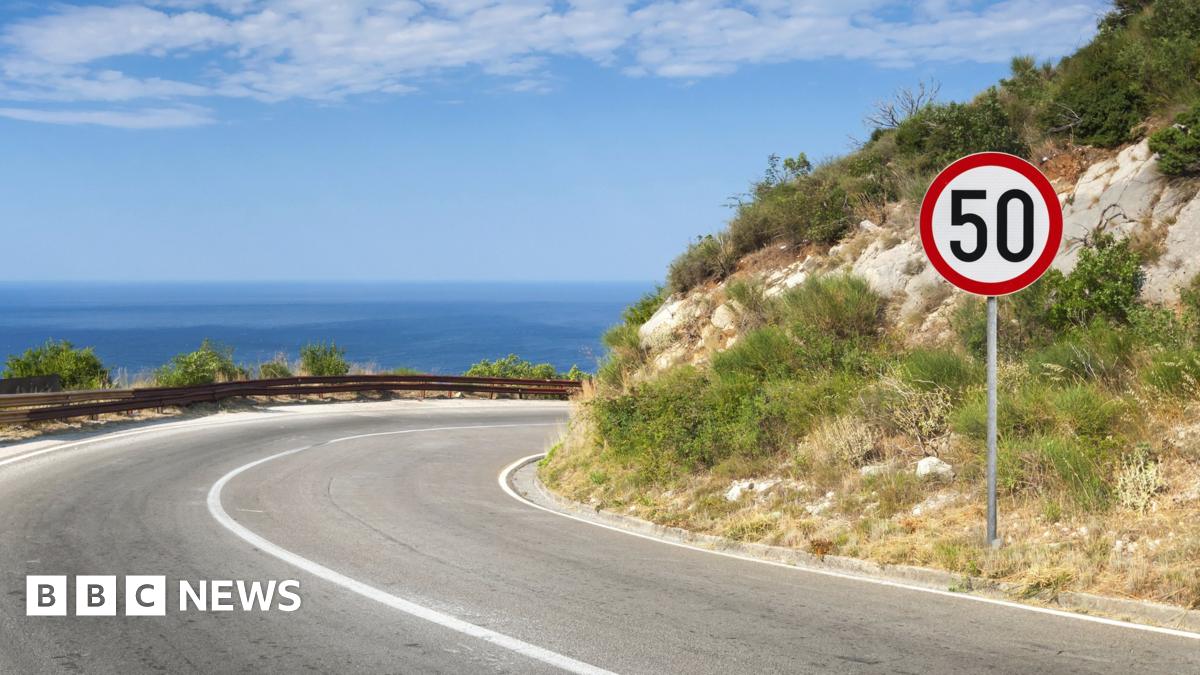
Google's driverless cars designed to exceed speed limit
Google's driverless cars are programmed to occasionally exceed speed limits by up to 10mph, says the project's lead engineer.
BBC News
31 points · by lsh123 · 12y ago · 59 comments
It would be stupid not to, especially during the transition phase where driverless cars are the minority.
YMMV depending upon local standards but here in San Diego, CA it is extremely common for the flow the traffic to be going 5-15 miles above posted speed limits and the cops do not care. Having a car going significantly slower than the flow of traffic is much worse than exceeding the speed limit.
Also there are sometimes situations where very temporarily exceeding the limit is the best option (eg. you're at the speed limit and someone cuts into your lane toward the back of your car, potentially shunting you and you have no clearance on the other side, but do have room up front). Driverless cars with full 360 (or close to it) lidar would be ideal for dealing with this situation (as opposed to a human driver that is unlikely to even see the other car in his/her blindspot) but if they are capped at the speed limit their options for resolving the situation safely would be severely curtailed.
I'd be very curious if I could sue those local governments for endangering me if my vehicle is forced to follow their rules and gets in an avoidable accident because of them. It would be an eminent domain defense, in the sense that government can't deny me of my property without a justifiable (public safety) reason for doing so.
And forcing my computer to behave in a certain way that causes it to potentially harm itself is definitely a denial of property.
I'm sure they'll just write me a ticket though - and if no one has gotten out of that by citing statistics on road safety, my autonomous car won't be any better off.
Hopefully, this will all be resolved reasonably with a national law and a nice bug report interface on Google's part.
Same here in the Bay area. It would be unsafe to drive no faster than the speed limits in some conditions of traffic. (Some drivers do this, and you have to change lanes on short notice to remain at the same speed as the rest of traffic.)
Clicking through to the source: "Google's driverless car is programmed to stay within the speed limit, mostly. Research shows that sticking to the speed limit when other cars are going much faster actually can be dangerous, Dolgov says, so its autonomous car can go up to 10 mph (16 kph) above the speed limit when traffic conditions warrant."
http://www.dailymail.co.uk/news/article-2016721/Slow-drivers...
Going slower? Possible, depends on how much slower.
They are much more likely to be highly aware of how they interact with traffic than they are a dangerous, oblivious obstruction.
Except when a special designation is made (common on, e.g., two lane highways that have a stretch where a third lane is added to one or the other side expressly for passing), no such thing exists in many US jurisdictions. There are some US jurisdictions where the leftmost lane is by default reserved for passing (or passing and allowing traffic to merge in the other lane), but that is the exception, not the general rule.
Even if it's clearly marked HOV, you need to make a left turn, or it's a single lane you'll still somehow be a danger to society.
Speed limits in North America were lowered to save fuel during the oil shortages in the latter half of the 20th century and subsequently were never raised.
Assuming you maintain proper spacing between you and the other cars, driving at 110 km/h is not significantly more dangerous than at 100 or even 90 km/h.
Actually most people drive ~100km/h on the road I have in mind so 80 is annoying to some already, but I try to never tailgate anyone into driving faster. Only when someone does ~72 because they think that's what they are allowed to drive... such a small difference and yet so annoying.
Another random thought: do the cars respond to a police officer trying to pull them over?
My two cents: if the car has the capacity for manual override, the owner (negligence) otherwise the manufacturer.
>do the cars respond to a police officer trying to pull them over?
Legally, humans are supposed to, so why would it be different for self-driving cars (which can at least be programmed to give control over to a third party when requested?)
There are plenty of ways a self-driving car could mess up and cause an accident where you do not have enough time to react to it. Not "you should have been paying more attention". As in "You are not superhuman enough to react in time, period".
Say, swerving on the highway into oncoming traffic. Some (incredibly rough) numbers: if you're going 108km/h and the car suddenly swerves into the other lane of a two-lane highway, if it's 20m between start of swerve and hitting the vehicle in the other lane, that's 2/3 of a second. You can't do that. You (or rather, an average person) are not going to be able to recover in time. The reaction time for an alert driver is something like 0.7s on average. [1]
And that's not the most pessimistic assumptions either.
[1] First link I found: http://www.technology-assoc.com/articles/reaction-time.html
Manufacturer.
However, what's going to eventually fall out is that self-driving cars are going to be SO much safer, that insurance companies eventually won't let YOU drive.
In case of other accidents -- pays insurance (and their pricing will be the best indication of how safe these cars are).
In my experience, even though speedmeter in the instrument panel shows 10mph over, actual GPS speed is around speed limit.
'Vehicle manufacturers usually calibrate speedometers to read high by an amount equal to the average error, to ensure that their speedometers never indicate a lower speed than the actual speed of the vehicle, to ensure they are not liable for drivers violating speed limits.', although no citation is currently provided.
Error is introduced by tire diameter being different than what was assumed for initial calibration... i.e. wear on the tires or tires that are under/over-inflated.
http://www.maps-gps-info.com/gps-accuracy.html http://www.gps.gov/systems/gps/performance/accuracy/
  for n, neighbor of neighbors
    if neighbor.vel > @vel # TODO: add something like: " and @vel < maxVel"
      @vel += 1