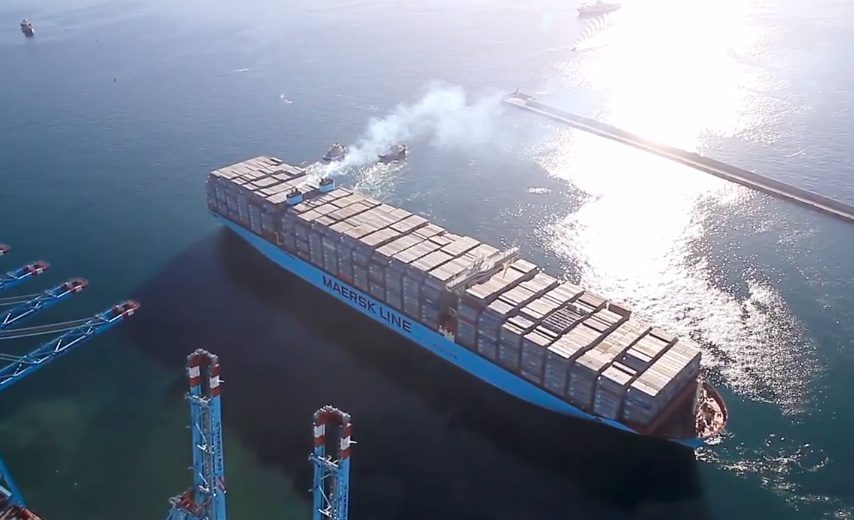
Watch: Triple-E Leaves Port With World Record Load
On July 21, 2014, the MV Mary Maersk departed Algeciras, Spain with a world record 17,603 twenty-foot equivalent units (TEU), the most TEU's ever loaded onto a single vessel.
gCaptain
131 points · by chermanowicz · 12y ago · 64 comments
This is the result: https://www.youtube.com/watch?v=qjD9VvhXJrE
I think he succeeded - it's one of the best brand videos I've ever seen.
This immediately makes me want to calculate the Maersk pole of inaccessibility just to prove them wrong. Maybe xkcd can get on it. (see http://en.wikipedia.org/wiki/Pole_of_inaccessibility)
But I don't think Maersk (or anyone) does much work shipping across land on Antarctica. They do supply some of the research stations[1], but these tend to be on the coast.
Given that, I'd imagine somewhere in the middle on Antarctica would be about the furthest.
That's the core of any really successful business, package a challenge in such a way that the rest of the world takes it for granted, internalize the complexities and reap the rewards that go with taking the responsibility for doing so.
Excellent corporate video, one of the best I've seen.
This is about 12 minutes long, has a fairly well known British Actor narrating, a well known film director, involved lots of world travel and various types of specialist equipment operators, lighting and sound folks.
I wouldn't think you'd get away from this for anything under $20m, and wouldn't be shocked to hear it was $30m.
Serenity, a 119 minute feature film, had a production budget of $39M.
Of course, there are probably higher costs for a "documentary" like this Maersk one, primarily because of fixed-costs and international travel, but I couldn't imagine that it would be more expensive per-minute by a factor of 7.
[1] http://www.porttechnology.org/news/we_are_maersk_worlds_larg...
One interesting thing is that those older, smaller ships had more powerful engines than the much larger current vessels! The engine installed on the 6000 TEU vessel was ~90,000 hp, and the ship was designed for sailing at ~25 knots, the justification being that the value of cargo onboard was so high that the cost of shipping was dominated by the interest charges!
Look at historical bunker prices to get an idea. I couldn't find a good link, but the USD/barrel is a nice indication: http://www.infomine.com/investment/metal-prices/crude-oil/al...
A problematic thing is they way ports generally work, you may generally not book a port for a specific arrival date. You have to rush to get there before other ships, to sit still outside and wait in line.
Not very good for fuel consumption and the environment.
For most ports in North Europe that's not the case (though it used to be). You generally agree on a standard arrival date (day of week + time + number of moves), then you should arrive at that time. This differs per region though. For Africa, it's "different". You have terminals owned by customers, etc. More often you still have to rush, then wait for ages.
Maybe things are different if you're a small shipping line and the same terminal also working for a few big ones.
Surely not "half as big". ITYM the engine size for a 2x vessel size increase is 1.5x. Maybe "half again as big" would convey it.
It costs more than you might think, partly because meals are included.
I'm not sure what the expected value is for number of TEUs lost per journey. I'd hope that it's near zero, but I don't know.
Edit: quick google. Estimates range from 1,000 (World Shipping Council)[0] to 10,000 (Singularity Hub)[1] lost per year. Either way, with 120 million containers shipped per year, it's quite low.
0. http://gcaptain.com/how-many-shipping-containers-lost-at-sea...
1. http://singularityhub.com/2011/04/05/10000-shipping-containe...
This site has lots of amazing pictures if you can get past the Geocities design. Like this:
How would you put out such a fire from under/inside the stacks of the containers? (and given the content of the containers with consumer goods - plastic, plastic and more plastic ... )
What are the limits on the size of a ship? Width of Panama/Suez channels? Lets say they would build by 2019 (they plan to start this year and be done by 2019) the Nicaragua canal :
http://en.wikipedia.org/wiki/Nicaragua_Canal
"The proposed canal would be between 230 meters and 520 meters wide and 27.6 meters deep."
And Egypt also invests billions in improving (and as i remember - building new pieces) of Suez.
So, how about double length and double width of the Triple-E?
No.
Losing customers containers is bad for business I would find it unlikely you'd just factor loses like that in.
I't take an accident/mistake or rare natural event to knock them out.
Even if you wanted to allow containers to 'fall off' as a business expense I'd see the maritime union causing issues increasing this expense since I'd imagine it creates an unsafe work environment.
http://www.marinetraffic.com/en/ais/home/centerx:114.6631/ce...
http://www.marinetraffic.com/en/ais/details/ships/9619921/ve...
Now, I don't have to wonder about all the ships sailing on the Hudson river.
The biggest limitation on Panamax size is whether a ship can fit into the Canal's locks, but the Suez canal is a sea-level waterway with no locks, so the limit is a lot higher.
See http://en.wikipedia.org/wiki/Container_ships#Size_categories