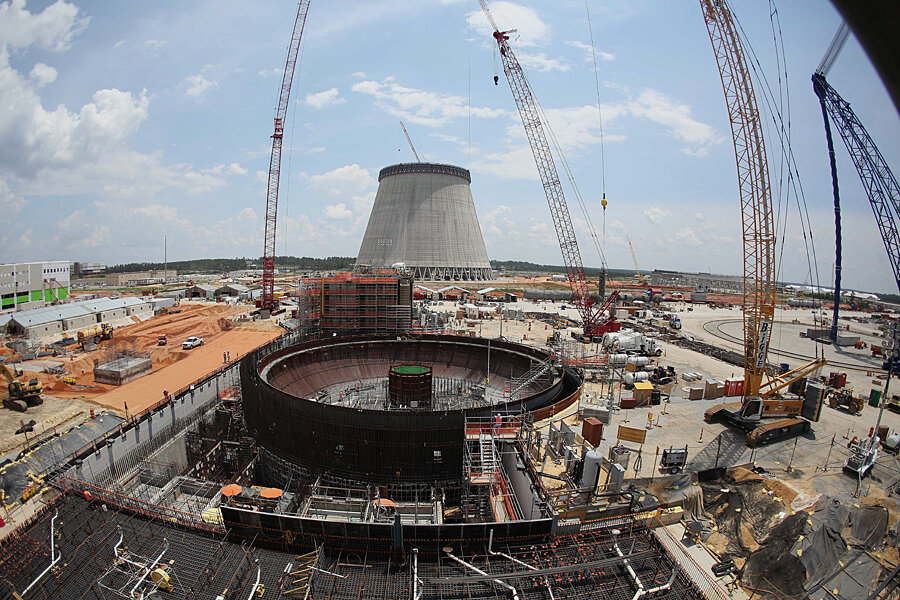
Want to fight climate change? Build more nuclear power.
The Christian Science Monitor
78 points · by markmassie · 12y ago · 158 comments
Here in Germany it is mostly dead. For us you are discussing positions of twenty years ago. The US has a very different energy situation compared to us: large country, nuclear weapons, lots of nuclear technology, extremely high energy use (more than twice than the average German), much lower population density, lots of energy sources, ...
Here in Germany we've seen a lot of the negative effects in a country with higher density in the middle of Europe:
* no plan or place for the waste
* nuclear power plants all over the country
* widespread corruption between politicians and industry
* protests were suppressed with military-like police, escalated almost into civil war
* lots of transport of nuclear materials through the country
* extremely costly research paid by the tax payer
* lots of promises of the nuclear industry just did not materialize: for example our pebble-bed reactor was closed silently, while earlier it was promised to solve a lot of technical problems
* centralization of electricity production in few monopoly-like companies with zero competition
The effects on an democratic society of nuclear technology is at least as bad as its technological problems. This was seen decades ago in the book 'Der Atomstaat' and the effects had been shown in Japan, where the Atomstaat was more advanced than here in Germany. We were able to stop it.
Now we have to build-up renewable decentralized energy during the next decades. That's the common goal here in Germany.
Off topic: I'm always a bit mystified as to why people try to use German articles in English texts when they obviously don't know the gender of the word. "Wende" (turn) is female and you thus use "die" as an article. The third possible article is "das" and used for neutral nouns like "Auto". Given it is easy to look up [1], I guess you didn't know there are several?
On topic: I won't state my opinion about the short term cost efficiency of nuclear power, because I don't have the references or raw data at hand to back it up (I wish a lot of others in this thread in the same situation wouldn't either). But IMHO the strongest argument against nuclear power is the uncertainty of long term waste disposal, given that we (currently) can't realistically predict storage conditions on a geological time frame. A month ago there was an article on HN about how we fail to come up with a way to communicate the danger of long term storage to future generations in a reliable way [2].
Even from an economic point of view the danger of a cost explosion of the nuclear waste disposal purely because of political struggles is daunting. In Germany we have a small disposal facility, the Asse, build to test long term storage in salt mines. Because of the usual combination of human error, incompetence and cover ups, waste was dumped there even while it was slowly becoming unstable [3]. Getting it all back out will cost somewhere around 5 billion euros. Guess who's paying for it.
[1] https://www.google.de/search?q=dictionary+energiewende
[2] http://99percentinvisible.org/episode/ten-thousand-years/ , corresponding hacker news thread: https://news.ycombinator.com/item?id=8090759
[3] I'm oversimplifying. See http://www.spiegel.de/international/germany/germany-weighs-o... for more background and http://news.nationalgeographic.com/news/2010/07/photogalleri... for pictures.
[1] http://www.theguardian.com/environment/2013/dec/01/sellafiel...
France's electricity is all state-run and the price of electricity is a political one. No French president survives raising electricity prices, even though the companies would need that money...
> Der Energiewende is both expensive and inefficient.
Expensive is not a problem for us on that level. Nuclear is as expensive as renewable and more. We have a lot of money. Let's say the Energiewende will cost us around a trillion dollar over 50 years. Maybe more? So what? The positive effects will be much larger. We actually have the money.
> inefficient
If you look at nuclear power plants, they use around 30% of the energy for electricity. With the rest they heat the rivers in France. That's inefficient.
http://www.forbes.com/sites/jamesconca/2012/06/10/energys-de...
Can it be done quickly enough to prevent the damage from climate change? If not, the problems of nuclear may be much less than the alternative.
> * protests were suppressed with military-like police, escalated almost into civil war
I don't mind a little hyperbole, but many people reading this have no idea what actually happened. Could you describe it?
Actually the renewable push in Germany is accelerating climate change, not preventing it. They don't get enough sun to make solar cells worth it, yet they do it anyway.
What it means is they will never make EROEI for them. On paper everything is wonderful (as a country emissions are low), but actually all they are doing is shipping the emissions to China which is where the solar cells are made.
PS: Though from an economic and EROEI standpoint Rooftop solar is significantly less appealing than solar farms.
I don't think so.
This book [0] goes through math of pretty much all energy sources and one of the conclusions the author reaches is that if you want to cover all of our power needs with green energy, renewables alone ain't gonna cut it.
Making them was never the problem.
Great. But Germany is also building new brown coal power plants, what's more Germany is backing a brown coal power plant just across the border with Poland. So it seems that there is a need for ongoing base load power generation... and effectively Germany is going for brown coal over nuclear.
Brown coal is, I believe, the most polluting way to generate electricity. So... why not nuclear instead?
Germany is also closing fossil fuel plants.
> So... why not nuclear instead?
There is no 'instead'. Coal will be phased out a lot during the next decades.
Granted, that's just economics at work as both countries are net exporters - but keep in mind that France periodically has troubles when it gets too hot to use river water for efficient cooling.
The proportion of renewable energy sources in Germany has risen to 23.4%.
Source: http://www.ag-energiebilanzen.de/index.php?article_id=29&fil... (PDF)
edit: Germany has been a net exporter since 2003 - 2008 was a typo.
edit : what I just wrote is untrue, Germany is a net exporter (since 2012) but suffer from the important irregularity of solar/wind production (overproduction and underproduction happen regularly and may damage the network).
And, 46% of the electricity is coming from coal...
However you've really answered the major reason of why nuclear cannot work:
>* centralization of electricity production in few monopoly-like companies with zero competition
If history has taught us anything its that the concentration of power is not a good thing.
So, the article is BS and repeating a lie once again.
I did not claim that otherwise.
One is that two other carbon-free options, solar and wind, are dropping in cost at a rapid rate at the same time that cost estimates for new nuclear plants are rising at a similarly rapid rate.
Another is that there isn't anyone who thought their investment in the existing fleet of nuclear plants in the US was a good investment. They were uniformly bad investments, which is the primary reason for the 40 year gap with essentially no new plants ordered.
Furthermore, even completely amortized plants are shutting down in the US. They can't even cover their operating costs, the few that shut down in the last year, let alone operating cost plus amortized construction cost.
So even with the federal government guaranteeing 90% of the funds used for new plant construction (free money) it hasn't been easy to find investors willing to put up the remaining 10%.
Nuclear power is awesome, especially if it is fusion power, and the reactor is 90M miles away, and anyone can use it for free just by put an inexpensive fusion power receiving panel outside with a clear view of the sky.
One just needs to project what the wholesale price of PV power will be in 10 years to see the real reason it is difficult to find investors for new nuclear plants. Why spend $5B on a nuclear plant when you could spend it on five solar panel plants that each produce 1GW of solar panels, each year, creating substantially more jobs than the reactor would? Just asking.
Nuclear gets loan guaranties which are not free money, and regulatory fees which are additional tax for nuclear industry.
Make carbon pay to clean up the mess it creates, and nuclear will look much more attractive.
- huge cost overruns, both in construction and maintenance
- very expensive end-of-life shutdown costs
- shut down costs incentivizing the unwise extension of nuclear facility lifetimes
What's with that myth? They are certainly not "carbon-free" (presumably you mean carbon dioxide free).
Solar and wind use huge amounts of energy to build. The most common way they make money is be spending energy where it is cheap, and selling energy where it is expensive. (But the CO2 is global, as is the pollution.) In essence they are a complicated way of shipping energy.
They have a positive EROEI, but not hugely, just somewhat.
You make a good point on the financial costs of nuclear.
That's just patently false. And without being too insulting, stupidly so, in a really obvious way.
A 300 watt panel without obstructed view in an average climate is going to get something on the order of magnitude of:
10 hours of sunlight / day 250 sunny days / year 20 years of service
so, 15 million watt-hours, or 15 megawatts hours.
Per wikipedia it takes 400 kilowatt-hours to produce 1 ton of steel in an arc furnace (http://en.wikipedia.org/wiki/Electric_arc_furnace).
That single panel can produce enough energy to produce something like 35 tons of steel over its service life.
Just looking at a state of the art PV panel (http://us.sunpower.com/sites/sunpower/files/media-library/da...) - note, its capacity is 345 watts - it weighs 41 pounds. I am fairly confident that, outside of it being made of pure energy, that the EROEI is pretty decent.
edit: Also, I can't imagine this is a favorable comparison to nuclear, which requires immense amounts of energy-intensive steel and concrete, as well as a fuel that is difficult to mine, process, purify, and separate.
You won't get 10 hours of direct sun, you're lucky to get 6. You are also unlikely to get 20 years out of it - certainly not with zero maintenance (i.e. zero cost). And you are ignoring conversion losses.
Assuming 6 hours and 10 years you get 4.5MW out of it, and let's ignore conversion losses. 4.5MW of electricty at $0.15 per KW/h costs $675.
Installed cost for a 300 watt solar cell? About $500. Not including the inverter.
Cost is a reasonable proxy for energy usage, so your EROEI is about 1.35. Even assuming your figures you have an EROEI of about 4. Less once you include maintenance.
i.e. huge energy costs.
PS. Don't confuse my numbers for financial ROI - if you want that you need to include the time-value of money, and once you include that solar cells loose money even by your measure.
1. You want to use government funding to build nuclear plants. My response: please look at previous government-funded nuclear operations of all types. It appears this doesn't work, from a failure to manage the environmental impact to a failure to keep the project cost-effective. This includes state-controlled energy companies, since nuclear power is a very tightly controlled business.
2. You want to use an unproven technology. My response: there are several well-proven nuclear options that are being developed by very promising companies. Please compare your technology with them. Some of the promising technologies are government-funded, however, which seems like a waste of a good idea.
3. You want to keep existing plants alive. This is nuanced. Some existing nuclear plants are necessary, but hopefully we can shut down the aging and dangerous and high-level-waste-producing ones in favor of cleaner alternatives. Doing so shouldn't necessarily cost a lot of money.
4. You want to reprocess existing nuclear waste and burn it to low-grade waste while generating clean electricity. My response: if you can show that you've cleared the regulatory hurdles (a lot of waste is held by governments) and if you're reasonably transparent about your progress, I'd like to give you a donation.
I could cite the "pamphlet propaganda" but I feel that I lack knowledge to lead the thorium discussion, so I'll let somebody else do that. :)
Most of their energy is nuclear. They've also standardized on plant design, which must have huge benefits - fungible employees and more MTBF being big ones.
All of our (the United States) plants afaik are bespoke designs, and can't be cheaper than pumping out cookie cutters.
What are they doing right, and how do we copy it?
They dump toxic waste from the rod processing into the sea. They pollute entire regions from mining operations (Niger, Canada). They operate plants at limits (age, cooling, costs) - not a week without an incident.
For that matter, they also have problems when it gets too cold: The French generally use electricity for heating and they cannot meet demand on their own.
Yes they river water for cooling, but water is not polluted as it's not in direct contact.
French use mostly electricity for heating, but we are importing only for some occasion when temperature are very cold which append maybe 10-20 times a year. The rest of the year we are heavily exporting to england & italy.
You can see all this in realtime here http://www.rte-france.com/fr/developpement-durable/eco2mix/p... And number are self explanatory, 1/4 is exported at the time I write this.
Which I never claimed. I don't know why you mentioned that.
> we are importing only for some occasion when temperature are very cold which append maybe 10-20 times a year
There was a spike in 2009, where France was a net importer for 57 days - basically, French nuclear plants could not satisfy demand for 2 months.
I stand by my points.
Sure not. Last I looked their cars all use gasoline...
I'm not anti-nuclear, but the cost of a failure at a nuclear power plant is so high, that the engineering must be to similarly high standards. Unfortunately, as we have seen in the cases of 3-Mile Island, Chernobyl and Fukishima, this is not the case. We need to really figure that part out before opting for this route.
And then there's the problem of nuclear waste disposal.
According to this article, coal power in China killed 300,000 people last year, which itself is way more than were displaced (not killed) by Fukushima. Even US coal power, which is much safer than Chinese coal power, is 160x more deadly per joule than nuclear, and it appears that's not counting climate change effects.
I don't mean to suggest that nuclear power is without risk -- of course it's risky business. But we need to compare the risk to the alternatives.
http://www.forbes.com/sites/jamesconca/2012/06/10/energys-de...
Which has an interesting outcome: The irrational response to Fukushima (in particular, the shift from nuclear to coal generation) will undoubtedly kill several orders of magnitude more people than the actual Fukushima disaster did.
Sometimes it's hard not to get cynical and bitter.
> Germany responded to Fukushima by shutting down their nuclear power plants
Germany did not do that. Some of the oldest were shutdown. Basically Germany went back to the original plan from 2000, which was made together with the industry. The last nuclear reactor will be shut down around 2022.
> In fact, they've embarked on a program of building new coal plants across Germany, which is madness by basically any metric you care to use.
Germany did not do that. Various coal power plants were planned long ago. Also many old were and are taken offline. That Germany is using coal is not actually madness. Germany has basically only one fossil fuel in larger quantities in the country: coal.
> Which has an interesting outcome: The irrational response to Fukushima (in particular, the shift from nuclear to coal generation) will undoubtedly kill several orders of magnitude more people than the actual Fukushima disaster did.
Germany is on a long missions towards renewable energy. Nuclear energy is not a part of the plan. Nuclear will be replaced early, since it is a very costly energy which needs decades to be replaced. So Germany wanted to stop investing into it very early.
There is no shift to coal. This year for example coal use is going down. What you think is a shift to coal, is just a temporary effect in a long-term plan.
> Sometimes it's hard not to get cynical and bitter.
If you would be better informed about German plans, you would not need to be cynical and bitter.
I'd much rather see wind, tidal or geothermal anyway. In the scheme of things they have lower regulatory hurdles and can even be tinkered with in your back yard for the former. One of the houses I walk past on my way home has a wind turbine made out of a washing machine motor and PVC pipe, it's extremely cool to watch.
What would happen if the Chinese took the same attitude with nuclear power?
I'd bet it would be pretty calamitous, as you imply. I can't say I'm comfortable with the idea.
However, would it kill 300,000 people every year? I'm not so sure.
Chernobyl is a bad example too, not because it didn't do harm, but because nobody since the Soviet Union is going to be insane enough to build a plant without secondary containment, or to run uncontrolled experiments with a reactor, or to build a reactor with a positive void coefficient of reactivity.
Fukushima is a somewhat better example, but the engineering that needed to be done better in that case was not nuclear engineering: the problem was siting the backup power generators and switchgear behind a seawall that got overwhelmed by the tsunami. (To be fair, newer reactor designs don't need backup power to cool the reactor after a shutdown; but those designs didn't exist when Fukushima was built.)
Nuclear waste disposal is only a problem if you refuse to reprocess the waste, which only the United States has done among all nuclear-using countries (because of misplaced concerns about proliferation; other countries have been reprocessing for decades and there have been no incidents).
Finally, if you're going to be fair in assessing nuclear power, you have to compare the overall cost of nuclear power with the overall cost of other forms of base load power generation. You have to look at the damage done by coal mining, coal ash and soot (not to mention radioactivity in coal ash, which is actually worse than many forms of nuclear waste), oil spills, fracking for natural gas, etc.
...because they'd built a sensibly sized sea wall. I'm all for learning lessons from Fukushima, but the lesson basically seems to be "don't put reactors on the coast without big sea walls".
As you obviously know, the Fukushima disaster was not because of quake or tsunami damage to the reactors. It was because of water damage to the diesel generators that circulated the coolant to remove decay heat. Then failures in 3 (4?) redundant backup measure to provide that power occured, too.
What would happen, hypothetically in the event of an human generated EMP (or general infrastructure because of war) or a multi-stdev CME from the sun? What if a sufficiently dedicated group was able to infiltrate a reactor and intentionally damage it? There's always a way to imagine a failure scenario that is possible, even if unlikely.
Thankfully Fukushima wasn't nearly as bad as Chernobyl. Had the fuel breached the containment unit and triggered a steam explosion with groundwater. it would have been worse.
Exactly. Also, it happened in 1957, when nobody really knew a lot about how to reprocess properly--but unlike the Russians, everybody else recognized that and worked on getting it right.
Also it was of the type that melts down if the cooling water is lost. Other reactor designs (eg 3-mile island) need water to operate so they shut down automatically if there's any major breakdown.
Furthermore, coal is far more dangerous. We just don't care when thousands of Chinese coal miners die every year as much as we do when Japanese farmland is rendered unusable once in a lifetime.
I don't trust anybody with nuclear power. I don't know whether I should be eating fish from the pacific ocean. I have some idea how much cesium is in our ocean water because somebody is tracking it, but no idea what the ramifications of the Fukushima disaster is on me now and in the future, as somebody living in the west coast of the USA.
Nuclear is—even counting all the accidents—the safest and one of the greenest forms of energy we know of. Geothermal is hugely limited; wind is flaky, limited, and bad for the environment; solar is promising and getting economical, but it's still faced major practical and safety challenges.
> I have [...] no idea what the ramifications of the Fukushima disaster is on me now and in the future, as somebody living in the west coast of the USA.
None. Zero. Absolutely no impact or ramifications whatsoever. And that you'd even feel like that was in question is a crushing indictment of our sensationalist media.
There isn't enough. Not even close. It's not as abundant as you think - the amount of our planets resources we would have to consume to make use of this "renewable" energy is enormous.
> but no idea what the ramifications of the Fukushima disaster is on me now and in the future, as somebody living in the west coast of the USA.
Well now you do. There are no ramifications whatsoever.
If we generate power some people are going to get hurt no matter which technology you pick. If we don't generate power some people are going to get hurt because we don't have access to the power necessary extend their lives.
Nuclear, hydroelectricity and wind have pretty much the best deaths per MWH, solar happens to be worse than nuclear.
http://nextbigfuture.com/2008/03/deaths-per-twh-for-all-ener...
Have you been to Kingston, or Martin County, or Buffalo Creek or .... I should stop or I'll be here all day.
Coal has killed hundreds of times as many people, and contaminated thousands of times as much land as nuclear, even including the worst accidents.
But this doesn't mean that we should be subsidising nuclear, we should be able to see and pay for the true costs of all our power sources. But instead we have crazy incentives where for residential and commercial energy contracts, the more you use the lower your unit cost. So a highly energy efficient house pays more per unit than an inefficient one.
Which is to say, people are terrible at risk assessment.
I'd say we have figured out the engineering more than you claim.
http://www.scientificamerican.com/article/coal-ash-is-more-r...
Sounds much like an aircraft. Let's revert to cars. Oh wait those aren't any safer, either.
I'd say 3 incidents in the almost 50 years of solid nuclear power usage is a pretty good track record. These incidents were also relatively "contained", that is, their meltdowns didn't trigger worldwide environmental catastrophe, or even a catastrophe inside their own countries.
While that's obviously tragic, the WHO has far less pessimistic estimates, it's worth noting that some 15,000 people died just from the earthquake itself, and another couple thousand or so from exposure as a result of evacuating to nowhere.
More importantly though, if they hadn't been utterly and woefully incompetent on safety, would almost certainly have survived the earthquake without incident.
source: http://www.forbes.com/sites/jamesconca/2012/06/10/energys-de...
Ideally this would be accomanied by a secret cult of priests of the atom, charged with defending the sacred temple sites fovever. (Religion being the one institution proven able to survive millenia.)