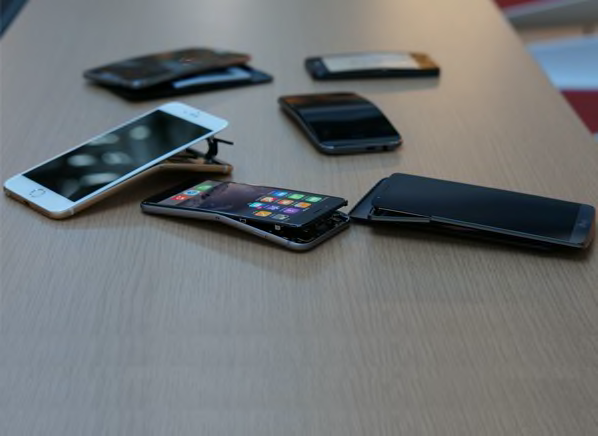
iPhone 6 And 6 Plus Bend Test - Consumer Reports News
Exclusive Consumer Reports test results show new iPhones are tough and not as bendy as rumored.
consumerreports.org
229 points · by eglover · 12y ago · 175 comments
Bending is a result of moments and moments are driven by moment arms. These tests should not be looking at point load required to induce deformation but rather the moment required to induce deformation. Each of these should have been converted into equivalent moments based on the size of the phone.
For example, the M8 is shown as 146.3 mm (5.76 in) H; 70.6 mm (2.78 in) W; 9.4 mm (0.37 in) D and the iPhone 6 is 138.1 x 67 x 6.9 mm (5.44 x 2.64 x 0.27 in) and both are shown to "deform" at 70 lbs.
The M8 has an induced moment of 100 lb-in while the iPhone 6 has an induced moment of 95 lb-in. The resultant bending stress by assuming a linear stress distribution across the section is then 1575 psi for the M8 and 2950 psi for the iPhone 6.
Similar analyses should be undertaken for each of the other phones.
A more accurate test for the failure mode of concern would be a four point load test in which moment is constant across a portion of the phone. The three point load test induces a moment that is maximum at the point of load application. The four point load test is more likely to show you where the point of weakness in the phone is.
The point of my response is that the test performed does not test against the complaint, it is a manipulation of the data (either through ignorance or malice) that presents data that may not truly imply the conclusion drawn by the article.
Phones are composed of many different materials of many different sizes and shapes at different points through its cross section. When looking for a "yield force" or "rupture force," as this article does, the three point test is effective ONLY for materials which are constant along the entirety of the test section or for parts where the loading condition is replicated exactly. When the loading condition may be unknown or the sectional properties may vary along the length of the phone then the four point test is more appropriate as it will show you the bending moment that is required to induce yield/rupture and, more importantly, it will show you WHERE that point is.
Most people elsewhere in this thread note that the point of weakness appears to be at the volume buttons on this phone. The three point bending test where the phone is loaded in the center may or may not reveal this, but a proper four point bending test would. Proper analysis of the testing method, reported failure modes, and the testing data would reveal this.
I also take a little exception with the "70 lbs is what it takes to break four pencils" demonstration they do as it is misleading and not informational at all. Four pencils loaded with 70 lbs at what point? What is the geometry of the four pencils? Is it 2x2 square or 4x1 rectangular? Which direction is it loaded?
The whole article stinks of pseudo-science which is what you get when you have journalists conducting tests without consulting with a proper expert in the field.
The article notes that the three point test is the "standard" that Apple uses for this type of test as if it somehow makes that the appropriate test for this type of analysis. It does not.
http://www.instron.us/wa/acc_catalog/prod_list.aspx?cid=833&...
http://www.instron.us/wa/applications/test_types/flexure/con...
---
My attempt at a "for dummies" summary of the issue here:
If you look carefully, the Consumer Reports tests involve placing end supports roughly 1/4" from either edge of each phone. Basically, all the phones are different sizes and thus have varying amounts of material and torque being applied between the supports and the part of the machine pressing down. A particularly long phone which yields at 70lb of force has actually performed better than a stubby one which yields at 70lb in this case. Hopefully I didn't just say anything too wrong or confusing, because I'm not going to notice until the morning...
I don't know what the stresses applied to a phone in a pocket actually look like, but it's not obvious to me that measuring force rather than torque is unfair.
https://www.youtube.com/watch?v=gJ3Ds6uf0Yg&feature=youtu.be
With this type of test, it may have been able to show if the volume or SIM card slots create structure weak points.
Ugh. What's that in microtonne-millileagues?
tl;dr the point it's not the fact that it's metric, but that it's decimal.
I am sure that Apple will not let this issue just stand, although they will definitely work to minimize and downplay it publically, and a few months from now the next batch of iphones will have been stiffened and will be much better. One of the risks of being an early adopter and if you can hold off for a bit I'm sure you'll get a stronger phone.
Placing the phone between two flat blocks and applying pressure at the exact center (three-point-test) will NOT test for this specific issue.
Even then it should be pretty suspicious that in the test conducted, the new phones are at the bottom of the stiffness list.
On another front, the Apple response is textbook - Deny, Minimize, (deride the press), then grudgingly make changes even while insisting that none were needed to begin with. Expect the next lot of these phones to experience a sudden stiffening.
All 10,000,000 won't dare to test the bending and would try to avoid conditions (don't keep in pockets, buy thicker cases etc) that will lead to bending..
Moreover, the rate of things like phone bending is probably non-linear, because it will happen during the highest amount of applied bending force over the period of use, which probably doesn't happen every day. If the iPhone 6 plus is just enough weaker than other phones such that it bends more commonly under fairly common handling conditions for any phone then the result could be a LOT of bent phones.
I've seen several videos of people bending these phones and to be honest it looks like Apple has a problem. The phone seems to be much weaker than any device designed for that use environment should be.
Considering that Jobs went to great efforts to ensure that the original iPhone was rugged under normal but inadvised handling conditions (i.e. putting it in the same pocket as keys, thus the use of gorrila glass), I can't help but see this bendiness as a decided step backwards in the design philosophy of the iPhone line.
Yes and... that was correct? Every other phone suffers from the same antenna attenuation if you enclose it completely in your hands. But because it's Apple, some news outlets saw a chance to make some pageviews by creating another scandal.
The "antennagate" crap was roughly equivalent to people complaining that a TV won't show any image at all if you set it up facing the wall, and writing lots of grandiose articles about how Apple TV doesn't deliver on its promise in all sorts of common circumstances, etc.
Is it a coincidence that the silicon cases for the 6 /6+ are stiff and fully wrap the back vs the bumper design they used for previous generations?
There are enough actual things here to criticize Apple for. No need to create conspiracy theories
  Phone	                 Deformation	Case Separation
  -----------------------------------------------------
  HTC One (M8)	         70 lbs.	90 lbs.
  Apple iPhone 6	 70 lbs.	100 lbs.
  Apple iPhone 6 Plus	 90 lbs.	110 lbs.
  LG G3	                 130 lbs.	130 lbs.
  Apple iPhone 5	 130 lbs.	150 lbs.
  Samsung Galaxy Note 3	 150 lbs.	150 lbs.
Secondly, they applied that force for 30 seconds and got significant deformation. I'm fairly sure that, given more time, they'd reach the less significant deformation reported and shown by others, with less force.
However just playing devil's advocate: 9 returns to Apple (assuming that figure is true) is absolutely trivial relative to the units shipped.
I think it will be interesting to see where we stand in 6 months time. Will we see tons more phones return?
Non-ECC memory is more likely to get corrupted than ECC memory, but that doesn't mean that every single person who uses a computing device should be using ECC memory. Just because one thing is quantifiably less robust than something else is meaningless without a concept of "how robust does it need to be?"
Obviously the company thinks the phones have sufficient tolerances. A few people on the Internet have posted firsthand accounts that they think proves that the phones are inadequate. A much larger group of people on the Internet who don't like the company that makes the phones practically salivate over these sorts of events, and have been making sure that absolutely everyone who reads any tech forums is HIGHLY AWARE that this is a very important thing that we should all know and care about very, very deeply. Journalists of course will write about this stuff because many of them interpret their job as writing about whatever people are talking about.
Which brings us to the present, in which the only truth that anyone can point to is: no one actually knows if this is actually a problem or not. The only way to answer that question is to wait and see how many returns there are due to breakage. For people who care about truth, well, that's the truth, boring as it may be. In a few months we'll find out if a big company might make less money because somebody should've used a bigger number on a spreadsheet. Exciting! On the other hand, for people who care about arguing about things on the Internet, well, to hell with them, honestly.
   WE'RE SORRY
   You need to update your Flash Player
Morons.
From specs to hardware build the iPhone 6 just seems really behind the curve and very "blah".
The iPhone 5 was definitely a class leading phone in the hand before this test, feeling like a beautiful instrument. This test is proving it too is a fantastically put together device from a durability POV.
The 6 is very ho hum and I'm adding this to my list of ho hum things about it. It's not a bad phone, but not a great, class leading one in any way either.
I never really thought I'd see the day that a Korean phone designed by a completely anonymous corporate industrial design drone really beat the socks off of Apple's offering, and yet it appears to have happened this year.
All that being said, #bendgate is seriously overblown, just like antenna-gate. This is most likely a desire to hit Apple where it hurts the most, image, in order to extract free stuff/lower price/whatever like what happened last time with antenna-gate.
Obviously people see what they want to see, but: http://www.anandtech.com/show/8559/iphone-6-and-iphone-6-plu...
I'm glad to see it's doing well in the javascript benchmarks at least. Speaks highly of Apple's nitro engine.
(If anyone from Apple reads this don't let store Managers abuse their position; you lose sales, and employee store moral goes out the window. You can guess which store it is from my name. Don't take my version of the story. Verify the incident with other employees, I don't think anyone would forget--it happened feb 1, 2013, and "The Manager" was Greg?)
And yes, virtually any corporation works somewhat like an army unit. Nothing strange about that.
They were set on allowing people to believe that a structural defect is only available for out of warranty service until the issue got enough attention.
(of course, under normal usage it's very unlikely that a modern battery will swell, but it's not impossible)
If you look at most of the user damage photos the phone bends towards the top end where the button cut-outs weaken it. The phone did fail around the buttons as well but it's still bent in the middle from the tests. It appears their setup didn't stress it where the problems are occurring.
My estimation would be if you placed a load equidistant between the top of the phone and the middle, stressing the buttons area specifically, you would see a large difference in performance between models. The pocket issue seems to be "bending over" the top of the phone, not applying point loads across the length of the body.
The iPhone6 has a weak spot for torque at about 1/3 of the way from the top where there are some buttons. This test didn't stress that as aggressively as it could have. I suspect that it would perform 20-30% worse if you loaded it at the weak point.
The real issue here is that the phone both grew in length and was reduced in strength at the same time. That means that actions which previously didn't approach the elastic deformation limit of the phone now are. No change in behavior => change in result especially one with negative outcomes is going to get people riled up.
This whole thing is stupid. I have an iPhone 6 and it just barely fit comfortably in my front pocket. If it's just a bit off I find it awkward and uncomfortable.
I would love to see tests involving the real people who are bending their phones in their pockets. a) to measure the forces in their pockets and b) to see how they can stand that sort of discomfort.
Edit: I'll be specific. When I am standing the phone fits fine in my jeans. It's not great when I try and sit. In some positions it's ok. But in my head I was implying that if it's uncomfortable, I take it out of my pocket. The 6 is definitely the limit of any phone I'd buy.
With regard to a weak point, the phone would bend there first in these tests if such a thing existed. That's how weak points work.
For him, it's uncomfortable to put his iPhone 6 in his pockets, and he wonders how much discomfort people are putting up with that is causing their phone to bend in their pockets.
Or at least thats how I understood it.
My wife and I stopped in the Apple store today, and she saw the 6 and 6+ for the first time. She has a 4s (4.5") vs the iP6 @ 5.4" is quite large by comparison. "Nope, too big. I want the same size as mine but that thin" was all she had to say about it. It's a bit sad that her 4s is starting to show its age, and instead of a 6 she's likely get a 5s instead.
I think a lot of people are wishing for a 5-sized 6. I'm hoping my 5 will last two more years and that Apple will have a new release by then that's < 5".
And while the iphone 6 bend video on youtube has almost 40 million hits now, the unbox therapy user who uploaded it hits less than 500.000 views on average for their other videos. I'm willing to believe that 40 million views on youtube can be monitized to pay for more than an iphone 6, but I'm not so sure about the 2-300k, so it seems like quite the investment to go around breaking phones.
If an ad plays on 1/10 videos, and each ad makes the person 0.1 cent its still (30 million * 0.1 * 0.1) / 100 = 3 thousand dollars. Now take into account the added subscribers this adds which will make all future videos more profitable, and that I'm probably underestimating ad revenue, it is worth it.
If you compare the thickness of the material in an iPhone 5 vs 6 casing, I'd bet on the latter being somewhat thinner. If that picture of the iPhone 5 is after 150lbs were applied to it, I don't see much "case separation", only a slight bend. It could probably take a bit more force before something catastrophic happened. So it is possible that those used to the robustness of an iPhone 5 are the ones bending their new iPhone 6s.
It would be a much more time consuming, expensive and complex test, but I think I'd trust the results much more than what I'm seeing here.
Correct me if I am wrong, but I think most people place the phone with the screen in, so that it would bend toward the screen not away from it. The results could be significantly different in that direction, especially since the major mode of failure was the screen separating from the case.
The phones most resistent to bending in their length axis have back sides that are curved. That makes the backside contribute to the strength of the phone in the bending direction. Flat backsides will bend easily, so the relatively tiny vertical sides (and any ribs inside the phone, but those are rare due to lack of room) are the main parts contributing to strength. That's why the iPhone's weakest point is near a slot in those sides.
Reminds me of https://en.wikipedia.org/wiki/Seattle_Windshield_Pitting_Epi...
He focuses the force on the lateral side of the iPhone in order to bend it.
This is probably not very representative of having your phone in your pocket as Apple says but makes for an impressive video that gives you views(and money).
Anecdotaly I also seen it first hand.
Confirms that the new iPhones are much bendier than the old ones.
But seriously they didn't do the test properly. https://www.youtube.com/watch?v=gJ3Ds6uf0Yg
I killed four phones to date simply by accidentally sitting down on them.
(unboxing Z3 under water)
Not until now has putting a phone in your back pocket been "crazy." I recently upgraded from the iPhone 4 (which I had for 3 years) to the 6, and for the life time of iPhone 4 I've sat on it for extended hours and had it my back pocket. I currently do the same with the 6.
What I really think has happened here is this whole thing is being blown out of proportion because 1.) its Apple and 2.) they moved 10M units in a weekend (if they had 1% defect rate, thats 100,000 angry tweets, status, youtube videos and blog posts).
FWIW the only videos I've seen of the phone actually bending are the non-measured ones when someone applies an inane amount of force with their hands trying to destroy the thing (with an Li-On battery inside!)
There have been other situations where I have unconsciously put my phones through pretty intense pressure, not realizing it was under me where I sit down or sleeping with it and it getting stuck in between mattresses/cushions/pillows whatever (although for other reasons I have been trying to not go to sleep with my phone anymore, leaving it plugged in somewhere else).
I think it implies being stuffed in pockets and left in the car (barring perhaps the most extreme climates), and perhaps certain types of drops, but not being sat on.
Stop sitting on your phone. Would you put your laptop of the edge of a chair and sit on it?
Uh.
Don't sit on them? Who does this?