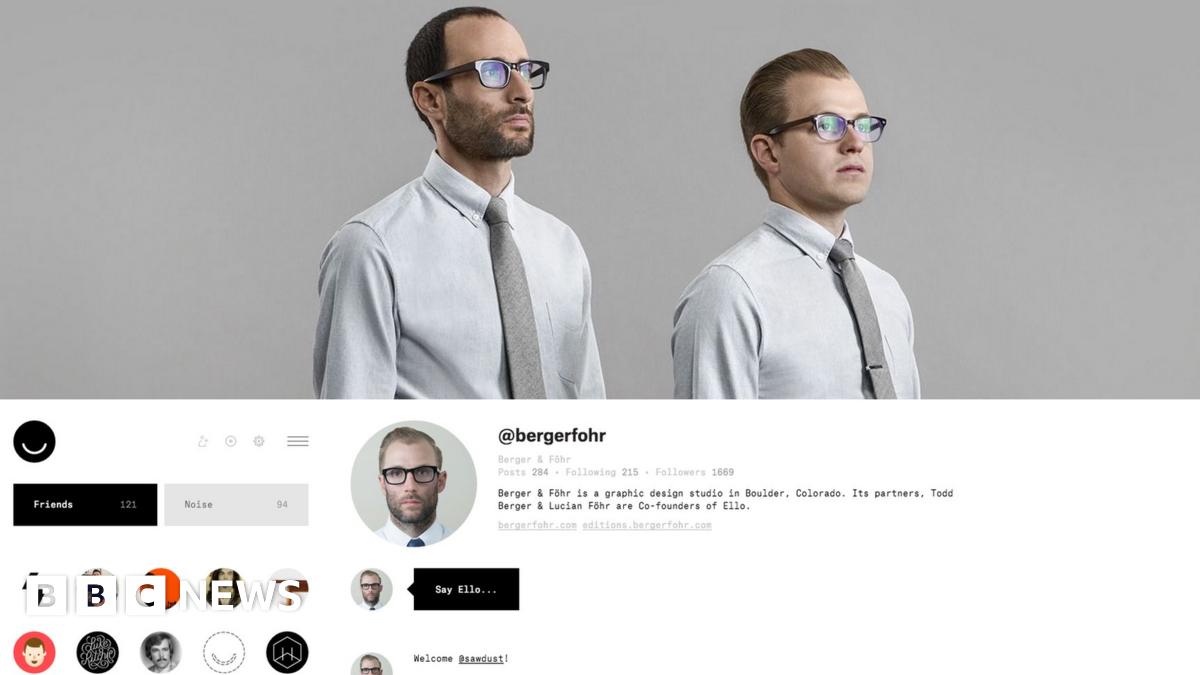
'Anti-Facebook' platform Ello attracts thousands
Ad-free social media platform Ello overcomes a technical setback to continue its rapid growth, but one expert questions its business model.
BBC News
50 points · by petethomas · 12y ago · 76 comments
Diaspora had the right philosophy.
1) So much dead real estate.
2) The buttons the same as input fields. Only difference is color but there's no distinguishing otherwise.
3) Strange choice of font. Seems like they're going for a typewriter feel, but I'm not sure how that's useful for a website. My opinion of course, but I don't really see the aesthetic appeal of a typewriter look here.
The real problem I see with Ello from a business perspective is that they don't have one. Where's the business? You're not selling ads, you're not selling your users information, they aren't buying anything (and won't) - where will the money come from?
>> It has been dubbed the "anti-Facebook" network because of a pledge to carry no adverts or sell user data.
I need more than a pledge to start believing in a VC-backed startup.
If you want to keep something private, don't post it on a social networking site.
Most of the users profiles I have clicked on seem pretty boring. I fail to see what is so attractive about it.
I definitely am taking the owners claim of "31,000 requests an hour" with a grain of salt.
Honestly, does the average person even care about being advertised to, or having their data mined? I have never heard anyone outside of tech circles even talk about it.
1. It's beautiful, which they had to add because they knew just saying "we won't sell your data" would not go far enough. They needed that extra edge. In my humble opinion, it's actually quite ugly, so I find it pretty funny they are advertising this as a selling point.
2. They don't sell your data. We all know this is flawed because there is no promise this won't happen in the future, and to boot MOST normal people do not care about this.
Their initial launch had the right elements that allowed it to go viral and non-technical people started signing up. I would LOVE to see some stats from the Ello team around retention, as I am willing to bet a large sum of money that stat is really bad.
As for what's attractive about it: it's not Facebook. People are ready for something different. I noticed more and more people talking about time spent on Facebook the way they talk about time watching bad TV or eating junk food ... plus, in my experience, most people really do find Facebook's ads irritating. Plus for a chunk of people, the "real names" issue is a big deal; and this follows the stuff about Facebook's emotional manipulation experiments.
Of course that doesn't mean that Ello's the answer to what people are hoping for; it's too early to tell how successful it will be. But I certainly believe they were getting 31,000 requests for invites an hour. Even if they were at level for 3 days straight at that level is only 2 million people -- a tiny portion of Facebook's english-speaking population.
A lot of bits are breaking, falling off, getting fixed, and getting added, so it's rather much in flux.
The clue factor is high, though one of my first observations is that one of the adventures of new discussion sites is rediscovering all the people you'd found annoying elsewhere and blocked.
It shines in some areas, lacks in others, the privacy, ads, and funding questions are very much open, but I think it's got a good start.
Just have a look at Google+, millions of people gave that a try but in the end only a very limited number of those formed enough connections to justify primarily sharing things on there.
The question then really is, if there is enough of these niche groups that will provide enough user retention to make the economics work. There has been plenty of things written regarding app development and the difficulties in supporting recurring costs with one time fees. I suspect you would need a pretty significant userbase to support even a small team on cheap one time feature purchases.
But I do know a bunch of people who value their privacy. They just don't know what they can do about it.
It's a nice idea but no for-profit has figured it out yet. Diaspora accomplishes it but lacks the most valuable asset a social network could have, which is a large userbase.
In fact, I suspect the "31,000 invites" was the result of one post on the Facebook group involving an exploit that used dictionary attacks to generate invites for someone's account, which was quickly used by several people, but eventually taken down, and is not their average traffic.
I suspect this because my personal opinion, my friends' opinions, and it appears quite a number of Hacker News peoples opinions, while anecdotal, seem to indicate that Ello is quite lackluster, and I find it hard to believe that many people would want to try a social media platform that:
a) has none of their friends on it yet
b) doesn't look great
c) appeals to you through things you typically don't care about ("ads", "data", "privacy")
What does it really cost to run a social network? $5/user/month? $1/user/month? If you could put it on your phone bill, would you notice?
As for "The fact is nobody has ever made a significant move away from any internet provider because of advertising or data", remember Myspace. They were #1 once. Their ad density got too high and people got fed up and left.
More than ${what parents will let their kid spend on the Internet}, which is usually > $0. The problem with non-free Internet is that it quickly gets inaccessible to those without credit cards.
Exactly! It's actually a lie that it's free in the first place: https://news.ycombinator.com/item?id=8372640
However is impressive to me how much exposure ello is getting every day, don't get me wrong but right now I can't see why. Feel free to tell me that's I'm wrong, I'm really interested.
I wish them all the best but more importantly that this "hype" will last
So... what if some of my "connecting" and "creating" is viewed by some as deception or coercion? Eye of the beholder and all that...
Certainly FB is a lot of data mining to sell ads, but I also see plenty of people connecting with family, creating groups and communities and communicating and growing... and they didn't need some monospaced hipsterific platform to do it.
The latest trends in advertising has moved beyond 'behavioral' targeted advertising, where a user is served specific content because they may have browsed something similar in the past.
The new trend is to use social networking models to discover 'influencers' in social groups and use those people's reputations to recommend products to other people. The diagrams (a) and (b) on page nine of the following research paper is a crude example: http://arxiv.org/pdf/1206.4327v1.pdf
Lindex 'Enterprise SEO Software' has this to say: "Our latest innovation Linkdex Networks enables you to visualise and analyse these groups of relevant influencers. The objective is to enable digital marketers to gradually identify the right personalities and build relationships with them, spreading along those networks for maximum exposure. If someone within your network has lots of relationships pointing to them you know that they are perceived as trustworthy sources. The aim is to find influencers who are passionate on a niche topic, have strong relationships with the group and are receptive to new ideas with plenty of reach." [1]
It's on fire everywhere in marketing and advertising and there are lots of variations being tried and tested at the moment, and also publicly funded research at universities [2]. Marketers will drop prices online when they detect influencers, in an attempt to encourage them to speak highly of their product to their friends and family (who will need to buy at full price). The Marketing Science Institute has a whole section dedicated to social networks and influencing them [3][4].
Just searching for the term "social contagion advertising" or "advertising influencers" reveals media research arms with nifty tables that map out ways of influencing social groups by targeting information strategically at certain members. For example you can get people to change their view of the "legitimacy of an item" by "encourag[ing] influential targets to adopt the item" or create the idea of a "status disadvantage of not adopting" by "Emphasiz[ing] activities of close connections in a social network to influence behavior". [5]
Perhaps a side note, but the DoD "MINERVA initiative" [6] studies social contagion strategies to track, create or lessen political instability in other countries (although the initiative studies a lot of other things too). The USAID Cuban Twitter project sought to (and nearly succeeded in) creating mass unrest by appearing to be a grassroots movement on Twitter in Cuba seeking the overthrow of the government. Snowden documents and leaked HB Gary memos show that both the NSA and GCHQ engage in astroturfing and social media manipulation [7][8][9]. The giant meta-data graph created by the NSA is also particularly valuable for 'influencer' and 'social contagion' analysis (leaks showed they do use it to understand internal chain-of-command and organization structure for target selection). You can bet - although direct proof is forthcoming - that other countries have these capabilities, or analogues to them, for targetting American and NATO news and social feeds.
These sorts of forces are abound on social media websites, as can be seen in the recent Wired article "I liked everything I saw on Facebook for two days" [10]. What's more, the role that social media has begun to play in political races is incredible. If you have the time and interest, look up the capabilities of incumbent Obama's "The Cave" for social media evangelism and tracking. Real time social estimates of support across dozens of major social media platforms with the ability to influence and target any of them at will. Interns scrambling to be "first to post" on online discussions in news media articles.
To be a member of online social media is to be surveilled by both governments and by corporations, to have your content curated for financial purposes, and to have your information sold to the highest bidder. It is also to be influenced not just by direct advertisement, but also indirectly through information that gets carried word of mouth. On the internet nobody knows that you are a dog. This is often an inconvenience and it allows trolls and other unsavory social behavior. Unfortunately it is now also true that on social media, those with the right perspective - those that can see social media at the thousand foot view - not only know that you are a dog, but also know how to make you drool when they ring a bell.
[1] http://www.linkdex.com/blog/social-contagion-why-ideas-and-p...
[2] http://icos.umich.edu/sites/icos6.cms.si.umich.edu/files/lec...
[3] http://www.msi.org/reports/distinguishing-among-mechanisms-o...
[4] http://www.msi.org/articles/what-drives-social-contagion-in-...
[5] http://socialmediaandmobileresearch.com/2014/03/10/social-co...
[7] https://firstlook.org/theintercept/2014/02/24/jtrig-manipula...
[8] http://www.theguardian.com/commentisfree/cifamerica/2011/jun...
[9] http://www.dailykos.com/story/2011/02/16/945768/-UPDATED-The...
[10] http://www.wired.com/2014/08/i-liked-everything-i-saw-on-fac...
Addendum: Another trend in advertizing is 'contextual advertizing' where ads are injected into articles in ways that make them look like they are part of the content you intended to read. From the invention of 'viral marketing' to the rise of the corporate news (http://tinyurl.com/k28ssjh), to be on a social network and to be online is to be subject to the forces of private interests.
What Ello is saying is that they want to sell the service directly to the customer instead of selling the user's data to these private forces.
Your post reminded me of an excellent passage from Yvain's recent post[0] (it's long, but it is a goldmine).
The point is – imagine a country full of bioweapon labs, where people toil day and night to invent new infectious agents. The existence of these labs, and their right to throw whatever they develop in the water supply is protected by law. And the country is also linked by the world’s most perfect mass transit system that every single person uses every day, so that any new pathogen can spread to the entire country instantaneously. You’d expect things to start going bad for that city pretty quickly.
Well, we have about a zillion think tanks researching new and better forms of propaganda. And we have constitutionally protected freedom of speech. And we have the Internet. So we’re pretty much screwed.
[0] - http://slatestarcodex.com/2014/07/30/meditations-on-moloch/
No, because the human immune system can learn to defend against propaganda. Many of the unfair advantages of propaganda arise from nominal invisibility when masquerading as healthy sensory input.
Take away that cover and it's much cheaper to audit and firewall hostile media, using exactly the same epidimiological and social network analysis techniques that can spread parasites and propaganda. The technology works in both directions, see Palantir and http://www.insna.org/socnet.html
If it achieves geopolitical policy goals or helps the bottom line, why wouldn't you?
[1] http://en.wikipedia.org/wiki/Asch_conformity_experiments
For me, until that changes, social media primarily exists as a personal communication mechanism via messages. In that case the network effect dominates all other features.
And here was me thinking that to be successful now you needed a somewhat original idea or a flawless execution, shows what I know I guess.
I had to search to find out it's ello.co Average user won't bother.
Honestly, their copy feels like written by WhatsApp wannabes that got wind of some tech crowd clichés.
Also a compelling story and userbase. There are people on Ello who aren't on Diaspora (I'm on both) despite the latter having been around for quite a while now.
Both lack search, which ... kind of sucks.
What would be really cool is if Ello might figure out a way to talk with Diaspora, essentially becoming a large node of it (or Friendica, or whatever).