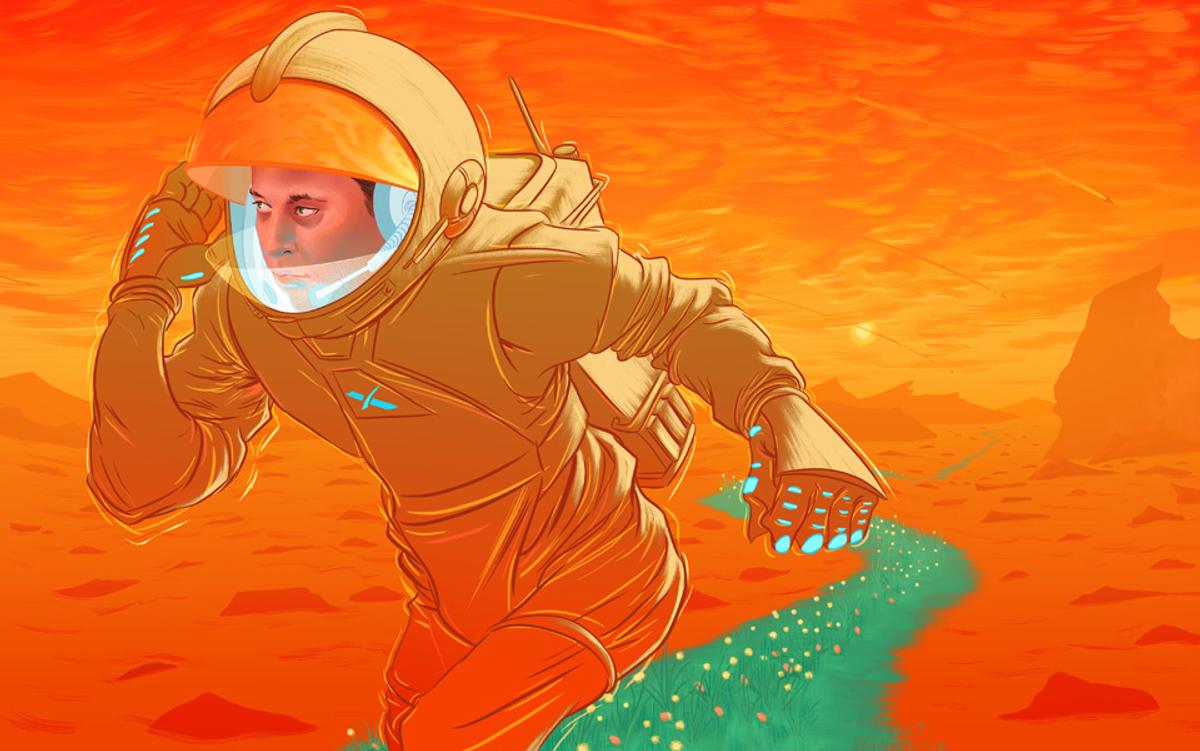
Elon Musk puts his case for a multi-planet civilisation | Aeon Essays
Elon Musk argues that we must put a million people on Mars if we are to ensure that humanity has a future
aeon.co
322 points · by todayiamme · 12y ago · 347 comments
I never see plans to get around this with real-world technology — it's always just hand-waved as something we'll figure out. But it seems like the "letting people live natural lives under utterly inhospitable conditions" part has a lot more to do with ensuring humanity's survival than the Mars part.
Because they don't want to live on underwater cities on Earth. They want to live on Mars.
You'll need to find a way entice doctors, farmers, miners, and other specialized professions to leave everything behind and consign themselves to death on a dark and barren rock. Historically, colonists have been motivated to such lengths for religious and political reasons. For example, perhaps libertarians will flock to Mars for freedom from oppressive governments. (Hey Bioshock developers: hint hint.)
http://shitelonsays.com/transcript/elon-musk-and-the-giving-...
I also have zero interest in an underwater city.
That said, if we do follow your advice, we'll likely learn a lot in the process that can help us get to Mars.
I'm not arguing for underwater cities or against going to Mars. I'm just saying that the cost and effort of getting everything to Mars is the easy part, and is not the part that will actually ensure humanity's survival.
Exactly right, how this escapes people I am unsure. The absolute worst climate predictions, asteroid impacts or seismic events wouldn't be nearly as hard to recover from than trying to get to and then live for a single day on Mars.
Also while Mars does get crazy cold -225'F it can also get up to a nice 70'F at noon. The deep ocean is 0-3'F with not much fluctuation. Of course we could engineer some water cycling around the cities to bring cold up and warm down.
The other psychological choice to make is, "Would you prefer to live in a dwelling surrounded by almost no atmospheric pressure, or intensely high atmospheric pressure?"
The major threat of climate change is not to things so expansive as atmospheric viability, but only to present geography and weather cycles. There will still be breathable oxygen in the atmosphere, there will still be water, animals, and vegetation on the surface. As dystopic as a post-climate-change world may look, it undoubtedly looks better than Mars.
This is probably even true after massive nuclear winters, etc. I don't think there's anything humans can do that would so disadvantage Earth as to make another planet in our solar system better suited to human life. The only thing that may require external planetary colonization would be an extinction-scale geological or astronomical event (i.e., something totally outside of human control).
Here's a thought, C3 plant life goes extinct if CO2 falls below ~200ppm. No more rice, no more wheat, no more potatoes, no more evergreen trees. Life on earth would probably suffer a good deal more in the long run (in geological terms) if we left all fossilized carbon in the ground.
In the near term, it's going to cause tremendous dislocation of human civilizations. In poorer areas, climate change will cause millions to die and tens of millions to suffer. That's the undeniable moral component.
Ecologically, climate change will hasten the mass extinction of species. A world covered in kudzo, algae, and roaches is technically "teeming with life", but I'm not sure it's the aesthetic vision you have in mind.
Or you know, the boundless vast uninhabited deserts that cover the world.
And, really, there are plenty of inhospitible places on Earth surface where people are already living.
Why don't we spend time working out how to lift people from garbage picking for example?
Nobody is going to spend billions to live in cities underwater. Simply, nobody wants to live underwater, or pay for it, or there is enough to be gained from that (we hurt the oceans enough already with fishing and others). And the eventual possible gain of maybe applicable useful knowledge is not enough to warrant the inversion.
It would be cool, though.
I can't believe I'm still hearing "sun isn't going to last forever" and "us" juxtaposed, as though one had any bearing on the other.
1. Humans have existed as a distinct species for about 200,000 years.
2. Given the process of natural selection, in another 200,000 years we will have been replaced by something different than us -- not necessarily bigger or smaller, smarter or dumber, just different.
3. In a million years, there will be nothing remotely resembling human beings -- it will be as though we had never existed. But let's argue that there's some hint of us after a million years:
4. The sun will become a red giant and envelop the earth in somewhere north of five billion years, which is five thousand times longer than we can possibly exist as an identifiably distinct species, using the optimistic forecast of item (4) above.
We need to have some perspective about our relationship with nature. Evolution teaches us that we're not at all exceptional, but are a random answer to nature's constantly changing question, which is "who is fit today?"
This idea that we're somehow ordained inheritors of the planet, is to me a 21st century leftover of the religious outlook, which is that humans aren't just another species, competing in an open-ended contest with no entry requirements or registration fees.
Here today, gone tomorrow. We're not special, and life is not an ordained right, but a gift. I intend to appreciate my unearned gift. How about you?
No, that's wrong. Humans, genus Homo, have existed for about 2.5 million years; the subspecies H. sapiens sapiens for about 200,000. The species H. sapiens is a little less clear, there's debate over whether it starts around 200,000 years ago (and includes just a few subspecies, notably H. sapiens sapiens and H. sapiens idaltu) or whether it starts around 500,000 years ago and includes several others.
> 2. Given the process of natural selection, in another 200,000 years we will have been replaced by something different than us -- not necessarily bigger or smaller, smarter or dumber, just different.
Unlikely; while speciation requires time, time alone is not generally enough, and even if it were, there is no reason to expect the time from the last speciation event to now (whether 500,000 years or 200,000) to be the time from now to the next speciation event.
(Colonization of Mars -- if Earth-Mars interaction is limited once the colony is established -- might actually accelerate that, since the one thing that does contribute to speciation is geographical separation which prevents significant interbreeding between segments of the wider population.)
> 3. In a million years, there will be nothing remotely resembling human beings -- it will be as though we had never existed.
Human beings, genus Homo, have been around for two and half million years already, and H. sapiens (whether you take the narrower or broader view of the species) would be a flash-in-the-pan as species of its size, lifespan, and geographic range are concerned if it wasn't around for several million more (H. erectus -- with competing members of the genus Homo around on Earth for pretty much its whole time of existence -- lasted about 1.75 million years), and things "remotely resembling human beings" have been around significantly longer -- and can be expected to be around significantly longer than humans in the strict sense, unless humans are wiped out completely in a cataclysm rather than subjected to the kind of pressures that produce speciation.
> The sun will become a red giant and envelop the earth in somewhere north of five billion years, which is five thousand times longer than we can possibly exist as an identifiably distinct species, using the optimistic forecast of item (4) above.
The million year forecast isn't "optimistic"; while it may be unlikely that human beings would be around for 5 billion years, your particular argument for that point is, well, based on one controversial claim and a couple of unjustified claims that don't follow from that controversial claim.
In the very, very long run, who knows.
But int the timescale of tens or even hundreds of thousands of years I don't think there will be any natural selection process that will apply to the current status of humanity as a species, unless for some reason civilization will fall and humans are scattered throughout the globe.
We've pretty much stopped evolving as a species through natural selection events. There's not much of that happening in the homogenized urban setting where the majority of people live, and will live for the foreseeable future.
Actually, having the current civilization as a substrate for the species does change the playing field considerably from what it was a few thousand years ago.
As for biodiversity creating some sort of 'better adapted species' to take over our position - the sad truth is that biodiversity is in rapid decline, and I don't know when it will stop. We are not killing the planet per se, only... homogenizing it and making it fit for humans.
In a million years, sure, who knows what will happen. But in the current mass extinction event - if we can feed the the human species it's very difficult for me to imagine anything will replace us when the timescale is only the current estimated age of the species.
Prepare to be rickrolled for the next 100k years. Or maybe we will move into some dense compute substrate made of exotic materials.
Humanity isn't that special and I'm sure intelligent life would arise again without us, but now that Earth has developed fungi that can digest cellulose Earth is never going to have this much fossil fuel sitting around again. Maybe that doesn't matter and humanity or some other species will colonize space anyways... but maybe it does.
In the very long run we're doomed anyway http://en.wikipedia.org/wiki/Heat_death_of_the_universe
(completely unrelated, but I'm getting tired of creating throwaway accounts on this site each time I want to post a new comment - why oh why is anonymous commenting disabled ?)
Honestly, are you really going to be disappointed if, after a few billion years, humanity runs out of gas? We'd have done be the most successful species in the history of species.
What? Humanity will have entirely disappeared in a million years, and in a billion years we won't even be a distant memory.
Please try to remember that we've only been a distinct species for 200,000 years, and in another 200,000 years, chances are we will have been replaced by something different. In a million years, five times as long, we will not exist in any form whatsoever. In a billion years, five thousand times as long, creatures who have forgotten about us will themselves be forgotten.
It is the height of absurdity to think that a lowly species like us will exist in any form at all even a million years hence. Both us, and all our stellar achievements (like Country & Western music and the Pet Rock), will have completely disappeared.
Did the words "tomorrow", "next week", "next year" not suit your argument? It's wilderness from the centre of the Earth all the way out - myriad accidents waiting to happen.
"I don't really think that worrying about the Earth dying anytime soon is much of problem"
You've not based that on anything. It's also ignoring the word "ensure", the longer we sit idly by, the less sure we can be.
"If we can't in a million years develop technology to survive we won't be able to do it in the next 50 years."
Obviously, but what's a million years got to do with anything?
As an alternative to possibly engendering environmental apathy, imagine a scenario akin to the Cold War, except that one of the superpowers has a million citizens on Mars, and the other doesn't. Does MAD still apply, or does the interplanetary superpower suddenly becoming all the more willing to watch the world burn?
Are you personally currently environmentally apathetic because you know somewhere there are some unspoiled mountain lakes that are still hardly touched by the hand of man?
Are you personally unconcerned about the possibility of your home being nuked because thank goodness Alaska will probably survive?
You hypothesize a very bizarrely precise self-interest that very suddenly gives way to complete wild suicidal abandon at a very precise point. I'm not at all convinced what you've ordered up here can exist.
There is a pretty clear body of evidence that humans do not expend resources on something they don't value. And the question of whether or not the value of the planet would change with the expansion into space is a reasonable one to ask.
I believe what is posited is not precise self-interest so much as a reevaluation of risk and its concomitant change to the cost of failure.
As an example, one might speed down the highway with a perception of low risk of being caught, but that behavior might change if a sign appeared that said "speed limit enforcers are on duty." So in the presence of the new information a re-evaluation of the risk of being cited is undertaken and behavior may (or may not) change.
The question posed is whether or not the value calculus that currently drives the environmental and military engagement thinking of the world today, would be altered by the existence of a stable 'somewhere else'. That is a general question and not one that turns on precise self interest.
I do not believe such a settlement would change the value equation, as it would not apply to a large enough fraction of the current residents to change the calculus. Now I also would not expect the prototypical someone who was born and raised on Mars to feel particularly motivated to change what folks on Earth were doing, just as non-Chinese do not feel moved enough to intervene on the actions decided upon by that country's government. They might "care" and have some empathy for the resulting negative outcomes, but they would be insufficiently empowered to actually act.
http://www.nytimes.com/2014/09/25/world/asia/25climate.html?...
Except, we still do care if their water is toxic and if the air conditions are poor. The same sort of empathy will apply to people on other planets as well. Even though a heavily polluted other planet doesn't directly affect us in the same way that a heavily polluted Earth affects us, we are currently pretty well isolated from the extreme conditions in Shanghai and yet we still care what happens there.
Furthermore, because of the large costs of shipping between planets, most of the things causing pollution on one planet is probably benefitting almost exclusively the residents of that planet.
Moral hazard is an interesting concern but I don't think that it's going to end up being a severe problem.
Self-interest isn't going anywhere.
Tons of CO2 emitted per capita:
United States 16.4
China 7.1
https://en.wikipedia.org/wiki/List_of_countries_by_carbon_di...
I feel like China can do a lot more.
  China         1,367,030,000
  United States   318,827,000
They do a lot more, you just saw a piece of the information.
The distinction is important, because coal is seen as a cheap way of feeding China's relentless appetite for growth (or more specifically, the appetite for the perceived advantages brought by this "growth" to those who are in a social or political position to benefit from it.)
No words, just data: http://upload.wikimedia.org/wikipedia/commons/f/f4/Carbon_Mo...
That said, maybe the technology created to sustain a colony on Mars could be used to clean up the messes we've made on Earth.
The weak gravity is the real killer, colonists bones would decay, the calcium would leach into the bloodstream causing serious health issues. Muscles would atrophy. The colonists' sense of balance and motion, evolved to Earth gravity, would be constantly disorienting. Low gravity has a lot of negative health effects.
Mars also has nothing like the Van Allen belt, it's bombarded with radiation that colonists would constantly need to be shielded from.
Mar's atmosphere is poisonous to humans, and has a much lower atmospheric pressure, so colonists would need to have a constant protective bubble protecting them from the world they were on.
Mars hasn't got liquid water. There is water there, but it would require a lot of energy to get it to the point of being usable.
Energy is another issue. Solar energy could provide some energy, though it'd be massively expensive to get enough arrays to support a colony with the required infrastructure. In theory they could create some kind of nuclear energy plant, though the logistics of transporting that to Mars and maintaining it are staggering.
The psychological impact of taking an animal evolved to live in Earth conditions and put them in a completely inhospitable environment deeply dependent on a very complex and expensive infrastructure, with disorienting gravity, health decay, very limited variety in food, and other likely spartan living conditions a Mars colony would be completely hellish for most.
There may be ways to manage these problems, but the millions of dollars spent per colonist to get them there along with the millions spent per colonist to sustain them are a pretty serious impediment. A colony would need to ultimately be economically independent to make it worthwhile. Mars has some resources that might be valuable to Earth, but whether they'd be viable to support a colony needing such an expensive infrastructure to survive isn't a guarantee. Would humanity be willing to pour trillions upon trillions into a Mars experiment in the hope that the experiment might work?
It may, in fact, require more resources for one person to live on mars than one person can produce with our current (or near future) level of technology.
I think just building the energy infrastructure to do energy expensive things like make steel or silicon ingots will be very difficult. Not to mention that there is no source of petroleum on mars, so plastics are going to have to synthesized using other materials. The difficulties are legion once you get down to the details.
Creating new habitable space will be expensive it will be like living in a submarine or an Antarctic base during winter. Forget about having large space for entertainment like a football stadium or a theater. I think that after a few months of that regimen people will start to appreciate more life on good old Earth.
The technical issue is not the matter. It's the sheer amount of resources for which the overwhelming majority of the human race will never see a benefit from in their lifetimes.
Perhaps then we will realise how fortunate we are to have a planet where this is not required and that may cause us to increase our efforts to save earth.
I would agree however that finding a hospitable planet that did not require 'terraforming' would be the death knell for the earth. Mainly because the rich/powerful would see their exit and would happily use all of earths remaining resources to get themselves there even if it was at the cost of most of the rest of the population of earth and earth itself.
Doesn't look like this is available in the solar system. Even the jovian moons MAY be habitable, but living there would certainly not be a pleasure.
Planets around other stars are currently a little hard to reach. Science certainly need more (earth- ) time to get there.
The selection process would be pretty draconian at the start and for quite some time. Can you imagine the protests over genetic and medical screening that would preclude a great many from ever being considered?
Transportation to mars is incredibly expensive. Even with reusable rockets refueling on mars (and that would be quite the accomplishment) it would still be incredible expensive to send 1,000,000 people.
This type of discussion always reminds me of a story Terence Mckenna told (https://www.youtube.com/watch?v=fLikdK8LjmE). To paraphrase, a vine refused to grow onto a branch of a tree in his backyard. One day, while contemplating this unfortunate affair, he witnessed the branch fall off the tree. He realized that the vine 'sensed' the instability. He then thought that the complex ecosystem of Earth might have a similar mechanism and that it might be aware that the Sun will explode at some point in the future, destroying all life. In anticipation for this inevitability, the human race (or another advanced species) was called forth to extend life/consciousness beyond the confides of our eventual death trap.
So why tell this story? What if the destruction of ones home planet is part of the evolutionary process of advanced consciousness? The same way that a fetus must purge itself from the womb or risk death by toxicity. In weird paradoxical way, those that pollute planet Earth might be playing their role as designed.
It's worth noting that I'm 100% for ecologically sound technological advancement and a society that doesn't destroy the environment. But part of me thinks everything is going according to plan, when viewed from a large enough perspective.
The destruction of Earth may be the only way to make humanity successful in the long term - that was the view given in some of Asimov's stories. Or it may just be a way to kill ourselves. The ecosystem as a whole is not an optimized complex system like a vine; it has not been subject to evolutionary pressure. There is no plan; the outcome will be down entirely to luck and our own decisions.
Or do you just get a third superpower less invested in the fate of home planet?
No one born on Mars is going to have any reason to care about what happens on Earth any more than the people of one continent care about the day-to-day life of people on another continent.
  > No one born on Mars is going to have any reason to care
  > about what happens on Earth any more than the people of
  > one continent care about the day-to-day life of people on
  > another continent.
Survival takes precedence over morality and convenience, that much is obvious. People will violate morals in the name of survival.
The question of saving the environment is not a moral question but one of survival. The irony about it all is, if saving the environment is about survival why do people still don't care?
Ask yourself, "If I care about the environment, if I care about my survival, why do I pollute it by driving a car to work every morning?" The answer is deceptively obvious. I direct you to an insightful article by Garrett Hardin describing a phenomenon known as the tragedy of the commons:
If you're interested in fiction along those lines, Kim Stanley Robinson's Mars Trilogy (Red Mars, Blue Mars, Green Mars) seems right up your alley. I'm about half way through the first book, and it's starting to delve into whether or not the distant, Earth-based powers that financed initial settlement have any ability to actually influence or control the resulting Martian population. Environmental concerns are also pretty explicitly considered. Definitely a fun read.
Sure. And that would suck. But that's not an argument against boats. Take the bigger perspective. The universe is bigger than you can ever imagine, on any scale.
"The universe is bigger than you can ever imagine" indeed, and I'm not advocating against space exploration. But humans as a species will never venture beyond the solar system; self-replicating robots designed to withstand 200,000 years of space travel might.
And even with a million people, Mars would be a long way from resupplying or repopulating a major country composed of hundreds of millions of people.
“What if Columbus had been told, ‘Chris, baby, don’t go now. Wait until we’ve solved our number one priorities — war and famine; poverty and crime; pollution and disease; illieracy and racial hatred—and Queen Isabella’s own personal brand of ‘interal security’‘” – W.I.E. Gates
Humans are capable of doing multiple things at once. Some people working on space travel doesn't preclude others from working to slow (can we even reverse at this point) climate change.
Columbus lucked out to have the political will to make his colonies work, mainly via the brutal large-scale warfare against the natives Isabella and others were more than willing to fund, largely to acquire natural resources and for further empire building.
SpaceX doesn't even have the ability to go. Comparing Columbus's low hanging fruit to Mars colonization is pretty unconvincing, especially on the economic front where colonization of the Americas was deeply profitable almost instantly, while Mars would be a welfare state.
Indeed, the main reason Columbus was mocked because his plan was rather extreme on its face (and, despite the fact that he never admitted this, was a complete failure for exactly the reason it was mocked, even though it happened to produce benefits completely unrelated to its intended purpose) because not only the shape but the size of the Earth was well known.
> Columbus lucked out to have the political will to make his colonies work
Columbus lucked out in running into a large land mass well short of his desired goal (which he never admitted that he hadn't reached, which is why the lands of the New World are now commonly known by a name derived from that of an Italian map maker and not their "discoverer".)
Columbus's plan was no less absurd than SpaceX's, and is only seen as successful in retrospect for accomplishments unrelated to its intended purpose.
And our ability to go to Mars isn't imaginary either (even if we haven't sent people).
Also, I've never seen literature claiming the Norse expeditions were very well known. (Not saying that doesn't exists, just that I haven't seen them.) > SpaceX doesn't even have the ability to go. Comparing Columbus's low hanging fruit to Mars colonization is pretty unconvincing, especially on the economic front where colonization of the Americas was deeply profitable almost instantly, while Mars would be a welfare state.
It wasn't know that America would be profitable. Granted it was thought spice trade would be.
The point of the quote is that Europeans chose to take on an expensive exploratory endeavour (with the hope of a profit) even though they had issues at home.
This is misleading, because the early explorers thought they were sailing to India, not to a new world that was unknown at the time. India was certainly regarded as profitable, and was the impetus for the early voyages. BTW this is why native Americans are called "indians".
Is the right time to try colonizing Mars? What would be the chance of success given our current technology level? I think those are very relevant question that needs to be discussed with facts rather than quotes.
Was it that reasonable at the time? Granted no one really thought they'd fall off the edge of the world and we did have long-time-at-sea experience, even if near the shore.
Compared to today: the US has a decent track-record of landing on Mars. We have the tech to do it. We have a decent amount of experience in LEO. What makes a manned-Mars trip more or less absurd than Columbus' first trans-Atlantic voyage?
Is it simply that Columbus hoped to be profitable by sailing to the East and we don't have that same expectation of a Mars mission?
Going for a 10 meter dive isn't a good enough testimony to over a 1km deep dive.
Also, there's nothing special about Europeans. If the explorers had been from China via the eastern region, the scenario would likely have played out the same way. Up until modern times, most warfare was either about power, e.g. preventing a rising rival or conquering a falling power, or extraction, where the goal was to remove as much wealth as possible in as short a period of time as feasible. Given human history, extractive warfare against the native population by militarily superior Eurasian invaders would be the expected outcome.
So no, I doubt the lack of Columbus's voyage would have done more than set back the timetable a bit, or changed the players. Societies in Eurasia just had too much of a biological (germs from city density), technological, and organizational advantage.
That said, what's unique about the Mars colonization idea is that we may have a limited time window in which to try it. Given that our chief sources of energy are non-renewable, we are living in a golden age of cheap production. We haven't so polluted space for Kessler syndrome to lock us in. We even have precociously advanced space technology due to the huge boost from the USA-USSR space race.
Right now we're watching our space programs atrophy. There may be a limited amount of time to get a viable off-world colony going.
Sure, right now we're talking about an Antarctica-style bunker mission, the Martian equivalent of Apollo. But to get to a true space colony you have to start somewhere.
If we cared enough to end war I would have hoped we would have ended slavery as well.
Putting people on Mars to save humanity is - in my view - a bad reason. There are better reasons to travel to mars.
Other first world problems include:
* Decarbonizing energy and achieving a sustainable energy and transportation infrastructure. (Not coincidentally Elon's also doing work in that area.)
* Curing the diseases of aging and achieving significant life extension.
* Augmenting and enhancing human intelligence.
* Closing natural resource cycles to achieve a much higher rate of recycling and lower overall resource consumption.
* Discovering new positive-sum solutions to the conflict between economic liberty and economic fairness / wealth distribution. These problems are probably game theoretic in nature and will probably require thinking at that level.
* Unifying quantum mechanics with general relativity and unlocking a comprehensive and coherent understanding of ultimate physical reality.
* Achieving a true holistic comprehension of the language of genetics and inheritance that goes far beyond "a gene for X" correlation-fishing.
On Mars, the best we can expect is a crude habitat, erected by robots...US colonies from Roanoke to Jamestown suffered similar social breakdowns, in environments that were Edenic by comparison...For all we know, revolutions in energy, artificial intelligence and materials science could be imminent. Any one of them would make human spaceflight a much easier affair.
The only thing that makes me feel better is that Musk seems to not be thinking through it all the way...and I mean that in the best way possible. At this point, from what I can tell he's still an evangelist and isn't putting resources to solving the minutiae of how to live on Mars.
He is so laser focused on the logistics that he likely wants to leave practicalities of the biology problem to someone else.
The only way we're going to start colonizing Mars is that someone focuses on making rocket cheaper.
We can wait, but we had waited for several decades after the Apollo landing. Since then, in some way, technology had stagnated.
We cannot ship all of if there, we can send the building blocks then use those to mine, process, and construct, what is needed. A viable colony must operated independently and not rely on Earth for its survival
With current limitation in AI and robotics, sending robots is not really good use of resources. They are inflexible and if something broke, it may be difficult to fix on the spot. Don't forget that teleoperation from Earth takes minutes, and by then, situation would have changed entirely.
You're better off sending a shit ton of materials to Mars, with many redundancies so that a colonist can survive for years without going home, until the next resupply point.
Teleoperation with the colonist nearby is a good idea though.
You can launch lots of things to Mars and have them sitting around waiting on the surface for the humans to show up.
    "A billion years will give us four more orbits of the Milky Way
    galaxy, any one of which could bring us into collision with
    another star, or a supernova shockwave, or the incinerating beam
    of a gamma ray burst. We could swing into the path of a rogue
    planet, one of the billions that roam our galaxy darkly, like
    cosmic wrecking balls. Planet Earth could be edging up to the end
    of an unusually fortunate run."
(I'm not at all dismissing exotic existential risks. But is this a solution, or is it "We must do something. This is something. Therefore, we must do this.")
[0] http://blogs.discovermagazine.com/badastronomy/2011/05/19/ar...
[1] https://en.wikipedia.org/wiki/Gamma-ray_burst#Energetics_and...
Given that we are on an exponential growth curve both in terms of technology and wealth, it seems likely to me that by the natural course of things 100 years from now maintaining an extraplanetary base on Mars would be much cheaper and easier, and would disrupt our growth rates much less, if at all. It may be that by acting now, it would take us 200 years to create a self-sustaining population on Mars, whereas if we wait 100 years, we'll be able to get something up and running in just an additional 50 years, thus better insulating us from disaster (consider that until the Mars colony is completely self-sufficient, it will likely be wiped out by any disaster on Earth, even disasters that aren't a real threat to our species, as long as we don't have enough surplus wealth to sustain an expensive Mars colony).
This is plain silly. "Solar wind" is absolutely no danger to people on the surface of Mars, at all.
Sure let's forget about all other examples of technological progress and point to the sell of a startup as a key indicator of modern day progress
Deceleration from what velocity? That of the 1800s? the 1900s? It seems obvious to me this isn't the case.
Additionally, at one point along our exponential growth curve, it became inexpensive to dedicate enough research funding to the creation of a digital music player that we got the beginnings of modern MP3 players. I don't see any reason why going to Mars will be particularly different - it's not like there's no overlap between the technology we need to survive there and the technology we need to thrive here.
Getting a population to Mars would be a considerable expense. Keeping them there would have to be free, or the whole thing isn't ready to go yet. Free, that is, in the sense that the whole population is capable of being self-sustaining. If they aren't then the whole "backup human race" idea fails, if Earth dies and then they inevitably die too.
Also, there's no point in sitting back and just waiting for something to happen. It doesn't work to discourage all the specific people who want to invest in the tech from doing so because "someone" will get to it eventually.... "someone" won't if all the interested parties have been counseled to wait for "someone" else to do it.
Putting aside the offsite-backup-for-humanity angle, if it becomes practical to send a significant population to Mars, wouldn't it consequently also be at least as practical to keep sending them stuff?
I have always assumed that any Martian colony would be receiving regular supply dumps from Earth for decades or centuries before becoming self-sustaining.
Not really, not with the expense that would entail. The only viable Mars colonization model assumes the creation of most needed commodities out of local resources.
> I have always assumed that any Martian colony would be receiving regular supply dumps from Earth for decades or centuries before becoming self-sustaining.
It such a colony required substantial supply dumps from Earth, and if this were anticipated in the planning stages, the colony wouldn't be funded in the first place. Transferring anything massive from Earth to Mars is extraordinarily expensive and will continue to be so.
There's a difference between "can be self-sustaining" and "is self-sustaining." A successful Mars colony would engage in trade with Earth.
Some predictable and unpreventable existential crisis might do that, but I can think of few cases where setting up a dozen similarly sized self-sufficient colonies on the Earth (in Antarctica, buried in the middle of the Great Victoria Desert, etc.) wouldn't be a better strategy with higher chance of success.
Colonization is a pipe-dream in our immediate future.
These numbers have 3 scenarios, all fairly optimistic:
Conventional (gasoline) emissions are 19.9 kg GHG emissions per 100 km.
1. Electricity is produced from renewables and nuclear
1a. Electric emissions are 0.343 kg/100km
2. 50% electricity from renewables, and 50% from natural gas with a 40% efficiency
2a. Electric emissions are 5.21 kg/100km
3. All electricity from natural gas with a 40% efficiency
3a. Electric emissions are 10.1kg/100km
At this point, I should note that burning natural gas has roughly half the emissions associated with burning coal in terms of CO2 equivalency.
Let's run with the middle scenario, which is still totally not representative of the country as a whole[3]. And we need some mileage, thankfully there are statistics on that. I'll use the 35-54 age group, which I'm guessing are the most likely to own Teslas, so 15,291 miles a year[4], which becomes 24,608km.
Aright, so we have 60,000 electric cars that we're gonna assume are straight-up replacing 60,000 conventional cars. Each car would replace 14.69(24608/100) = 3614.9152kg/year(60,000 cars) = 216,894,912kg. This is the annual grossly simplified reduction in emissions of replacing 60k conventional cars (using numbers from that paper for what a conventional car means) based on that idealized generation mix.
In 2012, our emissions were 6,526 million metric tons of CO2 equivalent[5]. Scaled down to our kilograms, it becomes 6,526,000,000,000kg. That amount displaced up above would account for 0.00332% of total emissions in 2012 based on those numbers.
For some other perspective, Ford F-series sales have been up significantly the past two years[6] post-ish recession, and 16 mpg seems like a reasonable average for that line of vehicles[7].
More perspective, the MIT study "The Future of Coal"[8] pegged an average 500MW coal plant as producing 3 million tons of CO2 a year (although it ranged up to 4.5 or so million tons in other literature). That presents a range of 2,722,000,000 - 4,082,000,000 kg. Although not all of that is necessarily emitted in every case. So, displacing one 500MW coal plant with say, a large wind farm, would displace 12.5x what those 60k cars would do annually.
Basically, what I'm getting at is that researchers and policy makers involved with utilities, DOE initiatives, and state governments (via RPS, no overarching federal clean energy policy[although the PTC obviously has a huge effect]) are probably all doing more to tackle climate change than Elon Musk. Not to crap on him, I would love to own a Tesla, I just like energy topics.
Links 2 and 8 are pdfs.
[1] http://en.wikipedia.org/wiki/Tesla_Motors#Model_S [2] https://facultystaff.richmond.edu/~sabrash/110/Chem%20110%20... [3] http://www.eia.gov/electricity/data/browser/#/topic/0?agg=2,... [4] http://www.fhwa.dot.gov/ohim/onh00/bar8.htm [5] http://www.epa.gov/climatechange/ghgemissions/sources.html [7] http://www.fuelly.com/car/ford/f-150 [8] http://web.mit.edu/coal/The_Future_of_Coal.pdf
If you really want a greener planet, do something in terms of public transport. Silicon valley is gas guzzling society and nobody is doing anything about it (tesla's home)
Amazingly, he's working on more than one project at a time.
Besides, climate change won't kill humanity. We'll adapt, even as climate change makes life on Earth difficult.
It's time to go have a poke around and see what we can find, there's a fair chance people might die along the way, but someone has to take that first step.
I wouldn't give good odds on earth remaining inhabitable for more than a couple of hundred years, at the rate we're going (assuming I'd live long enough to pay out.)
Calling multi-planetary life an insurance policy “for life as we know it,” the 40-year-old physicist/entrepreneur/inventor warned that catastrophic natural or man-made disasters -- such as the planetoid collision that wiped out the dinosaurs eons ago or nuclear holocaust or climate change -- could someday wipe out humankind.
Space exploration “is the next natural step” in the 3.8-billion year evolution of life on earth, he said.
Musk suggested that .25% of the nation's gross domestic product would be an “appropriate” expenditure by the United States on space exploration, which he said is roughly the percentage an individual spends on life insurance. Space exploration spending, he said, should be "much less than we spend on health care, but maybe more than we spend on lipstick."
(http://press.org/news-multimedia/news/space-exploration-crit...)Now, before you start complaining about climate change, gamma rays and comparing him to a disillusioned clown, answer the question: is it reasonable for us to spend more money on space exploration than lipstick?
EDIT: Talk about people missing the point. Keep on hating, just let Musk and people like him do their thing. Luckily, online comments have very little influence on the world.
Humans create AI, AI kills Humans.
The problem with creating something, is how do we know how it will judge its creator? The thought of creating another form of sentience scares me on a very deep philosophical level.
This is a textbook false dichotomy. Almost everything that is a long term investment falls prey to things which offer marginal benefit.
hell yeah
Like, if really rich people like Musk want to spend that kind of money on it, fine. But otherwise? No, it's not really reasonable to spend more on exploring space than on lipstick, and it's a pretty damn condescending question to even ask.
[1] http://online.wsj.com/news/articles/SB1000142405270230445980...
Let's have the US Congress fund this because as we all know they, like me, have no conflicts of interest, make decisions based purely on the science, have a very low time preference, are good stewards and very wise spenders, and plan for the future. And if Congress funds it then Americans must be willing to pay for it because, ta da, democracy!
I'm pleased to announce that I have made a personal and very generous contribution of $10 million to increase public awareness about the need for this project.
You're welcome humanity.
Sounds like a better use of taxpayer dollars than spending trillions to bomb brown people on the other side of the planet. And it will cost me less personally to fund a trip to Mars than I pay for a trip to Starbucks, so it's quite the bargain.
Also, he wants 0.25% of US GDP indefinitely, so ignoring all the complexities of taxes maybe an approximation would be 0.25% of your gross income, every year for the rest of your working life, or like, maybe 10,000 times the the cost of a trip to Starbucks.
I happen to believe that if everyone played music together once a week, humanity's future would be preserved through the effects of mutual cooperation, trust and survival information communicated through music.
Clowns probably believe humanity's future is ensured through everyone laughing at squirting flowers and Bill Gates probably believes curing malaria will ensure our future.
These are all overly-biased, myopic views which when stretched to the point of determining the fate of the entire human race become equally absurd. They're little more than attention-seeking plays.
No offense, it sounds like "deep" bullshit. You had yet to explain why Musk's views are myopic.
And curing malaria ensuring our future? Do you really expect Bill Gates to believe that? It seems far more likely that he see malaria as unnecessary harm and sought to eliminate it.
I'm a software engineer and I strongly believe that if every humans on earth worked all together with a single goal in mind, space exploration and conquest, instead of spending millions on wars (as an example) we would already been on Mars, or close to it. I kinda feel ashamed when I think about it, I would prefer to work into something which have a bigger impact on the humanity future, and that what I want to do later in my life.
Musicians, clowns, video games, movies, are all entertainments, it adds pleasure into doing things but don't contribute in the to the goal of a greater knowledge of the universe. (you could argue that if X wouldn't have listened to Y song he wouldn't have discovered Z, and I would agree).
He means that the reality of what is important for the future of the human race is subjective based on the biases of the person making the statement.
To draw a parallel, the most important legislature to next get pushed through Government is different for every lobbyist, because having different goals implicitly makes the meaning of important relative.
Still I agree that we tend to see things through our own lenses. Maybe evolution has something really amazing planned for bonobos, but we're too stubborn to die off.
Colonizing Mars? Sure, that's more about grabbing headlines. But saving lives from Malaria for Gates isn't about generating hype, or boosting stock prices ... it's genuinely about humanity and doing what's right (because they have the means)
Why do you think that? Bill Gates has certainly never said anything to that effect.
> Clowns probably believe humanity's future is ensured through everyone laughing at squirting flowers.
This seems less ridiculous than the Malaria one, but I would still be surprised if anyone I knew said something this silly.
The myopic views you are projecting onto other people may exist in a few, but I don't think that they are common.
That guy preserving music or that guy curing malaria or that guy trying to get humans onto another planet? They may be in some sense wrong, but if they all succeed we will have great music playing among the non-malarial population on Mars in a century. I don't see what's not to like.
While I admire Musk for his accomplishments this is no reason for us to follow his lead in ignoring the core of the problem. I'm all for absurdity masked as "vision" except when it distracts from serious problems. This is not really a critique of musk. His push for electric cars shows clearly he's both concerned as much with saving this environment as he is with leaving it. I'm just not sure great attention from the public to this idea of Mars inspires that same balance.
Finally, to entertain the idea of a colony on Mars is pretty much tantamount acknowledging you're lineage is going to die off. You do notice he said 1 million people. So I ask the proponents, are you really worried about the survival of humanity or does this issue touch some other motives? Perhaps just the novelty of it. Perhaps the relief it gives you from not having to waste as many neurons on thinking about ecological complexity and the economic complexity it carries.
In the same manner that Musk would say "fuck Earth" why can't we just say "fuck civilisation". I'm certain microbes and life on earth will continue onward long after we are gone.
Here's link to Google cache: http://www.google.com/search?q=cache:http://aeon.co/magazine...
Took me a while to process that:) The comments here seem to have the same sort of disconnect from what Mr. Musk is actually proposing. One gentleman suggests the only thing that's holding him back is the lack of a suitable Martian school district. Forget Martian teachers, or even a single Martian school - he wants an entire Martian district of schools so he can A/B test his way to the best one for his kid. Well, more power to him! At this rate, forget Mars, going to Mountain View for the 90 day yc gig seems a formidable exploration - what are you going to do about the school district there?
Agreed that humanity can have a more positive impact of the world/universe, but this seemed to be a statement that humanity is above all things, including nature. Nature should be respected and we should have our boundaries. It is dangerous to think that human can play god, or have some kind of superior ownership of the universe.
A magnetic field is not necessary for an atmosphere. Venus also has no magnetic field, four times the solar wind pressure and somehow ends up with 90x more atmosphere than Earth.
True, any atmosphere we put on Mars will slowly bleed away but we'll be able to top it off faster than it leaks out.
edit: It also depends on the gas. For example, Earth's CO2 levels are only 4x higher than Mars's. It is possible that very hardy (probably engineered) plants could grow in an unpressurized greenhouse.
WWF just released its annual report. Shocking. http://www.worldwildlife.org/publications
It's almost impossible to live in balance with nature in today's society
To me, that is an indication that we need to change today's society, not a justification for doing nothing.
Well, although I am a scientist and traveling to conferences is a habit that everybody does, I could limit my number of flights to one last year.
The point is, we don't need to fly. Conferences are boring, we have videocons. It is just a fashion to spend vacation overseas (even over the weekend). It is just the aviation industry screwing our minds.
"It's almost impossible to live in balance with nature in today's society"
You certainly have to be smarter than a hunter-gatherer to do it. But that's what makes us different.
Of course it's shocking. This tells you very little about how good or bad things actually are. WWF will always say that right now is the last chance to save life on earth unless their viewpoint is given high-status.
As far as I know, humanity is dependent on several crops and a few animals(cows, pigs, and chickens) for our survival.
Indeed, missing knowledge is most dangerous. That's why education is so important. Start by reading the WWf report ;o).
Not that building colonies in space wouldn't be a good idea for other reasons.
Humanity attempts to answer this question using trial and error method. From the previous attempts we now know that the correct answer is not:
- the proletariat,
- Jews,
- Circassians
- Armenians
- American Indians or indigenous peoples in general.
Edit: Drats, I spoke too soon. The server seems to up now.
Oh and node can easily do millions of connections and lighttpd beat the 10k problem a long time ago.
"Every time I see Jeff, I ask him why he's not doing more in space."
"Our [SpaceX] competitors are not Paul Allen and Richard Branson, but Boeing, Lockheed, and the big aerospace companies. I'm really glad to see all the activity in entrepreneurial space and hopefully this heralds a new era of space exploration with price and quality improvements similar to other technology arenas."
Or: Earth has a lot of advantages over Mars. Why would you totally diminish your life's possibilities and leave?
Chance of dying -- high. Chance of having children -- low. This is not rocket science, as they say.
Would-be colonizer: I am thinking of relocating the family to Mars for the stunning education opportunities the kids will have -- high average education level in the population, ...
Spouse of would-be colonizer: You make one move to relocate the kids to Mars and you will divorced before your intergalactic shuttle lifts off.
"to ensure humanity's future" This guy...unbelievable.
The Musk M.O:
1. Identify industry with big inefficiencies that depends on huge government subsidies. That's cars, commercial space vehicles, mass transit and now: colonizing another planet with the 0.1%.
2. Convince the media and envious government officials you are Tom Swift, boy inventor. Have these governments fight over how many billions to give you to build your space car factory.
2. Use these taxpayer dollars and gigantic tax breaks to create iconic products and services for the elite class, effectively transferring huge dollars from the poor to the rich.
3. Rinse and repeat.
I see no evidence at all that Musk cares any more about technologies to enable several billion of us to live together without slaughtering each other than he does about money
Then why did he say that to go to Alpha Century you needed 40 years? Why does he participate to this world wide disinformation?
Since 1904, we know that to go to Alpha Century, if you can accelerate to a non negligeable fraction of the speed of light, then you need a time that below the distance, and non negligeably close to zero.
In clear terms, to go to a star that is 4 light years away, with a 1 g constant accelleration, you need to travel for about 2 years.
If you put in space a nuclear reactor (that can produce energy for more than ten years), and if you can use that energy to produce constantly a 1g accelleration, then you can easily go to Alpha Century, in 2 years, spend 2 years there, and come back in 2 years, for a total travel of 6 years. Now tell me we can't with the current technology build a space ship that can work safely for 6 years!
Of course, when you come back to Earth, 82 years will have passed on Earth. I hope you put your saving in a good investment fund.
Anyways, I'm wondering why Elon Musk, amongst all others, is propagating this lie? It looks like quite a confirmation for a complot theorist...
edit - also, it is Alpha Centauri