170 points · by striking · 12y ago · 65 comments
I can only think of a few other companies that manage this feat. Nintendo's history seems to be rather frequently circulated (and I don't follow video gaming blogs, though I do occasionally play their games). Intel, Compaq, and IBM also see historical items published, but it's mostly concerning events that predate the 90's, a time when these companies were either much more visible or had a more prominent role. I've not seen much published about the past two decades of history for any other tech company at the same level as Apple.
The histories of other companies seem to be given a much more technical treatment: hardware schematics, design constraints, sourcing problems, blow-by-blow accounts, etc. That might just be because many of the Apple anecdotes are published as "fluff" for non-technologists; Apple also sees its share of technical history published, too.
Maybe I'm just blind to everything else or I'm biased in a particular way, but it certainly feels like we're telling a particular narrative here. If I were a future historian looking back, this might cloud my perspective. Everything seems to be about Apple. Am I wrong?
I saw how the iPhone was received at the time. In my environment of Nokia enthusiastics in Europe it was received with extreme skepticism.
Everybody said: "A phone where your fingers cloud the screen never will take off". "The battery lasts so little for a phone". "No way I am using a phone with the battery soldered". "I can't type while in the class, meeting or whatever", "glass phones are so fragile"...
Three years later, all of them will be using an iPhone or iPhone-like phone.
People value success histories, because knowing what is going to success is really useful.
E.g I bought Apple stock before the iPhone launch because there were rumors that Apple would be launching it, and I supposed that Apple were going to do it right after the people of "Telefonica"(a european telecomunications company) offering me something like 60 dollars for the entire rights of my smartphone App, which took months to make and won a big contest as people loved it.
It was so monopolized market that was a big opportunity for disruption.
I won a lot of money with the Apple stock, after that I bought stock from companies like ARM holdings and device sensors as I supposed that were going to benefit from a boom in smartphones and tablets later.
I supposed it right and the money I earned was extremely useful in making my own company later.
On the other hand, I personally met the guy that founded twitter and did not invested on his company, because it was a startup like any other.
There is value in knowing what is going to success, and this is the reason people is interested in success stories, as learning about them let them identify future success.
People care about Apple products only because Apple has a surprisingly high level of recent successes.
In any case, I feel like it's a little unfair to judge in hindsight like that. It had no PC compatibility, nor USB connectivity. To anyone other than a Mac user it was a dud. At the time.
At least Steve Jobs' Apple did that with iPod, iPhone, and iPad and even the iMac to some degree. The Apple Watch may be viewed that way in a few years but it doesn't seem like it yet.
The MP3 player was the evolution of the CD player, which was the evolution of the walkman, which was the evolution of the boom box etc...going all the way back to minstrels. Music and its transportability have always been a big deal and improving that core function is a big deal.
The watch....time is important, but it is solved problem in that space, and it's not clear that it makes any thing else better (i.e. you implicitly need to use two-hands to control a watch interface, you can handle a phone with just 1).
Perhaps for reasons of cost, the prototypes of the phones from non-Apple companies were "re-purposed" e.g. for destructive testing and therefore no longer exist.
edit: perhaps if other companies had the mindset Apple has (no limits, not even scale) then they would have to start introducing smoke and mirrors.
This means that as a new iteration is developed, every Apple fan is focussed on that team's output. More so when the company decides to venture into a new area altogether (smartphones).
When Samsung produces a new flagship phone (let's say a new Galaxy smartphone), there's a good chance that a Samsung fan will actually have their eyes on another of the companies lines - the Ace, the Note, etc.
This very narrow product focus has helped them direct the attention of users and the media.
Ask any loyal Apple smartphone user worldwide which smartphone they're looking forward to most, it'll be the next iPhone. Ask the same of any loyal Samsung/Sony/LG user and there's a good chance it won't be the global flagship device they mention.
(FWIW, I say this as someone who isn't very fond of Apple or their products, but I appreciate their design and marketing prowess, in most cases)
As you said, the difference is how Apple does it: out of the public eye. While all companies do internal dev and iterate a few times, it feel like Apple will keep something internal and iterate on something longer than others. The result is a product that feel more developed. It is often said that Microsoft needs 3 public releases to make some good (i.e. Windows 3.x was the first reasonable and "good" GUI). Apple hides those first 2 internally.
Go back and watch the iPhone launch video. Try and remember how crappy phones were in 2007. There are a lot of things the iPhone famously didn't have. However, the iPhone didn't feel like a 1.0 product. Clearly they had done a ton of work and iteration to make the features that did ship pretty well done and a great UX.
The first Samsung smart watches introduced last year were jokes with terrible compromises. Will they get better? Sure, But that happens in public.
And looking at mistakes they are making under Cook I hope it's further than I expect.
Right, sure it is.
Urban Dictionary is nowhere near the mark then, with widely accepted definitions of the slang term from circa 2004: http://www.urbandictionary.com/define.php?term=Skank
Edit: To be clear I read it as being "trashy", "tacky", "ugly". There are numerous definitions, I wouldn't have attributed (nor imagine anyone else attributing) the most unsavoury definitions to anything.
"That's one skanky UI. There's no way Apple is shipping that!"
Yeah, just substitute with nasty.
My first thought was Skank as a verb, which fits best with the idea of a handicapped/faux iphone.
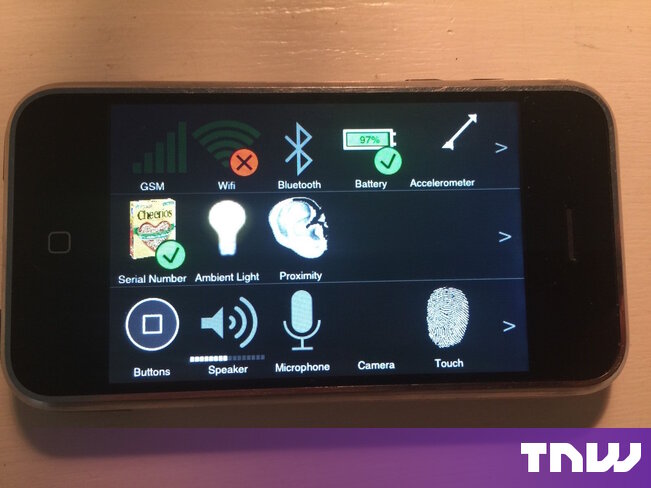
If you see an iOS device running this software, it's almost always a factory escape (something that got boxed up too soon), not a prototype.
If I remember correctly, you can see the PCB color of the M68 prototypes through the dock connector.
It is also conceivable that this was a prototype and it had a replacement case retrofitted which would explain why it has an FCCid.
There was also a case of a skankphone being lost and sold after it was loaned to a member of Cingular's senior management, that one wasn't a factory escape.
(Then again, I like artistically simple yet functional UIs and think gradients are far too overused now...)
Sufficiency for internal tools is the most important part of them.
One other thing of note is that the UI, especially the generic buttons, already followed the finger-sized buttons paradigm pretty closely. It looks like the only one that doesn't follow that is the list view for bookmarks; but, list views are hard and very different on phones than they are on computers, so it makes sense.
It looks more like a production iPhone running the (leaked) internal testing OS.
Lots of iPhone prototypes have surfaced with blank backplates, or IMEI inscriptions as a bunch of Xs. There's nothing separating this hardware from a production piece, which wouldn't be the case with the true prototype phones.