560 points · by geophile · 12y ago · 352 comments
Problem with fusion research like this is that the closer you get self sustainment or energy generation, the harder it gets and problems pile up. This project looks like many other similar projects that have gone bust. They start by solving the easiest problems first, get some funding and hit the wall.
The main problem with any reactor design is how to handle the 14 MeV neutrons produced by the fusion reaction (no mention in the article). They tend to damage the reactor and make it economically unfeasible. At this point being able to create fusion reaction is not the main challenge. It's the sustainment and economics of limiting the damage. If they really have solved all the problems and demonstrate economically sound fusion in 5-10 years, they will be handed Nobel price in physics for sure.
Honestly, those folks that stand back with their arms crossed watching you fail, and reminding you the whole way that you might fail, are the biggest pains in my ass in this profession. By a mile.
Maybe you can contribute your wisdom by going to Lockheed, instead of Internet commentary in which you bet against them?
In the rest of the engineering world, the answer to any question is: it'll be harder than you think it'll be (physics will beat you over the head at every step). You can cross your arms and say "that won't work" and you'll be correct 97% of the time. Fusion is something that some of the smartest people in the world, with enormous amounts of money behind them, have been beating their heads against for the last half century or more. Somebody will figure it out, eventually, but statistically, any given project is very likely not to be the one that does, and it will almost certainly take much longer than the optimists assume it will take.
Did you know that coal plants, which still make up the majority of U.S. energy production, are only about twice as efficient today than they were a century ago?
[1] Although math can be a kick in the ass too if you're working in domains where you can prove there are no polynomial-time algorithms for whatever problem you're working on. E.g. there is a reason people have been banging their heads on the garbage collection problem since the 1950's and it's still an active area of research.
There are certainly two ways of looking at that. The way I read your sentence it sounds very pessimistic. On the other hand, I look at that and say that over 100 year's we've managed to extract twice as much usable energy out of a pound of coal, through a variety of incremental improvements to what is fundamentally the same technology; and the world is a better place for it.
Wasn't most of the effort put into making them MUCH MUCH cleaner? I mean, the https://en.wikipedia.org/wiki/Cuyahoga_River doesn't catch on fire anymore, and the amount of https://en.wikipedia.org/wiki/Acid_rain seems pretty tolerable compared to the early 80's
Did you know that wind and solar are already at grid parity in over half the world? And that in many large first-world countries (Germany, Australia) the price of energy goes negative during daylight hours because of the amount of energy produced by renewables?
Lockheed Skunk Works, on the other hand, is not.
They've been pushing the frontiers of engineering in areas that are very much constrained by physics since 1943, and succeeding. Many times.
They too are a product of applying new discoveries and then engineering around the constraints of physics.
Things change. Progress is made.
Software professionals recognize the constraints on development imposed by entropy, information theory, and other esoteric branches of mathematics.
Rather than scoff at this article because Lockheed is making extraordinary claims without the backing of extraordinary evidence, I prefer to scoff because nuclear physics modeling and simulation software is still software. If I cross my arms and say "that has a critical undiscovered bug in it that invalidates the results," I'd be correct 97% of the time. It also has a SQL injection vulnerability, links to at least one library written 30 years ago, and was originally written by a physicist that knew a little programming rather than a programmer that knew a little physics.
This is no longer the case.
http://en.wikipedia.org/wiki/Coal_power_in_the_United_States
Among people who have a common mindset, yes. But in general people don't like to take risks or expend insane efforts to make something happen. When they see others doing it, they like to stop them. Generally its because they don't want the regret 'They tried and got it, If I had ...' Or they are plainly jealous and can't stand some one else do progress.
Even pg discussed the phenomenon, as you undoubtedly know. There's a good idea, or a news article hailing progress, or some other kind of optimism, then the first comment is a mid-brow dismissal. They are the lowest-effort comments to make; "that won't work because X isn't well-respected and Y often happens to similar teams" requires almost no research and cannot really be refuted.
The only way to refute it is by calling a spade a spade, and look what I get for doing so: having my comment twisted to be fuzzy feel-good smarm crap, when really I'm just saying "shut up and get out of the way if you don't think it'll work."
What I said, reworded, was the people who sit on the sidelines of anything and tell you, while you are trying something, that it won't work are among the worst people in the profession. I didn't say believe harder. I don't give a damn what you believe and don't need you reminding me, constantly, that my project has a chance of failure. Keep it to yourself or get on board. That's my point.
I am not a kind person, so that you'd ascribe feel-good nonsense to me is downright hilarious. I can handle it but a lot of people can't, and it's really, really tiring to keep a team from becoming demoralized when there's a naysayer popcorn gallery in every thread and watercooler discussion.
It's turtles all the way down. Guess we should just give up on Internet commenting. /s
Dropbox is a prime example of this effect: https://news.ycombinator.com/item?id=8863
I hope they have some novel ideas about neutron containment, though, otherwise you're right and this is project is not likely to yield the first economical fusion reactor.
obviously. The proposed reactor looks exactly like a great PhD thesis with honors - a novel field configuration proposed which allows to reach beta of one. The rest of the whole system is given only cursory treatment. In particular how about a "neutron absorbing blanket" in a business-jet size envelope?
Shielding was mentioned, though not enough, but it's fairly trivial: if you add enough matter with a high neutron cross section (paraffin for example), and build the mechanical components out of things with a low cross section (iron, I think) it's not a problem. Plasma is the problem.
It's interesting, but "10 years off" is not much better than the standard "20 years off" promises of fusion research. As others have pointed out, controlled fusion has been 20 years in the future since 1950 or so. "1 year off" would be a lot more noteworthy. As it stands, this is just Lockheed informing us they have a controlled fusion program. Anyway, "nice press release, dudes."
So are refrigerators.
Plausible, since he had the experience.
The challenges of fusion power are largely fundamental nitty gritty engineering issues. We know fairly well how to design most of a fusion reactor; in a lot of ways they are conceptually easier than fission reactors.
The two main hurdles are the materials problems and how to keep the reaction critical with radiative heat loss. These are big problems that so many times have been ignored by people claiming to have solved fusion power. You just can't get away from them, but solving them would be truly revolutionary.
I'm not saying they don't have something novel here as they really are some fine researchers at Skunkworks. Just temper your expectations.
I'm not saying they've done it and extraordinary claims require extraordinary proof but this is the place that made a Mach 3.5 jet with wings that leaked out of titanium in the 60's.
Nitty-gritty engineering is something they are fairly good at.
Time sell any oil company stocks, mutual fund holding?
Two points made reply to you are correct: neutrons are radiation, but not electromagnetic radiation; and neutrons can make other things radioactive.
Some thing other people are saying are less correct: any individual neutron will deposit most of its energy in one place, but averaging over many neutrons their energy deposition will be spread out. Furthermore, neutrons will come out in all directions. The problem of neutron damage is not small, but no one seriously believes it's a show-stopper.
Neutrons are the exploding billiard-balls of nuclear physics. Fusion produces "fast" neutrons, with moderate energies. This is a deuterium-deuterium device, so most of the neutrons will come out with 2.4 MeV, which happens to be the same as fission neutrons. The DD reaction produces tritium as a byproduct about half the time, though, and DT fusion will lead to 14 MeV neutrons. There will be fewer of these in most designs, and some designs incorporate ideas to get rid of the tritium quickly to suppress these higher energy neutrons.
At high energies neutrons don't tend to interact very much with light nuclei, and for a variety of reasons fusion reactor design is dominated by light nuclei. What they do do is bounce off, which is where the billiard-ball analogy comes in. Each time a neutron bounces off another nucleus it loses energy (because the nucleus it bounces off of recoils, carrying some energy with it.) This is just pure Newtonian mechanics.
Neutrons typically travel a few metres in the process of slowing down, depending on the material. Light materials slow them down faster: a light ball bouncing off a heavy ball doesn't loss much energy, but bouncing off another light ball it does (hydrogen is the best material for slowing neutrons down because of this, and hydrogen-rich materials like water are good too.)
The neutron never completely stops because the nuclei it is bouncing off of are in thermal motion. At room temperature a neutron in thermal equilibrium moves at about 2200 m/s. But not for very long, because this is where the exploding comes in.
You can think of it in these terms: once thermalized, a neutron is passing by other nuclei rather slowly (2200 m/s is slow when you're a neutron). This gives it lots of time to react with nuclei, rather than just bouncing off, and eventually it does. When a nucleus absorbs a neutron it becomes a different isotope of the same element, and in many cases adding a neutron to a stable isotope makes it radioactive. Carbon-12 is a stable isotope that, with the addition of a neutron becomes carbon-13, and if it happens to get another neutron added later on, radioactive carbon-14.
Neutrons are a pain, even to fission engineers, and fission depends absolutely on them to happen. They get everywhere, are hard to shield, make stuff radioactive and damage materials. But we know pretty much how to deal with them, and it's unlikely they will make the difference between working and not working in a device like this.
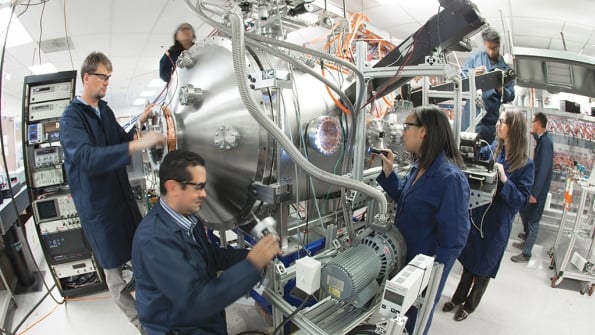
Putting a mice next to this system can make it a "carbon-14" mice? Can it glow in the dark? :-)
Fusion neutron (14 MeV) from fusion reactor is exactly as energetic as fusion neutron emitted by a neutron bomb and causes equal damage (just distributed over longer time). They have 10x as much energy as fission neutrons and travel at speed of 52,000 km/s (17.3% of the speed of light). Neutron capture before they hit and damage magnets, electronics or wear out materials is important part of the fusion reactor design.
Neutrons are interesting in that they dump all their energy into a very small region. Instead of losing energy continually and gradually, they travel a ways and then dump all their energy into one spot. This makes them potentially very useful for things like cancer treatment (you can select neutrons to ensure they deliver most of their energy into the cancer, rather than evenly along their travel path). I suspect this effect means that, for reactors, the wear and tear is more localized, but of a larger amplitude.
Not exactly. The initial collisions do indeed cause localised damage cascades, but the overall effect of a large neutron flux is embrittlement of the material. This is a problem already in fission reactor vessels, but the neutron fluxes are a whole order of magnitude larger in fusion reactors, and it's a very difficult problem to solve. To my knowledge, current materials can only just about deal with with the neutron fluxes in standard fission reactors, with no current materials being capable of withstanding neutron fluxes in a fusion reactor over any long (i.e. commercial) timescale at present. It would be a big achievement and a big jump in materials science to discover such a material, completely separate of any fusion project.
(Disclaimer: this is not remotely my field, but I have looked at some of this stuff in the past, and been to talks about ITER.)
Neutrons are radiation. Also It's the worst kind of radiation because unlike X-rays or Gamma, neutrons make other things radioactive.
Source for this claim: http://en.wikipedia.org/wiki/Neutron_activation
Neutrons are radiation, but not electromagnetic radiation. I'm guessing that nitpicking this is why you were downvoted? Dunno.
Actually even if you believed there's a chance this Lockheed concept can work, the time to buy airline stocks would be on the back end of this dead bull market that's about to fall off a cliff. And then there's the 20 year wait before it's finally deployed to a commercial airplane.
"As Tom McGuire, who is leading the Lockheed team, notes, however, the circular magnetic fields which coil around a tokamak’s doughnut become unstable if the plasma’s pressure is too high."
Exactly! Just repeat keep repeating that process!
McGuire is a top physicist - he is currently working on a compact fusion reactor at Skunk Works, which came out with the SR-71 Blackbird among other innovations.
Oh, did you mean, ones who had already succeeded in their top projects? Well, how do you think they got to succeed - by not doing it?
That being said, if they've genuinely cracked it, the game changes so much as to be unrecognisable.
They don't actually say it, but it sounds like they've only got computer models to work with at this point. Not very likely that they've actually cracked it.
According to this link[1] posted by another commenter, they create a "axisymmetric mirror by positioning zones of high magnetic field near each end of the vessel so that they reflect a significant fraction of plasma particles escaping along the axis of the CFR."
[1]: http://aviationweek.com/technology/skunk-works-reveals-compa...
LLNL scientists almost tested a similar device (see 'MFTF') but the project was cancelled in 1986 before it was turned on.
If you haven't hung around talk-polywell.org before, you might want to. It's focused on the polywell but they seem to at least try to fairly evaluate all contenders.
New confinement techniques (NIF, this article, Helion, Polywell) are actually making real progress. So it's becoming less likely that an announcement like this is 100% vapor.
Put another way, we're getting to the point now where we have tools sufficient to actually know what the results will be. That, more than anything, is the benefit from the billions spent on tokamaks.
> "We also have a recirculation that is very similar to a Polywell concept," he adds, referring to another promising avenue of fusion power research. A Polywell fusion reactor uses electromagnets to generate a magnetic field that traps electrons, creating a negative voltage, which then attract positive ions. The resulting acceleration of the ions toward the negative center results in a collision and fusion.
It's great that they've scoured even the non-mainstream ideas and incorporated them.
Now this sounds way more serious than Andrea Rossi's saga. But I did get a lot tougher on my wait and see stand.
We should be throwing more money at this...
sigh To the extent this is true I suspect those "large fusion reactors" are tuned not so much for generating electricity and a great deal for annihilating whatever the carrying missile is pointed at.
But never mind fuzzy thinking at Reuters right now. This is amazing news if holds up. Fingers crossed.
> U.S. submarines and aircraft carriers run on nuclear power, but they have large fission reactors on board that have to be replaced on a regular cycle.
Submarines and carriers run on a fission reactor. And it powers everything - drives turbines for locomotion, electricity...
I'm well aware of the fission reactors in large military ships, but if there is any application of nuclear fusion on them then pretty much the only option today is thermonuclear warheads. It would be really nice if that's about to change.
http://en.wikipedia.org/wiki/High_beta_fusion_reactor
This is not the first time they have gone public with this - Charles Chase gave a talk at Google X last year, recorded and publicly-available:
I do think what they are doing is interesting. If its like the Gas Dynamic Trap or Tandem Mirror it has promise, atleast from the fundamental physics point of view. Researchers in Novosibirsk had encouraging results in the last 5 years. They still have a long road ahead to get to fusion-relevant temperatures, but we are staying tuned to this one.
Basically you catch electrons flying out of the plasma arc (where fusion is taking place), and ground them back into the plasma (which is positively charged).
Umm its largely theory at this point.
That phrase has been accurate for nuclear fusion in general for more than 50 years. The engineering and construction problems are immense.
As long as they remain secretive, they have no right to demand to be taken seriously.
A typical thermal power station has an efficiency below 50% for electricity generation, so the plant dissipates at least as much heat as it generates electrical power.
I wonder how you could get rid of 100MW of waste heat from a volume small enough to fit on a truck. That's a heat flux of more than a megawatt per square meter of surface area.
Also consider that much of the size is due to the fan on the front (which is not part of the actual engine power plant), which makes the engine's area in the plane transverse to the axis of rotation seem larger.
However, jet engines have the advantage of burning their fuel directly in the air that is flowing through the engine, which results in an extremely rapid transfer of heat to the air compared to other (this is why 10 Boeing 747 engines == 1 GW coal/nuclear plant which is "buildings" in size).
See slide 25 (page 13) of http://ronney.usc.edu/AME436S13/Lecture1files/AME436-S13-lec...
But what gets me is that they are burying the lead. No fusion reactor of any size has reached sustainability...so why is the story here talking about size at all? Small size would be a very nice added bonus; fusion reactors that don't consume more energy than they produce are earth-changing.
"But on the physics side, it still has to work, and one of the reasons we think our physics will work is that we’ve been able to make an inherently stable configuration.” One of the main reasons for this stability is the positioning of the superconductor coils and shape of the magnetic field lines. “In our case, it is always in balance. So if you have less pressure, the plasma will be smaller and will always sit in this magnetic well,” he notes."
As far as I understand this (IANAP), they're saying that smaller size = less pressure, and that helps their design to work (in theory).
That's exactly what I was thinking. They'd better call the Truck a submarine, though.
Note that it converts ~100kW thermal into ~37-47 kW electric. It also has high air flow. I suspect that means that they are aiming to make their fusion reactor small enough that it can replace the burner section of the turbine.
Thermal transfer is still going to be a challenge, unless (Idea!) they are planning on spraying water into the airflow and using heat from neutron moderation in the water to provide primary heat transfer. Hmm, I wonder how much water you would need for 14 MeV neutrons? Let's see, half-value layer is around 10 cm, so if you threw a 40 cm thickness of water across a neutron flux, you'd absorb most of the heat (you could probably catch the rest in the duct casing). That's a lot of water in a pretty small space, but physically possible.
Note that the above is a seat-of-pants calculation and should not be taken as accurate by any means.
Or are my assumptions way off?
One can imagine these to be simple drop in replacements for existing coal plants with existing cooling infrastructure,which would be a huge environmental win in places where those are still built.
That's the standard issue joke. "Nuclear fusion has been just ten years away for the last fifty years"
It is so common as a joke I'm surprised the article didn't mention it.
10 - 765,000 results
15 - 9,730 results
20 - 793,000 results
25 - 8,750,000 results
30 - 709,000 results
35 - 4,700,000 results
40 - 472,000 results
45 - 10 results
50 - 493,000 results
Definitely not 45 years away.
They're more of a rounded (hence the clustering at or away from given numbers) measure of the remaining 'effort' versus 'difficulty'. Very likely there is some absolute time required (experiments take time to run), but throwing more people (and more importantly, more resources to run experiments and gather data) at the problem /would/ get to an end result faster (though how much faster is open to debate; it's sort of like asking how much effort does it take to win a top 30th percentile prize from a lottery).
Compare this with ITER, where they still don't know what material some fairly critical components can even be theoretically made of. It's just night and day.
the Skunk Works and EMC2 haven't even reached the stage where they would face the same issue of material - all of them would ultimately have to contain the same type of fast neutrons and there is no good known material to do it.
The problem is related to how you get rid of the post-fusion products. ITER is designed with divertor plates in the floor to scoop off the fusion ash and shunt them outside the core. My understanding is that these plates have to be a) solid, and b) capable of withstanding contact with absurdly high temperature plasma. There are some candidate materials which are hypothesised to be able to stand up to temperatures somewhere near what's required, but to my knowledge (which admittedly might be out of date) nothing's actually known to be suitable.
The reason I don't think the neutron absorption issue is such a problem here or on Polywell is because with a smaller reactor, replacing the vessel when it stops working is a far less terrifying prospect, even if you have to do so every few months. And even this is far less insane than some of the proposals for how you might do commercial laser fusion. That's just bananas.
Beyond that, you actually want some fast neutrons from the reaction to give you a tritium source.
They dismiss the concerns of the scientific community. Why shouldn't they? They're getting rich off of the ignorance of generals and venture capitalists.
It is however another great example that there is money going into lots of different fusion ideas. And that can only be a good thing as far as I am concerned.
[1] http://www.washington.edu/news/2014/10/08/uw-fusion-reactor-...
A year and a half later, they're apparently no closer to that goal.
http://blogs.wsj.com/venturecapital/2014/08/14/vc-funding-y-...
The team acknowledges that the project is in its earliest stages, and many key challenges remain before a viable prototype can be built
This falls under the xkcd 10 year plan:
"we haven't finished inventing it yet, but when we do, it'll be awesome"
I don't think so.
This article is the cognitive equivalent of parrots squawking, because they don't even understand why the news actually is news.
People calling this a "typo" are giving too much credit. It could be a mistake, but the whole point of having an editor is to catch typos and mistakes! And it's a simple, short article!
The difference is that fission is taking heavy elements, breaking them apart and using the released energy. Radioactivity, Thorium, Uranium, Plutonium, all the yucky stuff. Research has been going on for decades into making these reactors safer, and with breeder reactors and modern conventional designs that appears to have been achieved. Nevertheless, they appear on their way out anyway.
Fusion fuses together light isotopes and uses the energy thus released - they basically do what the sun does. And are clean. For various definitions of clean.
And if you're wondering how they are the complete opposite yet both work, it all pivots around iron. Copying from Wikipedia on iron:
> Its abundance in rocky planets like Earth is due to its abundant production by fusion in high-mass stars, where the production of nickel-56 (which decays to the most common isotope of iron) is the last nuclear fusion reaction that is exothermic.
And yes, that means that everything in this universe will one gigayear end up right at the pivot between fission and fusion, ever onwards oscillating further towards it. Our universe is ever tending tiwards irony. A pivot that we're probably going to see humanity go through too, but in a different way. Hopefully sooner rather than later.
But D-T is only the easiest form of fusion. Next up is D-D, which has much lower-energy neutrons. Helion is working on D-D combined with D-He3, producing only 6% of its energy as neutrons. And several outfits are hoping to manage proton-boron fusion, producing very little neutron radiation.
The AviationWeekly article mentioned D-T fusion for the Lockheed prototype and includes a diagram with the caption "blanket absorbs neutrons to breed fuel and transfer heat to turbines". This "blanket" will be tons of material that would be activated during operation and would have to be disposed of at EOL. Also, modern materials include many trace elements within the main molecular lattice such as cobalt, chromium, etc in steel and in some ways might be more difficult to process than used fuel rods.
I worked in the nuclear power industry decades ago and I don't recall the how the energy of fusion neutrons vs fission neutrons compared but I thought that in general fusion neutrons were significantly higher. Most power fission reactors also have neutron moderators which help to reduce the activation and embrittlement problems. Nevertheless, core components in fission reactors are already experiencing neutron embrittlement and has been a concern.
I'm not trying to be negative on fusion power but these overly optimistic reports have to be read with a critical eye.
I haven't seen any good quantitative comparisons of D-T waste to fission, now you've got me curious.
Totally agreed about the neutron embrittlement, I think that (IFMIF aside) this issue has just been brushed aside as a materials engineering 'detail' to be dealt with as part of commercialisation in a few decades when it might actually make the whole concept of using fusion for energy impractical.
Never mind, another linked article says that the injectors are only used for ignition.
No doubt that Skunkworks is world class... but claiming a "breakthrough in fusion energy" before a prototype has even been built is pretty bold of them.
So that would power 50k to 100k typical houses in the US... not bad!
Wouldn't the effect of its smaller mass be that the container will have to be replaced more often, more or less in the ratio of the masses of the machines?
I didn't find much to inspire confidence.
https://www.solveforx.com/moonshots/charles-chase-on-energy-...
"Until now, the majority of fusion reactor systems have used a plasma control device called a tokamak, invented in the 1950s by physicists in the Soviet Union. The tokamak uses a magnetic field to hold the plasma in the shape of a torus, or ring, and maintains the reaction by inducing a current inside the plasma itself with a second set of electromagnets. The challenge with this approach is that the resulting energy generated is almost the same as the amount required to maintain the self-sustaining fusion reaction."
I’m sure I’ve heard that somewhere before…
If a researcher says a cool new technology should be
available to consumers in... -> what they mean is...
[...]
ten years -> "we haven't finished inventing it yet,
but when we do, it'll be awesome."The mainstream magnetic confinement community has been very cautious about overhyping lately. Unfortunately, the over zealousness of groups like this and NIF saps credibility from them anyway.
These reactors will be similar to the Nimitz-class aircraft carriers and potentially only require refueling every 25 years through a process known as ROH.[1]
100MW capacity in the size of an international shipping container? The implications of this are massive if this technology can be brought to scale, and that is the key term - SCALE.
The cost of solar is plummeting and by the time fusion technology can produce 10% of our energy demand the cost of solar will be heading to $1/Watt, battery storage will be competitive and that is hard to beat even if the footprint is only a fraction of a solar farm.
[0] http://aviationweek.com/technology/skunk-works-reveals-compa... [1] https://en.wikipedia.org/wiki/Nimitz-class_aircraft_carrier#...
http://www.freepatentsonline.com/y2014/0301518.html
http://www.freepatentsonline.com/y2014/0301519.html
Both have publication date 10/09/2014. Maybe connected with the press release?
> Lockheed shares fell 0.6 percent to $175.02 amid a broad
> market selloff.
Doh.[0]: http://books.google.com/books?id=tEMQpbiboH0C&pg=PA15&lpg=PA...
Fusion Power GeekOut: http://www.dotnetrocks.com/default.aspx?showNum=1013
Fusion Power GeekOut #2: http://www.dotnetrocks.com/default.aspx?showNum=1022
Cold Fusion GeekOut: http://www.dotnetrocks.com/default.aspx?showNum=1037
http://www.extremetech.com/extreme/191754-cold-fusion-reacto...
Shouldn't the market be a little more excited about this?
As much as I want to believe it I can't find any evidence myself, either. At this point I'm pretty much at the "show me the over-unity reactor" phase. There's so many research paths to fusion right now that are all "promising", but until one of them actually builds something that works in the real world I'm not personally interested in hearing any more vague promises.
By all means fund them and keep working on them! I'm just not interested in the PR pieces any more. Give me a report about how it's working.
Lockheed has a market beta of 0.7 -- So it's correlated with the general market fairly strongly. On aggregate, if the market increases or decreases by 1%, you'd expect Lockheed to follow the market by 0.7%.
Today most of the major indices are down ~1%, Lockheed is down 0.4%, so you could attribute that 0.3% deviation from the expected number as reactor news. 0.3% of Lockheed's market cap represents about $170M today.
It's obviously not this straightforward, but if I were a shitty journalist, I could make the case that this is actually a pretty good result since commercialization will likely be a decade away, it will take a ton of resources and investment to get there, and there's a high chance of failure.
A shitty DCF with a ramp to $500M/year in R&D, 75% margins on sales, and a $10B/year business in perpetuity comes out to $170M NPV with a ~31% discount rate --- Not too unrealistic.
Skunkworks have as an organization an amazing engineering track record of implementing ground breaking technologies. I wonder what their current status is. Anyone have an inside scoop whether their game is still as sharp?
> U.S. submarines and aircraft carriers run on nuclear power, but they have large fission reactors on board that have to be replaced on a regular cycle.
Lockheed Martin is, indeed, saying they have a workable fusion reactor. Author of this article is the one that's confused.
Many companies have tried to set up a skunkworks since, but didn't have the guts to run it like Kelly did, and didn't get the results, either.
Or any other power plant for that matter.
"If it sounds too good to be true..."
Compare that to this: https://www.google.co.uk/maps/place/Barking+Power+Station,+B... google.co.uk
That's a 20 year old 1GW combined cycle gas plant, in a building roughly 50mx150m. Anything they can do to bring fusion plants smaller than ITER is going to help.
"Partners in industry and goverment". Translation: 10 years to product (but hey, prototype in 5) so please give us lots of dough. It's the technology of the future and always has been.
I suspect they are also much, much cheaper when you are talking about powers in the hundreds-of-megawatts range. I don't have specific data at hand to back that though. I never heard of any grid-level power generation being done with thermocouples.
[0] http://aviationweek.com/technology/skunk-works-reveals-compa...
(And then it rarely happens)
Ah science reporting.
RF and neutral beam heated steady reactor with very high mirror ratio and superconductors.
I can't see how heat energy is supposed to be flowing out of that plasma envelope yet the magnets are supposed to stay at near-zero temps?
I'm guessing this means that they will try and maximize profit rather than maximize cheap and clean energy for the entire world. That is a bit disappointing if true.
I don't understand what you expect? You want them to give it away for free? After paying very intelligent, expensive engineers decades worth of salaries to create it? You want them to create a fund where people can donate their hard-earned money for this noble goal? I'm sure you could give them a call with that idea, or you could create your own fund, even.
Or you could badger your "government" to fund such a project. Seeing as government is a very good analogy for a bunch of people giving their collective earnings for society-level goals. Let me know how that goes.
Cheap clean electricity means no-one needs to care about the Middle East for starters — most of the fighting there is superpower proxy fighting — e.g. Assad would be gone if not backed by Russia and China, so no Islamic State. No Oil, no Iraq war x2. No oil, no Hugo Chavez for that matter.
We always find a reason to go to war. Or it finds us and we return the favor.
Because a whole fleet of fusion air carriers, battleships, submarines and bombers versus a conventional army has plenty of implications in term of autonomy, reach, etc.
But on the other hand, there is a such demand for energy everywhere that it would really hard to morally ban all the civilians applications.
Energy use of the US (2011): 25,484 TWh Power needed: 2,900 GW = 25,484 TWh / 365 / 24 h * 1000 Number of 100 MW CFRs: 29,000
Civilian use will happen. The benefits are just much to great. There will be regulation and oversight for them. But you won't need one in every truck. It's overkill. As you can see from the above calculation 29 thousand CFRs could cover all the US energy needs. So there will be hundreds of thousands worldwide. It will be hard to keep all of them under control But this would basically solve all of humanities energy problems and decrease CO2 production, and destruction of the environment from mining immensely.
Having large amounts of energy available enables new weapon systems to become feasible: high powered lasers, coil guns and rail guns. They can be added to any air, land, or sea vehicle that's above the size of a small truck.
Ships are pretty large anyway and aren't as restricted as land or air vehicles when carrying big machinery. Aircraft carriers won't change so much. You can build them a little smaller and their defensive weapons might improve. Nuclear submarines otoh could be built as small as modern diesel powered subs like the Dolphin class.
You could build a drone with an extremely long loitering time. If it uses a laser or rail gun, it will also have lots of ammunition. Instead of carrying a couple of hellfire rockets and having to refuel after several hours it could stay in an area for months.
You can't have clean skies if everyone else is polluting. That is what makes pollution such a hard problem to solve. Even if USA cuts its pollution to zero, China alone can make up the difference.
But yeah, having access to this technology for everyone would be a serious game changer.
Edit: We are all riding the same spaceship... Its a serious flaw in thinking 'us vs them' when we are beginning to experiene some of the results in climate change.