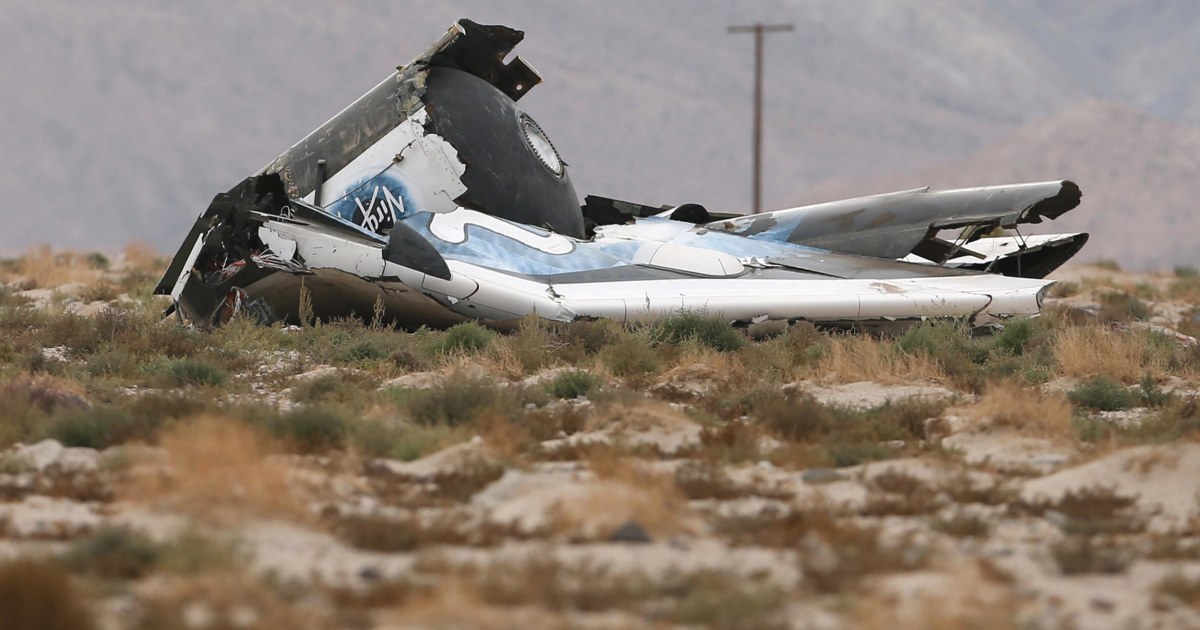
Virgin Galactic's SpaceShipTwo Crashes: 1 Dead, 1 Injured
Virgin Galactic's SpaceShipTwo rocket plane crashed during a powered test flight on Friday, resulting in one fatality and one injury, authorities said.
NBC News
598 points · by llamataboot · 12y ago · 300 comments
Most systems operate in extreme conditions, sometimes bordering on the improbable. Thousands, sometimes millions of horsepower in an engine smaller than a car, cryogenic liquids at -200 degrees celsius cooling a nozzle that is 3000 degrees celsius 5 millimeters away, heatshields designed to absorb obscene amounts of heat, the list just goes on and on.
Most people don't realize how hard this is. The physics, the engineering, the design.
Yet we have made great strides, especially over the last few years, and Virgin Galactic is a part of this. There is a new era of cheap spaceflight on the horizon, driven forward by fearless men and women that want to go to space no matter what the cost.
This is commendable, and is what drives the human race forward. Without these fearless men we wouldn't have gone to the moon. We wouldn't have explored the depths of the ocean. We wouldn't have flown the skies.
Today it appears we lost one of these fearless men, but he now rests in peace assured that others will take his place, that he was not alone in his longing to drive mankind forwards into the unknown, that his dreams live on to inspire others.
We have conquered the skies, and we will move on. Eventually we will conquer space and make it accessible to all mankind. A fearless man has given his life to allow us to some day leave the cradle that is mother Earth.
His ultimate sacrifice won't be in vain.
This is a tragedy, obviously. But the program is about six years behind schedule, been going for 10 years. The most stupid thing they've done is stay with an experimental rubber/nitrous hybrid engine this whole time, instead of switching to liquid/liquid engine, a well proven technology. I know first hand that groups with such engine expertise have approached Virgin and been turned down.
Seeing only the first paragraph, I already know that some rubber in the hybrid engine detached blocking the nozzle and causing the whole engine to explode. The pilots should have refused to fly until Virgin had 10 consecutive motor qualification tests at full duration, not ride on a ship with a half-baked motor that has seen constant modifications during the last year.
In the software development world, a "death march" in a program behind schedule does not result in loss of actual life, not so in manned spaceflight.
The flaws in Apollo One were so severe the three crew died on the launchpad. Describing that tragedy as "no in-flight deaths" is accurate but misses some important information.
To put it in perspective, Apollo flew on a rocket with five engines producing 1,500,000 lbf thrust each, on the first stage alone. By contrast, the Virgin motor produces 60,000 lbf thrust for 70 seconds.
The Apollo program had a safety culture configured so that if anyone identified a safety issue, they became responsible for the problem and responsible to sign off that it was corrected.
1. They didn't stay with rubber/nitrous.
2. Like the sort used on Antares?
"Seeing only the first paragraph, I already know that some rubber in the hybrid engine detached blocking the nozzle and causing the whole engine to explode."
But what you know is wrong, they weren't using rubber.
I think a good case can be made that they didn't do enough ground testing, but your post mixing disdain and falsity doesn't advance that case.
I think Paul McCartney was about 23 years old when the engines powering that Antares launch vehicle were fabricated in Russia in their race against the Americans to the moon. An antique liquid/liquid vs an inadequately qualified hybrid: no winners.
This you believe so strongly because a news story stated it?
Wait for the accident report. It will say "rubber".
Some of the boundaries that are being pushed are how much oversight, how meticulous, etc you have to be. In other words, how well you have to manage the program, how tight a ship you keep.
Keeping a tight ship raises costs, and isn't the big emphasis of all this privatized space travel on reducing costs?
Does this same concern apply to plastic-based fuel? It does seem like a terrible idea to have people in the rocket the first time you try a new fuel mixture.
"During the nine months since the previous rocket-powered test in January, Virgin Galactic switched SpaceShipTwo's fuel mixture from a rubber-based compound to a plastic-based mix — in hopes that the new formulation would boost the hybrid rocket engine's performance."
http://en.wikipedia.org/wiki/Hard_start
Another - nitrous oxide can become explosive in gaseous phase. If enough of it became gas, the oxidizer tank may have exploded.
There are also inherent instabilities of hybrids - higher pressure accelerates the burn, which increases pressure, which...
We'll know more after they finish the investigation.
Let's hope they won't ask you to run the inevitable investigation then.
Can I ask how? What is in there that tells you that?
You've got a hybrid motor, it's flown a number of times. You have a program that has been going for years but still hasn't got the motor design finalized due to unknown (to us) problems. Failure modes that could destroy the vehicle include things like pressurized oxidizer tank failure, burn-through of the nozzle, burn-through of the main combustion pressure vessel, blocking of the nozzle by unburned solid fuel chunks causing over-pressure failure, and the like. The last one seems most likely, since it's likelihood is modified by modifications to the fuel (which is what they are probably changing, as opposed to the nitrous system or structure or nozzle).
Obviously no one knows for sure yet.
I'd love to see civilian spaceflight become a reality, so this is an unfortunate setback. I hope Virgin will be able to take the time to get it right. I hope they will look back at this accident the same way the Apollo program viewed the Apollo 1 fire, as a much needed chance to fix a lot of potential issues that needed fixing that were thought to have contributed in a fundamental way to the lack of subsequent in-flight failures.
I agree that, for all we know, it was the catastrophic failure of a rocket engine that was not tested enough that killed a pilot and that they should have tested the engine for much longer than they appear to have.
I imagine they switched to this design because it's supposed to be a better one.
"During the nine months since the previous rocket-powered test in January, Virgin Galactic switched SpaceShipTwo's fuel mixture from a rubber-based compound to a plastic-based mix"
https://en.wikipedia.org/wiki/List_of_software_bugs
- radiation therapy machine kills 5 - clock drift in Patriot system caused 28 killed - Chinook helicopter killed 29 due to bug in engine control - Toyota's electronic throttle control system caused dozens of fatalities
Delays of months between flights are dangerous. Until you have a 1000-10,000 flights to build up operational data and envelope, this is a death trap causing unnecessary deaths.
It is true that computer models have definitely reduced the risks for test pilots by helping to define a much greater percentage of the performance envelope of a given system without the need for test flights. When a pilot steps into an untested craft for the first time, the "unknown" area of the envelope is better quantified; in different words, we have a better idea of how much of the performance envelope is unclear.
Yet that unknown area still exists and has to be discovered by actual human test pilots because as good as computerized testing is there still isn't 100% coverage.
(I'm a pilot and have dealt with experimental aircraft. Not on the level of this project, of course, where the envelopes of technology are being pushed, but on the level of small private aircraft where the technology is in many cases half a century old, well understood, debugged, and still has to be tested. By a human.)
At least one shuttle flight would have been lost if the crew didn't fly manually to correct for a malfunction. STS-4 PIO'd on landing and would have crashed if auto-stabilization wasn't overridden by the pilot.
Good point. What does the FAA say about unmanned rocket powered flight tests?
In fact, you don't even know that rubber in the hybrid engine blocked the nozzle. You can't know that - you aren't part of the investigating team. And they don't even know yet.
Indeed. Your statement reminds me of an insightful engineering article, "How Complex Systems Fail": http://www.ctlab.org/documents/How%20Complex%20Systems%20Fai... . A few relevant observations from the article that resonate with me:
> 1) Complex systems are intrinsically hazardous systems.
> 4) Complex systems contain changing mixtures of failures latent within them.
> 5) Complex systems run in degraded mode.
> A corollary to the preceding point is that complex systems run as broken systems. The system continues to function because it contains so many redundancies and because people can make it function, despite the presence of many flaws. After accident reviews nearly always note that the system has a history of prior ‘proto-accidents’ that nearly generated catastrophe.
> 17) People continuously create safety.
> Failure free operations are the result of activities of people who work to keep the system within the boundaries of tolerable performance. These activities are, for the most part, part of normal operations and superficially straightforward. But because system operations are never trouble free, human practitioner adaptations to changing conditions actually create safety from moment to moment.
1. contains a lot of energy
2. releases a considerable stream of energy at a controlled, steady rate
3. does that in a small system, while flying through the air.
It's a lot easier if you drop one requirement:
1 + 2 = coal-based power plant
1 + 3 = bomb
2 (sort of) + 3 = conventional airplane
All of the above have been done reliably. It's only when you put together all three conditions that you get a rocket, and that's when things get really, really difficult.
At the start "n" is small 1 flight, 5 flights etc. It's pretty much a given that there will be failures it's just a matter of when and how critical a failure. The failures would be loaded toward happening early on and then fixed so that one particular failure shouldn't happen again. Something else might of course.
As an aside this is similar to why large companies have really long involved legal contracts. They are large enoug,h and have run into enough problems, (or employ attorneys who have) that they've seen it all and done it all and know what they need to do to protect themselves because of the statistical chance that in their large operation a particular problem will appear.
In other words more likely that with a footprint as large as McDonalds there will be a customer that get's scalded by coffee and files a lawsuit than the local coffee shop on main street USA. More customers means more chances of some outlier even happening.
That's one way of looking at the matter. Another is that without this untrammelled technological evolution (I hesitate to use the word "progress") we wouldn't be living through the greatest mass extinction event of the last few of million years. A lot of this effort could go instead into finding a better cohabitation between humans and the other species with whom we supposedly share the planet.
Our resources would be better spent elsewhere. I know that this opinion is anathema on a tech-heavy site such as this one, but I must nevertheless express my respectful disagreement. It would be far, far more productive for the species to dedicate resources towards CO2 and CH4 reduction in the lower atmosphere.
Space travel is fundamental to the human species living sustainably in the long term. Correcting greenhouse gasses doesn't help us if the next day we find a planet-killer asteroid is a few weeks away.
So... what, we just halt development of all vehicles, globally, period? Bye-bye trains, planes, cars, bicycles, and buses?
You can't develop the future of transportation or the future of propulsion systems if you literally shut down global commerce.
Besides, an airplane (for example) is not wedded to the engine. Developments in prop planes carried over directly to jet planes, once the jet engine matured. Any future propulsion system that can replace jet engines will probably not be hard to work into many plane designs of the day.
The biggest lever we've got right now is computation, so yeah maybe it would be more efficient to develop AI / IA first and then mass space travel, but we can't be sure.
Also, fundamentally we can accept a few billion deaths. That sounds and is grotesque, but it wouldn't be the end of humanity. I don't see how climate change kills us all in the next 100-500 years.
This is a false dilemma. We have 7+ billion people on the planet. There is most certainly a significant amount of effort going towards the future you mentioned. They are not mutually exclusive (and are, most likely, going to be a product of each other)
At least with the mass extinction there are prospects for fixing the problem.
I wonder what the carbon footprint of space tourism is, and will be if it becomes cheaper and more popular? I feel guilty flying on a plane.
Let's go see the universe, and take life along with us.
It might be hard to argue that our industrial pillage of the planet is solely a result of exploration. Anything weaker than that and I think you have the tougher position.
More recently Oil is currently driving a lot of exploration into the oceans and other remote regions.
PS: Not that I think we should all just stay home, but whitewashing history is stupid.
Absolute zero is -273 °C.
Wikipedia lists: 19 Test Pilots 18 Astronauts in spaceflight 11 Astronauts in training
The death tolls for social progress are vastly greater.
These people choose to dedicate and risk their lives drive us forward.
We mostly still haven't! I think ocean exploration is pretty exciting too.
You are all prey to the "religion of progress".
Your dogma is that space travel is not only possible, but a given, something the universe has put somewhere for us to find and make ours.
Except that, basic hard laws such as the speed of light, the laws of thermodynamics, etc. say NO. And it's only your religious thinking that allows you to handwave all that with a "we always find a way".
For all we know, in this universe it may be impossible to bypass or even bend those laws. Yet, you're betting the future of the species on old Star Trek fantasies.
As you said, the conditions and difficulty for modern space travel are in the extreme and pushing all of our sciences to their limits. And for what? just to get to... the moon. I don't want to scare you, but if that seems far to you, see how much bigger the distance to anything else in the solar system is, nevermind anything outside it.
This is not true. For travel within the solar system the speed of light is no more than a nuisance delaying communication. The laws of thermodynamics don't stop space travel. No one is saying "we always find a way" to do the impossible. We are saying "we always find a way" to do that thing that we already know how to do and have demonstrated lots of times, only this time we need to make it cheaper.
b) We just need to make it cheaper? how, exactly, are you going to get up there except by burning obscene quantities of solid (fossil) fuel, as we do now?
That's where the thermodynamics things comes in play: you have to pay the energy cost, there's no elegant "oh, we're just going to fold space" or some such bs. And fossil fuels are finite by definition, need I remind you.
It's not "we just need to make it cheaper". It's coming up with new breakthroughs in physics that no one can assure even exist.
[0] News report: http://www.theguardian.com/science/2014/oct/31/spaceshiptwo-...
SpaceshipTwo is considered the 'simplest' and 'safest' of all the upcoming manned commercial vehicle. It has many features that should help keep it reliable. For example, instead of a real liquid rocket engine, it uses a hybrid engine; it has almost no moving parts apart from a valve or two. No turbopumps or gimbals or much mechanical stuff to go wrong. It only goes suborbital, so it does not need a heatshield because there's no re-entry. The landing system uses wings & wheels similar to any commercial jet. This stuff is mature and tested.
In fact, the only novel thing about SS2 is it's wing-feathering system. It's lets the craft to descend vertically still under the pilots control. I wonder if (and this is complete speculation) there was a problem restoring the wings to their 'atmospheric' flight position which prevented them from landing normally.
The consequences for commercial manned spaceflight will be quite severe, I think. I imagine that many Virgin Galactic customers will cancel their pre-orders. The flight test program is dead in it's tracks at this point; even those who don't cancel will be unlikely to fly for many more years while investigations and improvements are concluded. Other manned providers such as SpaceX and XCor will likely be extra cautious before allowing people to fly in their vehicles.
The image of manned commercial spaceflight will take a hit. If the 'Safest' of the commercial vehicles can crash before it even enters service, I worry that many potential customers will be put off. It never hurts to remember that Spaceflight is a dangerous business.
It's a sad day to top off a bad week in spaceflight. :(
see for details: http://www.knightsarrow.com/rockets/scaled-composites-accide...
or the "Test program accident" at the wiki: http://en.wikipedia.org/wiki/RocketMotorTwo
The whole incident indicates a lax safety culture.
While the design lacks complicated turbopumps and cryogenic fuels, it does have one drawback: the N2O is contained in a pressure vessel. If that tank is damaged while still full (or close to), bad things can happen.
http://www.knightsarrow.com/rockets/scaled-composites-accide...
http://www.dtic.mil/dtic/tr/fulltext/u2/a489459.pdf
(In that Air Force research lab report there's mention of supercritical N20 causing a spontaneous explosion with coffee grounds.)
Strong oxidizers are almost universally hard to handle. About the nicest ones around are Lox, Nox and hydrogen peroxide.
Don't forget that this is not the first fatality associated with this engine. In 2007, 3 people were killed in an explosion during a static test at Mohave Air & Space port.
Is this a case of not seeing safety's big picture? Cutting accidents in half (or by whatever) is great, but not if that means the remaining accidents are fatal. A more frequent controlled failure is a much better scenario, but I imagine hurts the bottom line too much.
I'm wary that for-profit companies aren't going to invest enough in private manned spaceflight's safety when there's a profit incentive at work dictating otherwise. At least without a fair bit of regulation.
edit: I'm wrong. They simply switched to a new type of fuel for their hybrid engine.
I dug up this article:
http://www.parabolicarc.com/2014/10/08/work-continues-hybrid...
I think it won't be that dire. People who sign up to fly into space on a new design would probably be aware of the risks involved.
Many people still climb Everest, dive into caves, and jump from clifs with wingsuits. I think there won't be a shortage and the future is bright and exciting.
XCOR's culture of safety is pretty good, though it's the school of thought quite close to Virgin Galactic . At least rocket engines in XCOR are designed with the highest standards of safety.
What's interesting is that the SS2 engine fuel was swapped out very recently for a new thermoplastic polyamide solid fuel for better performace. Maybe this new fuel was not tested as well as it should have been?
That said, I really have no clue about how these things work. That's just one scenario I could see leading to a midair explosion.
It may or may not be true, but it's the same thing it was last week.
Gene Kranz is the gentleman sitting in the flight director's chair in the Apollo 13 movie, wearing the white vest. He helped create the Mission Control organization at NASA.
"Spaceflight will never tolerate carelessness, incapacity, and neglect. Somewhere, somehow, we screwed up. It could have been in design, build, or test. Whatever it was, we should have caught it. We were too gung ho about the schedule and we locked out all of the problems we saw each day in our work.
Every element of the program was in trouble and so were we. The simulators were not working, Mission Control was behind in virtually every area, and the flight and test procedures changed daily. Nothing we did had any shelf life. Not one of us stood up and said, ‘Dammit, stop!’ I don’t know what Thompson’s committee will find as the cause, but I know what I find. We are the cause! We were not ready! We did not do our job. We were rolling the dice, hoping that things would come together by launch day, when in our hearts we knew it would take a miracle. We were pushing the schedule and betting that the Cape would slip before we did.
From this day forward, Flight Control will be known by two words: ‘Tough’ and ‘Competent.’ Tough means we are forever accountable for what we do or what we fail to do. We will never again compromise our responsibilities. Every time we walk into Mission Control we will know what we stand for. Competent means we will never take anything for granted. We will never be found short in our knowledge and in our skills. Mission Control will be perfect.
When you leave this meeting today you will go to your office and the first thing you will do there is to write ‘Tough and Competent’ on your blackboards. It will never be erased. Each day when you enter the room these words will remind you of the price paid by Grissom, White, and Chaffee. These words are the price of admission to the ranks of Mission Control."
Video re-enactment by Gene Kranz: https://www.youtube.com/watch?v=9zjAteaK9lM
For that alone, all involved are heroes.
In 100 years, more humans will live off earth if we iterate with machines, etc now than if we move slowly trying to reduce the risk in order to keep humans safe.
But people take far greater risks for far less reason. Monster Truck rallys. Motorcycle racing. Skiing. We don't change national priorities every time somebody dies at those activities.
SO lets keep it in perspective, and salute the brave folks who are trying to expand human boundaries.
There are a lot of people like that. Mountain climbers. Surfers. Volunteer soldiers. Alaskan crab fishermen.
You don't see anyone proposing that crabbing be banned until we can develop automated machines to do the job, right?
One man on mars for a day will be more informative than all the remote hardware we've sent so far. There is no substitute for being somewhere in person.
I find it absolutely reckless and inexcusable to require live humans riding on a prototype rocket when you have all the processing power needed to automate/remote manage the vehicle literally in your pocket.
EDIT: To those downvoting, you should really check that all current spaceplanes have the capability to fly and land autonomously--Boeing X-37, Dream Chaser, even Buran was fully autonomous and that was 25 years ago. There is simply no excuse for Virgin for being sloppy.
Please have a look here - http://en.wikipedia.org/wiki/Soviet_space_program#Incidents....
I think people should make that decision themselves.
I think at the moment, and into the foreseeable future, a human at the pilot seat for an experimental craft, where all sorts of unexpected scenarios could pop up, would be much better suited than an automated "test" pilot, given that sometimes you don't even necessarily have the correct parameters of your plane/rocket to program a successful autopilot.
Keep in mind that people at Virgin Galactic will have finite resources. Even if you can automate something that can access very unexpected situations and make a correct decision on what to do, the cost of doing that vs a test pilot is going to be much higher.
As far as I'm aware, aircraft autopilot systems do not perform well when unexpected mechanical failures occur and usually defer to humans by sounding alarms and such.
As for rockets, especially test ones, usually the automated system that makes a call when mechanical failures occur involves self destruct to prevent collateral damages.
"During the nine months since the previous rocket-powered test in January, Virgin Galactic switched SpaceShipTwo's fuel mixture from a rubber-based compound to a plastic-based mix"
[1]: http://webcache.googleusercontent.com/search?q=cache:JBrl96U...
For each of the technologies involved with the X-37, et al., that technology required testing with a human-in-the-loop to act as the judge for if the control output made sense. It simply isn't feasible to begin testing your robot pilot without first testing it with a pilot there in the first place.
Where is the line?
But I get what you mean. It's a tough thing to figure out, and hindsight is always going to be "well we shouldn't have done that".
http://forum.nasaspaceflight.com/index.php?topic=35117.270
What a terrible week. :(
- Virgin Galactic has ordered a total of 5 SpaceShipTwos from the aptly named "The Spaceship Company".
- There are 2 built, the VSS (Virgin Space Ship) Enterprise and VSS Voyager.
- Only the VSS Enterprise has been flown, so I assume that is the ship which crashed today.
This is a sad day, indeed.
While this is a major set-back and bummer, at the same time it is far better that something like this happen during a test than during a commercial flight. Whatever the design, manufacturing, or process issues are, they will now be sussed out reducing the chance of a failure later on.
I sincerely hope this is not such a huge set-back that it totally derails Virgin/Scaled's approach as I love the fact that we have competing commercial concepts working at the same time.
> Virgin Galactic's partner Scaled Composites conducted a powered test flight of #SpaceShipTwo earlier today.
> During the test, the vehicle suffered a serious anomaly resulting in the loss of SpaceShipTwo. WK2 landed safely.
> Our first concern is the status of the pilots, which is unknown at this time.
> We will work closely with relevant authorities to determine the cause of this accident and provide updates ASAP.
This is awful. I hope that problems like this don't result in more regulations and barriers to private spaceflight. It's about as dangerous of a job as they come and we have to expect companies will lose men. Every astronaut is a hero for humanity and progress.
I'd like to recommend everyone select as their next book for pleasure reading Andy Weir's "The Martian".
Here's my GoodReads review:
It's not high-brow literature by any stretch. But it's not about the writing per se, it's about the story. I challenge anyone to read it without caring what happens to the protagonist. I recognize that he (and perhaps by extension the author?) may be borderline juvenile on a few occasions... but for me it hardly detracted from the reading experience. On the contrary, I was sufficiently immersed in being on Mars in the shoes of this bold and lonely astronaut that the book per se disappeared nearly the entire time I read it. Pausing to re-read a noteworthy turn of phrase or analyzing it as literature might well have detracted from the author's intent. The story is the thing. For me, the writing got out of the way. And I'm glad it did. This is an extremely well-researched, gripping, exciting page-turner. If you are remotely interested in space travel, imho it's a must-read.
http://articles.chicagotribune.com/1986-03-18/news/860120045...
Space vehicles and space exploration is a very dangerous and high risk endeavor. This week we are unfortunately reminded of this fact. Thoughts go out to the families of the brave pilots and those with the Virgin Galactic program.
Say what you want about "cheap spaceflight", there is something dysfunctional going on here. This latest disaster makes me wonder if the US even has a current capability of space flight. Pinching a few pennies isn't worth it.
[1] http://spaceflightnow.com/2014/10/27/china-launches-third-sp...
[2] http://spaceflightnow.com/2014/10/29/russians-launch-progres...
Virgin Galactic was set up so eventually the average person can experience the wonder of space flight. The company didn't have Elon Musk type aspirations, but it is a big part of the process that will eventually allow us to colonize the stars.
These type of events show that even though we have the smartest scientific wizards in the world working on these things, there is still so much we have to learn, almost a half century after we landed people on the moon.
Virgin Galactic, especially those you lost today, you have my deepest respect for Daring Greatly.
https://www.youtube.com/watch?v=wz8wlcUPz90
The documentary includes a very touching interview with a test pilot.
In lots of ways unmanned is actually simpler than maned, as the US army knows.
Using pilots for testing new things looks to me as extremely outdated, from the old macho days.
In the old macho days you had to sacrifice people for learning things as simple as how to control the aircraft over the speed of sound.
But today it is totally unnecessary.
Eventually you'll have one.
( Chrome doesn't think evited is a word. )
> current spaceplanes have the capability to fly and land autonomously--Boeing X-37, Dream Chaser, even Buran was fully autonomous and that was 25 years ago. There is simply no excuse for Virgin for being sloppy.
The point being there shouldn't have been human pilots in those seats in the first place.
The mother plane part, or the spacecraft part?
Jet fighters do the same thing: convert control to the flight systems within an envelope.
Both incidents seem to involve ignition, so that seems to be an issue.