191 points · by Zaheer · 11y ago · 64 comments
I would like to have seen it dipped. Also demonstrated with contaminated water of some kind, maybe flour & water paste.
He states it would not degrade, but surely expansion and contraction will take a toll on nanoscale etchings, as well as abrasion and acid content of airborne contaminants.
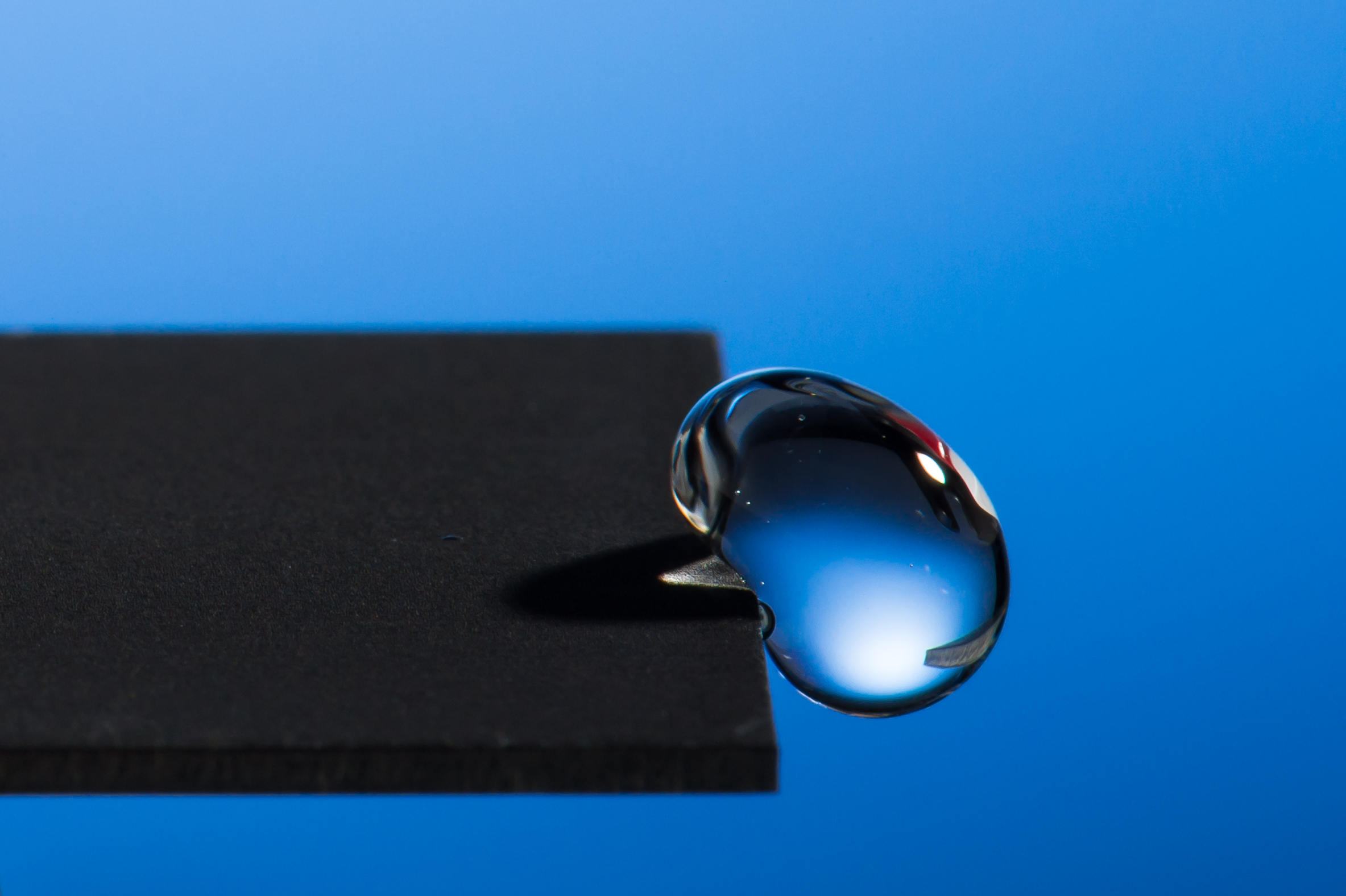
Looks amazing though watching the water spread out and spring back that much. Simply incredible.
If he ever wants to start a company, whomever he reaches out to, fund him.
I'd love to see it under a microscope, or see a visualization of the pattern. Is the strategy to maximize the surface area of an existing hydrophobic material?
[1] http://scitation.aip.org/content/aip/journal/jap/117/3/10.10...
http://www.asknature.org/strategy/038caf2e453c09b3016465cc6c...
Car wash companies will hate this stuff, and wouldn't it be nice if it could be etched into windshields, no more wipers!
Never took you for a limb air headline writer! :)
When swimming, the drag is pretty minor, most of your energy is spent on the displacement of water. That's true with fish, and with ships and boats.
http://www.lufthansa-technik.com/famos
See sharkskin bit above.
Teflon became a thing because it's both hydrophobic and lipophobic. There are lots of hydrophobic surfaces that work very well until you get dirt, finger oils, soap, or just about anything that isn't water-soluble on them. There may also be an issue here with friction damage.
Hopefully the technique here can be adapted to practical products.
Great achievement.
(maybe that's only the case for chemical hydrophobicity rather than structural)
It's a good thing the Olympics banned those full-body swimsuits. This would be the next million-dollar suit.
But for now, baby the shit out of them. Buy one that gets legit amazon reviews for your next one. Hand wash it and mayyybe use a sponge when washing it. Only use wooden, plastic or silicone utensils in it.
If somebody cleans it with a scrubby pad or uses a metal spatula, they get shot/buy you your next pan. :)
I did 2 years on my most recent nonstick pan until my roommate cleaned it with a scrubby pad.
"Non-stick cookware is not a significant source of exposure." is what cancer.org [0] has to say about Telon and PFOA.
[0] http://www.cancer.org/cancer/cancercauses/othercarcinogens/a...
If you want absolute proof an anecdote won't satisfy you, but it's plenty of evidence for me. Look at the cost/risk calculation. The cost of a ceramic pan is on the order of $35; the cost of getting cancer is potentially quite large. There doesn't have to be a very large probability that Teflon causes cancer before it's not worth taking the chance.
How exactly do you cook with it then?
"While PTFE is stable and nontoxic at lower temperatures, it begins to deteriorate after the temperature of cookware reaches about 260 °C (500 °F), and decomposes above 350 °C (662 °F).
…
Meat is usually fried between 204 and 232 °C (399 and 450 °F), and most oils start to smoke before a temperature of 260 °C (500 °F) is reached, but there are at least two cooking oils (refined safflower oil and avocado oil) that have a higher smoke point than 260 °C (500 °F). Empty cookware can also exceed this temperature when heated."
Most questions along this line are addressed on this page:
https://van.physics.illinois.edu/qa/listing.php?id=485
Note that if you try to avoid the formation of rust by submerging your steel in water, thinking that will remove the oxidative air component, you run into corrosion issues unless you are submerging in a tank of constantly refreshed distilled water.