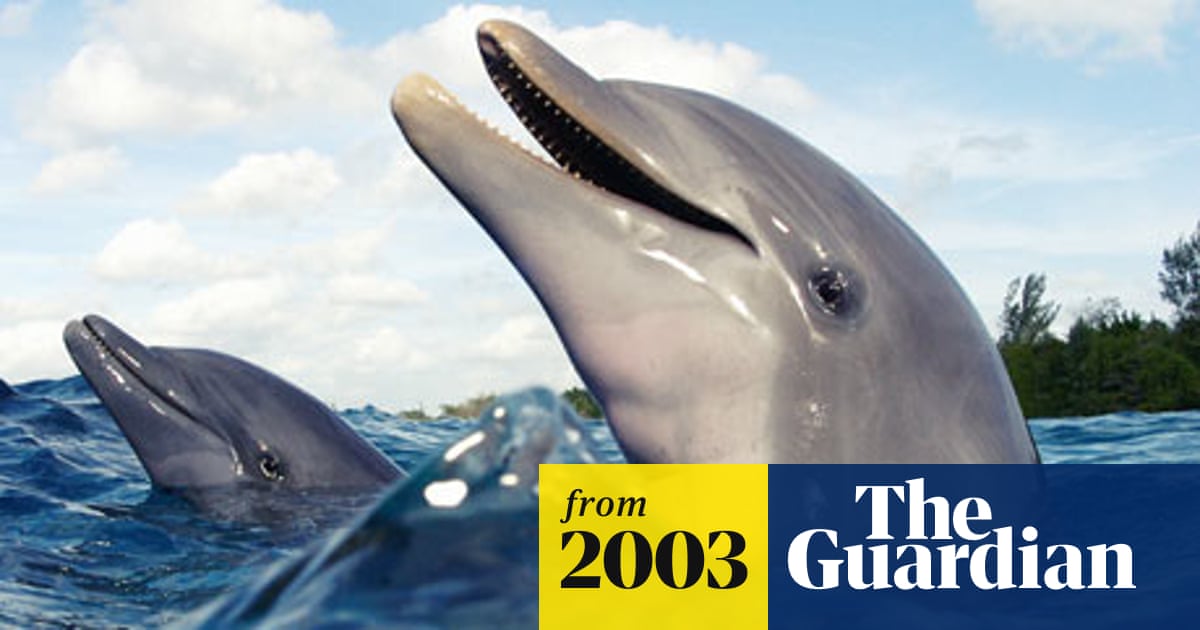
Why dolphins are deep thinkers
The more we study dolphins, the brighter they turn out to be, writes Anuschka de Rohan
the Guardian
86 points · by chaostheory · 17y ago · 28 comments
Or they didn't. If it's real, why not prove if it's real?
If it was part of an experiment published 20 years ago, and it was conclusive that dolphins can think, presumably we would have heard of it by now.
Additionally, given that dolphins can apparently teach each other behaviors the entire batch of dolphins they've got in their research tank is contaminated by the first dolphin.
Designing experiments to determine if your test subjects are smart enough to mess with you is hard and it's harder if they all live together and gossip between sessions.
Had a quick look around for some info on this topic and came accros a great resource : http://ngm.nationalgeographic.com/geopedia/Animal_Minds
I was looking for the study conducted on elephants (Payne, Katherine. National Geographic: "Elephant Talk." National Geographic: USA. August 1989) where they studied the infrasound communications of wild elephant herds. This one always struck me as significant, because it whispers to us of a vast and efficient network that would have spanned large areas of the African continent. I always thought of it like whale song, although being propogated through a denser medium it would travel faster and further (?). So maybe at some point during their ancient past, the elephant herds were in constant communication, following signs of water and congregating on grazing grounds and to mate/socialise.... I think this (like the dolphin superpods that have only recently been described in any great detail) shows of a formidable intelligence.
Best articles on dolphin intelligence: http://en.wikipedia.org/wiki/Cetacean_intelligence
And analysis: http://multiverseaccordingtoben.blogspot.com/2009/04/cetacea...
Its interesting to see that we try to use our language to communicate. Have we tried to understand their language or hear their sounds compared to what our words are? I could only imagine a dolphin language could/might be made....
"Not only do the dolphins understand the meaning of individual words, they also understand the significance of word order in a sentence. ... learned a vocabulary of more than 60 words and can understand more than 2,000 sentences"
And assuming EQ is based on some objective anatomical comparison of the brain...
Then Dolphins are 5.6/7.4 as smart as Man.
A rational society would be bound to protect the dolphins '75% human'-rights.
My position is that psychology is not [yet] a science.
Falling back on what we actually objectively know about dolphin anatomy [and subjective behaviour which does not contradict that] you would have to admit dolphins are possibly 75% as intelligent as humans, accounting for the huge difference in environment.
Does it not follow that they should have some form of protection under law as semi-intelligent beings?
One reasonable way to get a ballpark is to look at brain fold anatomy - I assume that's what EQ quotient in the OP is roughly equivalent to.
Rather than reduce human rights, I'm suggesting we act responsibly to all intelligent species.
If a reasonable physical measure of dolphin IQ puts it within an order of magnitude of a humans, we should probably not be killing such a species, for example.
http://www.guardian.co.uk/science/2003/jul/03/research.scien...
"The ability to recognise themselves [dolphins] in the mirror suggests self-awareness, a quality previously only seen in people and great apes."
Fast forward to 2008
http://www.sciencedaily.com/releases/2008/08/080818220557.ht...
The researchers subjected the magpies to a mark test, wherein a mark is placed on the subject's body in such a way that it can only be seen in a mirror. When the magpies engaged in activity that was directed towards the mark (e.g. scratching at it), the researchers were able to conclude that these birds recognized the image in the mirror as themselves, and not another animal.