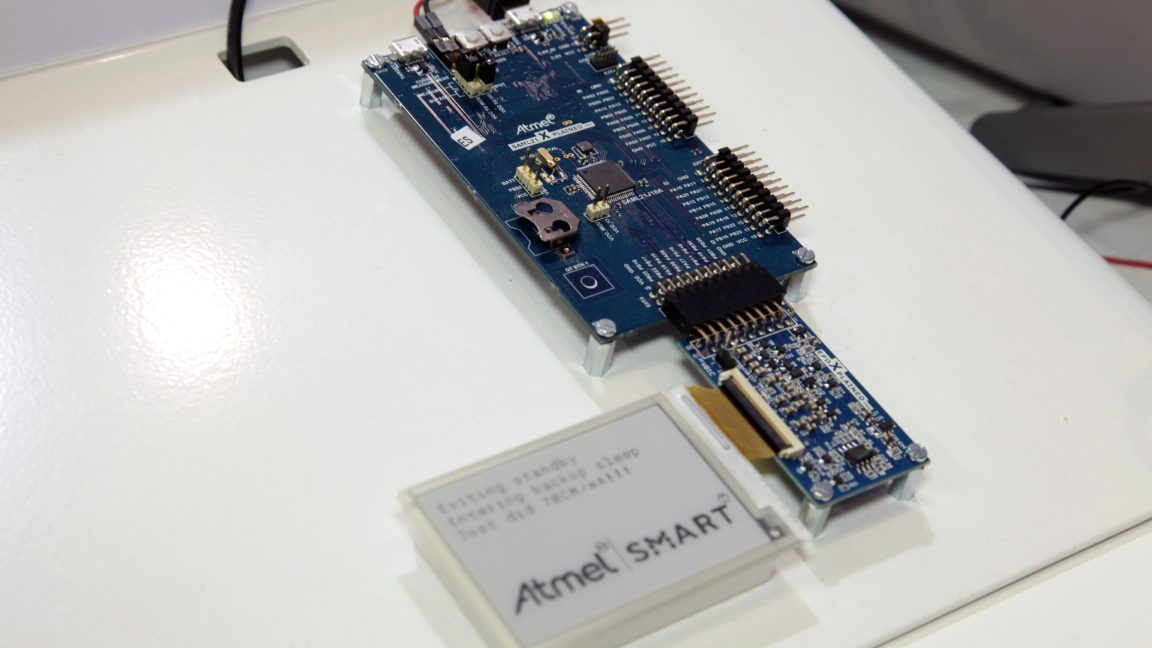
New ARM-powered chip aims for battery life measured in decades
Atmel's 32-bit SAM L controllers, shipping soon, take low power to new extremes .
Ars Technica
187 points · by xbmcuser · 11y ago · 88 comments
  The chip is so low power that it can be powered off energy
  capture from the body, as Andreas Eieland, Atmel's Director
  of Product Marketing for low-power products, demonstrated at
  CES earlier this year.
    The human body generates more bioelectricity than a 120-volt battery and over
    25,000 BTUs of body heat. Combined with a form of fusion, the machines had
found all the energy they would ever need."Combined with a form of fusion". The thing we understand to eventually provide abundant clean unlimited electricity (okay, relatively speaking).
It's a bit like saying "The human trigger finger can exert 300 pounds per square inch of force, and perform over 500,000 foot-pounds of work. Combined with a standard-issue pistol-grip chainsaw, the Zombie-Hunting Academy had found all the weapon it would ever need."
Now, presume there is no gauge at hand to measure a pound less a thermometer to measure fahrenheits. Often outside of commonwealth territories and US we use SI :)
Besides, the Matrix is about how our world is a simulation - who's to say how physics works in their "real" world?
NEO (politely): Excuse me, please.
MORPHEUS: Yes, Neo?
NEO: I've kept quiet for as long as I could, but I feel a certain need to speak up at this point. The human body is the most inefficient source of energy you could possibly imagine. The efficiency of a power plant at converting thermal energy into electricity decreases as you run the turbines at lower temperatures. If you had any sort of food humans could eat, it would be more efficient to burn it in a furnace than feed it to humans. And now you're telling me that their food is the bodies of the dead, fed to the living? Haven't you ever heard of the laws of thermodynamics?
MORPHEUS: Where did you hear about the laws of thermodynamics, Neo?
NEO: Anyone who's made it past one science class in high school ought to know about the laws of thermodynamics!
MORPHEUS: Where did you go to high school, Neo?
(Pause.)
NEO: ...in the Matrix.
MORPHEUS: The machines tell elegant lies.
(Pause.)
NEO (in a small voice): Could I please have a real physics textbook?
MORPHEUS: There is no such thing, Neo. The universe doesn't run on math.
If it were for something like a Stirling Cycle, you'd need a fairly substantial surface area to disburse the heat difference.
https://www.youtube.com/watch?v=nbNnNF9JHFQ
http://www.theregister.co.uk/2012/05/03/unsung_heroes_of_tec...
ARM low power consumption was an accident caused by financial constrains. Small team with no money (Acorn was starting to go downhill at the time) forced Sophie Wilson/Steve Furber team to be clever with resources.
In 1987 hand routed ARM2 build with 30K transistors ran at 8MHz reaching 4 MIPS (of 32bit operations). Coincidentally Intels 386 build by an army of hundred engineers supplemented by state of the art emulation/validation/automation software (Mossim etc, &) and divided into large groups working on individual parts of the design achieved ... 4 MIPS at 33MHz using 275K 2x smaller transistors and >20x the power.
&http://webee.technion.ac.il/people/kolodny/ftp/IntelCADPaper...
&software born from https://en.wikipedia.org/wiki/Mead_%26_Conway_revolution and following Darpa programs
Intel could have built an equal or better chip than the ARM2 but they were worrying about servicing the already established market for x86.
P.S. Is it even reasonable to compare MIPS between RISC and CISC designs? A RISC chip has to execute several instructions to do what can be done in one CISC instruction.
It had great instruction throughput performance by the specs but lacked in real applications, thanks to the sufficiently smart compilers never coming to be.
Intel's sane RISC was the http://en.wikipedia.org/wiki/Intel_i960, somewhat by accident.
Seriously, Microchip uC have now any interesting thing apart of a lot of embed I/O hardware inside ? ARM based uCs now are cheap, low powered and have far better IDEs and compilers...
Lead time is always an important parameter to consider when choosing a new MCU for a low-volume project :-)
I used to start new projects looking on digikey website more than anything.
But in the low-volume markets what wins is usually better software support, and with it's mbed-os(and other software frameworks availble for ARM mcu's), ARM is surely to win here.
PIC is weird. But it does the job and as the other comment said, they had a lot of models with a lot of devices (ADC, DAC, USB, fully configurable ports, etc).
Also cheap and available in "hobbyist" form factors (DIP)
Yes, you would either go to Assembly (which is harder to use than "tradicional uCs" - like 8051 family, Z80, etc), C compilers (some limited), or there was even PIC basic, heh
ARM? Write in C, "fire and forget" unless you are doing something more complicated (like audio synth - yes, I did this)
I'm starting to use ARM dev boards now, because of things like the MHz and the nice compilers available.
Oh look, we just launched a MCU with a power consumption so low that you can keep it powered for twenty years. As long as you don't do anything with it. Of course, every other figure that would make this one useful (such as per-module current consumption, time to sleep) is missing.
It's especially funny when everyone claims they have "the best" or "state of the art" consumption, but when you factor in everything else it turns out they're pretty much within the noise figure of the current state of affairs.
In my whole engineering career, I'm yet to see a press release or a market launch that isn't full of bullshit. Just hand me the bloody datasheet and give me a break, folks.
http://www.tadiranbatteries.de/pdf/articles/20-year-battery....
>Testing conducted by Apple in March 2015 using preproduction Apple Watch and software paired with an iPhone using preproduction software with 5 time checks (4 seconds each) per hour.
This is as compared with simple mechanical wristwatches that are self-charging (through wrist movement) and can be worn indefinitely, or have 72-100 hour power reserves from winding. [4] This is mechanical power we're talking about.
So don't talk to me about decades until you can get more than 48 hours of battery life....from a watch.
1 http://en.wikipedia.org/wiki/Standard_52-card_deck
2 https://www.apple.com/watch/apple-watch-edition/18-karat-yel...
3 https://www.apple.com/watch/battery.html
4 http://forum.tz-uk.com/showthread.php?250883-List-of-watches...
It's also going to do a lot more than the mechanical watches you are comparing it to.
If you just want to tell time, there is a wide market of solar watches:
http://www.casio-intl.com/asia-mea/en/wat/standard/solar_pow...
http://www.seiko-cleanenergy.com/watches/solar/
The Seiko tech runs for 6 months with no charging (left in total darkness).
It's an interesting model - there's some form of drive mechanism for the analog hands that let them move independently of the time. I.e. if you turn it to stopwatch mode, the hands will move to 12:00 and use the minute hand for marking minutes.
I've always wondered what kind of electronics are in there - and if they're even digital.
The input is limited to something like 10 square cm (that's a bit more than 3 cm by 3cm, or a circle ~3.5 cm across). 1000 watts / square meter is usually used as peak sun, so the max input would be ~1 watt (but actual energy captured would probably be more like 1/10 of that).
3 Watt hours is a very respectable figure for a AA battery, so it clearly isn't storing that much power. After looking up that figure, 10% efficiency for the solar cell is probably high.
Until they realized they were completely missing the point, since they were comparing a phone to _a pocket computer with a constant data connection_. Most have since stopped boasting and just silently plug in their phone every night.
A new API,to be released in april, that enables programming mcu's to very low power,easily(versus very high complexity of currently needed to achieve low power). It uses the mbed, which is of similar complexity to the arduino:
http://community.arm.com/groups/internet-of-things/blog/2015...
http://www.technologyreview.com/news/413744/wireless-power-h...
BTW, rf energy is generally among the lowest energy harvesting sources, and in many cases environmental light, vibration(for example on a machine) ,and heat are much stronger energy harvesting sources, and most likely available at low cost.
http://www.greenarraychips.com/home/documents/index.html#GA1...
If it doesn't then just note the time of arrival at whatever server is controlling the network and use that time exclusively. Then you can buy one 64-bit machine and leave it running all the time, and as an added bonus you no longer need to worry about whether each node has the correct time.
That's how computers are able to store, retrieve, and manipulate any variables (like strings) that might be bigger than their address space.