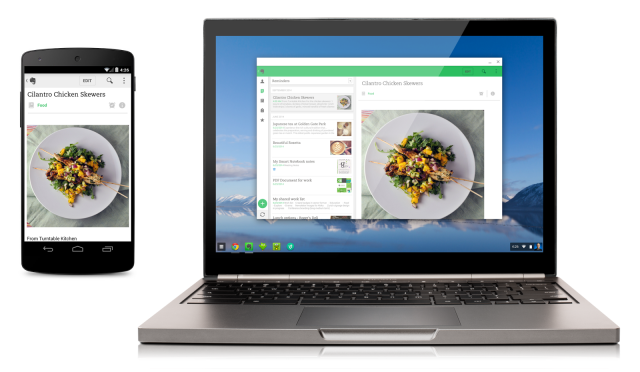
Google’s ARC Beta runs Android apps on Chrome OS, Windows, Mac, and Linux
App Runtime for Chrome" takes a big step toward making Android a universal binary.
Ars Technica
350 points · by ismavis · 11y ago · 132 comments
The overall experience with the Google team has been very positive. Which, in all honesty, surprised me. I was expecting the typical corporate attitude towards outsiders. The way the ARC team has gone above and beyond to help has been refreshing.
I do worry as to how this would affect the openness of the web. A closed source container used to run other closed sourced clients is not my idea of how the Web should be. Even Mozilla is going down this route with their browser apps. Though I have more trust in Mozilla than in Google in regards to having and keeping an open web. Either way, it raises an important question: Where is the Web going in the next 10 years? I wish I knew. Right now it looks like a toss up.
Why are you saying that?
What Mozilla is doing is to develop web APIs needed for those apps and then push for their standardization, but all the apps listed in the Firefox Marketplace are just web apps, having no problem in running in other browsers (assuming they don't rely on APIs that haven't been standardized yet). Google is also doing this with Chrome on Android, as they've also been pushing for certain standards to be adopted that would benefit apps.
Of course, I also worry about ARC or NaCL or Dart (what's with Google these days?), however the work that Mozilla and Google are doing on those web APIs meant for apps is really not the same thing.
That's fairly typical of Google to have 2 or more of everything. Inbox and Gmail, Chromebooks and Android are prime examples.
Ars Technica has a write-up on it that lists more: http://arstechnica.com/business/2014/10/googles-product-stra...
Back in the 90's Windows had a huge monopoly due to network effects - developers would target Windows because it had the greatest number of potential users. But now they will target Android for the same reason because it can run on Windows, Mac, ChromeOS and Android smartphones.
This "Android First" model will affect several major areas, all in Google's favour:
1. It strengthens ChromeOS over Windows.
ChromeOS is already a strong player in the education and low-price sectors. Having a huge range of Android apps will make ChromeOS far more attractive and grow its market share. Moreover if corporate, boring-office-CRUD developers switch to an Android-first model then it will very quickly kill Windows.
2. It strengthens Chrome over Firefox and IE.
Many apps will now require the Chrome browser to run. Oh, you are running Firefox on Windows and want to play that cool Android game your friend told you about? Just switch to Chrome and sign in with your Google account! Again there are network effects - the greater Chrome's market share the more willing developers are to create Chrome-only apps.
3. It strengthens Android over iOS.
Android has about 85% of smartphone market share, but many startups are still undecided about an Android-first approach because a single Apple user generates far more revenue than a single Android user. Having Android run on desktops will push some startups off the fence in favour of Android-first. A few developers switching from iOS to Android doesn't sound like much, but if there are a ever a critical mass of Android-only apps it will quickly kill iOS. Apple should be worried.
4. It strengthens Native over Web-app development.
Ok this isn't a huge benefit for Google, but it is significant for developers. Back in 2005 every startup chose browser-based web apps as their target platform. The rise of smartphones has pushed the pendulum back towards native development, but desktops have remained the preserve of web apps. Many startups now develop both a Web App and Android version of their product - by dumping Web App development startups will now be able to (a) save costs; (b) produce a desktop app that has native performance and better access to Google Play Services.
The one exception could be games, which are a lucrative market. That said, mobile games will offer a limited set of interactions compared to typical PC offerings, which will limit appeal to people who are already playing mobile games but who wish to play those games on their desktop as well. It will increase time spent in the app, but not grow the market substantially relative to new users coming in from mobile devices. And because it requires a browser anyway and because ARC is never going to run on iOS, if the web can advance fast enough to keep the market satisfied (asm.js is a start, but payment is still horribly lacking) then there will be pressure to just do everything on the web anyway.
Interesting times are in store, regardless.
Which is why we don't see a ton of HTML5 games on desktop. Expectations for desktop games are far higher nowadays. If you're competing with a household-gaming experience (i.e. desktop games are generally played on your home computer), we're talking about competition like World of Warcraft, League of Legends, shooters, RPGs, or indeed big budget console games.
And seeing as any of these games can also run on your phone, and seeing as most gamers have phones nowadays, and seeing as your phone gives you a touch-screen experience around which the gameplay is built (e.g. swipe to throw a basket ball), you might as well play on your phone.
There are some exceptions, but not many. At the end of the day though, if the mobile game runs on your phone and desktop, you'll play it on your phone. If the game has a mobile version and a desktop version, and the mobile also runs on your desktop, you'll play the desktop version instead on your desktop. Mobile games on desktop is likely a relatively small market.
Of course this entire thing will shift slowly once you can run mobile games on your desktop. But it won't be a gigantic thing overnight. It's years away.
And considering I fully agree with all your points (Flashlight, nav, cab, Photoshop and Notepad++ are excellent examples of the divide) I think it'll take quite a bit of time before things take a big turn.
It kind of feels like the early Android tablet days. When the tablet app store offered just blown up phone apps. This is going to be that, but even more blown up, and much less finetuned to the mobile form factor. (e.g. things like swipe based UI just doesn't fly.) Of course it was clear that one day developers would build apps that'd adjust to both phones and tablets perfectly, but it took some time and it's still not quite there yet. This will be similar but I think it'll take a little longer, as it's not just a resolution-difference, but also requires developers to build multiple control systems (like swipe). The entire fat-finger vs precise-mouse driven UI/UX divide now needs to converge and it takes time.
In any case, the latest announcement of touch-screen Chromebooks makes a lot more sense now.
I have to wonder if this is why Google decided to implement Pointer Events.
I don't see why the same applications couldn't be compiled to run on iOS, like unity or AIR for example.
And that's just the thing: if your app can be done on the web, you're already going to do it on the web, because there's not a platform on the planet that won't automatically have it. If the website that you already have doesn't perform well enough, then you make a second app while you wait for the web to reach parity.
You're going to think I'm weird, but I don't use the Facebook app, I use the site. I don't use the Twitter app, I use the site. This isn't some philosophical choice on my part, I really just can't be arsed to take the effort to search for yet another app on the app store, and then fret over the implications of approving yet another set of meaningless permissions, and then resign myself to endure yet another app pestering me to update it for the rest of my days.
I accept that there will always be a place for native apps. The web is slow to pick up on new bits of hardware and new modes of interaction, so native will always be ahead of the pack there (though Mozilla is at least attempting to prepare itself for the Oculus Rift with a big push for VR on the web). It's a conservative platform. But once something is Good Enough for the web, you need a very good reason to dislodge it.
Windows and Linux have many, many more applications that are meant for trackpad-and-keyboard-with-'large'-screen interaction. Adding phone and tablet apps to ChromeOS doesn't make it instantly comparable to Linux and Windows.
It remains to be seen if more Chrome OS devices will come with touch screens or if app developers will modify their apps to work well without them.
Editing photos, video, text, is all less productive, slower, less capable, more superficial on mobile. Adding an instagram filter is kind of iconic for mobile's productivity factor in my opinion.
So is ChromeOS suddenly comparable to desktops if it can run mobile-productivity software? Of course not. Far from it.
This may change as we're seeing mobile/laptop blur a bit (iPad Pro with force touch, a stylus and USB ports for externals, 12" Macbook with Intel Core M processor, for example. Or any of the 2-in-1s, the MS Surface etc). Once we see Mobile software running on Laptops, and see Tablets equipped with a keyboard/stylus, converging around the 11" form factor, with ever improving mobile chips, then we'll probably see more 'real' productivity software.
But it's a bit too soon to call ChromeOS comparable all of a sudden. It's a great move, though. I remember you couldn't/can't even run Skype on ChromeOS. Soon, stuff like that will be of the past, without requiring massive Tizen-like investments to have developers completely rebuild a hundred thousand mid-high quality apps for your store.
Oh, because if you add an OS made for touch/small screens on a notebook equipped with a keyboard, that immediately makes it as good as regular desktop OS ?
http://lifehacker.com/how-to-run-android-apps-inside-chrome-...
But in future the simplest way for a developer to provide the same functionality on both desktop and Android smartphone will be to create a single Android app.
Really, Chrome itself isn't so much a web browser any more. I swear, at some point they're going to let you generate seeming-OS-native-binaries from Chrome Apps which will then bootstrap themselves by silent-installing Chrome—but only the "app launcher" part, not the "web browser" part. At that point, Chrome will be a capital-P-Platform: exactly the same as Silverlight/Adobe Air/etc.
It's interesting that what you're describing is actually been done by Mozilla, when they separated XULRunner from Firefox. A few apps already use it², including Google's own Analytics Editor, but it needs to be way more polished to make it attractive to the general app developers.
¹ http://www.youtube.com/watch?feature=player_detailpage&v=j8o...
Or Flash, or Java...and look how well things have worked out for all those "write once, run anywhere" client app platforms!
Straight out of the MS playbook, 'lets use our dominant browser as a pincer move to gain developer/market share'.
The other side of the medal is that this might slow down progress on the open web-platform as developers would rather develop a native android app than put effort to make a web-app.
It somehow funny: Recent developments around the web platform (service workers, etc) are supposed to make web-apps compete with native apps and even Microsoft is starting to embrace this (web based skype). At the same time now native apps run in the web. It will be interesting how to this will evolve.
It also shows why Google developed NaCL and that it doesn't really matter that it hasn't been adopted by other browsers. Because its main use case is for ChromeOS.
We now have a development platform for desktop quality apps in a proprietary format that run via a plugin in the web and in a runtime on desktop.
The only missing link is publishing the plugin so other browsers can run the apps, oh and renaming it to Flash.
ARC is going to be the next Flash(TM). And now developers still have to target multiple platforms (web, android, ios), instead of just the web.
That leaves things like Scala, Kotlin, Grovy, etc.
Once can take advantage of this in interesting ways. If you are Myriad and you have a Java(tm) runtime for mobile devices, you can skip (or reverse) the Dalvik bytecode translation and run Android apps in your runtime. At which point Oracle sues your ass, and the settlement is confidential. You can see this approach at work in the Jolla handset.
That aside, this will seriously increase the appeal of Chromebooks - who doesn't want a simple, secure platform that can run all the bazillion Android apps? Google just needs to pay some more attention to Chrome OS desktop interface - it is shitty frankly.
Now that there's a supported way to get Android apps running on people's desktops I could see this becoming more of a thing, especially for things like photo and document editing.
Too bad its still Java though :p (with many advances in sandboxing and security), but I guess Google/Android didn't really have much of an option back then and I'm honestly not sure what would be the better choice now.
https://medium.com/@seanmdixon/run-android-apps-in-chrome-78...
a) Android becomes the "write once, run anywhere" platform, attracting developers away from native iOS development.
b) Android loses app exclusivity that pulled/locked users into the platform.
Was that ever a thing? I can think of apps that had this effect for iOS, but did it ever work in the opposite direction? I got Android because it's less expensive...
I also like being able to configure my homescreen and having different keyboards (though the latter's shown up in iOS now)
There's some feature differentiation for sure, though iOS has the advantage on some things (I would kill for fingerprint unlock)
[0] http://www.technobuffalo.com/wp-content/uploads/2013/04/Face...
I already have all the Gmail and hangouts on my desktop I could ever want. I don't think I'll use the Clojure REPL app in lieu of $> lein repl or the Maps app in lieu of my browser. To a first approximation, apps are better than nothing but I don't see this as a Windows 8 app killer ~ their standard of fit and finish is generally higher.
There's a niche where this will be great but I don't see an app replacing audacity or blender anytime soon.
Edit: reading further, PNaCl happens to be a subset of LLVM IR. The Emscripten code could probably be repurposed to run NaCl and thus Android apps everywhere.
Google is the only reason Java is not a dying Language.
Yahoo! (search, infra),
LinkedIN,
Twitter,
NetFlix,
Square,
RelateIQ (startup, bought by Salesforce),
Salesforce (itself),
Google,
RedHat,
Facebook (I'm sure there are a few teams that have to use Java),
Yammer,
the list goes on and on and on...
Looking to how the Android team deals with anyone that dares to use the NDK, I bet if they had the freedom to choose the NDK would never had been made available.
If you are an app developer, you want your apps in front of as many people as possible, regardless of their device.
Or, for the kids, this may mean Minecraft Pocket edition on the Chromebook :)