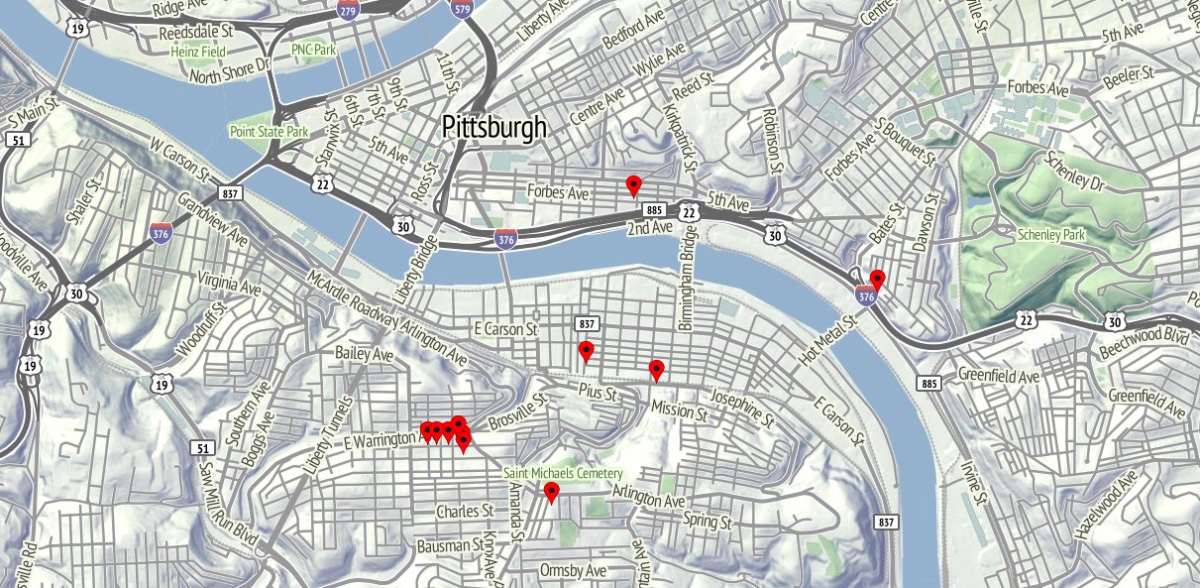
12 communities experimenting with mesh networks
Whether to get around traditional ISPs or to bulk up resiliency in the event of a disaster, these mesh networks are worth knowing about.
Technical.ly
34 points · by carybeta · 11y ago · 14 comments
If you were to put up a big WiMax antenna, you are the single point of failure - you could spy on the traffic, you could banish specific clients, and if you were to disappear, everybody in your neighbourhood would be without internet.
A mesh network allows none of these (in theory), because there is not one single point of control.
It's different from what you describe in that a typical WiMax antenna setup mirrors the star topology typical with network switches. Clients are connected to a piece of infrastructure, which is in turn connected to a larger piece of infrastructure, and so on up the tree.
In a mesh network, clients are connected to each other without using infrastructure as an intermediary. Every node relays traffic for its neighbors, and you reach distant points by hopping through many of your neighbors (or you don't, if they don't happen to currently be arranged in a way that facilitates that).
A good mesh network system has intelligent routing algorithms that are some combination of fault-tolerant, efficient at finding the shortest path, equitable in distributing load, and designed well in terms of incentive structure (so that people do not freeload by acting as clients but not relays).
If you are using a mesh network to reach the internet, you are still dependent on the nodes that route between the mesh network and an actual ISP, which presumably pay for the privilege and want to recoup costs somehow. However, it can be a decent way for a community to roll its own last-mile infrastructure, provided it can purchase wholesale transit somewhere within the mesh, and drive enough participation that there is sufficient capacity between you and the backhaul most of the time.
The more interesting uses are for meshes that are not (mostly) about Internet access. There is experimental work on protocols for messaging and durable document storage/publication (think Wikipedia but without web servers) that work well on meshes, providing pretty good internet-like capabilities to areas where access to the actual Internet is impractical. (Some of this is embedded in OLPC/XO).
So I don't anticipate meshes replacing traditional ISPs any time soon.
Crowdfunding SEC rules + neutrality ISP rules could very well open up an opportunity for crowdfunding municipal ISP's. Communities run their own mesh and rent fiber from an upstream transit probider.
So it's possible, but I don't think it's a good model for how most Americans are likely to be using their internet connections. Most of their use would likely be the mesh as transit to the uplink and then off to Facebook or Amazon or Netflix.
I think the lesson is that meshes and traditional systems have different strengths and weaknesses. One isn't always a good substitute for the other.
There should be an incentive for individuals to participate. A thread of catastrophic communication system failure (as in case of a natural disaster) is not enough to stimulate the deployment. But the promise of income is.
Would you be inclined to install a mesh node if it gave you a small income stream?
What goods/services can people buy with your "income stream" system?
The problem, I think, is distributed accounting - in the presence of untrusted and malicious nodes. Micropayment transactions need to work faster than existing systems like BTC, to be able to support fast call set up, for example.
I am taking a good Coursera course "Fog Networks and the Internet of Things" that covers edge networks. I am also planning on including a section "IoT and Edge Fog Networks" in my new book I am writing.
There is a lot that can be done at the edge (collecting and processing local data, sharing computational resources, etc.) without needing LTE/core or the cloud.