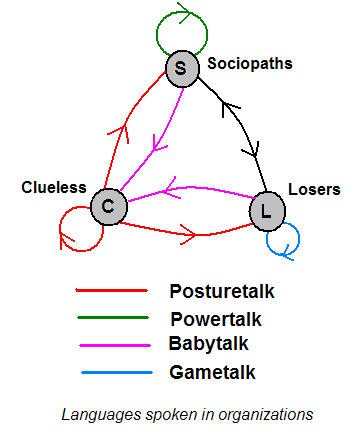
The Gervais Principle II: Posturetalk, Powertalk, Babytalk and Gametalk
We began this analysis of corporate life by exploring a theoretical construct (the Gervais Principle ) through the character arcs of Michael and Ryan in The…
Ribbonfarm
84 points · by cool-RR · 17y ago · 32 comments
I am also surprised by the number of people who seem to think small/startup companies are immune to these dynamics :)
(p.s. I did spend 1 year as the first employee of a startup... I found the same dynamics to apply, mutatis mutandis). Anyway, thanks for reading and keep the great conversation on!
Venkat
That said I'm sure there are a lot of bright kids around as well.
I also like the way he actually explains the connections to other books and posts when appropriate instead of just referencing them and assuming they have been read as I've seen some other authors do.
Compare this to what someone like Seth Godin (who, I actually like). He creates one word per book.
If you are writing books or blogs or other things that people read by choice, you are very limited in how much you can do here. It's like adding equations to a pop-science book. Formal courses (EG at universities) can force you to understand new vocab (or equations) and build on that knowledge. The problem is that this means they don't need to be sparing.
Venkat doesn't have that kind of privilege. The only way he can make you do hard things is by making it pay.
Worth a careful read is one hell of a compliment.
The only winning move is not to play.
How about a nice game of chess?
<so sorry - couldn't resist..!>
I would truly appreciate advice from someone who understands my situation. I am not interested in sympathy.
I think a key takeaway from that article, that the author didn't get around to stating explicitly, is that for a 'sociopath', _everything_ is a negotiation. Everything. In fact, all of Powertalk is subtle positional negotiation hidden in everyday language. (For the security research-minded, I think a helpful metaphor might be covert channel information attacks/information passing).
If Powertalk is negotiation, then learning how to actually negotiate might help. Luckily, there are hundreds if not thousands of books written on the subject. _Negotiation Genius_, by Malhotra, _Bargaining for Advantage, by Snell, and _Negotiating Game_, by Karrass are all seminal works. I've found them helpful.
(Note that these books are usually written from the perspective of someone trying to sell a thing or a service. It takes a bit of a mental leap to figure out how to apply these strategies to the rest of life, but if you're intelligent enough to be a reader of Hacker News, I'm sure it won't be that hard.)
http://greenlightwiki.com/improv/Status
start reading Robin Hanson's blog Overcoming Bias, he's an economics professor who posts a lot about signaling.
Theater/acting related metaphors and ideas are pretty central to the way I am developing the series... the next piece is shaping up to be even more theater-informed.
Overcoming Bias is a good reco -- I used to read it regularly, but (pot-kettle complaint here...:)) I couldn't keep up with the length of some of the stuff, especially by Yudkowsky. Hansen is thankfully briefer.
Venkat
One thing that confuses me is when it's strategic to act high status, and when it's strategic to act low status. For example, sometimes, when you need something from someone - do you want to raise their status, and make them like you? Or do you want to convey high status, so they will want to associate with you? Or should you try to juggle raising your status and then lowering it, in order to achieve the illusion of parity?
E.g. Selling to a customer, getting a job, getting help with something in the workplace. . .
Somebody has got to have written something about this. Please help.
the original. so lucid I doubt it will ever be dethroned as the best. hmm, can't find an online version right now even though I know multiple sites have a plain text version. anyone have a link?
a direct answer: I personally think it's better to act high status the vast majority of the time, only acting lower status when it is absolutely required. when I started doing this people's reaction to me immensely improved (night and day difference).
You don't need to "relate", or "understand" other people. You just need to recognize and develop an appreciation for their point of view, even if it doesn't make sense to you.
The best way to do that is to immerse yourself in it. If "people" were a new programming language that you needed to learn, how much would you dedicate to learning it? If it were a language that you would be required to use for the rest of your life, how much would you give to it?
It won't be easy, and it won't come all at once. I assure you, as someone who has gone through all of this, that it is totally worthwhile. Professionally and personally.
Listen to gossip, try to understand the way your boss feels about his boss. About his peers. About his portfolio. And look for leverage.
<PostureTalk>I find it exhausting and truly boring so I don't do it. But maybe that's because my personality doesn't enjoy power plays and I want a happy life over a rich/powerful one.</PostureTalk>
This is the most important line of the article, in my opinion.
First step to learning how to play this game is setting goals for yourself which will expose you to real risk if you were to try to achieve them in earnest.
In the tech world the most common place this sort of game is played out is the recruiter/engineer relationship. Spineless developers are favorite targets for sociopath recruiters. Next time one of them calls you, treat it like a game in which you are trying to dominate him or her.
In either or any case, nice!
Edit: Oh, you're serious. Oops. Well I enjoyed reading it as sarcastic gametalk ;-)