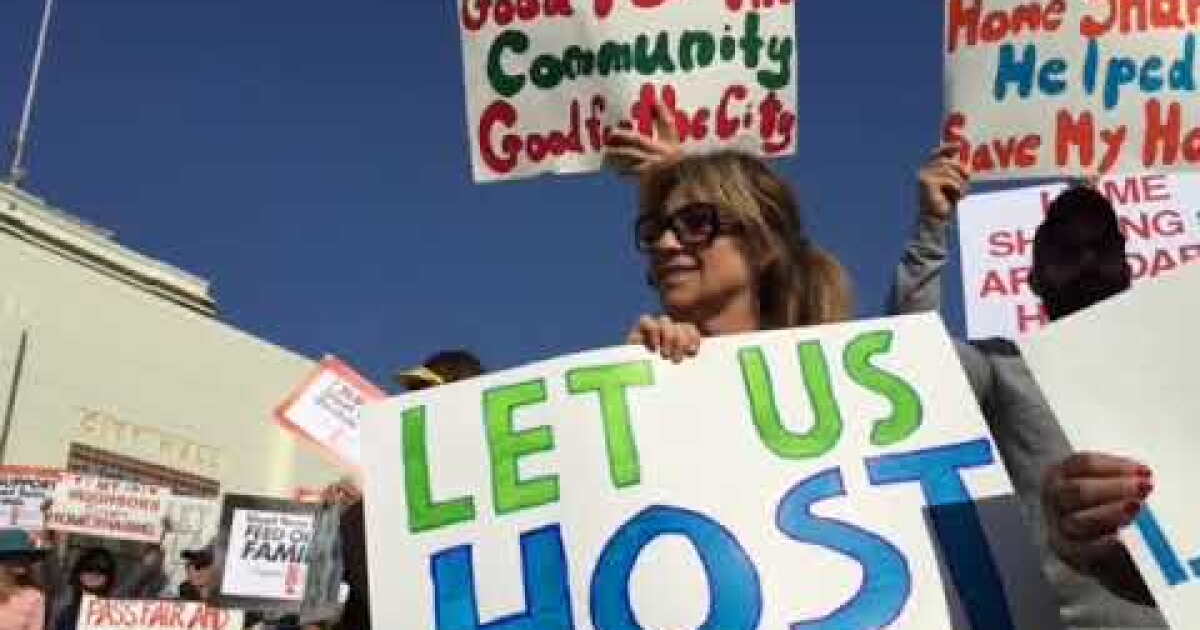
Santa Monica council votes 7-0 to crack down on Airbnb
Los Angeles Times
241 points · by adamio · 11y ago · 409 comments
People like to invoke the evil "hotel lobby", which I'm sure does exist!, but it is not even a little bit hard to find loud, angry citizens complaining. Those complaints are entirely predictable: people buy or rent residences in buildings expecting those buildings to be inhabited by long-term residents, then some part of the building gets converted to a hotel. People aren't OK with that.
There are also places where vibrant short-term rental markets may exacerbate tight housing markets.
I've had nothing but good Airbnb experiences, in SFBA, NYC, and London. I hope Airbnb works this out. But they don't really hold all the cards here.
The owner of my apartment building has set up an illegal air bnb in an empty apartment(I'm going to guess this is a rent controlled or stabilized apartment "under renovations"). Usually it isn't an issue, besides for frequently seeing groups of strangers come in and out of the building. Last week though, a lovely fellow decided that, after drinking what must be approximately 2 liters of wine, he was going to pick my door to puke outside of(5 floors below his air bnb) at 2AM. He then started crashing into the wall separating my bedroom and the hallway a number of times. Then he went down into the lobby, puked some more right in front of the door, then peed in the stairwell. I think it's pretty straight forward to see why tenants don't want air bnb rentals in their residences.
The externalitati.
Solution? Instead of allowing building managers/owners to allow/disallow short term leases by their lessees as determined by the externality-including market value of such a policy, let's just ban it altogether. The principle of the least-elegant solution.
This "thing", is exactly why so many municipalities have explicit laws on the books regulating and taxing hotels.
NYC might be an exception as it seems like subletting is a big thing there.
AirBnB has hit that (several times, in several ways). Uber has hit that. The general tech industry and tech culture in the bay area has hit that. Drones and to a lesser extent, 3D printing, are getting pretty close. On demand services (Instacart, etc...) are close as well.
Instead of looking at it as a licensing opportunity, they are doing the same as music industry did with every new recording medium that came about.
But by then it will be too late, and the true disruption will happen and change everything about manufacturing small goods at home.
I'm not sure I'd want an amateur's DIY 3d printer in a 40 story apartment building. These things are usually left running unattended overnight.
Sorry about going off-topic.
Chesterton's fence comes to mind:
The debate often sounds like it must be 100% of either.
Some buildings won't take care of it (especially in situations where people are buying whole buildings to rent out), leaving their neighbors without much recourse without regulation.
I understand the argument for apartment buildings. If someone in your building buys/rents a unit, then puts it on airbnb, they decrease your security because strangers are going in and out of the building.
I do not understand the argument for an entire building. If I own a building, it should be my right to decide who stays there. As long as the airbnb guests are not throwing wild ragers, I don't see what argument the neighbors could have.
Not necessarily.
In some cases the ability to have tenants able to rent out their units will allow the landlord to charge more rent for that unit, because the tenant is able to offset the rent. That is good for the landlord, but not good for the other residents who are bothered by the short term rental activity. As others point out it can also add to an increase in rental costs by creating artificial price pressure since tenants can afford to pay more.
I think the discussion comes around to controlling people's activities within their homes and on their land. If you own a home no one should be allowed to tell you who you can and cannot have over to your house and what type of home business you operate.
If they want to regulate something, which may be necessary, simply enforce already existing regulations and policies regarding noise and disruption. Who is the local government to tell you for how long you can or cannot rent out your home to to someone. Are they going to crack down on renting out a loft to a student too?
So your issue is with zoning laws. So, if you buy a building in a zone that allows you to run an AirBnB-type business, would you be okay with the zone changing after you've made your purchase? Because your asking the residents of these spaces to accept the opposite.
The congress can.
[The Congress shall have Power] To regulate Commerce with foreign Nations, and among the several States, and with the Indian Tribes;
So ... if it is from other state and money exchange hands - you are under its authority.
The interesting question is, where do you draw the line at what should and shouldn't be regulated?
Hotels are prepared to deal with problems that tenants may cause. Locks are re-programmable between stays. Security, housekeeping and maintenance people on staff. Etc.
In a condo building, any problems caused in the common areas are going to end up being the responsibility of the association. Which is generally going to be ill equipped and probably unwilling to deal with any issues since they are getting no benefit from it.
Of course, this always depends on your definition of "abusive" and your beliefs about the role of government (or other) regulation.
> people buy or rent residences in buildings expecting those buildings to be inhabited by long-term residents, then some part of the building gets converted to a hotel.
I'm just not sure why the duration of a resident's stay has relevance to neighbors' preferences or government regulations. What are the neighbors' actual concerns, and why can't those be handled directly? If it's excessive noise, then isn't that just as bad whether it's a long-term resident or a string of short-term residents? Same goes for any other concern I can think of, like maintaining the outward appearance of the property.
It's not complicated.
These aren't people patrolling every apartment in the building (some of these buildings are huge). They're tenants who are noticing the actual externalities of Airbnb tenants.
> It's not complicated.
Everything is complicated when the government gets involved and starts inventing regulations.
Close quarters living like we have in major cities is a very delicate dance that involves building a relationship with your neighbours. Introducing someone not committed to that can absolutely cause huge problems.
Because they could be fined or otherwise penalized for violating noise ordinances, which apply just as well to short-term and long-term residents.
Long-term residents tend to have more of a need/interest in keeping the peace with their neighbors.
Hard to swallow an outright ban though. Then again zoning regulations have a purpose.
What, next we're going to require Sally's lemonade stand comply with Sarbanes Oxley??? I can't stand it when people want to bend the rules just because things are not turning out how they had hoped or in their favor.
AirBnb is a pretty big corporation at this point, they should start playing by the rules.
Generally rules are designed for general case, yet in some (legally or not) specific cases we just close our eyes. Sally's lemonade stand is an exception - even though agencies could fine her to oblivion we just don't do that, because it is more beneficial for society. If she starts doing that on any scale larger than several hours per month, then it could very well be entirely different story.
In some parts of the world it is illegal to be drunk in public. Bars are public, buses are public. Even though you are braking the law just by going home on a bus/taxi after a night out, noone will arrest you if you are doing that quietly.
Hotel is by definition place that provides lodging on short term basis. And general rule is that hotels pay taxes. Again noone is going to extract taxes for allowing some friend of friend even if it involves direct or indirect (we call it barter) reimbursement.
AirBnB is not letting friend of friend stay for a night. It is a business. So, please, stop bending the rules yourself and try to claim that lodging regulations should not apply to AirBnB.
> What is it whit this damn country that people want to just start bending definitions and terms to fit their despotic little minds will.
I actually mostly agree with this. Laws are generally designed in a manner "mostly people will not do foo or neighbourhoods will sort it out themselves, therefore enforcing regulation on foo will be more expensive than revenue generated". And then come people like you, who try to bend definitions in a way that implicit social contract works in their favour.
Hotels may be corporations, but they can also be other business forms, including sole proprietorships or partnerships. Sole proprietorship hotels aren't particularly uncommon. You are the one bending definitions.
> What, next we're going to require Sally's lemonade stand comply with Sarbanes Oxley???
Most SOX provisions apply -- by their text -- to public companies; except things like rules prohibiting willful destruction of evidence related to a federal investigation. Obviously, by the text of the law, the former wouldn't apply to a typical lemonade stand, and, the latter wouldn't apply to anything a typical lemonade stand would do even to the extent that the rule would in principal apply to them.
and frankly, all airbnb renters should be treated as a class(or a franchisee), in which case they are more like a corporation then a sole proprietor.
From personal anecdotal experience, when traveling alone for short term, chain hotels are frequently cheaper than AirBnB - the host has to hit you up with cleaning fee per stay, while a large hotel has economies of scale working in its favor as far as cleaning, parking, utility bills and other stuff.
Besides, couch surfers typically stay in the same house as the current resident, and he/she has to maintain good relations with the neighbours.
The apartment adjacent to mine recently got turned into a short-term rental place. Most of the time there's no problem, but every couple of weeks an extremely loud group of tourists comes over and treats it like a party house, making tons of noise, blasting soccer games on the TV with associated loud cheering, etc.
Pulling up AirBNB listings for a random week a few months from now in SM also makes it look like most of the stuff being listed is small apartments/houses, not the swanky giant houses that would be well outside the market of the typical renter who's currently being squeezed. However, it's unclear from a cursory look how many units were permanent rentals versus "I travel on business a lot so I can have guests stay when I'm not here" type stuff which is much more reasonable.[1]
There's a fair bit of new residential construction going on, but it doesn't seem like enough yet, and I think a city—especially one that already has an easily-healthy number of tourists/visitors—has more responsibility to residents regarding rent than to visitors who are experiencing a likewise-overheated hotel market.
[1] although it's not a pleasant thought to think that for many people, things are tight enough that the money made from renting out their place (and the risks that go with it) when not home is a significant boon to their life.
A good friend lives in a nice building in SM, the owner wont fix one of the elevators because he is trying to push the seniors out that pay less then 50% of the current market value, so he can raise rent.
"expecting" is little slippery - do they have actual contracts spelling that out?
While not a literal contract, certainly a layer of legally encoded social contracts with a long history.
But isn't that what Home Owners' Associations and condo bylaws are for? If you don't want to risk this happening in your apartment, don't buy one that permits other residents to do this. Thank you Market.
I think this is always the main motivation of replacing one-size-fits all government policy with the ability of smaller components governments to decide on their own, for any political issue.
The mini-governments could enact policy that meets the demand of constituent groups within a small corner of the larger entity, vs being forced to follow a "majority" position mandated city-wide that does not match minority preferences.
In a situation where HOAs/bylaws do not allow renting on airBnb, there already exist proper legal channels for enforcing contracts, and these extra regulations are not needed.
Your comment made it seem like these extra regulations somehow ease these complaints (which you are implying are legitimate). Is my understanding correct?
I have used Uber -- and I love the concept of free people making side deals with property/time they have to earn a little extra cash. Been going on forever. Likely will continue. With or without some kind of community oversight.
Which brings me to my point: must we always be swinging one way or another on a pendulum? For the vast majority of transactions, it seems like we've solved this for both sides of the transaction, buyer and seller. The remaining piece is negative externalities.
Part of the problem here is that most anything you do in life is going to have some sort of negative externalities, the only thing that changes is the magnitude -- much the same concept as anything you consume is a poison, the only thing that changes is the dosage.
It just seems that the scales will always be tipped against guys like Airbnb or Uber. If a million people rent an Airbnb apartment and one person gets killed or raped? Headlines will say "Airbnb leads to killing and rape on the east side!" If the same numbers happen in a hotel? No headlines.
So even as a libertarian I'm in favor of some reasonable kind of accommodation between banning and complete laizzez faire. The problem is that I've yet to see anyone define "reasonable" in a way that doesn't sound like a knee-jerk reaction.
And let's face it, these kinds of transactions will continue no matter how many city councils vote them down. The problem needs a public airing and 100 possible solutions tried. I'm sure one will work. Perhaps some sort of insurance with all risk factors made public? Neighbor rents out his apartment as an Airbnb and partygoers destroy your yard? File a claim. You get your yard back, Airbnb has somebody who handles these problems, and the neighbor's insurance rates go up. We see this a lot with driving: the ticket isn't much of a concern for folks, but the rising insurance rates hurt for a long time afterwards.
Why is the answer not "get over it"? What's their legitimate complaint about having short-term residents nearby? If people are complaining about bad behavior by those residents, punish that.
You own the property; rent it as you wish.
That is absolutely false in 2015 compared to the past, and since your premise is completely false its very sad that this is top rated comment....a sad commentary on the present bad state of HN.
Is the solution to have governments ban AirBnB all over the world, or do you think people might be able to just agree on house rules that forbid disturbing other residents at night?
It's amazing how blind people are to common sense.
Is one form of demand morally/ethically superior to another?
EDIT: Downvotes? I thought we were all being nice?
Hawaii, for example, is pretty poor. If we halted the renting of property, then presumably available long term housing availability would increase... yada yada yada, housing prices become more affordable.
At the same time, tourism would crater and the locals would have less income.... yada yada yada, housing is relatively expensive again (until some unknown economy evolves).
If you think the idea of letting some unknown economy evolve to make up the deficit from tourism is morally/ethically acceptable, then is it not morally/ethically acceptable for me to say "people should move to where they can afford housing?"
Besides, shouldn't outsiders be allowed to enjoy the natural beauty of a place? They need to sleep somewhere when they visit.
My only concerns are 1) the diminishment of property rights and 2) the idea that we can artificially force equilibrium without negative feedback. I'm not in favor of gentrification, but I do believe property values should reflect demand.
I don't think the idea is black & white, nor is this some libertarian position.
By the way, I completely agree with you. I actually live in Los Angeles county, and there NEEDS to be regulations regarding housing. This city is so crowded and congested.
For the record, I'm not against Airbnb, but city are zoned and regulated for a good reason. Airbnb needs to work it out with cities on how to allow their business to operate.
It's a strong hint to the community to cut back on negativity.
Emphasis on this: "Avoid gratuitous negativity" - the gratuitous part.
So just write in a contract "This residence can not be used as a hotel". Done, problem solved. Why on earth do we need government's involved again?
> There are also places where vibrant short-term rental markets may exacerbate tight housing markets.
AirBNB in a small influencer in the housing market, i would be pretty disgusted if my elected officials were pursuing airbnb in an effort to normalize the housing market. To me it would be like the capitan on the titanic telling everyone to start hauling water to save the ship.
> I've had nothing but good Airbnb experiences, in SFBA, NYC, and London.
I have never used it personally but to me it seems everyone who has a complaint isn't using it and is being affected by externalities which they can only fight using the government.
Any other actions disgruntled people would otherwise take would be illegal by nature due to property rights.
This is already part of any rental contract. People just choose to ignore it.
My parents rented an AirBnb (in Santa Monica incidentally) and they where instructed to tell the neighbors that they are friends of the owner.
That's a very standard clause in most leases, and in some agreements that mutually agree on restrictions of use of owner-occupied housing. City zoning regulations also apply to many of these situations. Right now there are many, many, many (but not all) Airbnb rooms that violate multiple legal agreements or applicable laws that apply to the person offering the rooms on Airbnb. It remains to be seen what form of enforcement will work best to make sure those lease agreements or other contracts are honored, and the zoning regulations obeyed.
EDIT: Several comments here mention the legal history of how regulations developed in the first place. As Justice Oliver Wendell Holmes, Jr. wrote, "The life of the law has not been logic; it has been experience."
Actually, I've never seen a lease that allows subletting as an AirBnB. It's always against the rental agreement. AirBnB are basically just facilitating people violating their signed contracts, and we mostly look the other way because everyone hates landlords anyway.
Santa Monica has, by some indices, the most expensive hotel rooms in the state. This has driven a huge demand for short rentals near the beach. I have no access to numbers but my personal anecdata is interesting for the number of people I know involved in grey-market short term rentals and the number of people unable to find available apartments, let alone available apartments anywhere near the rents 2-3 years ago pre-AirBnB.
I did protracted apartment searches in the same area of Santa Monica in November 2012 and 2014 and the difference in price and availability was immense. At the same time I had one friend who was making a full time job out of "hosting" for AirBnB-ed condos and apartments either bought or rented in the past year by deep-pocketed "investors" in Malibu and Santa Monica with the sole purpose of short term rentals. I know another young lady who rents three apartments and lives in whichever one is earning the least on AirBnb. She nets about $1000 a month doing this and manages to take 3 single residential units off the market in the process.
There's a lot of people doing variations on this business model and it is absolutely pushing out the longer term residents. I've seen many of my beach friends (mostly involved in entertainment, good living wages but not anything like tech wages) progressively pushed further and further afield as random housing events (unit selling, massive renovation, roommate disputes) mean they cannot afford to relocate anywhere near the place that they are leaving. That is also despite their earnings increasing through normal career progression.
My parents came to visit last Christmas and they used AirBnB to rent a back house for a week a few blocks from my apartment. It was great. Do I think that shouldn't be allowed? No, but considering their host was running a year-round business out of their home I don't think it is unreasonable to treat them like a business.
Not saying I agree with this but it's something that should be considered.
I have a lot of family out of state, and when they visit, it's great that they can rent an entire house on AirBNB/VRBO. We did this for my wedding (in Santa Monica) and it worked out fantastic.
When I travel, my house is basically empty. I don't see why I can't rent it out to another family.
I agree AirBNB should charge the hotel tax & all that, but the approach of outright banning whole unit rentals seems wrong.
That said, I agree that AirBnB guests should pay hotel tax. Otherwise they have an unfair advantage.
However, I do think that this is very limited to areas of already high demand and shouldn't be a blanket policy across a whole region.
That doesn't make any sense. $333 from an apartment per month in Santa Monica.
You've been lied to.
On the other hand, I just got back from traveling to Europe, where all of the bookings we made were AirBnB. My wife and I were traveling with our 4 month old baby, and there weren't any hotels that could really meet our needs as well as the apartments that we rented. The trip would have been much harder without AirBnB.
I think Santa Monica went too far here -- they should have left some wiggle room for folks who want to rent out their place on weekends and such, like the folks we rented from in Vienna.
Also, when I stay in a real hotel, there have been many times when folks were noisy and disrespectful.
What happens when your neighbor decides to rent their place via Air BNB, And folks are noisy and disrespectful.. Who do you complain to?? The home owner?? Do you think he's going to kick the people out? They are a revenue stream, and you are not.
Well.. you may say. I'll call the cops. Ok. Your neighbor gets a warning.. then eventually a 300 dollar fine.. Your neighbor can afford a few fines a month from a few random loud nights as long as the air bnb money keeps coming in. In fact your neighbor will need to make sure their place is full more nights if you start calling the cops.
The problems that almost everyone seems to talk about are the (rare) bad actors -- the loud, disrespectful, messy, troublesome guests who ruin the residential experience for others.
So I wonder if the solution is in the platform itself -- it's not AirBNB that people don't like, it's bad AirBNB'ers. And maybe if AirBNB puts some real effort into cracking down / banning / preventing bad AirBNB'ers, a lot of the bigger issues & externalities go away...?
I think this will need to be settled in court, but it is absolutely disgusting to try an apply a hotel tax to someone who is renting out a single place. Sure, classify a company that owns and rents out several places as a hotel, because they are at that point, but don't fucking tell me what I can do with my house on my land. It's disgusting.
You can move to the backwoods of Idaho and rent anything you want. If you want to live amongst people, then act like it.
(I have a theory that a large part of why the Valley wants to put so much of civil society to the torch is because there isn't much of one there, now that very large corporate interests have a stranglehold, but I cannot prove it.)
Also, it seems reasonable that hotels and Airbnb comppete on a level playing field in terms of tax and regulation.
All that said, I think they need to find solutions that accomodate all parties: Hotels, short-term rentals, and the housing market for renters.
Sure. So why does that automatically need to be resolved in favor of increasing regulations on AirBnB rather than decreasing them on hotels?
? Did someone say that it did?
One issue is how to fund government services if revenue from hotels/short-term rentals are decreased.
That doesn't necessarily make them sensible, just less controversial because non-residents don't get to vote.
It really is that simple. Don't deprive other people of choice because you don't want to choose.
I agree. The regulations were written for a different market; new regulations are needed that provide a level playing field for competition, which means hotels aren't at a 14% price disadvantage and short-term rentals can cost-effectively comply.
It's going to take some innovation.
(I'm assuming the hotel regulations are too onerous for short-term rentals, but I don't know much about them.)
I just hope we can come to a point where perhaps there is a way to allow airbnb to exist, while making it illegal to rent out property purely to rent it. This could allow it to be more like the bed and breakfast logging that it tends to feel like. I'm thinking restrictions to aid this are artificial limits to how many people/how many days per year you can rent out rooms in your home, which airbnb would be required to record.
I still have no idea how things like sanitation will be handled. Right now an airbnb host has very little obligation be sanitary like a hotel, except that it might make their reviews worse.
The primary housing problem here is an influx of people from more-expensive cities (LA, SF, Seattle, NYC) moving in and snapping up homes to actually live in. Meanwhile the city is making it difficult for developers to add any real housing density within the Urban Growth Boundary (and instead are thinking about expanding the UGB. Ugh.).
So there's no real "problem" aside from Portland is a desirable city to live in and people are flocking to here.
1. Pricing in major markets is no longer competitive with hotels. Since most Airbnb properties lack anything close to the amenities offered by hotels, it's just not economically compelling anymore.
2. The last several times I've stayed, I've felt the effects of the new scrutiny. I've been to clandestine meetings with hosts, purportedly on premises, only later to find out that the listed address is false. "Enter through the alley door," and, "Say you're my cousin, if anyone asks" are typically elements of the conversations. That's not what I pay for.
Now, my first choice is hotels, and it's only the rare case that I opt for Airbnb.
Why? You're making the notion of landlords illegal? What purpose does this solve, what benefit is there? Why should I not be allowed to purchase a house and then place a tenant in it?
In many places the rental community is larger than the homeowner community, these houses would simply sit on the market, rather than have someone buy it and put a renter in it. How on earth can you justify making home rentals illegal?
Not taking any side in this debate, but that makes some economic sense to me.
Why is this bad?
It makes houses within walking distance 2-4x as expensive, houses in the target area about 1.5-3x as expensive.
Without Airbnb, the only difference is that you'd have more shared disgusting hotel rooms.
And cheaper real estate, as fewer properties are bought up to rent out on a short term basis.
All these problems revolve around rich folks investing in real estate to make a buck - that that is even a thing, is insane.
Housing is for people to live in, not for you to buy, renovate, sell. Or buy, rent. Or buy, tear down, build new, sell/rent.
It's all part of a greater problem - when folks can become multi-millionaires by gaming the system instead of contributing to it and do so with impunity, we have what we have.
Housing prices are inflated by people who buy/sell for profit, coupled with retarded regulations that favor that over people trying to live their lives.
Capitalism yay in other words :)
It is not even remotely an easy fix.
While I agree that some rules need to be adjusted for Airbnb type of rentals, I really can't think of a reason why anyone would want to straight up ban it.
> The rules legalize “home-sharing” – in which the occupant rents a couch, spare bedroom or backyard unit – but require hosts to obtain a business license and pay Santa Monica’s 14% hotel tax.
Is this going to be the new loophole?
What this might enable is "sharing" a huge property, say an apartment complex, essentially opening up a new class of low- or no-amenity hotels.
It's hard to blame cities when this (and other) kind of abuse is going on.
Just shows what I know.
He is probably not untitled to housing assistance if he has another apartment. He should make as much money as possible and stop that scheme because if he get caught doing that he may go to prison for fraud.
it's very common in santa monica.
My uninformed gut instinct without doing any research is that the hotel market is probably over regulated and the prices are artificially high or there are simply not enough available rooms (lobby mini-monopolies or whatever you want to call it) and that's the reason why people flock to lower priced/other available options.
I guess a study on residential to short term rent demand would be helpful.
I traveled in Europe a bit last year and was amazed at the affordable options for travelers. Between nicer hostels and hotels that offered small single rooms with a communal bathroom, I was able to get a clean place to sleep for $25-70/night. I haven't seen that in the US outside of AirBnB.
Most US hotels give you a huge room with a huge bed for a high price, and they're either located right in the middle of downtown or all the way on the edge of the city so you'd need to rent a car.
When I'm traveling, I much prefer to ditch the bullshit standard amenities like room service, a pool, continental breakfast, etc. and get a simple room in a part of town where people actually live. Even more so if I'm visiting friends.
Not sure what in our regulations makes this unpopular, but it's the real problem.
Airbnb is doing good and evil in the world. They deserve to be forced to reduce the evil to reasonable levels. Maybe apartment buildings shouldn't be generally permitted, for example.
Build more homes. Build a lot of them. It's the only way to keep our cities affordable.
Airbnb is a p2p market. When regulation attacks p2p markets, they don't die, they adapt.
Airbnb itself might die like Napster, but someone else will find a way to take their place. Maybe the company that replaces it will be based outside US borders, safe from any subpoena for rental records.
http://www.sfgate.com/news/article/Airbnb-to-collect-hotel-t...
http://nypost.com/2014/04/14/airbnb-aims-to-start-taxing-ren...
> When regulation attacks p2p markets, they don't die, they adapt.
I think we've seen that iteration with craigslist -> apts/housing -> short-term/sub-lease, and in many popular destinations the space was prone to scams and shady dealers.
That only works when activity is online-only and difficult to trace. If you're renting your apartment out it's pretty easy to detect.
However, government has a right to close loopholes in existing regulations (e.g. hotel tax) that are opened by the changes in the environment (e.g. availability of new technology such as airbnb). It's unfortunate that they chose to do this by an outright ban. It's especially unfortunate for homeowners who can't as easily leave the community if they disagree with the councils decision.
As I read through the comments in this and previous posts about airbnb, I noticed that a majority of issues cited by angry neighbors are related to renting of units in apartment buildings, as opposed to single family homes. I'm not suggesting that there are more abuses of the service in apartment buildings (though here may well be for a number of reasons), merely that the abuses are more troublesome in these cases because of the resources shared by neighbors (staircases, walls, etc.). It seems to me that the owners or managers of apartment buildings, and the homeowners associations of condos, should be able to enact reasonable limits to short-term rentals of their own properties in their rental agreements. To me this is a much more desirable way to attack the problem, rather than a hasty ban, as it may give people more choice in the matter. I say may because it's probably equally likely that apartment buildings would blindly start banning it as well. Nonetheless if I am someone who cares about using the service, I would try to find apartment that allows it.
Sure, Airbnb has grown way past that, but in my mind there is a very big difference between running a business on Airbnb and subletting while you are away to help pay for a trip. A provision with a cap of how many nights a year one could sublet without being considered a hotel would be a lot more sensible.
While I'm sure it would be difficult to enforce, services like Airbnb and HomeAway would probably cooperate in disclosing booked stays per address. It wouldn't be that hard to link the data together and spot violators. I'm sure residents would help as well.
Taxing is sensible though.
I can say with first hand knowledge, that HomeAway at least engages with cities politically to build cases for short-term rental advocacy from economic development to enabling and increasing the attractiveness of tourism in cities where they operate. They setup sessions with city and community leaders and work on actionable regulation and legislation with cities to introduce fair laws for rentals.
I'm no shill for HomeAway, but I do have a close personal friend who works on the Government Affairs team and have witnessed their efforts with my own eyes. At least in their case, HomeAway works with cities, instead of against them.
As I am searching for a good apartment in LA, this makes me bit upset.
This graph (p. 3) shows that zoning changes in LA since 1960 are many orders of magnitude more important than 7,000 short-term rentals: http://1.bp.blogspot.com/-HnkwzmO56vU/VQHurofJUUI/AAAAAAAABE...
As an aside, if anyone is looking to locate a startup in Los Angeles, do your future employees a favor and avoid Santa Monica. Downtown LA and Culver City are far more sensible options and allow for a reasonable commute and/or nearby housing at lower prices than Santa Monica.
The owners of these properties have clearly determined that the actual value they can realize on the properties they own is maximized by Airbnb as opposed to a more traditional rental. They're certainly happy, as are -presumably- their short-term renters.
Perhaps you could take a different approach and explain to me why you feel the interests of a single renter should supersede those of a property owner and 10's or even hundreds of shorter-term renters.
You lost on that bet. Rather than than trying to decide if you are willing to take that risk next time or to pay a little extra for certainty with a traditional hotel, you want all the option removed to everyone.
This dilemma isn't at unique to hotels, the "cheap with risk versus expensive, reliable name brand" applies to nearly everything. Do you get leaves cleared by some guy off of Craigslist, or spend more for "real" landscape contractor? Do you get your car brakes redone by Joe the Mechanic, or do you pay extra to go to Midas?
That IS regulation.
The more I hear about uber and airbnb and those websites who try to replace existing services that doesn't use internet, the more it looks like some libertarian business model.
I'm not against it, but once insurances and the law adapt to it, I wonder if it will really be attractive anymore.
I understand that services like Airbnb and Uber are unregulated, but instead of working with these companies to draft legislation that addresses the concerns, you're seeing draconian bills just outright banning them. It doesn't matter what the people want, when there is money involved, you can bet the side who doesn't necessarily make the most noise, but has the most money will win.
Whether or not politicians, corporations and residents afraid of change like it or not, the sharing economy is here to stay and will always find a way around any opposition. Look at Uber, opposed not only in multiple states in the USA, but also in other states in other countries.
The other side is safety and security. I lived in a building next to a hostel for a year and a half. It was well maintained and the guests were regulated. Never had any complaints about the guests. On the other hand, my next door neighbor rented out his condo AirBnB style for a few months. It was obnoxious, the owner was remote and the guests were never regulated. The common areas were trashed, the guests were loud, and none of it mattered because they only had to deal with the consequences for a short term.
The fact of the matter is: there needs to be a distinction in regulation between short term and long term housing. As much as I am a fan of startups that make life convenient, the unregulated nature of AirBnB makes life difficult for anyone else not in the exchange. That's what hotels are for, to abstract that difficulty so that it only involves those within the boundaries of the exchange: the guests, the owners, and the service.
Why is that? On previous stories the issue has been bedroom rentals, or listing rented apartments (i.e. short-term subleasing). But this seems to target whole-unit short-term rentals, even if they're owned. That seems to be right in the VRBO wheelhouse. For example: 158 listings:
http://www.vrbo.com/vacation-rentals/usa/california/los-ange...
(Disclaimer, such as it is: former TripAdvisor employee, incidentally touched their Vacation Rentals stuff a few years ago, don't really care about it and I use HomeAway.)
We have a lot more issues with those two students and their friends than with all of the Airbnb short term renters. It's anecdotical but I don't believe that short term renters are more likely to cause issues.
Airbnb's concept is also not new. Before Airbnb people rented apartments on Homelidays. It's interesting that thanks to the critical mass of Airbnb and their marketing people become more aware of it.
http://www.newsobserver.com/news/local/counties/wake-county/...
It's not fair these companies skirt well known and age old laws to create an unfair advantage(and wealth) for themselves, by simply ignoring those laws. Play by the same rules as your competitors do and see how well you fair. Disruption by evading legalities isn't really all that impressive... the cartels and mobsters have done it for decades.
I should say, I've used AirBnB many times and always had a great experience, but this isn't a clear cut "good" vs "evil" issue.
Banning AirBnB is at best going to lower demand a little bit, it' not going to fix the much larger underlying problem.
There are legitimate arguments for limiting someone's ability to rent out their living space to short term tenants that have nothing to do with the hotel lobby. As someone who lives in an apartment building with fairly thin walls, I can sympathize with some one not wanting a parade of short term tenants as their neighbor.
AirBNB should seriously hire a full time team of economists to publish studies defending their company. The efficiency gains are tremendous.