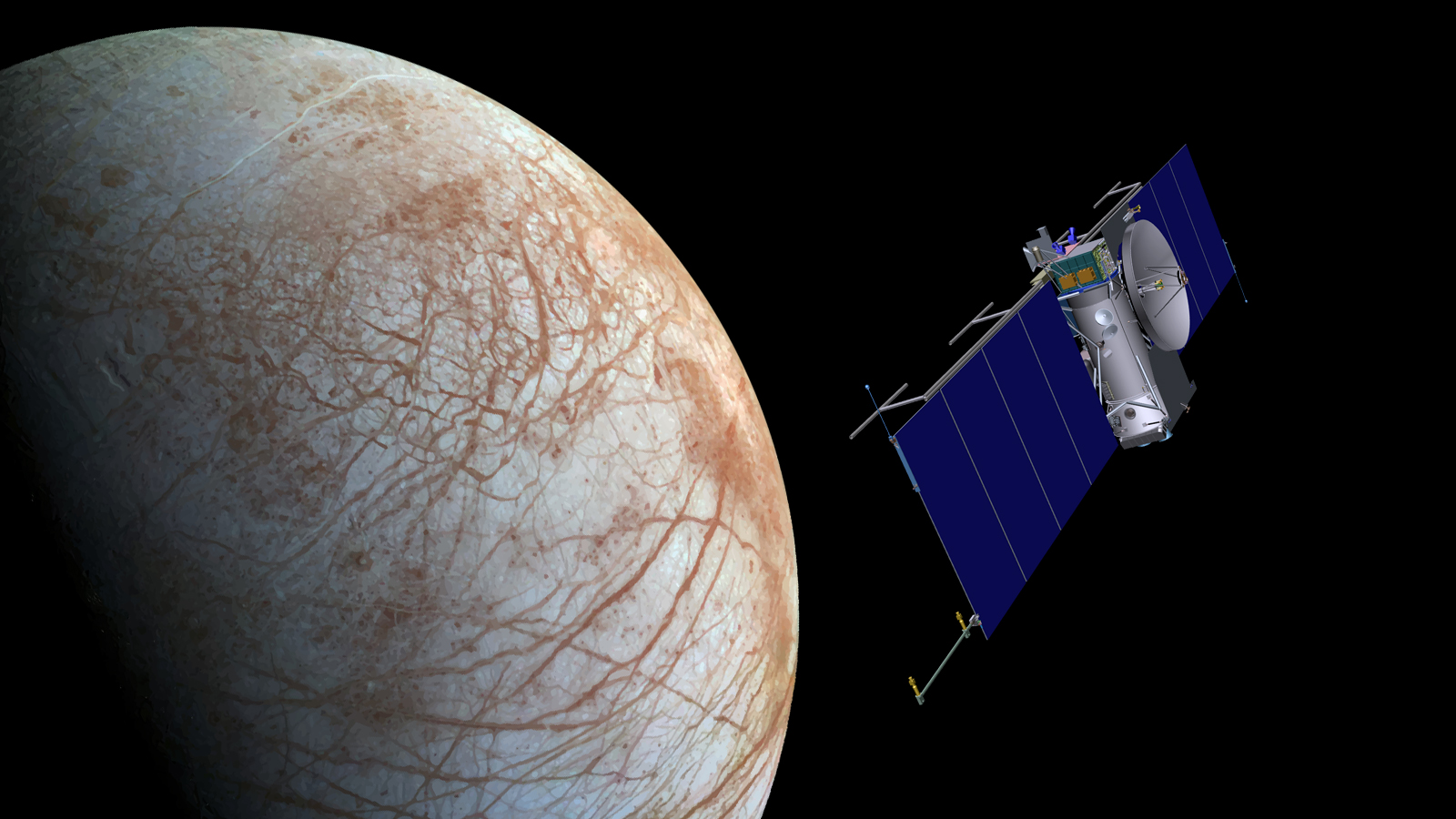
All Systems Go for NASA's Mission to Jupiter Moon Europa - NASA
Beyond Earth, Jupiter’s moon Europa is considered one of the most promising places in the solar system to search for signs of present-day life, and a new NASA
NASA
249 points · by Thorondor · 11y ago · 102 comments
EDIT: The Wikipedia article on Jupiter's Magnetosphere [1] has great details on the impact of Jupiter's radiation on previous missions. For example, Pioneer 11 lost most of its images of Io, and Galileo had total data loss on three of its orbits.
[1] https://en.wikipedia.org/wiki/Magnetosphere_of_Jupiter#Explo...
For comparison, Venus and Mars have magnetospheres that are smaller than their atmospheres, allowing the solar wind to blow away lighter molecules, such as water. Earth, by contrast, has a magnetosphere that's much larger, and provides significant protection.
Mars is actually an interesting case because it used to have an active core (and hence a true magnetosphere) a long time ago but it has since died out. The latent magnetism still remaining in its iron rich crust is what protects it from the solar wind now and if you look at a 3d map from orbiting magnetometers it's all lumpy and not symmetrical in the least.
But yeah, anything below the ice in europa would be fine. Ice is an electric and thermal insulator so it doesn't even need an atmosphere to protect from dangerous radiation.
Imagine a clock-work computer with exposed parts attempting to operate in an unrelenting rain of sand and gravel. That's the sort of environment that computing equipment has to deal with around Jupiter, in some ways it's surprising that they work at all.
From Wikipedia https://en.wikipedia.org/wiki/Terraforming_of_Europa#Magneti...
> If proven to exist, this global ocean could hold more than twice as much water as Earth.
I really wish we were past the "is there water there" stage and onto the "Lets drop a submarine and see what's down there" stage. I imagine getting through 15 miles of ice might be a wee challenging.
Why are we creating a new spacecraft every time this happens? Why are they not "mass producing" the same generic exploration sat, with a generally useful set of features, then slightly modifying it for any specifics?
Launch in 2020's? snooze. Just launch the same sat from the last mission and start getting data now.
Second, these missions aren't actually that frequent. It takes months or years for a spacecraft to arrive at its destination, and its design had to be finalized and tested rigorously years before its launch. That means by the time we even get a close up picture of Ceres, for example, the science of spacecraft building will have advanced by several years and we now can include new sensors and improve fuel efficiency and so on.
Third, what do you think science is? Taking photos and readings. That is a huge, huge part of basic science, especially when it comes to astrophysics, astrogeology, astrochemistry, and so on. Landing on a planet provides further opportunities to take photos and readings, but it's phenomenally difficult to do.
Finally, if you are bored by cutting-edge space travel and the study of distant worlds that may hold the possibility of life... I don't even know. I'm mystified by your perspective on the universe we live in.
https://solarsystem.nasa.gov/europa/sdt2013.cfm
A key document is the very granular "Science Traceability Matrix" which is very focused on "can instruments be made to satisfy these science goals" (zoom in to notice a lot of requirements flow-down from science goals):
https://solarsystem.nasa.gov/europa/docs/Clipper_Trace_Matri...
And regarding Europa, one particular item of concern has been, can markers of life be detected in a plume as sampled by an orbiter. Here's a recent workshop on the subject:
https://astrobiology.nasa.gov/calendar/europa-plume-workshop...
It's a colossal understatement to say that a standard design plus tailoring isn't really going to lift the burden of figuring out if detecting life in the plume is possible.
But that said, there are re-usable components. Some of the spectral radiometers ("take photos") are largely re-used, also communications devices, etc.
Or at an interval of say 6 months a piece? That way we will have low cost since the r&d will be basically 0 for all the extra models and we get 10x the data and larger time span of coverage. Plus we won't be putting all our eggs in the same basket.
> Orbit around,
Orbiting Europa requires a different amount of propellant than orbiting Mars. Solar panels that power a probe at Mars won't power one farther away from the sun. Radio that can talk with Earth from the Mars orbit won't be able to do that from Jupiter.
> take photos and
Different cameras required due to different amount of light, expected distances for imaging, filters optimized for materials being imaged, etc.
> readings.
What readings? Basically no two probes carry the same set of scientific instruments. Often, the instruments carried are one-of-a-kind, specifically designed for the specific thing the mission wants to investigate.
That's the problem. Great as those are, by continually making one- or two-of-a-kind devices we are endlessly prototyping. What if we picked one or a few different designs, selecting for greatest generality, and then worked to get the costs very low by manufacturing a lot of them, accepting that they will be suboptimal for almost every target?
Of course crappy probes would give crappy results, and many of them would fail altogether. But what if we deployed hundreds of cheap crappy probes on a regular basis - ie build a shotgun instead of a series of sniper rifles? Obviously finding a good general-purpose design is easier said than done.
We have I think 3 lunar probes in orbit at the moment, and a few more on the way, as well as various probes that have gone to the moon, sent back a bit of data, and then crashed into it by design. That's not very many at all. The moon's not that far away, why not try putting 50 low-cost probes around it with the same instrumentation and see what we learn from that? If we can get better astronomical observations from arrays of relatively low-power telescopes, surely we will get better planetary observational data from arrays of low-quality probes? Simply getting an array of probes up there and running and learning hwo to handle the networking, data flow, and and the inevitable variety of unexpected failure modes will provide us with a vast amount of experience, not to mention a vast amount of additional data about the moon that can be benchmarked against a whole lot of excellent data we have already for accuracy.
I don't mean this as a dig at you or the other commenters critiquing this proposal, but you remind me of Thomas J Watson suggesting that "I think there is a world market for maybe five computers" (not withstanding the apocryphal nature of this quote, similar sentiments were expressed by other experts around that period, eg https://en.wikipedia.org/wiki/Thomas_J._Watson#Famous_misquo...).
That said, usually you would do this to leverage economies of scale, and I think there probably isn't the budget or demand for enough space probes to make it viable. Who knows though, if the price of space launches continues to plummet, maybe it starts to make a lot of sense.
Whatever these things are, I'm assuming 3 facts:
1. They require some type of electricity to operate.
2. They require a data interface for output.
3. They occupy a finite amount of space.
Based on these, can't we modularize the scientific instruments? Provide common power and data ports within a common frame? So they can fit into the same bays, like a blade server, or even like Hubble's 4 bays.
Here is an overview of what we know about the mission now: http://futureplanets.blogspot.se/2015/06/nasa-goes-first-cla...
"Galileo’s camera and spectrometers revealed that the icy crust is fractured and frequently covered with material that appears to have originated in the ocean below. The Clipper’s radar instrument (Radar for Europa Assessment and Sounding: Ocean to Near-surface (REASON) – principal investigator Dr. Donald Blankenship of the University of Texas, Austin) will see below the surface to investigate the structure of the shell, potentially all the way to the interface with the ocean below."
"The MAss SPectrometer for Planetary EXploration/Europa (MASPEX) (principal investigator Dr. Jack (Hunter) Waite, of the Southwest Research Institute (SwRI)) will measure the composition of gasses, ices, and organic molecules."
"The wide angle camera in the Europa Imaging System (EIS) (principal investigator Dr. Elizabeth Turtle of APL) will map the surface of Europa at 50 meter resolution in color to document the surface structure."
"During each of the planned 45 flybys, the spacecraft will travel close to the surface of Europa. At each encounter, the wide and narrow angle EIS cameras will record the surface geology in high resolution recording details as small as one meter."
Most of the effort goes into novel and usually hand-made sensors to deal with specific scientific questions. There's not particularly a point in sending the same instruments to the same places again, and the accessible parts of the solar system are fairly well studied from a generic standpoint. If you're going through the (fairly expensive) effort at all, you want better or different instruments, and that's what takes so long. There's a reason all these programs are led by a "principal investigator" and not a "head engineer".
I do think a common design with fairly generic instruments would be useful for a pair of ice-giants orbiters. Uranus and Neptune are basically unstudied up close, compared to all the other planets. But two does not mass production make.
So imagine someone working on the Foo Mars Orbiter. They're probably employed by the University of Bartown, and their work is being funded by an NSF grant for the Foo Mars Orbiter project. Neither of those bodies is interested in making something reusable for another satellite ten years down the line: the university may well not be involved in the next one, and they're unlikely to get much academic prestige from having their designs reused, they'd rather their professor spend time making their paper nicer and getting it in better journals. Meanwhile the NSF wants its grant to be used for the grant's specific purpose, not as a general slush fund, and will be hostile to any expenditure that's not directly related to getting the Foo Orbiter into orbit. Even if the team did put together something reusable, the team's going to be dissolved as soon as it launches (with a skeleton crew remaining to check when it arrives) or at very best once the primary mission completes, so no-one's going to be in a position to handover the assets to the team making the next satellite. If you've ever tried to reuse some code that was written two years ago by someone who thought it was a one-off and has since left the company, you get the idea.
However, they are absolutely used for more than one purpose, and this is part of the reason the mission plans are so detailed. We generally try to get as much usable science out of what we send. For example, the mission for Cassini Huygens[1] included Venus, Jupiter, and obviously Saturn and its moons. Some of the other easy examples... Voyager[2] I and II, Spirit and Opportunity[3].
[1] https://en.wikipedia.org/wiki/Cassini%E2%80%93Huygens
https://en.wikipedia.org/wiki/Joint_Strike_Fighter_program#C... https://en.wikipedia.org/wiki/Joint_Tactical_Radio_System#Pr...
You end up with a super duper expensive thing that takes 15 years longer than you expected to build and ends up not being able to do the job of any one of the things it was intended to replace.
There's a lively discussion on the front page about one of the examples above.
I think you're overly abstracting the missions. It may seem similar at such a high level, but the actual readings being taken are likely very different and require very different hardware.
Also, space missions do not have the luxury of activities on earth where if things go wrong one can quickly try again if funds are available. Thus, much more preparation is needed.
Just drop a nuclear probe that can melt through: http://news.bbc.co.uk/2/hi/science/nature/3548139.stm
oh wait...
Here's one for a submarine on Titan - https://www.nasa.gov/content/titan-submarine-exploring-the-d...
There was another Titan boat proposal a couple years ago, but it lost NASA's internal funding battles to Yet Another Mars Lander. http://www.universetoday.com/96924/mars-lander-wins-out-for-...
The biggest issue, however, was the problematic development of the needed power supply[1].
There is another option for these missions, of course. A nominal increase in NASA funding to increase the number of missions we can fly.
[1] https://en.wikipedia.org/wiki/Advanced_Stirling_radioisotope...
TiME was always a longshot proprosal, but I'd personally rather see the lower budget Discovery Program missions doing riskier stuff. And while I love a good Mars mission, Mars gets all the marquee missions anyway. It's kind of a shame to see it eat the resources of the lesser missions too.
15-130
All Systems Go for NASA's Mission to Jupiter Moon Europa
Could a liquid water ocean beneath the surface of Jupiter’s moon Europa have the ingredients to support life? Here's how NASA's mission to Europa would find out.
Credits: NASA/JPL-Caltech Beyond Earth, Jupiter’s moon Europa is considered one of the most promising places in the solar system to search for signs of present-day life, and a new NASA mission to explore this potential is moving forward from concept review to development.
NASA’s mission concept -- to conduct a detailed survey of Europa and investigate its habitability -- has successfully completed its first major review by the agency and now is entering the development phase known as formulation.
“Today we’re taking an exciting step from concept to mission, in our quest to find signs of life beyond Earth,” said John Grunsfeld, associate administrator for NASA’s Science Mission Directorate in Washington. “Observations of Europa have provided us with tantalizing clues over the last two decades, and the time has come to seek answers to one of humanity’s most profound questions.”
NASA’s Galileo mission to Jupiter in the late 1990s produced strong evidence that Europa, about the size of Earth’s moon, has an ocean beneath its frozen crust. If proven to exist, this global ocean could hold more than twice as much water as Earth. With abundant salt water, a rocky sea floor, and the energy and chemistry provided by tidal heating, Europa may have the ingredients needed to support simple organisms.
The mission plan calls for a spacecraft to be launched to Jupiter in the 2020s, arriving in the distant planet’s orbit after a journey of several years. The spacecraft would orbit the giant planet about every two weeks, providing many opportunities for close flybys of Europa. The mission plan includes 45 flybys, during which the spacecraft would image the moon's icy surface at high resolution and investigate its composition and the structure of its interior and icy shell.
NASA's Jet Propulsion Laboratory (JPL) in Pasadena, California, has been assigned the responsibility of managing the project. JPL has been studying the multiple-flyby mission concept, in collaboration with the Johns Hopkins University Applied Physics Laboratory (APL) in Laurel, Maryland, since 2011.
Instruments selected for the Europa mission's scientific payload were announced by NASA on May 26. Institutions supplying instruments include APL; JPL; Arizona State University, Tempe; the University of Texas at Austin; Southwest Research Institute, San Antonio and the University of Colorado, Boulder.
“It’s a great day for science,” said Joan Salute, Europa program executive at NASA Headquarters in Washington. “We are thrilled to pass the first major milestone in the lifecycle of a mission that will ultimately inform us on the habitability of Europa.”
NASA's Science Mission Directorate in Washington conducts a wide variety of research and scientific exploration programs for Earth studies, space weather, the solar system and the universe.
For more information about NASA's mission to Europa, visit:
-end-
Dwayne Brown / Laurie Cantillo
Headquarters, Washington
202-358-1726 / 202-358-1077
dwayne.c.brown@nasa.gov / laura.l.cantillo@nasa.gov
Elizabeth Landau / Preston Dyches
Jet Propulsion Laboratory, Pasadena, Calif.
818-354-6425/818-354-7013
elizabeth.r.landau@jpl.nasa.gov / preston.dyches@jpl.nasa.gov
Last Updated: June 18, 2015
Editor: Sarah Ramsey
(For those on older / non-JS browsers)
Is there any chance they could be open sourced?
Why is the hardware on them so weak? Why is the bandwidth so low?
Why can't we just spend a billion dollars for more bandwidth, CPU power and hard drive space? Why don't we just build an army of orbiters and send them into space?
Hardware has to be radiation hardened and redundant.
Bandwidth is so low because it has to send radio waves 500 million miles, and that's not an exaggerated number.
https://eyes.nasa.gov/dsn/dsn.html
Edit: The Deep Space Network is currently down, might be aliens, good luck everybody.
Why can't we just craft that hardware we need in bulk? We have billions of dollars in funding. Make a factory production out of it.
Why don't we send 300 mars rovers? We can make 5000 tanks. We can build 5000 fighter jets. Why do we just build one rover?
My impression with astronomy is it has nowhere near the fervor or seriousness that defense has. Why are we not dumping supply ships in the moon in anticipation of colonization?
Basically just read everything on Wikipedia about DARPA, NASA, CIA satellites, the NRO, the Apollo missions, Sputnik, Voyager 1 / 2, the Curiosity rovers, KH-9, KH-11, Hubble, etc. then come back and criticize NASA if you still think that they are not doing their job properly.
You have the answers to all of these questions and more at your fingertips via Google.
NASA has another Curiosity rover, but the cost/benefit of sending it to Mars isn't worth it in their expert opinions.
Nondismissable "upgrade your browser" dialog. Which, of course, I can't actually do.
I thought we learned this was a bad thing in the 1990s.