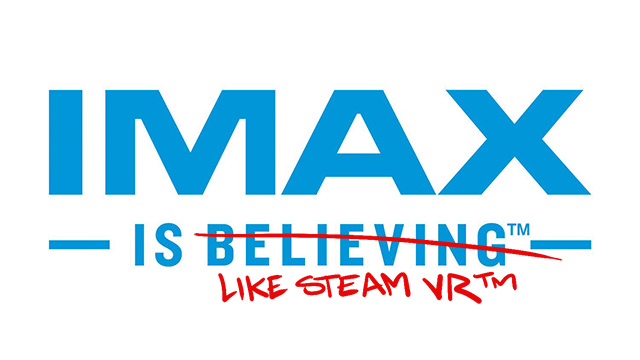
IMAX’s absurd attempt to censor Ars [Updated]
The letter we got is kind of like using SteamVR—out of this world.
Ars Technica
254 points · by twsted · 11y ago · 146 comments
This is why IMAX is annoyed: they understand that VR is a huge threat to their business. The reason watching a movie on a very large screen is better than watching it up-close on a small screen is that in the case of the large screen, your eyes can relax by focusing at infinity. With VR, you can effectively simulate an infinitely large screen infinitely far away.
In theory.
But the "further" away you project the virtual movie screen, the higher the resolution of the VR headset needs to be to support it. And considering that VR screens are already an inch from your face (and thus require a high-ish resolution to just basically "work") we're talking about better-than-exist resolution screens for that form-factor.
I don't legitimately consider IMAX's business threatened by VR headsets in the next ten or so years, and even then we'll have to see how well people like wearing a VR headset on their face (which might hurt necks, feel uncomfortable, suck for glasses wearers, etc).
VR is better now than at any point in history. But people are pretending like it will definitely succeed. But Google already cancelled Google Glass (and, no, Google Cardboard isn't the same thing). This might be another "3D" flop all over again.
2) It doesn't have to be clear that VR will succeed for it to represent a threat to IMAX's business.
However, clearly you can get away with far less than that. But, the point where increasing resolution is not noticeable at some level is ridiculously high.
Both we agree on #1, we both said the same thing.
> It doesn't have to be clear that VR will succeed for it to represent a threat to IMAX's business.
I literally don't understand what it is you're trying to say.
If VR fails, it isn't a threat to IMAX business by definition. Something that isn't popular or doesn't exist cannot be a threat to something else.
There is no way to interpret what was said to say "SteamVR is the same thing as IMAX, from the same people, etc."
And there's a difference in saying "Twice the resolution of IMAX!" (for example) and saying "It's like having an IMAX theater in your house." Those aren't the same kinds of statements.
1) The mechanic silences an opinion by making it harder to read/requiring highlighting to read
2) Swaying public opinion of a comment without even reading it. "Oh, it's already almost faded out entirely. It's probably a terrible post that I should just downvote without actually reading." (E: I understand HN requires you to "spend" a karma to downvote something. This doesn't prevent people from using their karma in this manner when they have 1,000's)
3) Allows self-validation of "others agree with me, because this comment has been downvoted and I disagree with this comment", which is fallacious reasoning. Popular/majority opinion can be wrong and patting yourself on the back for having other people agree with you can be detrimental. Self-validation without critically thinking about your opponents arguments is an injustice to them.
I have a rule in Stylish to set "font" to #333 so that all comments appear the same for me. Unless someone mentions "why is this downvoted", I'm completely unaware of any comments being downvoted. I find this leads to a better experience on HN.
Note: For #3 I use "you/yourself" in a "third party not necessarily you 'you'" way.
"Hmm, we know we have nothing to stand on here, but if we politely ask Ars to remove references to IMAX and they do, matter ends there. If Ars doesn't comply, we just lost 5 minutes of drafting this pointless letter. Nothing really to lose."
Hits send.
The irony? IMAX is now paying the real cost of that poor decision. Bad publicity and worse - the revelation that they are insecure about and feel threatened by emergent technologies. Talk about pissing on your own product.
It's kind of amusing if you call a legal bluff, the other party now has two bad choices: either they will have to go away quietly and the issue will remain or they have to actually sue and will most likely lose (that's never guaranteed).
The real downside is not that these lawyers make dubious or baseless legal claims (it's up to you to respond or take them serious or not), the problem is that most people will not feel qualified to make that call and so will either comply or run up some legal expenses.
So for small entities (private individuals for instance) folding is usually the only option. In this case Ars was a pretty dumb target of such a C&D, they're part of the media and will of course use it to maximum effect.
Of course, being lawyers, they would probably put in some fine print that states that no legal threat is implied, or something like that.
Companies can loose their trademark if the term becomes generic, and one way to defend against that in court is to show a history of defending the mark (I'm not lawyer but that's my simplistic explanation) this is a great article explaining the phenomena around derby pie
http://www.npr.org/sections/thesalt/2015/05/01/399842082/wha...
My bet is that they are weighing the lesser of two evils (to them) loose their trademark or look like a fool in the press for a few days...
All the lawyers are doing is chasing a pay check
This is ridiculous on its face. Its not like some competitor made an IMAXy Projector. This was a quote in a press article. This is a speech issue that has nothing to do with dilution, which is obvious if you bothered to read the article where Mary Ruby assaults ars staff with a weird rant about how VR cant compete with IMAX.
Frankly, the fact that trademark abusing corporations have people repeating their bullshit is scary.
All publicity is good publicity, right?
As for the new IMAX screens, not only is it the size of the screen, but the quality of the projector and speaker setup not to mention the actual proportion of the screen as well.
There are only a handful of "true original" IMAX screens. I'm not hating on their brand, I know they've needed to dilute to actually not go bankrupt, but it's important to note that there is a legitimate difference between "large format" (that's the term that's replacing IMAX for legalities sake and so IMAX competitors can be introduced and undercut IMAX licensing fees) and IMAX.
To be totally honest, they're in a lot of trouble as a company and they desperately need to find a way to save their product before competitors like Regals "RPX Experience" ruin them.
I still love IMAX.
Having to recline and look up at the screen was annoying, and the size was gratuitous with most of it wasted to peripheral vision. That's definitely not something I'd want in my living room.
From what I understand, movies shot specifically for IMAX are meant to be framed something like a stage play, with your eyes wandering around the screen rather than staying fixed near the center.
Of course, that presumes the movie was made for it (or had a cut framed specifically for it), rather than just being "normal theatrical cut but bigger".
Sadly, the IMAX CEO says screen size does not matter [1] and thus the majority of them are being replaced by smaller digital screens in multiplexes. lfexaminer.com has a great list of IMAX theaters and their formats [2].
[1] http://www.wired.com/2009/05/imax-ceo-screen-size-isnt-every...
IMAX, especially as current IMAX Digital theaters have similar screen sizes and also only 2.8K (two 2K projectors on the same screen), just isn’t really worth it anymore.
It's a horrible experience. You can buy a horribly cheap TV, a 5.1 sound system and plop it in your living room and get a better experience. Getting the sound right takes a long time, but my end conclusion was that suspending bunch of cardboard everywhere seemed to negate the poor acoustics of the room.
The first feature is a function of sitting to close to the screen, and isn't specific to IMAX format. The second is by design -- a major point of large-format cinema screens like IMAX is to provide a more immersive experience by making it so that, in shots where there is a strong central focus, even the non-focal parts of your vision field are occupied by the movie screen rather than (usually, just black) background from the theater, and, second, enabling shots that are composed so as to invite audience members to not just focus near center, but to look around the screen (this second feature isn't taken advantage of in films not designed for large-format screens, but major films now generally are made in a large-format aware manner.)
[1] http://www.lfexaminer.com/20081016.htm [2] http://www.digitaltrends.com/home-theater/imax-looking-punie...
IMAX's legal counsel failed to see the big picture.
": Consumer electronic products, namely, headphones, earphones, cables, camcorders, DVD players and stereos; home theater systems comprised of a projector system, a surround sound system, a screen, media servers and control devices; and gaming equipment, namely, video game machines for use with televisions and computers; video game controllers; computer software for playing video games and for accessing and browsing global computer and communications networks; video game programs downloadable from global computer networks and global communications networks; and user manuals for all of the aforementioned software and devices sold as a unit therewith; devices used to facilitate interactive game play over computer networks; television and video converters; speakers, loudspeakers systems"
http://tmsearch.uspto.gov/bin/showfield?f=doc&state=4808:77u...
http://variety.com/2014/digital/news/samsung-unveils-virtual...
Samsung's VR will offer "a selection of IMAX films in a virtual theater".
Samsung's VR is based on Oculus tech, and actually will be an IMAX theater in your house.
Heh.
Well that shut them up!…
In other words, no matter how silly and innocent the passing reference to IMAX is, is it possible that IMAX lawyers must pursue those genericized uses even though those lawyers (and the client IMAX itself) knows it generates negative publicity?
A natural human tendency is to speak with similes & metaphors. "Yosemite Valley is like a jacked up IMAX for nature lovers" or "my budding friend the film student with his overuse of lens flares thinks he's the second coming of J.J. Abrahams".
The tension between trademark enforcements and natural human tendencies to color conversations with innocuous references to pop culture creates silly-looking "cease & desist" letters.
[1] https://en.wikipedia.org/wiki/Generic_trademark#Trademark_er...
Yes, everyone agrees that they were refering to IMAX. It is also legal for them to do so (and for Ars to publish this opinion) without seeking permission from IMAX first. Some people on HN are surprisingly disagreeing with this (or at least condoning IMAX's response)
Also, the law shouldn't be that trivial uses of the mark like this work to erode it, but the law is not precise on the issue so mark holders tend to have to be verzealous in showing their defense of the mark.
This letter is just a lett-er not worth the non-paper it's not-written on.
The whole purpose of the letter is to be able to show diligence in court if the mark is threatened... not to attempt to get Ars to do anything different.
Are should know that too... but I guess they feel this is good link bait. (personally I think it adds tarnish to Ars's reputation, by making them look like rubes.)
No, this is absolute bunk. There is no reason for this. At least in the US this is protected by Nominative Use, which guarantees that "a person may use the trademark of another as a reference to describe the other product, or to compare it to their own."
Further: "Nominative use does not require that ownership of the trademark be acknowledged, for example by use of a sentence such as "UNIX is a registered trademark of The Open Group"."
IMAX's lawyers are clearly overreaching here.
I suppose they don't and I'm not disagreeing with you on that.
The IMAX situation may be different in that their trademark is very catchy sounding (2 syllables "eye"-"macks") and is getting pulled (by innocent human tendencies) into a lot of conversations unrelated to IMAX(tm) theaters. When people use words like "AMD" and "Honda", it doesn't seem to erode their trademark. But for some reason with "IMAX", and "google", and "kleenex", it does. In other words, most people haven't genericized "Honda" to the point of saying "I'm going to Honda my but to the grocery store."
Are the cultural references to "IMAX" trending towards trademark desctruction such as "kleenex" and "escalator"[1] or are the usages actually trademark preserving such as "AMD" and "Honda"?
[1]https://en.wikipedia.org/wiki/Escalator#Loss_of_trademark_ri...
Now, that's just me, but I can imagine it being similar for most people.
Real-life examples include "give me a kleenex" when you just want any random facial tissue, "give me a coke" when you're just asking for any soft drink (this use is common in some places, while in other places it means only the actual Coca-Cola product), or "I xeroxed this document" when you have no idea of the actual brand of the copier.
Just using the trademark as a comparison doesn't do it, as far as I understand it.
This is actually still an example of trademark erosion, even if referring to an actual IMAX theater. This is using the brand to refer to the abstract thing. It's not an IMAX. It's an IMAX theater.
For a relevant example, look at Google's guidance to journalists. They say not to write "I googled X", but "I searched for X using Google". Using "google" as the verb, even when literally referring to Google, erodes the brand, because it conflates the brand with the thing.
This is so, so far outside of the rights of trademark that it is just plain abusive. This sort of behavior comes about not from attempting to protect ones brand from unfair usage, but from thinking one's moneyed influence allows them to do whatever they want.
Just because you can philosophically conceive of a stretch by which an egregious abuse might possibly not be one, doesn't mean you're helping at all.
"SteamVR ... feels like an 'IMAX in your house'" --Ars Technica
It's as if Ars had said "we googled up their website" while showing a picture of them using Bing, or if they had said "We enjoyed some Coke after the demo" and had a picture of them holding a can of Pepsi.
I'm not saying that this letter isn't ridiculous, but just realize what the job of the internal lawyer is at IMAX: Her job is to defend all mainstream attempts to use their brand name out of context, she doesn't seriously expect arstechnica to comply- It's just that people in the past have lost rights to trademarks they failed to defend, so she is pretty much obligated to write these silly letters.
No, it's not that at all. Ars was making a comparison to actual IMAX, not using it as a generic.
"This new pepsi tastes as good as coke"
I'd say that's attempting to do hey job, overreaching, and causing more harm than if she had done nothing.
http://arstechnica.com/business/2015/05/reddit-announces-sit...
On the other hand, much of the tech press is coordinated, spoonfed promotional material for the industry, where such a thing, even in a quoted endorsement, is arguably trading on the mark in a way which, absent a license, is a violation, and there are strong legal incentives for trademark holders to assume the worst of an unauthorized use without concrete evidence to the contrary.
Ars may have been in the right initially, but I think that the current article calling IMAX's response an absurd attemp at censorship is, at best, hyperbolic and wilfully blind to the realities around trademarks.
No, that's not what I'm saying. There's a big difference between press releases existing and presented-as-journalistic pieces being essentially paid promotional material for vendors.
> Do you actually think that position has a wooden leg to stand on?
No, which is why I didn't make it.
> I don't see how you could possibly read a comparison like this — even if made outside of quotes — as anything but descriptive of IMAX's actual product.
I don't see how you could read it as descriptive of IMAX's actual product, since there is no actual description of IMAX's product being made. Its clearly a nominative reference; its clearly a statement saying another product is good because its like IMAX's product.
> I don't think a normal consumer would likely be confused.
Perhaps not, but legal actions for violations of trademark rights don't always require that (infringement does, but dilution, which seems the most applicable trademark concern here, does not.)
And I do think that's a potential valid source of confusion with consumers, who could potentially think SteamVR lives up to the same image projection standards.
It's not as clear cut to me as Ars is making it out to be.
2. It was someone else who was describing something and likened this other thing to IMAX. Ars was quoting this person, not writing it themselves.
Don’t drag out the “confusion with consumers” thing – absolutely no-one would think that this thing actually was an IMAX™ – it was a comparison. Would I be sued by Coca-Cola if I said that “Pepsi is kind of like Coca-Cola”? Would I cause “confusion with consumers”? No. Trademark law does not mean that trademark owners can control every use of the word, despite what they (and apparently you) would wish for.
But that consumers could think it was IMAX certified or some such. That sort of thing is worth defending.
Making the leap from what was written in the article to "IMAX certified" is a hilariously wide leap. It's about two orders of magnitude too wide to justify the threat letter from IMAX.
For example, if IMAX's point of view is correct here, the entire article linked below[1] wouldn't be legal to write as it compares AMD's new GPUs to Nvidia's GPUs. Simply put, it's a staple of product journalism to compare with other similar technology, and this has always been the case. IMAX is clearly and wholly in the wrong.
It used to mean that, not any more. IMAX screens are allowed to be much, much smaller than before.
And that's because a trademark is exclusive rights over using the name for a commercial purpose. So the IMAX folks could make a product called IMAX-VR if they made a VR headset. But the Oculus folks, if they got some 8k phone screen, couldn't call it Oculus-IMAX without a licensing agreement, because IMAX owns the name IMAX with respect to product names.
But owning it with respect to product names doesn't mean you can prevent people from using it at all. How else would Coke (tm) be able to tell you in a commercial how much better they are than Pepsi (tm) as a result of some ridiculously staged "public tastings" where regular people prefer Coke (tm) to Pepsi (tm) three to one?
Anyone can refer to someone else's trademarked product name full stop. The only thing a trademark does is prevent other people from naming their products the same as, or confusingly similar to, the one which was trademarked first. And if someone thinks their new product name is different enough to be confusing the trademark holder still has to take them to court to prove it.
Nope. It was smaller than the unbranded "Monster Screen" at my local theater in the middle of nowhere.
IMAX no longer really means anything to me.
That "innovation" is >5 years old: http://www.bigscreen.com/journal.php?id=1505
We're left with Lincoln square in NYC and possibly New Rochelle, NY as the only remaining large format IMAX in the area.