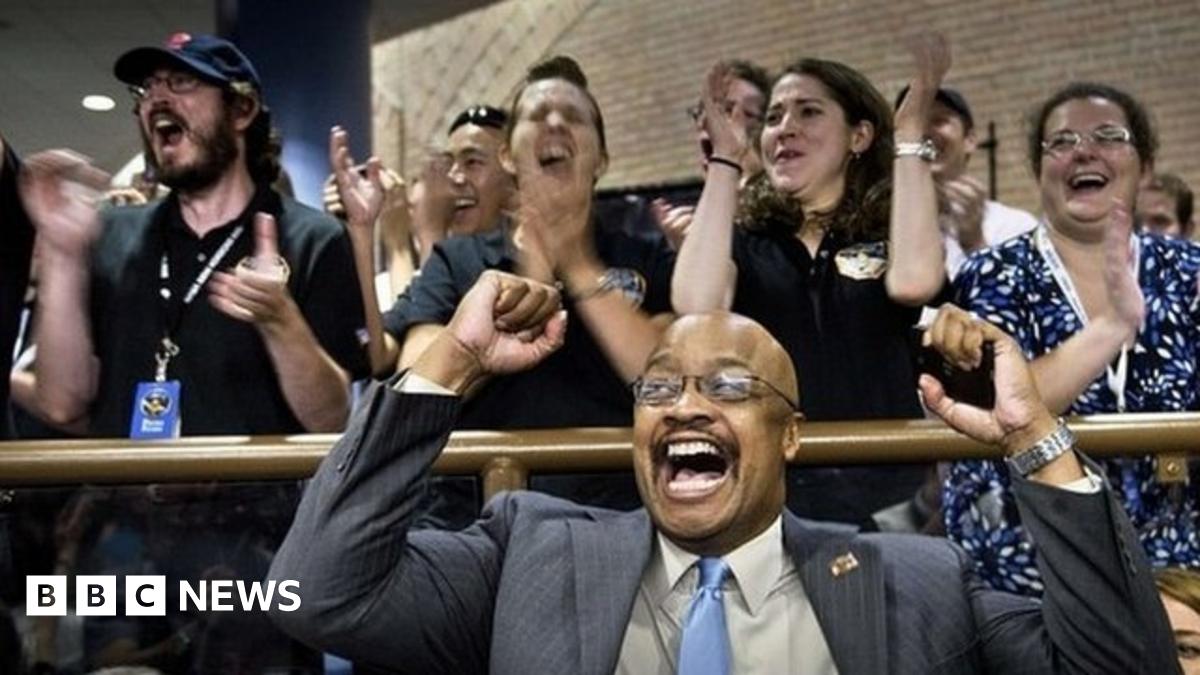
New Horizons: Spacecraft survives Pluto encounter
A signal received from the New Horizons spacecraft shows that it survived its historic encounter with Pluto.
BBC News
325 points · by aestetix · 11y ago · 91 comments
https://twitter.com/tothur/status/620601134651166720/photo/1
http://www.abc.net.au/news/2015-07-09/pluto-comes-into-focus...
This shows a time slider, where you can see the different images, along with the time and distance from Pluto. They have been pretty quick to update it with new images too, so I look forward to the final image(s?) being added.
[1]: http://www.slate.com/blogs/bad_astronomy/2014/01/01/moon_and...
https://www.nasa.gov/mission_pages/hubble/science/pluto-2010...
Shows better the previous best.
> The Hubble images are a few pixels wide. But through a technique called dithering, multiple, slightly offset pictures can be combined through computer-image processing to synthesize a higher-resolution view than could be seen in a single exposure. "This has taken four years and 20 computers operating continuously and simultaneously to accomplish," says Buie, who developed special algorithms to sharpen the Hubble data.
Uhhhhhhh... Should somebody tell him?
Bolden says he still considers Pluto a planet. http://www.telegraph.co.uk/news/science/space/11739763/Pluto...
Acronyms
Use the abbreviated form of a title without explanation only if there is no chance of any misunderstanding (eg UN, Nato, IRA, BBC). Otherwise, spell it out in full at first reference, or introduce a label (eg the public sector union Unite).
Where you would normally pronounce the abbreviation as a string of letters - an initialism - use all capitals with no full stops or spaces (eg FA, UNHCR, NUT). However, our style is to use lower case with an initial cap for acronyms where you would normally pronounce the set of letters as a word (eg Aids, Farc, Eta, Nafta, Nasa, Opec, Apec).
[0] http://www.bbc.co.uk/academy/journalism/news-style-guide/art...
"Use all capitals if an abbreviation is pronounced as the individual letters (an initialism): BBC, CEO, US, VAT, etc; if it is an acronym (pronounced as a word) spell out with initial capital, eg Nasa, Nato, Unicef, unless it can be considered to have entered the language as an everyday word, such as awol, laser and, more recently, asbo, pin number and sim card."
[1] http://www.theguardian.com/guardian-observer-style-guide-a
Informally, it's sometimes referred to as "vat", e.g. calling a tax inspector "the vat man".
If used in context, no one is going to get confused by either pronunciation though.
> Where you would normally pronounce the abbreviation as a string of letters - an initialism - use all capitals with no full stops or spaces (eg FA, UNHCR, NUT). However, our style is to use lower case with an initial cap for acronyms where you would normally pronounce the set of letters as a word (eg Aids, Farc, Eta, Nafta, Nasa, Opec, Apec).
http://www.bbc.co.uk/academy/journalism/article/art201307021...
It seems strange that the highest ranked story about Pluto for the past few days has been from BBC not NASA. Check out www.nasa.gov for the original press release and updates as they come in.
It's not meant to imply that this specific mission visited all the planets, just that this mission completes the achievement. (In his opinion).
The short version is - for the most part these trajectories can be calculated with a decent degree of accuracy with relatively simple equations. Rocket engines tend to give acceleration in short bursts (which simplifies the computations a lot as well), so New Horizons was launched out of Earth orbit at about 16km/s and since then has only fired its own engines for short correction burns.
It's a remarkable achievement but the science behind it has been known and used successfully for decades.
http://www.planetary.org/blogs/emily-lakdawalla/2015/0624055...
http://www.planetary.org/blogs/emily-lakdawalla/2015/0714133...
An even more exotic arrangement, beyond electrochemical processes, to somehow 'metabolize' matter directly into energy would exceed the definition of life in my opinion, as though it would be life 2.0 or something, and also have a pretty fascinating impact on the universe.