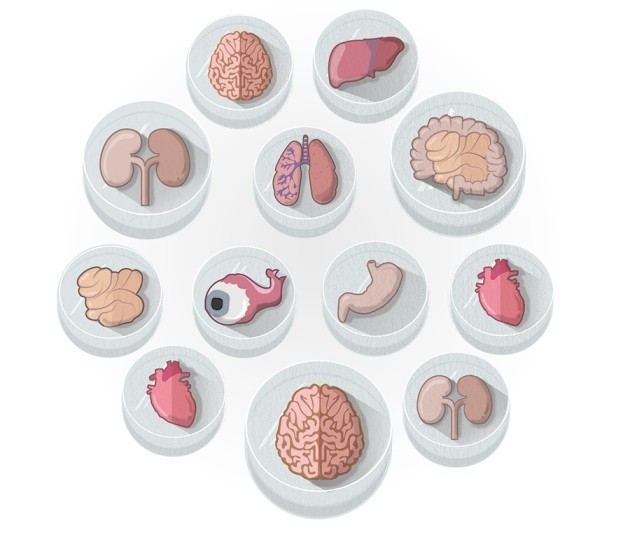
The boom in mini stomachs, brains, breasts, kidneys and more - Nature
Biologists are building banks of 'organoids', and learning a lot about human development on the way.
Nature
172 points · by sergeant3 · 11y ago · 30 comments
I was studying the way cells move, and to make cells that moved, we would dissect hearts out of seven-day-old chicken embryos, shread them into chunks, and put the bits down on a layer of matrigel in a dish full of tissue culture medium. After several hours, the cardiac muscle cells would start to dedifferentiate into fibroblasts (not really fibroblasts, but people call them that) and start zooming around, at which point you can do science on them.
I painstakingly prepared one of these dishes, then forgot about it, and left it in the incubator for a week. When i got back to it, the initial chunk of heart muscle had completely gone, turned into fibroblasts - which had then spread out over the dish, and turned back into cardiac muscle cells. There was a thin sheet of muscle strung out across the width of the dish, and it had started beating.
[0] http://ideas.blogs.nytimes.com/2010/04/30/heres-to-you-biolo...
[1] http://www.genome.gov/images/content/costpermegabase_apr2015... [2] FWIW I'm hiring staff and postdoctoral positions in bioinformatics looking for folks with experience with genomics, machine learning, and/or CS.
If, instead, I were choosing exclusively based on the importance of the work for humanity, I would still go for energy research before biology. That is what civilization's survival hinges on.
It's almost as if a human missing most of their senses spent their entire life in a float tank. I don't think it would be humane or inhumane, merely different. Without tons of advances we wouldn't be able to relate to it, or it to us. It wouldn't even be aware we existed.
In a way, its possible that the first intelligent alien life we make contact with will be one we create. As a specie, we've spend an inordinate amount of time and effort trying to make contact with intelligent life that might exist beyond our planet. Learning to make contact with artificial brains that we can hook up to different senses (artificial and mechanical or artificial and biological) is going to be awesome.
It's even possible that the brain in it's own isolation from us even does something humans do naturally; it tries to explain and understand its world and may even form the notion of a god or creator that brought it into existence. Hopefully one day it will get to meet its creator that brought it into existence. It likely won't damn us or condemn us because it won't know any better that it was crippled, just as the religious among us don't damn their gods for not bestowing us with talents and abilities like omniscience and omnipotency.
    "With the pit of despair, he placed monkeys between three
    months and three years old in the chamber alone, after
    they had bonded with their mothers, for up to ten weeks"
While I'm not denying that human brains have been shown to hallucinate under sensory deprivation, there's no way to say whether or not a lab grown brain would experience discomfort because of its lack of input, or whether it would even dream up a coherent reality for itself at all. There's simply no way to test this.
Also by definition science is immoral :)