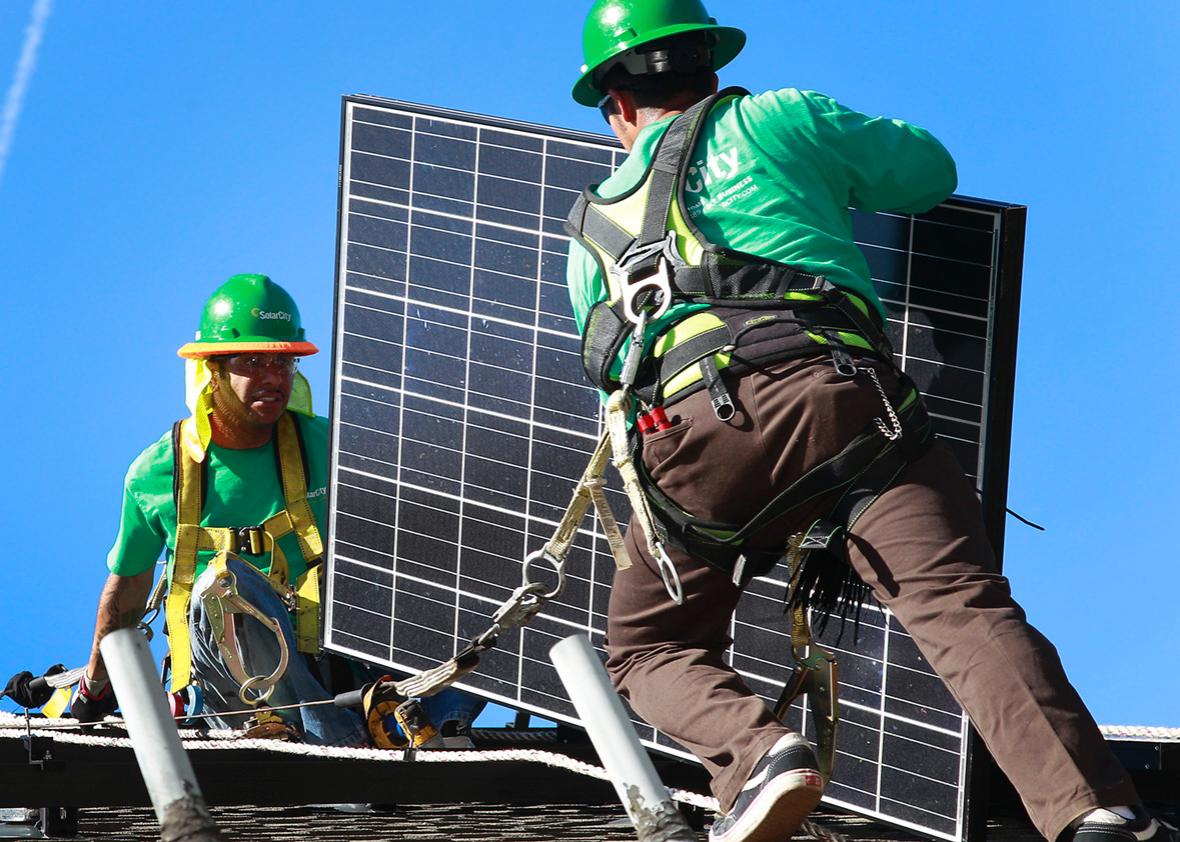
Elon Musk’s Most Impressive Company Isn’t Tesla or SpaceX. It’s SolarCity.
There’s a huge, ongoing, and justifiable obsession with Elon Musk and his ventures—chiefly Tesla, the electric car manufacturer, and SpaceX, his...
Slate Magazine
79 points · by prostoalex · 11y ago · 48 comments
Three major factors contributed to making solar as viable as it is now, none of which Solar City invented (but it is executing on them better).
1. Germany basically subsidizing China (and others) to build the massive solar panel production pipeline it has now that are producing ridiculously cheap panels[1].
2. Financial innovation to allow consumers and installers to pay for panels over time (PPA, leases, loans, etc.). These were originally pioneered by SunEdison[2], and the industry has been innovating on them since (including SolarCity with its MyPower Loan).
3. The California Solar Initiative[3] and Department of Energy's Sunshot Initiative[4]. Both were incredibly well designed to gradually wean solar off of subsidies and foster innovation through strategic grants, and they have worked incredibly well at teaching the solar industry to stand on its own two feet. We are well on our way to $1/watt[5].
SolarCity has executed incredibly well in this industry, so they definitely deserve tons of credit for installing so much solar. But it's a disservice to the rest of the companies, governments, and financiers to say they invented the recent growth. Everyone, including SolarCity, has come together to build a mature and exponentially growing industry that was 1 out of every 78 jobs last year.
[1]: http://qz.com/41166/how-germanys-energy-transformation-has-t...
[2]: http://archive.onearth.org/article/selling-the-sun
[3]: http://www.gosolarcalifornia.ca.gov/csi/index.php
[4]: http://energy.gov/eere/sunshot/sunshot-initiative
[5]: http://cleantechnica.com/2015/07/10/price-solar-hits-record-...
"Two weeks before his Hyperloop announcement, Musk quietly met with the founder of ET3, an even-faster, already patented[since 1999] tube transport system."[1].
That's not to say Elon didn't help the hyperloop - he helped greatly by exciting the public's and investors imagination. But he didn't invent the thing.
[1]http://www.fastcoexist.com/3015704/futurist-forum/how-much-d...
Several companies were offering Solar lease in 2007.
The article seem to imply that SolarCity invented Solar Leasing which is inaccurate.
[1] https://en.wikipedia.org/w/index.php?title=SolarCity&type=re...
[2] https://en.wikipedia.org/wiki/Special:Contributions/UVHaight
IMO, no one reads that and assumes that McDs invented the lobster roll. Why then would someone read the Wikipedia quote and assume Solar City was first or assume that's what the wikipedia quote was implying? That was when Solar City first introduced their new product: a lease.
1 - http://www.nydailynews.com/life-style/eats/mcdonald-start-se...
Maybe there are cases where leasing makes sense...but those are few and far between...or maybe SolarCity counts on people being uninformed/clueless, which is why this 'lease' model works. IMHO, it's total ripoff.
Post a (disposable) email address where I can reach you with his info if you're in SoCal.
[1] http://www.usatoday.com/story/news/nation/2015/05/20/califor...
If you were looking to buy a house, and it was 7 years into a 20 year solar contract (hence locking in the rates/financing of 7 years ago), wouldn't you want it either removed so you can put in something better, or be compensated for taking on such obligations?
I can't find out how often houses are sold in California, but it seems like ~7 years is normal.
> "Your kind began as self-repairing distributed storage systems for our supercomputers. [...] No, I didn't create you. Engineers did.
> I created something far more powerful... The marketing campaign that made you profitable."
Also, I wonder where any of this (solar city, spacex and tesla) would be without government help?
2) This comes up in libertarian circles frequently, and is usually meant as deriding comment, but it's important to keep in mind that all energy business has government involvement in some ways. Nuclear and hydro are frequently government-owned, coal was subsidized back in the days when it got its start, there are natural monopolies involved in grid and energy distribution. Solar, however, enables such a great level of autonomy, that it might just be the last sector where government and private interests are intertwined.
Has any world-changing industry gotten anywhere without government help?
I'm not arguing (here, at least) that those are bad ideas, just that there's a broad spectrum in what constitutes government "help".
Industries such as what?
If you don't throw subsidies at key industries (energy, automotive, aerospace, computers), some other countries will, and those countries will inevitably come to dominate.
Most countries that do this might try to hide it, but they still do it.
Did you have something specific in mind?
In other words, the buffer allowed them to be less risk-averse, and accelerated their growth.
My rooftop solar (I believe it'll be ~6kw; installation is soon) is around $20,000 to own outright, which includes 30 years of maintenance, whether or not I pay it off early. Once it's paid, it's mine.
That's actually not a "very high" price compared to decades of electricity, particularly not once you include the federal tax credit (30% of the system price). So you're right that the federal tax credit is a big deal, but I wouldn't have described the system as a "very high" price (it's around the same amount as the average "minor" kitchen remodel.)
EDIT: the big deal with the federal tax credit is that it can be used as a down payment, which makes the overall system payments begin at a lower price than grid electricity rather than a slightly higher price. This means monetary savings is immediate.
Solar is still not really cost effective without massive subsidy. But those subsidies exist for a reason and taking advantage of them is not weakness.