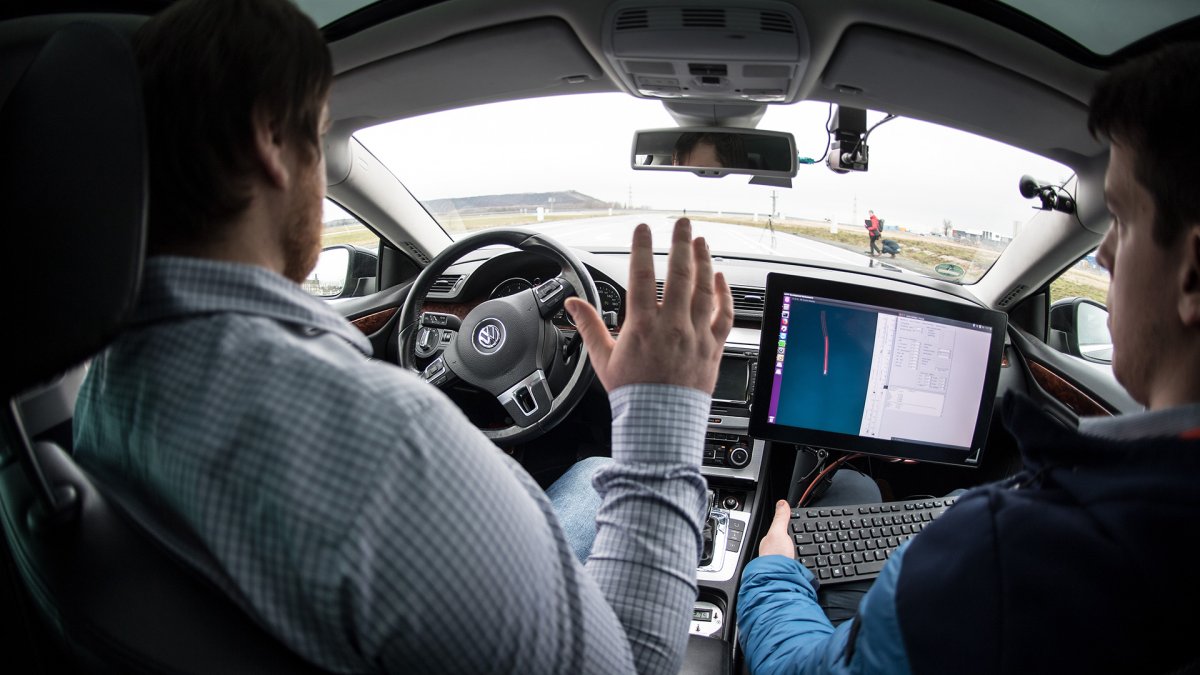
Key Volkswagen Exec Admits Full Self-Driving Cars 'May Never Happen'
Full autonomy remains an impossibly difficult prize.
The Drive
486 points · by stopads · 6y ago · 897 comments
Aren't sanity checks basically common sense? I would suspect they already play a major role in making autonomous driving a reality.
We won't lose that capacity.
The overhead lane markers in Hokkaido work well, but would be an expensive retrofit elsewhere (not the poles themselves, but the foundations)
FWIW though, it probably is possible to use this sort of technology for buses and shuttles. You can’t fix markings on ALL the roads, but you can make sure the markings are good enough on main arterials to have a dedicated bus lane.
From one of my previous comments on a different post: https://news.ycombinator.com/item?id=19638171
- - - -
Reducing the number of cars (and therefore traffic) on the roads will benefit everybody You seem to have a rose-tinted view of the world we live in.
  Have you ever had to commute in less-than-ideal
  conditions?
  Heavy snow? Sleet? Black ice?
  Have you ever lived in places that are not
  perfectly flat? or lived in places that
  are hot that make bicycling unfeasible?
  Did you have sporting gear / work gear that
  you had to lug? Did you know some people have
  to fetch their own gear to work
  Did you have to take calls during transit?
  Did you know its common practice for employees
  to call into meetings during their commute and/or
  help assist operations via conference calls?
  Have you had to shop for more than a baguette
  or a bagel at a store? You know how cumbersome
  that gets for even a family of three?
  Do you have the slightest clue how much casual
  violence and crime happen on public transit?[1]
However doing away with cars or vehicular traffic is just pollyannaish madness.
[1]
Teen robbed at gunpoint at Fruitvale, BART officer says writing a report is a 'waste of resources'
https://www.sfgate.com/local/article/bart-police-refuse-repo...
- - - -
edit: formatting
In peacetime, self-driving cars are a nice-to-have that can save many billions of driver hours and a few traffic fatalities. In wartime, they're literally a matter of life or death. The side that can handle all of their logistics without exposing their precious humans to enemy fire has a huge advantage over the one whose supply lanes can get picked off one by one.
I am extremely skeptical that beacons, sitting out in the heat, and the sun, and the cold, and the rain, and exposed to whatever we use to maintain roads at that juncture, will not be "a wear item".
If we're going to beacon up a road, they easily make the most sense.
And you say "private contactors will save the day", please, stop drinking the Ayn Rand Cool-aid.
https://en.m.wikipedia.org/wiki/List_of_automated_train_syst...
Cars are already equipped with suites of sensors giving them far more complete information than any human can process. Cars can already react faster and hold lanes with more precision than humans can.
What’s lacking is general intelligence. The ability to creatively respond to unexpected situations, even when it’s something you’ve never seen before.
Autonomous driving is a marginal improvement on an already deployed technology.
0 visibility in snow happens often.
The full description of the system can be read at https://path.berkeley.edu/sites/default/files/advanced_snowp...
Alaska uses GPS for their precision plowing - https://www.truckinginfo.com/329914/how-alaska-dot-uses-gps-... . Note that to get the 2" precision you need high quality GPS receivers.
> The trucks have two GPS receivers mounted atop the cab. These receivers cost about $10,000 each, Shankwitz says. "That's probably why this hasn't been deployed in many other areas; it's just too expensive and most applications do not require that level of accuracy."
> The two-centimeter accuracy actually comes from a third receiver -- a high-precision, stationary ground-based receiver perched atop a microwave communications tower in nearby Valdez. It's accurate to within millimeters and it acts as reference receiver for the plow-mounted systems.
I don't see this being standard on self driving cars.
That said, ground penetrating radar is being looked at and appears to be a lower price point. https://phys.org/news/2016-06-vehicles-high-precision-advers...
What I think is that self-driving cars may also force us to confront ways in which real-world driving environments are inadequate, so that we can make them more adequate. For example, there are intersections where stop signs (or other signs) are present but not visible. Humans know they have to stop there, so they stop anyway. Self-driving cars could systematically find and report these locations, and might get the city to do something about them.
But you are right, road maintenance is never cheap.
It would probably be easier to have a swarm like national airtraffic AI, all cars flying, all cargo in blimps than to maintain a complex ground network of "smart roads"
All the road and infrastructure taxes being funneled by the politicians to, other areas as they see fit to placate their constituencies or finance their pet projects.
Same with out-of-control grossly over-budget projects that dont deliver the bang for the buck.
If we - as an electorate - insisted on superior paint or "marking technology" for surface roads, we shall have them in one form or the other.
That obviously has downsides too, but unreliable road markings would be a pretty silly blocker to ever having a self-driving car. that's a solveable short-term problem.
Driverless lorries that go from one service station to another will be the first fully autonomous vehicles I think.
Another possibility is Automaker X partnering with comms / infrastructure Company Y (e.g., Comcast). Put another way, if they can get to the point this is the dealbreaker then it's easy compared to what it took to get here.
"We can't even keep the bloody yellow markings on the road visible"
I live in a wealthy jurisdiction, and the road markings here largely are not what I'd consider to be "perfectly visible". I'd guess that currently, probably 3/4 of painted lane markings have one or more of the following issues: a) obscured by snow/ice, b) faded c) road under construction and lane markings don't correspond to current lanes.
Where the car would freak out and stop, you don't even notice anything is missing.
Between vastly reducing car traffic and separating it from pedestrians the problem of fully self driving is greatly simplified (probably not eliminated).
"I have this new auto-mobile concept which doesn't require a horse and which can go fast; I envision up to fifty miles per hour. It will require a smooth, hardened road surface, but that will be achievable someday."
"Forget about it. We already have millions of miles of roads, which are bumpy, made of dirt, and hard to build and maintain. Who will do the extra work to smooth them? Harden them? Maintain them? What if some jerk digs a hole in one as a prank? Maybe this could happen in a limited way in cities, but this is overall a pipe dream."
My point is, it isn't a question of whether this is feasible, it's a question of incentives. If the incentives lead society in this direction, it will happen.
The difference because the horse-to-auto transition and the auto-to-self-driving-auto is that autonomous cars solutions are inherently fragile and cars reasonably robust. (Flying cars are inherently fragile too - the problem isn't get a car-like-thing to fly, it's getting it to not hit things).
I could see autonomous vehicles working in a city, but not out in the country where a driveway might be an unmarked dirt path.
With the ongoing climate change and projected energy crisis, humanity may not have the physical resources to build and maintain self driving cars.
If somehow the energy problem is solved and climate change does not bring chaos, I can see true self driving car before 2100.
I'm sure it'll be possible some day, but I'm not positive that it'll be possible in the general case before we reach the Singularity. And when we get there self-driving cars are going to be a small side-effect of this unprecedented revolution.
I can't help to draw a parallel between these threads about self-driving cars where many people are saying that it's basically a done deal and we just need to wait a few years, and that thread I read a few hours ago about the Boing 737 Max re-certification being delayed once more. I know it's a bit of a fallacy to treat HN has a singular entity but when I read the threads about the 737 the consensus in here is that "it's a death trap and I'll never fly one of these planes ever again" but at the same time we're totally optimistic that the industry will have perfected self-driving technology in our lifetimes? The industry has been cutting corners on planes that cost a fortune and didn't manage to make them safe to operate in unobstructed airspace because of a minor sensor dysfunction but they're totally gonna nail the incredibly complex task of operating a 1+ton vehicle at highway speeds in much less controlled environment?
I can totally see an ever-increasing amount of driver assistance in the future. But fully autonomous driving everywhere at all times? I'm really not so sure.
There's a certain similarity but I don't know any paper that actually gives any assure that self-driving is going to ever be possible. The only theory is "we will prevent extraneous factors and then calculate".
Everything that is possible today... used to be “impossible”.
If something appears “impossible” to you... there’s no information there about whether it is possible.
https://i.imgur.com/3vYLQmm.png
I don't think self-driving cars have this problem.
What happens to all these markings when it snows a couple centimeters?'
Fully self driving cars won't happen in our lifetime, probably not this century.
Imagine you are following a pickup-truck and out of the back an obviously empty box floats out of the bed and lands directly in front of your car.
For a human its trivial to know the box is empty and its ok to hit it....does "AI" know that?
Multiply that case x1000 and you have the conditions self-driving cars will need to handle on a daily basis.
Humans make the wrong call on this sort of thing all the time. They also make stupid passes, yield the right of way at the wrong time, drive the wrong way down one way streets, cut each other off, fall asleep at the wheel, drive drunk, drive without their glasses on, get road rage, etc etc etc.
There is this sort of one-way lens when it comes to self driving cars. People want to throw up red flags about all things they might do wrong while ignoring the millions of stupid things that humans do to kill each other with cars every single day.
This is a great anecdote that definitely needs a source to back it up.
Primarily, there are a significant number of single vehicle accidents caused by drivers jerking the wheel instead of acting in a calm manner.
Secondly, there are many cases where a box is not safe to ignore; that could mean it damaging a fog light, a large staple in it hitting a tire, or it getting stuck somewhere, temporary loss of traction or visibility.
In conclusion; anything on the road should be treated as something to avoid, but definitely something to avoid a high speed collision with.
Other Anecdotes to consider: The first model S firs was caused by a trailer hitch in the road. Hammer hit a model 3. Asphalt coming loose in slabs and hitting a driver. Mattresses and ice from the roof in front of you. Tldr; There are many accidents that do happen with human drivers.
I anecdotally question this based on both personal experience and stories I've heard. It seems like it would be a hard problem for both humans and AIs, however AIs have the edge in the long run due to sheer processing speed.
Autonomous vehicles will only ever truly exist upon infrastructure literally designed to aid them, greatly simplifying how they need to interact with the environment, thus making the problem tractable with code we can prove works. I really think it will take more than putting markings on existing roads. It is going to take new roads full stop, probably with various wireless checkpoints built into them.
After all, every driver on the road today is an incomprehensible black box where not only do we not know the parameters, we don't even know the function they're parameterizing. Every instance functions differently, and our testing procedures have woefully low coverage.
Not to mention that most software fixes cause other bugs...
You don't understand the complex weighted probabilities in your doctor's head either, but you trust them to diagnose cancer (which incidentally machine learning is beating humans at). None of the algorithms in doctors' heads can be formally proved to work in all circumstances, nor can the code that runs medical equipment.
A full understanding of complex systems (machine or human controlled) is not possible today in many domains, that's why we measure results. If the data shows that self-driving cars are safer, we will switch. At present, that's what it shows.
As to special roads/markers, these would make the technology less effective at dealing with the unexpected (crash ahead, moose on road, cyclist in the lane etc), and many of the leading companies don't think they are necessary. I can see cars forming networks which report danger, or adding more sensors, but don't think our roads will have to change for self driving, which will be prevalent within the decade IMO without infrastructure changes.
... ok.
How will it deal with an accident up ahead where some drunk bystander is trying to direct traffic? How will it know to ignore the drunk guy? What if it isn’t a drunk guy but a sober person directing traffic? Does the car obey in that case?
None of those are edge cases because every time it drives it will encounter some novel edge case that has never happened before and it will have to perform better than a human.
Don’t even get started with liability. Once you take away the steering wheel the manufacturer is on the hook for every single mistake and every single accident. You’d be insane to be a manufacturer and sign up for that.
Sorry, but self driving cars are a complete fantasy.
Most people wouldn't instantly know how to handle those cases either. Many people would obey the drunk guy. Maybe that's the right thing to do.
None of those are edge cases because every time it drives it will encounter some novel edge case that has never happened before and it will have to perform better than a human.
That's why these things could never be rule based, there are too many small exceptions. When they're not overfitting/able to memorize all your training examples, neural nets learn heuristics, just as people do. Different people learn different heuristics. Granted, they don't have much of the same context about the world that people do, it will take a long time to build enough examples for them to infer all of that. But Tesla's fleet is getting more driving experience every day than you will get in your entire life, and every time they train on one of those exceptions, the entire fleet will benefit.
Don’t even get started with liability. Once you take away the steering wheel the manufacturer is on the hook for every single mistake and every single accident. You’d be insane to be a manufacturer and sign up for that.
If drivers no longer carry their own insurance, this is probably going to be handled by insurance at the manufacturer level, and baked into the price. The insurance will demand certain processes to prevent large-scale bugs being rolled out.
I don't see any fantasy here, just a lot of work.
Humans can reason about things that haven't to them happened before. Today's machine learning systems cannot. As you say, to react appropriately they must have been trained to do so using human annotated data.
The argument against FSD is that you would need an infinite number of annotated examples, and an infinite number of subroutines for behaving in any identified situations, because the space of driving is effectively infinite.
Until machines are able to do general reasoning about things they've not experienced before then FSD is not happening. By the way, Demis Hassabis thinks that this sort of transfer learning is the key to solving AI.
That’s not how machine learning works. You can “train on exceptions” as much as you want, and you have 0 guaranteed results. It can help, it can make no change or it can cause unexpected regressions.
Prove they are getting better. They run into the sides of trucks and off ramps on the freeway quite often (and don’t you dare blame the driver... it’s “full self driving” remember?)
Can you prove a machine learning algorithm does the right thing in novel cases it hasn’t encountered before? Nope.
And also, don’t reply with “well can humans”. That is a lame rebuttal. Computers will be held to an almost 100% non-failure standard before society accepts them. And that will never happen because of, well, reality.
I haven't done the math, but time spent on forest service roads, wedding parking lots, and boarding ferries is quite low overall. And the idea of driving in those instances doesn't bother me. Having the car take care of the other 99.999% of my driving live is what I do care about.
> None of those are edge cases because every time it drives it will encounter some novel edge case that has never happened before and it will have to perform better than a human.
If most of your driving involves drunks directing traffic, forest roads, and dirt-lot weddings then a self-driving car is likely not for you.
Which is all well and good until you realize a few things:
1) that “last 1%” happens every trip at any time. You will always encounter an edge case the machine cannot handle. Period.
2) as a result you have to always pay attention in order to immediately take over
3) you can’t because you (the royal you) are three sheets to the wind plastered drunk.
Sorry. If I have to pay attention for that 1%, it ain’t full self driving. And anything that encourages you not to pay attention 100% of the time is unsafe and shouldn’t be allowed in the road. And if I have to pay attention 100% of the time in order to take over, what the fuck is the point?
Driving safely on frozen surfaces is not a solved problem for human drivers, but most of us insist it is a perfectly reasonable thing to do.
If the vehicle drives as slowly as it should in those conditions, it would probably frustrate a lot of people who really depend on their false sense of invincibility.
A car has access to all 4 wheel sensors independently, it can apply brakes on each 4 wheels independently. It can always turn the steering wheel in the right direction, and it wouldn't panic.
Also, it would always drive the 'right' speed limit... sure, other human drivers might get annoyed, but assuming the true 'full self driving' future happens, there shouldn't be many of them on the road in time anyways.
What does that mean? That it actually is solved by humans? Or that it's not, and we just take the increased risk? If the former, then we can automated it. If the latter, then the self driving cars can also drive at increased risk, opt-in of course.
[citation needed]
It's possible, sure. But it only seems likely to me because I grew up in an age of rapid progress in information technology. History, though, has plenty of examples of technological plateaus and regressions. To people in the 1970s, it seemed obvious that by 2000 they could vacation on the moon. But the rapid progress of the space race quickly dwindled; the problems were harder than we thought and the rewards smaller.
The notion that we can make a computer as smart as a human is one of those things that seems like it will be just around the corner. But it seemed that way 50 years ago, too. E.g. HAL from 2001. It's perfectly possible that humans aren't able to make anything smarter than themselves. Judging by most of the software I use, we're barely able to make things much dumber than ourselves.
I feel like the correct way to describe this future isn't "self-driving cars", but rather "personal autonomous trains." In est, the road system described here would just be a rather clumsy railroad network.
I interpret the goal of having "self-driving cars" as referring to the ability to have a passenger vehicles that can autonomously navigate (wayfind?) off-road, i.e. what the aim of the DARPA Grand Challenge would eventually evolve into.
Think about attending a festival or fair with grass parking. You follow a line of cars, pull up to a guy who's standing out in the field. He looks around and says, "Why don't you go park next to that red Toyota two rows over?" Sure, that part is not "on the road," but certainly I had to take highways to get there.
Maybe I, as an urban-dwelling American, only need functionality like this a few times per year. But there are significant chunks of this country and the world in general where this is part of daily life. Adopting fully self-driving cars without manual driving modes is going to take extreme amounts of change and adaptation, not only technologically but also culturally. I would recommend spending a few weeks in the deep country if you want to fully understand some of the difficulties in reaching level 5.
If the time scale you're talking about is on the order of 50 years, I could maybe see it. But I do think there will always be a need for personal vehicles with some level of manual control.
Beyond all that, however, this article to me seems like 90% clickbait. The statement merely was "Maybe it will never happen," and it was stated in the context of a discussion of the difficulty in reaching level 5 autonomy. But now we have articles throwing headlines up saying "VW Exec admits fully self driving cars may NEVER happen." Feels a little disingenuous.
(I mean, we're still a long ways away from level 5 in the city.. I'm just saying, something that was level 5 only on pavement and only in the city would be damn useful; and good enough for more than half of us.)
We’ve done self-driving as a POC for a decade in Denmark, and it hasn’t really improved much, to the point where we too are considering, that it’s probably never going to work in the real world.
Don’t get me wrong. Self driving already works, it just doesn’t work on roads. Roads where you’ll suddenly have a bunch of leaves flying around. Roads where the paint job is cracking, perhaps even missing. Roads where the street signs are old and faded.
In ten years of testing with some of the best in the business, we’ve had maybe two days worth of self-driving.
Who is "we"?
new technologies are over-estimated in the short term, and under-estimated in the long term.
Decades ago our computers were "soon" to be voice controlled, listening to our speech and doing our bidding. That was a big load of hype. However, over time and below the radar it became true as computers first answered phones, then took limited commands in cars and smartphones and now it is basically true (without all the hype).
Also, I wonder if these kinds of comments risk becoming
"I think there is a world market for about five computers."
or
"640K of memory should be enough for anybody."
[What I actually said was 'I dictated this entire comment in a quiet office <period> The word error rate isn't too bad <period>'. Built-in recognizer on a Mac.]
In fact, the new generations of Volkswagen Golf, Škoda Octavia, Seat Leon, and Audi A3 (released between October 2019 and March 2020) will already be able to communicate with each other[1] and with the traffic authority[2] in real-time to prevent road accidents.
Volkswagen Golf, Škoda Octavia, and Seat Leon are #1 best-selling car models in multiple European markets, and Audi A3 is one of the most popular and affordable premium cars in Europe.
[1] https://innovationorigins.com/nxp-makes-volkswagen-golf-cars...
I'm presonally bullish on fully autonomous transport because of the industry interest shown in it and the potential demand for it. The latter I don't see going away unless something comes around that makes it redundant.
If it takes 50 years to have a fully ready environment with beacons, networking etc., will we still be riding “cars” on “streets” ? I ‘d guess when we reach that point we’ll also have solved the “getting from A to B” in completely different ways.
We have already done this, they are called railways. Some of them evening have self driving trains.
To get self driving cars on roads you need a human level AI. Trying to get away with less intelligence by restricting the environment will never get to the point where it will be safe to have automated vehicles - you can’t provide infrastructure clues to the vehicle to help it tell when a child is about to run out into the road for example (and there are many other examples too) so you would have to segregate them physically from everything else and then you might as well stick to railways
When I drive and there's a child walking on the sidewalk, I'm not analyzing the chances the child will jump onto the road. I'm just assuming the parents have succeeded at explaining how to not kill yourself, without that assumption I would go crazy with too much things to worry about. AI does not get crazy, nor even tired, with too much tasks. It might usually come up with the same result that I always apply - just drive slowly through roads with children on sidewalks. But it might do something I won't do - slow down even more if the child seems to be doing something suspect.
One of the problems with Google-designed self-driving is that it goes slow and refuses to go if uncertain. I imagine that's why those cute little cars without driving wheel were axed. Even if the system has driven a bajillion miles without inflicting any risky situation, it won't sell if it can't guarantee doing your commute in your usual time. But it can't assume the same risk you take every day, that if that child behaves extra stupid and law misfires, then you might find yourself traumatized and without a driving license. Because when AI loses that license, it's killing the whole business. So, the bar for safety must be higher, slowing you down to a fully-controllable crawl, or constraining to high-safety situations. Hence, you get all those highway-assist features all over the place.
Disclaimer: I work in Google, but have no insider information about Waymo. Just remember these marketing materials back from the Chaffeur days and still think that was the way to go.
Then you give users of the service a choice: maps where service was very reliable, where some accidents happened or where not enough data was gathered i.e. there can be problems. Let users decide where they want to go and what level of risk they are willing to take.
Maybe we can have a device (smartphone?) that serves as marker for vehicles and helps them identify people/dogs/properties around them. If you ask me this can be done even now.
Having cars move slowly but steadily does not make trips longer on average, at least in areas prone to traffic jams. Even though human drivers can find it frustrating, it's actually the opposite. If vehicles are consistently slow enough, you can even get rid of traffic lights and stop signs.
- researching it may not be feasible
   * because it becomes a waste of engineering resources to continue the research

   * because almost self-driving cars may be good enough
   * political resistance or liability laws prevent mass rollout

   * the cost of building and maintaining required infrastructure is too high

* not enough car purchasers may want itI think when someone says 'will never happen' they mean 'not in the foreseeable future'.
Obviously the environment, usage and science can change such that full self driving could happen. I mean in the 1600s nobody could imagine a Boeing 747 flying loaded with hundreds of people, sure.
But the hype around self driving (by all the dreamers) has been that it's more or less 'right around the corner' not in 30 or 40 years or even 20 years.
How resilient would such a system be.
How easily can it be attacked to fiddle with the ability of the car to navigate safely?
Also, and much longer term, isnt it kind of weird to think that human infrastructure can only be seen to massively scale i. The planet so long as we turn the planet into a cyborg?
Isnt it weird and wasteful to build a planet wide cage of tech infrastructure for the evonomies of the world to survive and for human civilization to operate along the trajectory we are currently pointing?
Seems dismal to me.
Or even easier, platooning. I don't understand why autonomous cars is a bigger thing than platooning. I mean, platooning solves 95% of use cases of self driving cars [1] and is orders of magnitude easier problem to solve.
[1] At least for me. I do not mind driving in the cities myself, but if I just could nap or watch a movie on the highway part, that would have some utility
Multiple important stake holders seem to have significant incentives to make this happen. Local/state govs want less traffic jams and crashes, auto insurance companies would love to collect premiums and not pay out, Uber, Lyft would love to get rid of their drivers
The ratio of pilot to total people on the plane is often something like 1/100. In a cars it might average 1/1.2 or something. I think that should be improved.
Also, on a plane, those pilots are never expected to jump in with 2 seconds notice because something isn't working right. I don't think that is realistic....people zone out, but that is expected in "supervised self driving".
Never means never, not even in 145 million years. But he probably meant not in our lifetimes and with current urban planning. When all cars are self-driving it will probably be better
My guess is that interstate type highways will be instrumented for trucks and cars will benefit.
So this means that self-driving cars will have to safely handle these cases and that also means that it is likely that cars will have to still be able to be driven manually.
Bottom line: self-driving cars will have to handle absence of smart infrastructure (in which case do we really need that infrastructure? I think we'll still need it, though, to guide and improve traffic)) and/or cars will continue to be driven manually at least some of the time.
A city-only car would be totally useful for people who live in cities; you just rent something when you want to go to the boonies.
Heck, most BEVs are that way now; I've got like 120 miles of range on mine, which is fine almost all the time. the two or three times a year I need something with more range or with more cargo capacity or what have you, I borrow or rent.
I think that the economics of the first level5 cars might be similar to current BEVs, in that you can only go where there is infrastructure. which is where most of us go most of the time.
But they still need to handle fault cases: e.g. they cannot only rely on a beacon sent by traffic lights because that beacon or the whole traffic light might out of order. So, imho, while smart infrastructure may help self-driving cars and traffic management it does not allow you to avoid the "hard work", which to make sure self-driving cars will behave safely and reasonably completely on their own.
Also, a vast majority of the world doesn't even have proper roads like many western countries do.
In many parts of the world a road is not even paved or asphalted, and let's not forget what is actually making use of that road.
Seeing animals on roads might be a rare sight in a western country, but in much of the world, the road is shared by more then just passenger cars and trucks.
Take an electrified rail network, pave it over to resemble a tramway track and add on/off ramps wherever they might be useful. Figure out an economic mechanical design that would allow a computer to precision-drive along the rail for on the fly mode switching. Which is an extremely limited task scope where computers would excel, very much unlike the almost-AGI requirements of full self driving. Mandate strong requirements for access to that network including a small minimum range of battery-autonomous operation so that you don't have to reach the atrociously high number of availability nines a conventional rail network needs to avoid total schedule collapse.
A lot of this is because railway signalling operates on a brick-wall principal: it is constantly assumed the vehicle in front could come to a dead halt instantaneously, whereas most road situations assume if you can match the braking performance of the vehicle in front with some margin.
The railway case is safe for the trailing vehicle in the situation there's a concrete block on the track ahead, the road one is not.
Just like horses. Am sure there was a time no one ever imagined cars would completely replace horses on roads.
Here's a grim reality: at ~3 million per death in a car crash (that was a reasonable estimate of insurance cost, overall, a decade ago or so), with ~37k deaths/year in motor vehicule accidents in the USA for instance, that's roughly $100 billion / year — a mere 0.5% of its $20 trillion GDP. So I'm not holding my breath for public or private action at a massive scale (think that fracking alone was orders of magnitude more profitable for the US, and came with a strong geopolitical advantage to boot with).
Do the math for your country, $3M/death over GDP, it's usually negligible compared to "the big thing" that your local politicians and corporations keep talking about.
Even in Western Europe, where
- regulation is people's #1 method for solving everything and anything,
- "the value of life" is emphasized every other speech and publication and actual social security systems, free medical care, free education even, etc. (a few hundred bucks away from actual UBI, for real),
- companies could actually compete (Europe has 0 tech giant, but several big car manufacturers),
you don't hear a lot of political or popular or private (business) support for Level 4 infrastructure (L4: roads dedicated to self-driving cars, likely to kill ~1000x less than human-driven roads, not to mention the economic gain of time while commuting and travelling by road, which whether work or leisure is a net psychological gain).
Actually L4 is not even a "topic" in many such countries (let alone L5), it's a curiosity, a funny segment to wrap up the news. Even though L4 is totally doable NOW. What you actually hear is much fear about tech — as usual. That's about it for self-driving cars.
I have no idea why, it makes no sense to me, but even if rich cosy comfortable life-adoring 35h/week western Europe doesn't want it bad, I don't know who does/will, in the short/medium term.
The above "grim reality" is just my way of fishing for answers, really. I don't know. I'm just skeptical that self-driving cars are a thing that people or leaders (public and private) actually want. I hear much, much resistance to the idea and very little interest for the upsides from the mainstream. I sees smiles and eyes rolling, and 10 years later there is still no decent infrastructure to charge EVs except Tesla's — a foreign entity, by far the biggest promoter of it all, but can they do it? Can they reach L5 or politically negociate L4? Back to the above concerns, or absence thereof really, of the mainstream.
It's like space, basically: it would be incredibly little of the world's GDP to put massively more effort and shorten industrial-scale space activities dramatically — like if it's 30 years away at current rate, we could make it by 2030 really easily, without pushing it far (nothing like a war effort for instance). And the benefits are so immense it's basically stupid to argue against, the question is how to do it best. And yet it's still anecdotal in most countries budget, it's mostly just PR. Even as we speak, a "prime time" for space as a topic of (positive) interest for the mainstream. Go figure.
Self-driving cars, it seems, are met with even more political and social resistance than they are made impossible by idealistic goals, because the former is a current showstopper whereas our current technological capacities are not.
- ridiculous before the fact
- dangerous as disruption becomes real
- obvious in hindsight
I.e. a "paradigm shift". These things take time, from inception to maturity for adoption, regardless of tech. Usually about a generation: that customers and voters be mostly people born with the idea as an "almost reality" (after PoC, before mass adoption), that's what it usually takes to raise the S-curve.
Cars themselves weren't accepted or desired by most people years after their appearance, it took time to change minds.
But in some cases, it was much faster, like the web or mobile phones. I just hoped this would be a case of that.
(meta: I think it's totally OK to disagree, upvoting you for discussion as a shield against downvoters based on opinion)
As a rough rule of thumb, I'll call a car fully self-driving if, without any changes having been made to the road system to accomodate self-driving cars, I feel comfortable getting in the back seat, telling it to drive me to a certain house in a city a few hundred miles away, and falling asleep.
And sing kumbaya, holding hands together....
What about adversarial car AIs? Malicious actors, etc.?
I reckon motorways could be handled easily enough, and basic dual carriageways and normal intersections, but once you start mixing up multiple modes in inner cities, some tough decisions need to be made.
So it's like the IPv6 problem. If we could all coordinate at once, it would be easy-peasy. In reality, it's virtually impossible.
Edit: a commenter pointed out that pedestrians are also a major problem; even in a far-fetched imaginary scenario I don't know how you would remove those from the equation.
Most of the value in being able to travel by auto without attention is in trips longer than 15 minutes. Commutes, tourism, vacations. Shipping. Most of which is certainly highway driving.
If it's possible to automate highway driving under most conditions (and safely transition either to a stop or human-piloting when those conditions aren't met), then at least 80% of the value is there.
Wrestling with the harder edges of the problem is still the right thing to do for tolerance reasons, but I hope we don't have to see last-mile problems solved before we start reaping the benefits.
Behold! https://c1.staticflickr.com/8/7177/6894934663_0619c8bea3.jpg
Bonus: the vehicle can be resized at will, depending on the number of passengers.
The problem with trains is that they are very, very inconvenient for most journeys. Sunday evening? forget it. After 11pm? Nope. Journey that runs perpendicular to the local line to London? Lol, enjoy a 5 hour journey to go 100 miles. Want to take cargo like a new washing machine? Lol. Want to go somewhere that's not near a station by bus? Enjoy Journey times that are 4, 5 or 10 times slower than a car.
Trains are good for busy commuter lines and nothing else.
2) a train doesn’t need to replace 100% of personal car trips to be useful. I’m sure you’re not transporting dishwashers or taking trips after 11 pm every day. Covering 90% of use cases is sufficient, and the other 10% can be handled by either renting a car or taking an Uber.
3) we can and should make busses faster than cars during times of congestion by giving them their own lanes.
Highway-autonomous vehicles would give you the benefits of rail service plus arbitrary departure times, more direct routes, on-demand route changes, and you're traveling in a vehicle that you can use for first and last mile and intra-city travel.
But otherwise agreed a ton of this stuff could be solved with modern trains.
But appeasing all of the special interest groups in between has made infrastructure development impossibly expensive or takes a decade. So we keep driving cars even long distances between cities.
(compact towns & bicycles)
On top of that, I personally (and know many agree) HATE the stress of keeping track of times, scheduling around infrequent departures, logistics to/from stations, etc.
> Bonus: the vehicle can be resized at will, depending on the number of passengers.
Yeahno. "please wait 15-30 minutes as we shuffle cars around the rail yard" is not exactly "at will"
I gladly pick rail over car for good lines, because it's stress free. Get to the station in time (with public transportation it's quite deterministic, subways and trams don't get into traffic jams, buses sometimes do).
Cars of course win when it comes to flexibility (late night getting to a small town address).
Of course, I live in a city, where parking is a major pain. But the other things still hold. It it far more efficient of resources to have cars be used most fo the day, rather than sitting idle.
This is better and more easily addressed by car sharing services like car2go than autonomous cars. The more I use them the more I wish for a world where every car was shareable: you need to go somewhere? you simply get into the nearest parked car and drive it to where you want to go. And, unlike autonomy, there are no technical barriers to this, only the will to do it and the economic model to sustain it. Sadly these services seem to be in full retreat now but I will miss them and still hope they'll rise again soon.
This is not the conclusion I would draw from car2go failing out of North America. They still had the problem that you are required to find a legal parking spot and there's no guarantee that there will be a car available anywhere near you. Taxis and private vehicles solve the latter and former respectively but they all suffer from the inefficiencies inherent to the system design.
I’m imagining how gross a taxi would be that doesn’t have a driver to provide passengers a low level of behaviour moderation.
If people have to pay the cleaning bill they will be careful not to make a mess.
For "free floating car sharing" (DriveNow/ShareNow, Yandex.Drive, ...) this seems to work quite well.
I've talked to a number of uber drivers. The cameras recording the passengers are a much greater inhibitor of bad behavior than the driver.
Think about Uber cars today. Their entire value proposition centres around them breaking parking laws in order to pick you up. Now the liability for that behaviour is with the driver. In an autonomous car the liability would be Uber which is why they won't do it.
An Uber that needs to look for parking in order to pick you up is never going to work in most busy cities. So I suspect you will see people opt for the driver based taxi service instead. Or maybe autonomous taxis will be reserved for emerging markets e.g. Indonesia which are more relaxed about parking.
I take Uber and Lyft in NYC multiple times per week. No one ever “parks”, they just pull up, you jump in, and off you go. Takes less than a minute in most cases, doesn’t block traffic, and I suspect it virtually never results in a ticket. Maybe if they sit there for 10 minutes or more, but that’s exceedingly rare. And even then, they’re not going to get a ticket outside a few ultra-congested areas of manhattan that make up a tiny fraction of this city. Even in most places in manhattan, you could sit in a running car in a no parking zone for hours without getting a ticket. I had a moving truck up on the curb on the Upper West Side in a no parking zone for hours and the NYPD rolled past several times without a glance.
Also, this is exactly how taxis all work too, btw, which seems to undermine your entire point.
Autonomous cars won't have the same algorithm as selfish humans to position themselves.
A human will go to one of the busy places and will probably drive back to the original point of pickup.
While a computer will be notified ( 1 car only parked on the busy place) and immediately replaced by a new available/nearby car. Making the process more efficient, more remote places will be handled faster. Busy places more efficient.
Not all cabs will need to earn money, since the biggest expense will be the car driving and not the human driver ( waiting for work).
And as always, if income > fine. They will just pay the fine, some companies even negotiate it because of the sheer amount.
Anyway, "people are willing to break the law but companies aren't" seems a really weird reason to stick with the status quo over something far more efficient.
Studies have shown that the growth in Uber/Lyft has increased traffic congestion. This system autonomously will be even worse.
https://edition.cnn.com/2019/08/22/us/traffic-commute-gridlo...
They can also, if Level 5 becomes a thing, reduce traffic collisions. And if they all end up electric, through route optimization they can significantly reduce energy consumption requirements for vehicle usage.
Self driving cars can plan the whole exchange, negotiate (or be directed by an intersection controller) to decelerate, align, merge, and maintain high throughout at low latency. ATC does this for planes already; we have the coordination technology. It’s just about getting drivers to listen to precise instructions without deviation. For everywhere I know of, that’s going to take automation.
Reading up on standing waves taught me a lot; you might like adding that wrinkle to your model.
Imagine highway where everyone drives 80mph with 5ft of distance between cars. No one suddenly changes lanes, no one suddenly slows down for no reason.
Here is illustration from Waymo testing facility: https://youtu.be/hKfEivMfDPU
https://www.geotab.com/blog/traffic-congestion/
Given the same number of cars on the road, a self-driving fleet would eliminate many mechanical failures and many human failures, and be able to adapt to sub-optimal infrastructure at a network-wide level.
Infrastructure would also be easier or more efficient to improve, because you'd have removed much of the human variability that makes identifying choke points difficult.
They might even Uber to the train station then Uber from the destination train station to work. Lots of ways of cutting traffic!
- selfishness eg stopping or parking in no parking zones, driving aggressively
- error eg causing accidents
- ignorance eg not knowing the traffic flow in an intersection, driving slowly to find your bearings.
Also, if we have fewer cars, but higher utilisation of vehicles then we will require less parking.
Half of the work on "self"-driving is actually traffic dispatch.
The value in the 95/95 autopilot is because it will make commercial drivers be able to never need breaks (they sleep or rest until the autopilot is in trouble, and they can even remote control cars). And of course because a lot of people seem to hate driving and would pay to avoid it.
I don’t - I hate owning a car.
A car that can only drive within major cities in the UK and on motorways would be entirely fine for the vast majority of people. Exceptional journies I can always rent a car that suits my needs for the one week in several years I'm in the Highlands.
People will abuse that. They will get high/drunk/whatever and when that “5%” rolls around (quite unexpectedly mind you), they’ll run into a bus full of nuns. Always assume people will be judgement impaired because “the car can drive itself”....
But, this is also why I think the next car manufacturer race will be about who can solve this for their customers. That is, who solves the problem of making 95% autonomous cars able to drive in 99.9% if all situations without manual intervention by the driver, where the provides automatic remote control from massive rooms full of people steering drunk car owners out of situations the autopilot couldn’t. The better the autonomy, the fewer people needed to remote override.
Given that planes, which rely on a class of specifically trained professionals with minimum hour requirements, still have issues with this from time to time, I don't think this is a realistic thing for cars.
Driving standards, at least in the US, are very low, and raising them is a hard problem.
Most of this issues come from the fact that planes can't just stop in the middle of the road and wait for help, they have to land somewhere and do it fast enough not to be out of fuel.
Cars don't have to drive themselves to nearest service center when they encounter any hardware malfunction, they can just stop and unload passengers. Self-driving company would use another car to drive you to your destination (not even necessary self-driving car).
The problem with complete automation is how accidents are perceived. Probably a good thing considering how low the bar is right now for road safety. Being killed by a robot's mistake is perceived far worse than by human error.
I think a middle ground like autopilot on the highway could significantly improve safety while still accommodating perception issues.
I don't think so. Airplane autopilot automates away the safe, boring parts of air travel, much like highway driving, so in that sense I agree with you. Truly autonomous landing is still a big deal, and planes that the benefit of ATC, and I don't think there are any planes that taxi or takeoff autonomously. Furthermore, accidents involving autopilot are always at the edge, when control changes from computer to human unexpectedly or when the human has to take over the autopilot in less than ideal conditions. I don't think there's much perception in the public eye of "robot pilots killing people"
I think once autonomous driving accidents go through the courts a few times, the same will happen to cars. After another decade of development and legislation, people will die not because the robot made a mistake per-se, but because it encountered a situation it can't cope with and the human wasn't ready to take over in an emergency, or because the robot tried to cope with the emergency situation the wrong way and the human didn't notice in time and took over too late (if at all). This may still sound like the computer making a mistake, but the subtle difference is that the mistake is made in an extraordinary situation, as opposed to the current accidents that happened in regular driving conditions. I think this subtle distinction will be enough for the PR people to spin the blame away from the manufacturer.
Call my cynical, but I can also see successful lobbying efforts in the future by corporations to reduce liability in class-4 and lower autonomous car accidents involving unusual situations, citing the fact that the driver should have been paying attention and taken over.
That aside, road safety is better than ever these days, with a lot of what would have been fatal accidents being merely property damage due to modern safety systems, and highway driving is probably the safest kind of driving out there, thus it is not clear to me (and I have no data either way, I don't think a study has ever been done) that current offerings (Tesla et al.) are any safer compared to similarly priced modern luxury cars per mile driven, and I'm not sure that will change in the future. The only reason I see for adopting highway autopilot is not safety but comfort. You might argue that comfort contributes to safety and enables longer driving times, but driving for 8 to 12 hours is pretty safe regardless, and I don't think I could do more than that even if I was a passenger.
This is a bit of a controversial opinion, but I don't think we will see a meaningful reduction in fatal accidents or serious injuries due to self-driving cars for a long time, but I do think we will see a reduction in accidents involving only property damage or minor injuries from low to medium speed accidents, and I see a sharp decrease in parking-lot scrapes and dings in the near future. Low to medium speed streets and tight maneuvers is where I see most "bad" human drivers have the most trouble and already things like parallel parking assist are a godsend to these people.
If anything, I think your example underlines just how valuable and realistic this is for cars.
Full autonomy was always, IMHO, a silly pipe dream. But that doesn't mean that there isn't tremendous value -- in terms of safety, time, money and environment -- to partial autonomy.
I interpret the stats the other way. Cars are not planes and driving involves constant encounters with potential collisions and which would make level 5 too difficult technically and socially rendering them too costly to be valuable.
But one needs to plan and book a travel in advance. There are also capacity limits.
The way, the channel, the [1] https://en.wikipedia.org/wiki/Erlang_(unit)
all there to calculate whodunit in advance, this is no Voodoo, just calm glance at what is there, to not get stuck, that would suck, and be unfair.
that to me is something automakers can easily cooperate with governments to get done and done well. they already mark HOV and Express lanes and with federal legislated lane markings it would make automating those drives pretty simple. Then as the number of cars increase the number of free drive lanes is decreased until the vanish.
using metro Atlanta as an example express lanes have their own entrance and exit points so they are already separated. One set for I75 is wholly elevated two lane bridge work nearly the full length of its run.
Tesla Model 3 owner, I think even Musk is walking back what he "implies" as self driving. As into self driving with human oversight
This way, you can set out home with cars and you only operate the last part going to Cities for work. And when you leave you drive out to high way and then every full else will be automatics. It also partly solve housing problems and people can now live further away from work.
Surely this is a solution that is simply enough for the short term. What am I missing here?
A 90% autonomous trip where I have to pay attention 100% of the time gets me no real value. It's just a slightly nicer, maybe, ride.
It seems unlikely you commutes would completely autonomous even people commute on freeways.
Self-driving cars that only go 80% of the way would compete against those forms of transportation which have established business models, networks and in the case of trains are subsidized in a way that self-driving cars likely won't ever be.
Additionally the key advantage of cars is flexibility, not having to figure out how to get to or from the train station or airport. In your scenario self-driving cars would lack this advantage.
Now granted this may still sound like an appealing proposition in countries with poor public transportation infrastructure but that substantially reduces the size of the overall market. Sure this might be attractive for the US but what about Europe? Asia?
Now of course there is an obvious answer to this problem: Keep the steering wheel and drive the rest of the way yourself. That just means you'll have a lot of drivers who won't gain experience at the current rate though. Not sure I would like to share the road with those people.
To the extent cost is a a factor, it's unnecessarily high due to these aforementioned issues[1]. So I don't think money invested into self-driving cars hurts trains and rail infrastructure.
[1]: https://www.vox.com/policy-and-politics/2017/1/1/14112776/ne...
In the US, trains are for freight. It would cost too much to create a new passenger rail network compared to automating existing intercity roads.
Now, increasing the throughput of rail using self-driving trains could make a bundle in the US.
It would be the end of owned cars, huge reduction of car production, millions of jobs in the transportation business amortized, to name just a few.
Spoken like someone who does not drive regularly in snow.
People claiming most of AI hype barely know what the "AI" people mention is.
And people who go as far as drawing rosy pictures of human like general AI being your personal chauffeur are past ridiculous.
The entire idea of human-like general AI for practical applications is like trying to make people using horses for transport in 21st century, by trying to make a horse than if better than a car.
Also, while claiming these innovations are only a few years way may be insane, saying they will never happen feels probably just as non-sense. History hasn't been on the side of such absolute claims.
It will take time, but Waymo already has working 100% self-driving cars out in the wild. Yes it's in a small area, with perfect weather, and with technicians ready to jump in, but it's still a good start and easily paves the way for it to extend over the next decade or so.
Waymo ceo made a similar statement.
The Waymo CEO was very clearly referring to extreme conditions like storms, and honestly, most humans can't and shouldn't drive in said conditions, so it's not that crazy to say Waymo may never be able to either.
All and every piece of electronics we did in the automotive sector had some lame "AI platform" attached somewhere, for no apparent reason.
The most blatant "AI washing" I saw was an "AI power steering" which was a plain PID, inferior on all fronts to purpose made systems already on the market.
Second to it was an "AI airbag," which was basically an OpenCV hello world that will trigger the airbag ahead of time. Terribly unreliable, and would've probably killed more people than saved.
I totally understand mistrust. Less so if there are somewhat capable alpha products already available with huge economic incentives behind made by somewhat reputable companies. It might not happen in the current hype cycle, then it will be a future one. But I don't ever see self driving cars quietly being deployed. That's just a way to well known game changer hardly anyone will want to sit out.
I wish there was a collection of stubborn dismissals of things that did come to pass and became bigger and better than originally imagined, so we could point and laugh at those cynical sticks in the muds.
Steve Ballmer's dismissal of the iPhone being a popular relatively recent case.
I still remember that quote I discovered through Civilization, apparently made by some popular leader (Napoleon?) about steam engines: "You would make a ship of iron and without sails move by lighting a bonfire under its deck?? Absurd!"
Like we never wondered about self-driving trains, essentially. It just became a fact once we could do remotely supervized L4, and that novelty was short-lived too.
(full autonomy on some/many roads)
Driving a vehicle is not an AI problem and none of the serious autonomous vehicle teams are using AI.
Unless you are using a super loose definition of AI that includes anything with an if statement.
But that's just because the AI we currently have - basically idiot-savants made of silicon - is mostly useless to them, since the kind of AI they would need for actual, 100%, no-compromise level 5 self driving capabilities hasn't been invented yet, nor does anyone have a promising idea as to how to invent one.
I am pretty sure that the only way to actually reach this goal requires a full-blown AGI. Because what we call "driving" and what is often misunderstood as a rather mundane and repetitive mechanical operation of machinery governed by a few simple ground rules is actually an insanely complex task that requires several higher-level capabilities of the human intelligence: besides pattern recognition, quick evaluations of situations with an unbounded number of variables and application of knowledge and concepts to an unlimited number of ever-new traffic situations it requires foresight, communication (of the difficult nonverbal kind) and sometimes even carefully dosed brazenness - to know when rules should better be ignored or bent instead of followed.
This is incidentally one reason for Tesla's huge market value. The company actually has a plan to transition from individual ownership to fleet, so when this happens it will be prepared to deal with a new manufacturing reality.
Just try to imagine VW without all those ads to sell a positive self image because you drive a sexy cool car they make.
Cuts both ways. Tesla execs have the same reason to overhype autonomous driving, because their market value depends on being perceived as a hypermodern tech company.
So far reality has proven VW right. Elon himself had to walk back on grandiose claims about full autonomy and robotaxi fleets, or advertising cars with slogans like "the driver is only there for legal reasons, the car drives itself" a bunch of years ago.
Full autonomy on a human level requires human levels of intelligence and 'common sense', it's a ridiculously hard problem that requires several leaps in AI and plenty of other fields.
Why on earth would anyone use this over public transit? That would be a hugely expensive way to travel.
Due to these advantages, I usually take Uber/Lyft instead of BART or Muni. Autonomous vehicles would reduce the cost of such services even more.
And I can't see mass transit being viable when our biggest cities with the money and initiative to improve it plan these projects over the scale of decades and billions per mile.
Self driving cars or trolleys on the existing road surface is probably the most realistic form of mass transit out there. We have the vehicles and the infrastructure already.
It doesn't have to be self driving at first either. Uber's forays into mass transit with shared rides and fixed pickup locations was always pretty solid for me and reasonably priced.
I can see that this isn't a future a VW exec would dream of, since it would mean far fewer cars per person.
Where I live self-driving cars, even if "highway only", IMO are much more feasible than an adequate public transportation system that would cost billions to construct.
> "This is one of the hardest problems we have. This is like we are going to Mars," Hitzinger said in a comment. "Maybe it will never happen."
First of all, it seems obvious that we are going to go to Mars, eventually. Maybe not any time soon, but never? Seriously?
But the bigger thing is that there is about 1000 times more economic benefit to self driving cars than of going to Mars, at least in the near term. To think we'd just give up on it seems absurd.
Given the questionable economics underlying humans having a presence on Mars and the extreme toll on the human body this will have, foremost by radiation I think it's actually a fair comparison in particular because full autonomy like mars colonisation is constantly being overhyped mostly by a very small group of very affluent individuals who seem to be more inspired by sci-fi than engineering.
Let's take going to Mars. We can't reliably go to the moon. We can't even go everywhere on the Earth, where we have every possible advantage. Spend a year on the ISS and you'll develop all sorts of health issues. Spending time on Mars isn't likely to be less hazardous. We may send humans to Mars but it is by no means guaranteed. (And I would also ask, what reason do we have to go to Mars? Probes do a better job of exploring, and I doubt we could colonize it.)
Until someone builds a real self-driving car it is just an idea. On today's roads, it is probably not possible to safely implement a fully self driving car. Driving is not only a technical exercise but a social activity that involves communicating your intentions to other humans, and interpreting the intentions of others. That is something that humans do far better than machines. (Edit: To clarify, humans are better at communicating with other humans. Machines do a great job of communicating with each other, but have mixed results communicating with humans.)
If every car was self-driving and the roads were remade from first principles, then sure, that seems feasible. The degenerate case here would be a self-driving train, which seems perfectly reasonable. But the technical challenges are the easy part of that endeavor. Funding such a project, developing the political will to see it through, and organizing the logistics are far more difficult. Consider for instance; what will happen to the legacy vehicles? Will it be illegal to drive them? Will there be a massive government buyback? Who will fund that? Where will the cars go? How will we organize the logistics of moving hundreds of millions of vehicles? How long will that take? What other matters will we need to turn our attention away from to accomplish that task?
A much more likely scenario is that companies continue to come up with partial, ad-hoc solutions, driving gets more automated, ride sharing becomes more popular and car ownership less so, but that humans remain in the loop for the foreseeable future. What happens outside the foreseeable future is something we can't and shouldn't pretend to know with any degree of certainty.
There are a million ways in which we could never go to Mars or build a self-driving car. We could get a better idea for how transit should work, making self driving cars superfluous. We could discover life on Mars, and make the decision that it would be too dangerous for us to visit. The superpowers of the world could go to war with each other, and our infrastructure could be devastated to the point where space travel is impossible. Climate change could drive us to extinction. Something could happen that we cannot predict or imagine, that we have no precedent for, that completely changes our situation and outlook.
Some of these are more likely than others, but the point is that it would be folly to take the future as read. And frankly, a couple of them are more likely than us ever going to Mars.
It’s just that it would cost an incredible sum of money for very little gain and so it hasn’t happened - even the mission to the moon was a huge drain on the budget and the program was canceled once we won the space race.
Going to Mars is like supersonic passenger air travel (Concorde) - something we have the technology to do, but it just doesn’t make sense.
An autonomous, self-driving automobile is something we just can’t do today no matter how much money we spent on it. I think it’s a different question because we are trying to predict if we will ever reach the level of technological sophistication to allow it. (Of course we have a solution for “driving a car from one city to another” and it’s putting a human in the seat, or of “making a self driving vehicle” and it’s putting the vehicle on grade separated tracks like the Morgantown PRT)
But I agree that it's actually a generous comparison to self driving cars. After all, we do occasionally send machines to Mars, and they work quite well.
I think it's more than an idea when we have self driving cars, they just don't meet our standards for safety yet so they aren't legal on public roads.
I mean, we had airplane flight in 1903. Good chance you'd die if you went up in one for the first decade. But we did have powered flight.
The situation may be different in Europe, but I think self-driving cars could be useful for navigating the sprawling American suburbs or less-dense cities. But yes, we shouldn’t attempt to replace perfectly functional and more efficient public transport within cities, only supplement where public transit isn’t (yet) practical.
People with disabilities or those living in extremely remote areas are the only ones that should have their own cars.
For some context here: it would take on average 1.5 hours for me to get to a friend's house by bus/train, when that's ordinarily about a 30 minute drive. That's highly variable too; if I miss one bus with a 1.5 hour route, there's another one a few minutes later, but that one would take 2 hours. If I didn't leave before 8pm for the return trip, I'd be stuck there until morning, as the buses stop running around then.
And Google Maps won't even give me transit directions to the venue for a friend's recent wedding, which I interpret as "don't even try."
I don't think lack of public parking at a train station is a good enough reason to develop self-driving cars. It's easier to build a car park.
Why can't we have both, and sizes in between, and then dispatch whichever vehicle size is most appropriate for the situation?
Highway driving is the most constrained normal driving problem, and this is solvable in 99% of cases. But there are so many things that can happen in most other driving situations that make me think that model-based approaches (Tesla) are doomed to fail... Go ahead, train a classifier for every situation you can think of - I guarantee you that you've missed many things.
Elon tweeted the other day that FSD is "coming soon". Either I'm totally wrong about this, and of course I hope I am, or Karpathy + the dev team should be tempering his expectations.
That isn't to say that there isn't immense value in L2/L3, there totally is. But I think that solving driving (being able to drive any situation a human can) is pretty much the same thing as solving intelligence generally.
... while Musk promises "you'll be able to self-drive, coast to coast, this year" (haha, no).
In Jan 2016: https://twitter.com/elonmusk/status/686279251293777920
“In ~2 years, summon should work anywhere connected by land & not blocked by borders, eg you're in LA and the car is in NY”
Four years later, summon works in parking lots at 2-3 mph, while a person is supposed to be monitoring and watching the car the entire time and holding a button to keep it moving.
> Part of the job of being a CEO is to sell the dream, even if it's years or decades away.
He literally said you would be able to do it _this year_. That's after he said you would be able to do it in 2018. And that's after he said you'd be able to do it in 2016. And all the while charging thousands of dollars for the promise of it "coming".
At some point in the not-to-distant future I expect them to bundle most of what they currently package as FSD and sell it as enhanced autopilot again, for a whole lot less than $7K. Then I might buy it.
We've had autopilot for decades, we're certainly not flying planes without pilots. Or even getting them from runway to gate without humans. Nor is anyone claiming that pilot-less planes are coming soon.
The thing is, there are some conditions where people probably just shouldn't be driving. Like we shouldn't be driving in a heavy snow storm, at least not for most trips where you can just wait it out. Planes will wait out storms, even with human pilots. I don't see a problem with "level 4.9" cars that occasionally say "I'm going to wait out the storm" or that will avoid certain routes (such as "crazy mixing bowl" intersections where you can instead just take a side street)
I imagine there’ll also be manual modes to get the car into trucks and ships, or even just out of the factory.
Guess when they take control? When something bad is happening (and there are literally a million things that can go wrong and the autopilot could not fix, ever).
Guess why MCAS did not result in more crashes (the system has been known to malfunction a couple of times before the crashes)? Righty because there were pilots that could manually control the plane well enough to land safely.
This just reflects VWs ideas to accomplish the goal... ie: they have none.
Let me know when Google says it's not possible.
https://www.cnet.com/news/alphabet-google-waymo-ceo-john-kra...
And since he recently worked there I am sure he knows quite a bit about where the industry is at.
I mean all we have to support that they're working on self driving cars at all is DMV records, articles, and pictures of their car efforts. We have no idea how far along they are.
Citations needed. I consider Waymo, Cruise and couple of other companies in the top tier.
Disc: Googler
He's poo-pooing level 5 autonomous driving and says that they just about have a level 4 autonomous vehicle?
This article makes no sense.
Honestly, the CEO of my company has very little idea of the details of the technology that we produce. If you picked some cutting-edge technology that isn't key to our market-share yet, he'd have even less of a clue.
Nobody's who's contemplating a level 4 is holding out their purchase for a level 5.
Level 5 basically removes the steering wheel so you never drive. But once you're at level 4, almost all of the hard problems have been solved.
https://www.sae.org/news/2019/01/sae-updates-j3016-automated...
He has no software background... he specializes in making gas cars go fast. He has no idea how to make a self driving car.. and honestly, why would we think he would? He hasn't exactly been pioneering vision systems, or anything else related to the tech.
(a) He was the Head of F1 Development and Advanced Technologies which involves significant software exposure. F1 has a ridiculous amount of software both on car and in the factory to process all of the sensor data and design future cars. I've first hand seen their streaming big data stacks and they are on par with anything you will see at a top tier startup.
(b) He was the Head of Product Design for Apple's Car and we know they were going to have autonomous capabilities as well as hundreds of ML models powering AR, Maps, facial recognition etc. If you think you can get away without deeply understanding software whilst leading a major Apple project then you really don't understand how that company works.
(c) He's the CEO of VW Autonomy. He doesn't even need to be an expert in software. He just needs to be able to listen to his engineers.
Yeah, because making Formula 1 cars "go fast" involves no software whatsoever, right?
I love how you dismiss "Formula 1 engineer for many years". Maybe if he helped build a payment processor we could take him seriously.
>He has no idea how to make a self driving car.. and honestly, why would we think he would?
Because he's running the autonomous car division of the biggest automaker in the world? I have no idea if he's right or not, but dismissing him as not knowing what he's talking about is hubris. He's trying to build this stuff.
Maybe he's right, maybe he's not. But either way it'd be dumb of him to claim level 5 autonomous cars were right around the corner.
Agree completely. It would be suicidal (in a business sense) to say that Level 5 was right around the corner right when you're on the verge of rolling out Level 4.
Why are "admit", "confess", "announce", "reveal" etc used instead of the usually more accurate "says"?
(rhetorical question)
This is an off-the-cuff remark turned into a clickbait headline for a fairly bland article.
Insurance solved that problem, both by eliminating the possibility of a catastrophic financial loss, and by creating a buffer between me and all those lawyers.
I predict that insurance will solve the lawyer problem for self-driving cars as well. At some point, it will cost me $5,000 a year to drive my own car, and $500 to let it do all the driving.
And on top of all that, if my car drives itself into an accident, the lawyers will talk to my insurance company, not to me. I see the insurance companies as the enabler for this tech. And they will want to enable it, it will put them in control of the market.
Indeed we can which is why some cities on the planet have gone carless and more and more opposition is mounting in the face of traffic deaths, pollution and so so on. Even in the US, maybe the most car dominated country in the world, there is a political revival of talks about high speed rail and alternative forms of transportation.
The other important difference being that the step from having no cars at all to having cars was one of the largest leaps in mobility in human history. Self-driving cars are nice, but not that much of a leap, and they have much more ambiguous implications when it comes to the job-market. They will face significantly larger hurdles with significantly less payoff in sight.
However, I think the profit incentives of the trucking industry will manage to carve out some regulatory exceptions; something like “freight trucks can self-drive between 11a and 5a on these specific Nebraska highways, with warning signs on both roads and vehicles”. This sort of lobbying will be the thin end of the wedge for both iterating the tech, and normalizing its acceptance.
With a self driving car you know exactly what happened in an accident as video and telemetry is recorded. This is a tremendous advantage over having to reconstruct it without this data.
On the contrary I expect legislation forcing every car to include telemetry like the Chinese are forcing every car to be connected.
This accident's data is evidence, not opinion, not a belief, not a prejudice.
The usefulness of this has already been proven with airplanes.
I mean, sure, you can come up with some scenario where the liability exceeded the insurance coverage, but I haven't heard of many of those. Anyway, it comes from somewhere. If bankruptcy protects drivers, it also exposes them to the risk that they will suffer damage that isn't compensated.
Regardless, expecting a legal loophole to preserve the status quo indefinitely seems quite unrealistic and inherently unstable. If that actually holds up something that could massively benefit society (both economically and in saving lives), we simply legislate liability limits.
It's a different type of potential error and a much more scary one. I can mitigate human drivers as a pedestrian by taking care walking, but I cannot mitigate an AI that thinks my shirt makes me look invisible due to its learning being deceived by a pattern.
With the caveat: for commercial travel. And even then it’s partly due to noise restrictions. It’s not like the technology for supersonic flight isn’t widespread.
We are not "back" to windmills that give 3 MegaWatts of power because they never existed in the first place, like affordable solar panels with 20-40% efficiency.
Progress is not automatic. It is millions of times harder to create or improve a technology than imagine it. And also takes lots of money.
We have nuclear tech because Manhattan project, because WWII(and because they were scientists coming from Europe that were scare of Hitler). It took a tremendous amount of money and sacrifice to get there.
No, Manhattan project took trivial amount of money by today's standard. It costed less than the rounding error in typically given federal budget figures for past few decades.
Nuclear power, let alone fusion. What happened to “too cheap to meter”?
Supersonic travel: raynier already pointed out what a bust the Concorde was. Nothing else on the horizon now.
Automation giving me a 20 hour work week. Nope, capital holders just skim that efficiency right into their pockets.
I’d go on, but suffice it to say that about the only thing much different than my childhood in the 70s are computers in our pockets. Revolutionary, no doubt, but we are still burning oil for our energy needs, our cars don’t fly, and I still show up and do my 40 hours. And healthcare has gotten worse in the U. S., not better, if you can believe that.
So, yeah, when the head of the autonomous driving division of VW says Level 5 ain’t gonna happen, I don’t immediately jump to doubting him/her and attacking their resume.
And yet HN threads are all about "here are all these cool things that will happen tomorrow if Elon Jesus delivers".
He ain't going to deliver, people.
[1]https://boomsupersonic.com/
Health care is worse? More expensive, yes, but anybody getting cancer and wanting to live is much better off now than in the 1970's.
The article describes Level 5 as 'full computer control of the vehicle with zero limitations' but what exactly does that mean?
(a) Does it mean a vehicle available for sale to the general public that can drive at night when it is snowing on a new road that has not first been mapped by a human?
or
(b) Does it mean that there is at least 1 city of a million residents where at least 50% of vehicle journeys did not require any occupant to have a driver's licence?
To me (and Volkswagen) it's far more useful to forecast when the second criteria will be met than the first.
1. First, it begs the question. By saying "X admits Y" we are assuming that Y is true. This is very different than writing "X says Y", or "X believes Y" etc etc
2. Then, they carefully chose Y to include the word "may" so that they can claim it is true regardless of its content. As long as the rest of Y isn't literally a tautology, you're good to go. "A teacup may be orbiting Jupiter" etc etc
3. But step 2 is sneaky. The way that the word "may" makes the overall statement true is different than how it functions in the quoted speaker's sentence. In his sentence, he means like "there is a good chance it will never happen." When they use "may" to make Y true, it is invoked in a much weaker sense.
Basically they are reusing the word "may" in two different sentences to achieve a misleading headline. They obviously have skin in the game and I don't expect this to be a fair article.
I see the future diverging into two paths, fully autonomous commercial vehicles, like taxis, delivery vehicles, semi-trucks, etc. that work within urban areas or other designated, mapped and specially prepared areas. This will possibly involve a centralized system of control and communication, something like an ATC but for cars. These will be owned by corporations and only used by people. It makes no sense for a person to buy one of these fully autonomous vehicles, although I imagine some people would pay extra to have priority access so they always have one available.
The other side of the coin will be privately owned cars that have autonomous capability, or autonomous cars with override. These will be able to go anywhere the driver wants, including unmapped villages, small towns, off road tracks, etc. I suspect these will be the domain of enthusiasts, people who really need them for work (ranchers and farmers, for example) and people who choose to live away from urban centers. They will be more expensive than cars now, but the need for these vehicles will never go away. Even if we get true AI capable of driving anywhere with only the sensors aboard the vehicle, there will still be the need for a human to override it, even if that involves just authorizing a risky maneuver or putting the AI into "unsafe driving" mode.
I think the movie I, Robot (with Will Smith) got the future of autonomous cars surprisingly right, autonomous inside cities and on highways, and using the manual override comes with penalties (higher insurance, being at fault in an accident, etc.).
On a personal note, and this may sound bad, but I would never buy a car which I cannot use to break the law. Even if I never plan to do it, being able to speed, jump the curb, intentionally crash into a wall (or another car) or even run over a person (for example, in self defense) may be at some point required or the least bad of many bad options. In this case any consequences should fall on me, but I don't think a thing I own should be designed to prevent me from breaking the law or doing something stupid if I really want or need to, although providing warnings or an optional safe-mode is fine. I suspect many people feel the same way, even if they don't put it in such an extreme way. This can be seen by the fact that a lot of cars, particularly those focused on performance or off-roading, come with switches to turn traction control off, and if they don't, it will get mentioned as a negative in any review done by publications focused on those audiences.
Can one take an "autonomous car" up a barely visible car wide path (not a real road) which squiggles through a forest (up to a cottage)?
Can one make an autonomous car understand a free-form textual sign when there's a roadwork or accident?
Drive in a place without marked roads?
There are plenty of edge cases and difficult situations.
Hitzinger says that level 4 might be achievable. I agree, it is conceivable that some day a lane of a motorway could get reserved for semi-autonomous vehicles; those vehicles can communicate with each other and are allowed to drive much faster (say, 250 km/h) since it's mostly a straight way, computers have faster reaction times especially given early warnings from cars ahead in the chain and so on.
If you go up or down, the number and kind of obstacles reduces. The location of interactions between the vehicles is reduced, and the interactions with other classes of vehicle are zero, so you can negotiate.
Solve a simpler problem, if you can.
Is the term "Grade" here used in the "Slope" sense, as in don't run the cars up and down the hill?
And if that's the interpretation, I don't necessarily agree with the next point that obstacles are reduced on slopes/hills... so I probably am not following correctly :-/
Thanks!
However that would mean that everyone would have access to it.
The idea of self driving cars now is, a winner take all situation where whichever funded effort that succeeds, generates outsized profits from licensing or going public at a high valuation.
The tags, whatever form they may take, will designate the official lanes. But people in snowy climates don't drive in the official lines because they can't be seen. They drive an emergent set of paths where everyone else drives. It's often, if not most of the time, that these paths human drives take don't follow the actual road markings.
Now imagine we're doing that 1000 times per mile, like what you're suggesting. Even if the device is free (both initial cost and maintenance) it's just too cost inhibited.
I think we shouldn't assume that the reason is some malicious intention behind "However that would mean that everyone would have access to it." It could simply be that the idea is not economical.
Those are installed with a massive handtruck saw while cutting off a lane of traffic all day. It takes a half dozen people working on-and-off, doing different jobs. It takes jackhammers, high pressure water from a tanker truck, and people to place and wire the sensor to power. It's way more complicated than anything you'd do at scale, because it's infrequent and the goal is to do it thoroughly with non-specialists.
If you were installing millions of tags you'd have a dry drill that could go off the back of a truck and place+fill a tag in ten minutes. If you had a line you'd have a it hanging off the back of a truck and place it continuously, like a street cleaner or edge clearer. For tags there's no reason they'd need more than one person to place and no reason to even put them in the road when they could just go on the edges. Triangulate with directional antennas or something.
That said, I think it's pretty obvious that locating the roads is by far the easiest problem for self driving. If you wanted to make a serious attempt you'd want every car to broadcast a short range location, and to share data over a mesh network. "Knowing where the road is" to precision RFID would give you has been solved for over a decade with GPS and digital maps.
Much more pressing issues are non-obvious sensing like hearing a car around a blind corner or knowing when to be cautious about moving. Knowing when something is coming onto the road or when a vehicle is having a problem. Inter-vehicle communication is just so obviously important to that... it's really frustrating how vaguely it gets talked about. I don't give a shit about teslas coordinating braking so they can form a tailgate train for efficiency, I want cars of all kinds to be warning each other about what they intend to do. I worry that legislation or at least a regulatory body will be the only way to even get people talking about it seriously.
Other than that, cameras watching for intrusion into a road would be easier than solving it from vehicles. It seems patently ridiculous putting cameras to watch every 50' section of road. 1080p+ cameras, simple detection, and mesh wifi can be built in a $30 package... but there are >2.5 million miles of paved roads in the US. 30$ per 50' would cost, bare minimum (and ignoring electricity requirements+labor+the pole to put the cameras on) 8 billion dollars.
Would be curious to know the current work in this area.
I can see this happening gradually, beginning with docking stations, followed by parking spots with wireless charges and then downtown roads and highways. With each step reducing the required amount of space destined to parking.
That will affect how outsized the profits will be.
Also, because of politics, I expect there to be separate geographical winners, at least in China and not-China.
A signal embedded in the pavement wouldn't be subject to wear, but it would make adjusting lanes much more difficult (if you've driven in the bay area, you've probably noticed lane lines moved back and forth for construction pretty regularly) and it would actually be worse in the snow/ice --- a consensus lane appears which may not follow the marked alignment, and following the marked alignment would involve driving over accumulated snow and ice.
Road conditions can easily come from anywhere. Weather radar is at least good enough to know when roads might be wet or cold. Making roads smart enough to sense oil spills or even wetness would be incredibly hard.
Knowing where the road goes is certainly far better done by cellular. Connection to each segment of road would be fraught with hard to repair problems. Traffic conditions likewise are far better done from somewhere else, and cars would be much more able to see things on the road etc.
The only argument I can see as at all reasonable is that locating cars is difficult, and doing it with vision is incredibly challenging. You may not be aware how much GPS has improved. With a good view of the sky you can get (somewhat slow) accuracy to about a foot. Realistically that's just as good as you could possibly expect from a roadside device like RFID, bluetooth, or induction. The last inches may be important, but billions of dollars spent burying things in the road will not help.
Human drivers don't follow the official lane markings because they can't be seen. They follow the paths in the snow everyone else has packed down. These paths often diverge from the road markings or any sort of absolute positioning system.
Sure, technological advances will boost the vision resolution or interpretive rigor to insane levels (compared to present day), and this will be used to acquire increased confidence from the public, but is that enough for you to sit your child in the street and trust the driverless car to steer around it? This is the question I would ask of any proponent of any model-interpreting public technology.
For example, there's a snowstorm out here today. Unless they really need to, people aren't going out displayed their incredible skill at navigating through snowsquals with centimeters of snow on the ground. They just stay home.
What will determine the success of self driving cars is not philosophical musings but their usefulness in day to day life. And if you can spend 10k on a system that'll work most of the time, but refuse to go out in snow squeals, it'll sell very well. I'd buy it.
The space is incrementally improving. Lots of new ideas.
I’m very bullish on systems that improve human driving and slowly move to more and more autonomy than “replace humans”
Anyone claiming full self driving is around the corner is prolly lying. I have no idea when it will be here. The edge cases are enormous.
But self driving on selected city routes and highways in good weather is here.
I would say Highway lane following and distance keeping is already better than human.
We aren’t great at holding monotonous focus. Machines on the other hand excel at that. We do excel at edge cases though. Marrying the two seems like a good bet.
When a work colleague drove home completely wasted and his Mazda CR-V nearly drove itself, you could not tell that his driver input was erroneous. Actually, it felt very safe. It dawned on me that these systems will mitigate a great deal of preventable accidents due to human stupidity.
What I mean is it's a fascinating but daunting task.
But I am pretty sure it will happen within 20 years. 5 years? Unlikely.
In any case, it will require much better testing than just letting it learn on the street. A vehicle should be able to deal with a snow covered road in the dark going down a hill with babies crawling across the road.
And EMP-induced total electrical failure. No sense in a million people getting injured at once, should that ever happen. Emergency brakes should quickly engage in a predictable way when power is lost.
I'd expect level 5 autonomy to be slow, because level 4 delivers 80% of the benefits for 20% of the cost.
BUT "never" seems crazy unless you've got a very pessimistic outlook on humanity's medium-term future. Other than extinction or the collapse of civilization, what could cause it to "never" happen?
I hope that by the time I'm too old to drive - a few decades from now - self-driving are available, but I'm not betting on it.
There's video on YouTube from three years ago with George Hotz predicting that Level 4 or 5 would never be reached without artificial intelligence. It made sense to me then and it still does today.
Volkswagon can speak for its own company. It can't speak for the industry. If it were to speak for the industry the word admit can't be used. It would be a different word, like "believe".
Volkswagon can certainly admit that "they" won't have full self driving capability, but it can't "admit" that for other people.
The cost to upgrade roads appears to be a significant hurdle. A google search says:
"There are approximately 4,071,000 miles (6,552,000 km) of roads in the United States, 2,678,000 miles (4,310,000 km) paved and 1,394,000 miles (2,243,000 km) unpaved."
And there's this:
>> einrealist 18 hours ago [-]
>> I am more fearful of trolls, tricking the technology.
That's even more difficult to address.
We have to evaluate the cost/benefit of implementing this once we get the tech to the point of near total awareness of real world conditions. It might make sense to implement it on major highways, but probably not on rural roads and neighborhood streets because it's not something we can skimp on.
To make it cost effective the roadway tech has to be for the most part "dumb". We cannot rely on "smart" tech that requires complex communication systems or dumb tech that's easy to hack, like lines painted on the road or stop signs and traffic lights that AR can "see".
I think we'd be better off working on implementing assistive safety technologies for automobiles and mass transportation infrastructure like high speed railways.
What won't happen is cars without the ability to have a human take over. There are too many fringe cases to allow cars without steering wheels.
I were a VW engineer, why would I continue working in the autonomous driving division, if my CEO says the team would never succeed in the end game ?
I'd rather work in a company where the leadership is actually leading instead putting on the brakes.
I'd prefer an executive to be level-headed than spouting dreams that will never come true and expecting engineers to just make it happen.
If anything I respect him as a leader more than "visionary" executives.
https://en.wikipedia.org/wiki/Hype_cycle
The big challenge for self driving cars is that they are held to a standard of perfection. No human driver can meet that standard either, but they are exempted due to incumbency bias.
The benefits of self driving cars are so phenomenally huge that if they are possible they will happen. Apart from the costs of paying people to drive, there are the time benefits of not wasting time driving cars - is there anything more boring and tedious? - and the fact many people, the young, the old, those with poor eyesight cannot drive.
I don't see any evidence it is not possible within 10-20 years. Cars will get smarter and easier to drive and the final step will not seem large. For the edge cases, there is always the possibility of having the vehicle temporarily being taken over by someone remote. Remote driving is already done in some mines.
This is definitely not consistent with statements Alex has made in the past. Seems like more of an off the cuff remark a German engineer would make while confident that the fully realized result is right around the corner.
If you want to know about the future, don’t ask the incumbents. They will only tell you about the status quo.
admit (v): confess to be true or to be the case.
Correct use in a sentence: "VW admits guilt and pays $4.3bn diesel emissions scandal penalty"
The word admit doesn't apply to predictions of the future.
Compare driving somewhere vs taking a ride share and how much more prepared/present you are when you arrive.
[1] Yes, I know about the accidents
It's personal & subjective, and nobody will persuade anybody in a thread, but FWIW I absolutely positively can.
- I'm unlikely to utilize self-driving any time soon
- The stories of their firmware terrify me. And I don't want a DAW and computer games running on my ECU :O
- More pragmatically though, the Tesla UI paradigm is completely foreign to my way of driving/thinking.
I'm looking for a "HOTAS" type UI, where I can do anything I want without taking my eyes and focus off the road. A UI that's one giant screen, that may change position of buttons from minor firmware to another, is basically as scary and alienating concept as I can imagine.
I get that I am in a minority nowadays - a lot of manufacturer's are replacing switches, buttons and knobs with a touchscreen and deep menus, but not thankfully all just yet :|
Radio and other such features do not need dedicated buttons. Crazy how many buttons my normal car has.
I wasn’t trying to paint a broad picture because as you suggest, it’s subjective. But there is some evidence that I’m not alone.
https://www.wheelsjoint.com/tesla-model-3-is-wreaking-havoc-...
> I'm looking for a "HOTAS" type UI, where I can do anything I want without taking my eyes and focus off the road.
I agree, the cockpit design on the Tesla is not my choice and may actually be a deal breaker. But since there is a 30 day no commitment period I’m willing to give it a shot and see how it works in actual use.
Oh, absolutely - as I said, I'm in a minority.
But I feel a lot of it is: Sexiness of how it looks vs Practicality of usage
The problem is, sexiness is immediately obvious & attractive. Practicality takes a long time and active observation to notice and appreciate. I fear that touchscreens with bad UI will win; though I hope eventually there may be some backlash from consumers - or at least thought and compromise from manufacturers. :-/
Honestly - these shouldn't be "either or". Sure, have a screen and voice for those who prefer - but leave a button or six for us ol' timers :-)
The big thing I would want self-driving capabilities for is long cross country driving. A thing Waymo doesn’t offer even to people in it’s service area.
Tesla has hundreds of thousands of cars which range over the entire country and has driven millions of miles doing exactly the sort of self-driving I most care about.
The two barely overlap in terms of offerings so I’m not sure what the point of comparing them even is.
Aside from the fact that the Tesla is not available where I live, if I was only going to own one car, it would not be a Tesla. A Tesla (or any other EV, really) does about 80% of what I need a car for, so it would be perfect to buy as a second car for me, to be used most of the time and have the other car be a backup for when I really need to.
If I had to settle for only one car, it would probably have to be something like a Chevy Volt, which I am quite sad got discontinued. Even then, that would get me about 95% of the way there.
If my non techy family see the Tesla performing what they deem to be self driving then they will quickly trust it 100%.
Electric, sure, bring it on.
And flying would be superior to driving (faster, no traffic, no need to maintain infrastructure, etc..) so there’d be little incentive to continue even trying to get to level 5 for self-driving.
Let's suppose it will happen. Do you have a proof that such "good" tech does not develop a will to one day run over every human it can?
I've been following this stuff casually since about 1980 when I totally failed to write an AI program and since then processor performance has been steadily increasing, first with clock speed and now more with multi cores. Hans Moravec, a robot guy did a reasonable estimate that to get equivalent hardware to the brain you'd need about 100 teraflops and just recently the first 100 teraflop GPU has come out (https://www.nvidia.com/en-us/data-center/v100/) which is kinda historic in a way, maybe a billion times faster than a cheap computer in 1980. Of course this will keep going for a while so the situation will flip from we can't do much because processors are much slower than the brain to the other way around.
(update NIDIA may have fudged the numbers a bit but anyway.)
Updated to clarify message a little.
Level 5 means that the car can drive autonomously > 95% of the time, and it will absolutely be possible. Level 4/5 distinction doesn't really make any sense once the autonomy gets beyond certain percentage. It doesn't mean that it's level 4 until it hits 100% (which is impossible).
Level 5 car is designed to drive in all conditions, but there are always statistically unlikely corner cases or situations that require high-level decision making, which the car can't handle by itself. A single driver may never hit such case, and for them the experience is full self-driving.
[0] https://newsroom.intel.com/news-releases/volkswagen-mobileye...
It's likely that if humans ever developed the sort of AI necessary for full self-driving, this AI technology would radically transform the world. Using it for cars would be one of the least important applications.