153 points · by codesections · 6y ago · 137 comments
Worse, Cloudflare can inject JavaScript into your site. The default settings will show Captchas to users if CF thinks they are not trustworthy. So you end up with MITM anyway if you aren't careful. For a static site, does a captcha really make sense? Cloudflare makes the internet worse with insane defaults like this.
https://community.cloudflare.com/t/getting-cloudflare-captch... https://www.techrez.com/remove-cloudflare-challange-page/
Takes defaults far more insane than Cloudflare to do worse than the internet status quo.
FWIW I've found more websites that prompt for Cloudflare captcha than I've seen websites offline due to DDoS. I've seen lots of websites offline because they get too popular though. Many websites that I've known were currently under DDoS attack stayed online while I used them (like GitHub using Akamai).
At the risk of Troy writing a blog post proving me wrong... does the average static website need DDoS protection? I'd guess they don't.
[1] https://support.cloudflare.com/hc/en-us/articles/200170416-E...
https://support.cloudflare.com/hc/en-us/articles/11500047950...
Cloudflare are technically competent which is great, but their clients are impossible to assess. I see a lot of formerly insecure local web servers switching over to Cloudflare (and HTTPS), and I know it's the same morons operating the web server. For me the safe default assumption must be that the site behind them is run by people who are not technically competent. I suppose Cloudflare could set a server header indicating the connection between them and the proxied site is HTTPS?
Hello Ryan,
This is something we are definitely considering. I will pass your feedback on to our team. Of course, we need to carefully consider the security implications for the millions of sites using Cloudflare before making this change, as it may have unforeseen consequences. Let me know if there's anything else that I can help with at all!
Best Regards,
Does it? I know the defaults can be overly sensitive, but I wouldn't call it impossible.
I have my site behind Cloudflare, using it's protections:
> ALPN, server accepted to use h2
> Server certificate:
> subject: C=US; ST=CA; L=San Francisco; O=Cloudflare, Inc.; CN=sni.cloudflaressl.com
> ...
> GET / HTTP/2
> Host: sixteenmm.org
But you won't find any issues streaming the videos on it under Tor. I, and several others, regularly do.
1. Privacy matters. A medical website, or indeed Wikipedia, should prevent a snooping ISP from finding out you have been reading about an embarrassing condition. This is similar to the way librarians are extremely protective of their loan records [0]. Netflix use HTTPS for their streams, for the same reason (it does nothing to aid their DRM, it's purely about privacy) [1].
2. HTTPS prevents ads/trackers/malware being injected into the page by unscrupulous ISPs (this really has happened [2])
3. Modern browsers will (rightly) warn users not to trust the site. This makes the site look bad.
4. Some fancy browser features are disabled if you use unencrypted HTTP. Likely irrelevant for a static site though.
5. Let's turn the tables and ask why you wouldn't use HTTPS for a public-facing web server. There are just 3 reasons:
* Reduced admin overhead not having to bother with certs
* It enables caching web proxies, which is only relevant if you're running a serious distribution platform like Steam, or a Linux package-management repo [3]
* Better support for very old devices, such as old smartphones in the developing world
[0] https://www.theguardian.com/us-news/2016/jan/13/us-library-r....
[1] https://arstechnica.com/information-technology/2015/04/it-wa....
[2] https://doesmysiteneedhttps.com/
[3] https://whydoesaptnotusehttps.com/
(Taken from an old comment of mine at https://news.ycombinator.com/item?id=21912817 )
Edit: Added the third reason not to use HTTPS
* You don't like the Let’s Encrypt Subscriber Agreement, for example the part about indemnification and attorneys' fees.
* Your domain name is on Let's Encrypt blacklist (https://community.letsencrypt.org/t/name-is-blacklisted-on-r..., https://community.letsencrypt.org/t/domain-blacklist/106374), though they now seem to un-blacklist most cases on email request.
I think the problem is that there are little alternatives to LE.
If I see unencrypted HTTP on a website, I immediately think less of that website. It's a Good Thing that the web has got to this point. Quibbles about Let's Encrypt's terms don't strike me as convincing.
> I think the problem is that there are little alternatives to LE.
But there are. Again, there's a whole marketplace of CAs to choose from.
If anything, there are too many CAs trusted by today's browsers.
It is also relevant if you're in an African village, or any other place that has bad/slow internet and children in school can't visit typical websites because they want a fancy separate connection with each of their devices.
https://stackoverflow.com/questions/499591/are-https-urls-en...
Of course, your DNS is likely still unencrypted. But maybe one day we'll get there.
Jacob challenges him to "hack [his] static blog". I don't know what 'hacking a website' means to him, but to you and me it probably means compromising the web server, which is not directly related to HTTPS (although I can think of a lot of ways that the use of HTTP could lead to a web server being compromised).
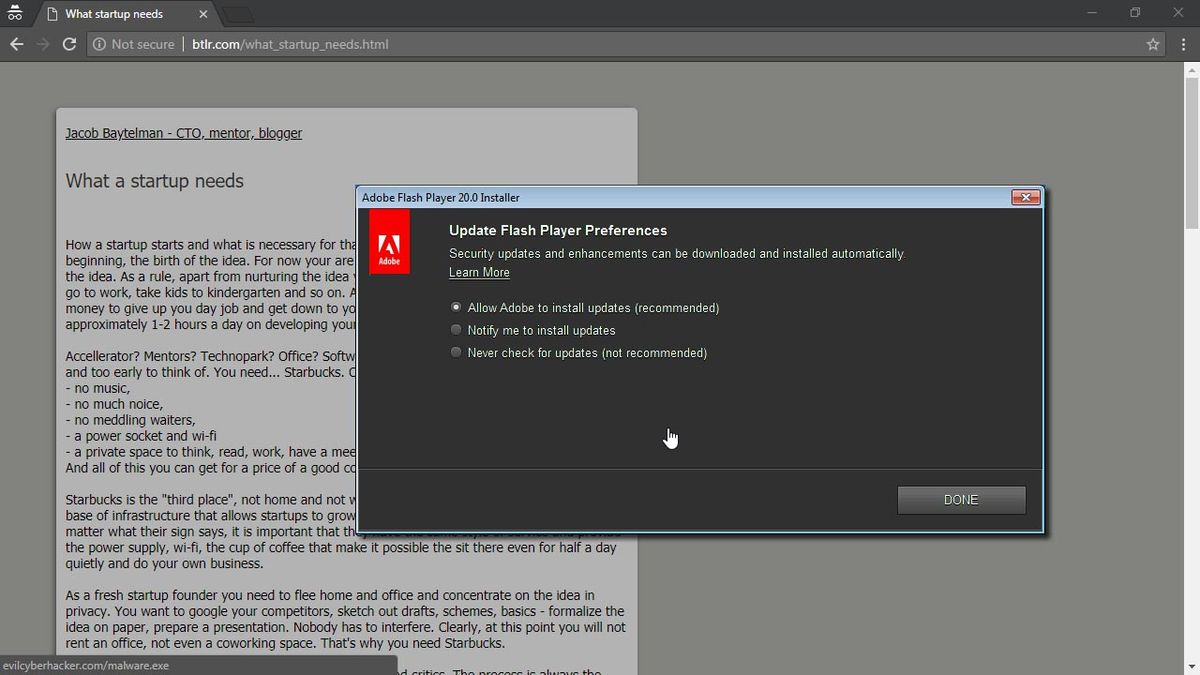
Troy responds by taking him up on this challenge, accuses Jacob of thinking that his site is immune from transport layer risks, and then performs a man in the middle attack on himself using Jacob's site (when in reality literally any HTTP site could have been used).
It's like these two are having completely separate conversations.
And arguably, the fact that nearly any HTTP site could have been used for the demo is partly the point.
Not on all shared hosting plans. And migrating from a shared hosting plan can be quite a lot of work, depending on the website.
Also: Getting a LetsEncrypt wildcard cert for Apache on a CentOS 8 VPS is non trivial (for individuals not already familiar with docker) [1]
Use the nginx/apache plugin, or the webroot option. Yes, it won't do *, but on shared hosting, that might even be better.
It seems crazy to me that Microsoft shops are annoyed that the Windows tooling for Let's Encrypt isn't great yet didn't direct that straight at their vendor. What's the point of having that relationship if they don't do what you need? Are you paying them because you hate money?
Microsoft definitely could, if the feedback from customers was there, have shipped an ACME client for IIS in newer IIS releases/ updates. But the feedback from customers is seemingly "More beatings please, and have you thought of increasing prices?"
CF also allows for self-signed certs: https://blog.cloudflare.com/origin-server-connection-securit... - which are (to me) more complicated than standard certs.
The real game changer in all of this is LetsEncrypt which has become the defacto option for services with huge amounts of custom domains (Shopify, Hubspot, Wordpress) etc.
https is easy. point everything DNS everything to cloudyfiare and click Purchase and by clicking Purchase agree to all the terms (but don't actually read any of them.) hand over root access to a program with the word bot in it, and allow it to update itself automatically (what could possibly go wrong.) Everything HTTPS all the time. https://en.wikipedia.org/wiki/DigiNotar
call me skeptical, or the many ( https://slate.com/technology/2020/01/what-to-know-about-the-... https://www.zdnet.com/article/kazakhstan-government-is-now-i... https://en.wikipedia.org/wiki/DNS_over_HTTPS#Criticism ) many reasons Why My Static Website No Longer Exists.
But in practice over many years of involvement my observation would be that the only thing which matters is Mozilla. At the others such oversight is opaque and whilst opacity might mask a hive of frantic activity it's also what doing nothing would look like from outside such a corporation. But at Mozilla it's done in public, where you can participate if this idea of a "privileged few" bothers you. And so again, I can't prove Microsoft doesn't have loads of smart people dedicated to this problem, but I can tell you that their actions in the period I've been paying attention look exactly how I'd predict from two inputs: Government scale purchases of Microsoft's product platform (driving trust inclusion in Windows for a variety of governments I wouldn't trust to tell me if it's raining let alone in the CA role) and copy-pasting Mozilla decisions.
However I’m far more concerned about chrome, and the attitude of so many in the biz that think Firefox should be mothballed.
It is not easy at all. Getting a certificate and putting it into the conf is. Maintaining that certificate, applying the ever growing number of "security" headers, dealing with broken stapling, is anything, but easy.
Let's Encrypt ACME challenge resolved this from now on. However, I'm using a really old machine + OS, and the nginx version I'm running is old enough not to be compatible with it. So, instead of having a hard time updating the server, I decided to migrate the site to a newer machine (even because some AWS technical limitations don't let me migrate to a new instance type).
~10 years ago I slacked in getting an HTTPS certificate as this would have meant a lot of money.
~ Today, I want to use the ACME challenge with Let's Encrypt (no need of OV for a portfolio website), but I never find the time to finish the migration (that should take more 4 to 16 hours).
I personally prefer them even on current systems, as I don't really like the "automagic" nature of certbot.
https://cloud.google.com/load-balancing/docs/ssl-certificate...
In the case of Cloudflare (or any CDN) best practice is to reject requests not from the CDN. Cloudflare doesn’t support AWS S3 compatible storage directly - it won’t make signed requests - but you can write IAM policy that only responds to certain IP.
Troy talks about a tipping point, which was Jan 2017.
Maybe I just don't get Twitter. Every time I look at a thread it starts with some coherent conversation, but then devolves into a bunch of tangents that don't coherently follow each other.
HN and similar seem much better suited.
- It wastes resources.
- It adds complexity.
- You can solve everything HTTPS solves over HTTP!
- It encourages passive destructive behavior.
- Troy Hunt probably has money coming in from certificates somehow.
HTTP/2 and HTTP/3 are also bad.
WebSockets are bad.
As a side note:
Vulkan is bad.
HDMI is bad.
Wakeup people. Time to get off that over-engineering couch and downvote the guy telling the truth again!
Is much of the current tech overengineered? Yes, it definitely is.
HTTPS on it's own - having TLS and a certificate - is not. It never was. But with stapling, CORS, X-XSS, and the rest, it becomes a beast. Those are becoming requirements, and they are making things _very_ complicated.
I hear you, and I tend to agree on many things. Serial ports were gloriously simple whereas USB3 is a nightmare on every level. VGA was beautiful in it's simplicity, HDMI 1.4 with Ethernet included is certainly too much.
mta-sts is probably the worst idea that could have been added to email, by relying on HTTPS requests.
My personal take on this: use all of them responsibly. Use HTTPS, but don't make it exclusive, let the user make the choice: keep HTTP as well. Leave CORS, STS, Referrer Policy, etc out.
Here are a bunch of solutions I use instead of complexity:
I hash with one time server generated salt for login:
I use Comet-Stream for real-time communication over HTTP:
And my latest finding is DPI for video:
Many parts of the world can't deal with TLS1.3 HTTP/2 websites only.
https://caniuse.com/#feat=tls1-3
That may or may not be a fraction of traffic you care about depending on your visitor profiles and security posture but it's not really accurate to say “many parts of the world”.
http://webcache.googleusercontent.com/search?q=cache:hV6m26a...
Indefinitely babysitting letsencrypt is a small price to pay to keep those grannies safe!
There are plenty, I'd say most, websites which do not need HTTPS. And my static website does not need https. It's nice, sure, but it's a personal website and there's no money or personal information involved. Leaving an HTTP version going alongside the HTTPS and Tor hidden service is just fine.
The greater evil is having people run third party code by default on every website from every random domain that's called. Now that's insecure. It's like opening every email attachment you get. Every single "danger" of HTTP he lists is actually a danger of running third party code blindly and automatically.
I remember getting a Vodaphone sim card (I think it was in Belgium or The Netherlands) and seeing their banner displayed on MY WEBSITE! It wasn't in a language I know, and it might have just been a bandwidth warning or something to indicate I need to reload, but it was still on my website, injected right in there.
HTTP is needed for static sites, if you want to ensure your readers see the exact same site that you made.
If your ISP does this, or if you are on a sketchy network somewhere, then maybe you should not use it at all. Get a new ISP, or use a VPN if you are that worried. If the webmaster is not sharing sensitive information on his casually maintained static website, then that is good enough reason not to use HTTPS. I know it sounds... uncaring.
It is true ordinary people, who don't understand the risks could get MITM'd and never suspect a thing. For some reason I still don't care enough to put HTTPS on my shitty old flash game website. I just can't be bothered. I think that is good enough of a reason. Blame should go on the ISP who are MITM'ing their customers.
Don't trust random sim cards you buy off of the street either.
Also, an attack on my end users is an attack on my site. Anytime someone wants to see my content and gets something else, that is bad. If I can significantly raise the difficulty of doing that, why wouldn't I?
alongside:
Optional security is not just an upgrade; it opens up a downgrade path from more secure to less.
Maybe something less friendly.