Building the Bell System
If someone was making a list of the most important American companies today, it’s unlikely AT&T would be anywhere near the top.
construction-physics.com
149 points · by JumpCrisscross · 2y ago · 59 comments
And of course bell labs created a number of incredibly important technologies. This isn't as easy as just throwing money at the wall, someone had to be in charge of talent selection and what projects to invest in, but when you review what they were able to accomplish, it can really make you wonder what other labs were/are doing.
>Between 1960 and 1973, NASA spent almost $26 billion on the Apollo Program ($311 billion in 2024 dollars), over 2% of U.S. GDP. Over that same period, AT&T spent almost $70 billion building new telephone infrastructure
What a crazy statistic to pull, and the chart in the article also adds to it.
Most tech companies seem to be focused on drop-in/turnkey solutions made by others that make it seem that any imagination for the future is dead.
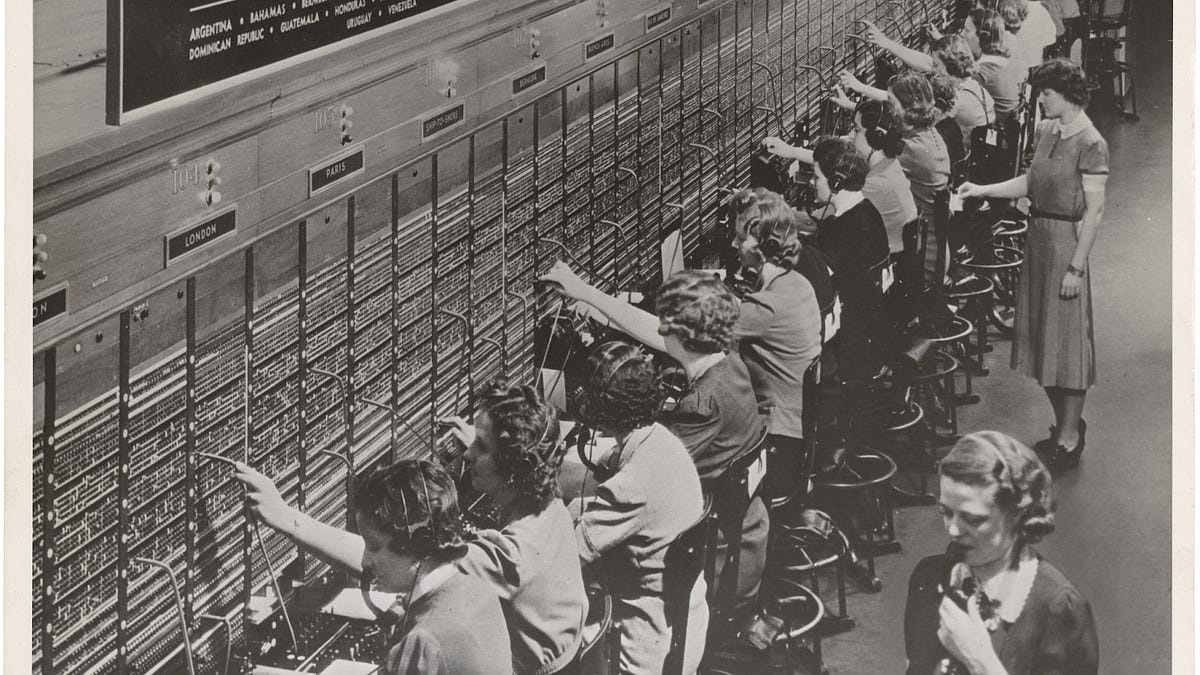
For a surprisingly large fraction of the 1900s, a Bell Labs scientist's introductory training would include elements such as climbing telephone poles and operating exchanges!
For me, as someone who spent some portion of my career in wireline telephony, I feel these losses acutely, particularly as the copper wireline network dies - the fact that all of this infrastructure was built by one company was not lost on me, and was very obvious early in my career - but is less so now.
500-467 thru 500-478 will tell you more than you ever wanted to know.
https://www.amazon.com/Idea-Factory-Great-American-Innovatio...
I'd also recommend Skunk Works: A Personal Memoir of My Years of Lockheed[0] by Ben Rich.[1] Rich was the second director of Lockheed's Skunk Works and protégé of its founder and famed aerodynamicist Kelly Johnson.[2]
The book covers the creation of the U-2 spy plane, SR-71 Blackbird, F-117 Nighthawk, stealth technology in general, and talks a bit about the F-22 Raptor. I'd recommend the book even if you're not super into aerospace or defense tech. It's amazing what the Skunk Works was able to achieve with such a small contingent of dedicated engineers, technicians, machinists, and managers for so little when left alone to do what they knew best.
In my opinion, these days, the term 'skunk works' is all too often used to describe a company's secret R&D wing when it would be more appropriate to use it to describe a small walled off portion of a company with tenure, a place engineers and architects get to roam free and experiment without meddling and micromanagement, even if constrained by a limited budget.
[0] https://www.amazon.com/dp/B011M8DBI6
https://www.amazon.com/Three-Degrees-Above-Zero-Information/...
Backstory: https://www.lrb.co.uk/blog/2019/october/three-degrees-above-...
My takeaway from that one is that Bell Labs' success relied on the common feeling that they were all contributing to the nation's survival and flourishing by supporting the core infrastructure role of the Bell System.
(Compare with the cynicism of Googlers/Eric Schmidt)
And those phones were very well made. My parents had the same Western Electric rotary dial phones in their house for close to 30 years, and they never had an issue.
My biggest question is what happened around 1970? Did their analysts predict saturation or the rise of other networks? It's not exactly clear from the article.
They basically were spending money like it was free in the name of growth for a century, and stopped about that time, which led to all sorts of problems. Was it a prediction, or the onset of 'beancounter accounting'?
It was so capital intensive that it must have been earning good money, but without computers, how was their business model?
E.g. a fixed fee per line, or did they have a way to charge its customers per call, or duration of the call as we're now used to?
In 1920:
>a call from New York to Indianapolis, Indiana would cost $4.15 for the first three minutes and $1.35 for each additional minute
>a call from New York to Los Angeles, California would cost a lot more - $15.65 for the first three minutes and $5.20 for each additional minute.
https://history.stackexchange.com/questions/35135/how-much-d...
By that time their billing was computerized, so the monthly statements would list each long-distance number you called and how many minutes you spent talking. I was calling BBS's at that point (300 baud acoustic coupler hotness!) and I had a phone budget that I had to stay under or pay the parents. Long distance calls (basically anywhere outside your city) were expensive!
Bell planned for the 2 line scenario, as your wiring out to the pole had red/green (tip + ring for line 1) then black/yellow pairs (tip + ring for line 2). So they could offer two lines without needing to run additional wires to the house. Or use the second pair if the first one went bad. The Bell System did forward-thinking like this all the time. And could afford it because (as mentioned) they amortized their system investment over 40+ years.
Different billing strategies often were based on how often the pulse was triggered. This is also related to "billing by the second" - it was originally a technological issue that caused per-minute billing.
As far as the bill - you'd be billed for local service (either unlimited or metered rate), plus a phone rental, and then on top of that local toll and long distance usage. For this, you got a telephone, and the phone company was responsible for your inside wiring as well.
Entire buildings underground on springs, underground generator farms and weeks of fuel, a hidden set of 4 buttons on your touch tone phone for specifying quality of service during dialing, etc. Fascinating stuff.
One of his great contributions, I would argue, information theory being another, and secure telecommunications.
Early work on switching networks (MS Thesis):
https://dspace.mit.edu/handle/1721.1/11173
Seminal work on information theory
https://en.wikipedia.org/wiki/A_Mathematical_Theory_of_Commu...
> they let him work on whatever he wanted
UNIX was written by some guys in the same organization, I wonder one of them thought "Oh sure Shannon gets to work on what he wants, why can't we work on the the future of a global inter-net? Why do we have to hide it as a text processing system?"
My management here apparently is a crowd sourced mob trying to silence me by clicktivism. Shannon and KNR had it easy, IMO.
It's interesting to read this early use of “bit”, before the term became commonplace. The first publication to use “bit”, also by Shannon, was only a year prior[0].
https://en.wikipedia.org/wiki/Communication_Theory_of_Secrec...
> what societal changes happened as a result of engineering the Bell system specifically
I don't have that much time, but in general think about how I am even capable of communicating with you at all. Start with the "https://" at the beginning of most modern URLs.
UNIX, transistors, foundational information theory, "on and on till the break of dawn." If you want to become more familiar with Shannon's work and Bell systems, separately and together, try his master's thesis, followed by his Ph.D., ...
> obviously
I thought my original comment was obvious. At least we both seem to be familiar with the principles of:
https://en.wikipedia.org/wiki/Paul_Graham_(programmer)#/medi...
Thank you for for helping me clarify my thoughts, and have a nice day.
https://en.wikipedia.org/wiki/Discovery_of_cosmic_microwave_...
Your comment is stronger without this. (From a fellow Shannon fan.)
Ma Bell today is really AT&T, Verizon and parts of Lumen, Frontier and Consolidated.
AT&T also is worth less than Verizon due to bad mergers (DirecTV and non-cable Time Warner) which added a lot of debt, money that should've been used for fiber and 5G or even a bidding war against T-Mobile for Sprint if you had to buy your competitor.
That would be correct and only natural. I started with Michigan Bell in 1977, went through divestiture, the assembly of Ameritech, then SWBT/SBC. The Bell System / along with Western Electric/Bell Labs was a great place to be. You could spread out the SD's to work on problems and end up talking with engineers/programmers. My bosses went from being in Michigan, to Wisconsin, to St. Louis, to NJ. So, yes, the jobs have changed, the coworkers have changed, the jobs have changed. Plus, we all missed Ed Whitacre when he retired.