Computer Scientists Prove That Heat Destroys Entanglement | Quanta Magazine
While devising a new quantum algorithm, four researchers accidentally established a hard limit on the “spooky” phenomenon.
Quanta Magazine
178 points · by isaacfrond · 2y ago · 143 comments
Is this concept debunked by this paper, or could it be that 'destroys entanglement' actually means 'becomes entangled with almost everything else'?
Is this conjecture, do we see this in some specific toy systems, or do we know this is how all 'collapsed' waveforms behave? In other words, to what degree is the many-worlds interpretation just an interpretation of the waveform, or is it also a conjecture about how the waveform behaves?
edit: it also sounds like the 'many worlds' are separate, but the 'real' waveform actually still has the information of all the worlds. That suggests the information in that waveform is huge. It also feels like the 'non-collapsed' things from the different worlds could still interact. How much of what I said here is wrong (I presume it is a lot)?
And yes, in many ways the conjectured real waveform is quite a beast. Though you could also argue that the information content is actually very low, in that it is fully specified by the boundary condition of the big bang (well, at least any quantum-like correct theory of everything, remember gravity isn't explained by QM). Thus it's any given universe that actually represents a lot of information because it's the result of many different 'decisions' as that initial state starts to become very complex as it evolves (in a similar way to which pi can be simply defined but contains infinite digits, and if it's 'normal', you can find any string of digits in there, but it'll almost certainly take more digits to specify the position of the sequence in pi than are in the sequence). There's often similar objections on the basis of energy/mass which can be addressed in a similar way.
And, as far as I understand it the interactions between 'worlds' can only really happen for things that are 'close by', in terms of how much the states have separated (that is, in order to observe quantum effects you need to have isolated the system well enough it hasn't already entangled with you. Once it has you can't undo that). I think one general challenge with conceptualizing it is that in practice the correlations in the waveform are extremely messy: the whole universe is not entangled all at once. The 'splits' suggested in the interpretation are basically creating a potentially infinite amount of universes every time any entanglement occurs, which makes it really hard to reason about (indeed, there are philosophical issues that arise if you try to imagine what you should expect to see as a subjective observer in such a universe)
A very hot cube of metal isolated in a vacuum wouldn't have any less overall entanglement than a cold cube.
The other thing you talk about is true. If you have a system in quantum superposition, to measure it you need to entangle it with some macroscopic system. Macroscopic systems decohere very fast. This concept is well explained in excellent John Preskill's quantum computing lecture notes [1]
Note that the system for which wavefunction collapses is not in equilibrium with the measurements equipment (otherwise it wouldn't be measured), so the claims of the paper do not apply to this case.
[1] https://web.archive.org/web/20231005202201/http://theory.cal...
So designing an experiment to show that a cat is in a superposition of alive and dead is at least as hard as bringing a dead cat back to life (obviously in real life it would be much harder, this is just a lower bound).
So in practice the experiment only works with very small systems with a few atoms. Each year there are experiments with bigger systems, but they are usually frozen and very small. Perhaps one day we will be able to do the experiment with tardigrades.
Now, the process of atom decay that would be registered by a Geiger counter has some interesting properties and that's where the "quantum magic" happens.
(at least, that's my mental model of it; ask an expert, I'm not an expert)
But nobody knows what "observed" even means.
It is very hard to demonstrate that fact though, the obvious way of doing it is to build a large quantum computer.
It's not so much a question of scale, but of statistical noisiness. Quantum effects are primarily observable in the low-temperature domain (this is not necessarily "thermometer temperature", but a statistical measure)
Maybe you know the thing I’m about to say and just consider it to be too pedantic, but:
The question to ask of a system is not [whether it is “in a superposition” or “not in a superposition”], but rather, [whether it is “in a superposition of these different states” or “in a specific one of these states”].
Suppose I have a particle which I know is spin up (ignore the position aspect of things, considering only the spin). Is it “in a superposition”? One might be tempted to say “no, it is spin up.”, but the correct response is “A superposition of what? Anything? If so, then trivially yes.” . Because “spin up” can be regarded as a superposition of “spin left” and “spin right”, or as “spin northeast” and “spin southwest”. Likewise, “spin left” can be regarded as a superposition of “spin up” and “spin down”.
To usefully ask whether something is “in a superposition”, you have to specify what states you are regarding as the basis, as far as the question is concerned (or, alternatively, with respect to what observables, where “in a superposition with respect to those observables” would mean that if those observables were measured, the result would be random* ).
Now, why don’t we observe superpositions of states of macroscopic things which differ according to ordinary observables such as “x coordinate of center of mass”? In don’t know. That may be something still not understood. I don’t really understand these attempts, but I think there are things called “pointer states” and a process known as “einselection” which are supposed to help explain that? (Though it has been argued that this explanation involving einselection may be somewhat circular?)
Anything, really. There are no "classical devices", after all, all of them are quantum systems, aren't they?
For some strange reasons [2] it's enough to consider atoms with spin |up> and |down>. But if you put the device sidewide, you would preffer to use |right> and |left> instead. But if you are forced to use |up> and |down> then
  |right> = ( |up> + |down> ) / sqrt(2)

  |left> = ( |up> - |down> ) / sqrt(2)
The same idea of expressing a state using superposition/sums of states in other base is very fundamental to Quantum Mechanics and appears everywhere.
[1] The idea of using Stern–Gerlach experiment is stolen from Feynman, not a brilliant idea of me.
[2] Too much algebra and the SU(2) group. Just bear with me.
But if measurement basis and spin direction are not aligned, then the measurement result will be random in proportion to the misalignment and the spin state will be non-unitarily changed by the measurement, projected onto the measurement basis.
It the second scenario that lacks proper understanding, the first one seems much less interesting, you measure something that you already know and you get the value that you expect. It is certainly an interesting fact that being in a superposition is not an absolute statement, but it also seems not to uncommon. In additive color mixing magenta is a combination of red and blue, in subtractive color mixing it is one of the base colors.
A) In a molecule with two electrons, the wavefunction of the electrons is written as |aa> + |bb> + ... combining one electron with spin up and one with spin down. [1] [2]
It would be nice to choose the base carefully and write only |aa>. That is the Hartree-Fock method [3] and the result is like 95% or 99% accurate, sometimes you get 100% accurate, but it's not usual.
To get the small difference, you must allow combinations like Sqrt(99%) |aa> + Sqrt(1%) |bb>. [4]
It would be very nice to be able to use the simple form because calculations would be much faster.
B) In a different area, IIUC the neutrino osculation is caused because it's impossible to choose the bases for leptons and neutrinos and their transformations in a way there is no superpositions.
[1] Actually, in some cases you must use |ab> + |cd> + ... , but the simple version is good enough.
[2] And with more electrons it's even worse.
[3] https://en.wikipedia.org/wiki/Hartree%E2%80%93Fock_method
To me that just screams "particle physics are predictable(determinant) as long as the particles are shielded from outside noise, not because they are connected/bound together by some mysterious force or law of physics."
I suppose a thought experiment to prove/disprove that would be to send one of the entangled particles, particle A, around a black hole to slow it's time down and then afterwards measure if the entangled particles still give opposite results but consistent with the time delay.
In short, you can never properly describe what happens by assuming the particles states are already determined after being entangled.
[1] https://en.wikipedia.org/wiki/Aspect%27s_experiment?wprov=sf...
That setting is not known when the particles become entangled, and so in principle cannot affect the state of particle B. However since the setting does in fact correlate with the measured state of particle A, it also correlates with the state of particle B.
It proves there's no "local hidden variable"--the state is indeterminate until they are measured. It's proven through some pretty simple probability theory, and is (relatively) easy to follow. There's a great video of Leonard Susskind explaining it somewhere
I send your friend a copy of the same box. I tell you that the result of pressing each button is random but no matter what, if you both press the same button you will see the same result. If you press two different buttons, the results will be uncorrelated.
You ask me to send you and your friend a bunch of these paired boxes and start testing. You then both press random buttons on each box and record your results.
Comparing notes afterward you can see that every time you happened to press the same button you received the same result. You confirm that if you pressed two different buttons, you get uncorrelated results. No problem, you think. I have obviously preprogrammed each box to be one of GGG, GGR, GRG, GRR, RGG, RGR, RRG, or RRR.
But then you notice something strange. If this theory was true, for 2/8 boxes you would have an RRR/GGG box and would see the same answer no matter what. The remaining 6/8 boxes you should get the same answer 2/3 of the time. This means that your answers should agree 3/4 of the time. Even if you surmise that I never send you a box set to the same three values, your results should agree 2/3 of the time.
You crunch the numbers and find that your results agree precisely 50% of the time.
A nice thought experiment is the CHSH game. It's a two player game where the players (player A and player B) cooperate to beat the house. It is played as follows:
1. Each player is assigned a referee.
2. The players, accompanied by their referee, go to separate rooms. Before going to the separate rooms the players can confer. They may also bring any equipment with them that they want. The rooms are shielded to block any communication between the players during their time in the rooms. You may assume that the communication blocking is 100% effective.
3. Each referee uses a true random number generator to generate a bit, and tells the player the value of that bit.
4. The player then generates a bit, by any means, and tells it to the referee.
5. The referee records the bit they generated and the bit provided by the player.
6. Steps #3-5 are repeated 999 more times.
7. After both players have gone through #3-5 1000 times, the referees confer and check their records. For each round the players win $100 in these two cases:
  The players generated different bits and the referees both generated 1
  The players generated the same bit and at least one referee generated 0
In a quantum universe the players can do better. They can generate 1000 pairs of entangled particles and each take one particle from each pair. Let's assume that the particles are linearly polarized photons polarized in the up/down direction.
When player A is given the referee's bit, A sends their particle from the first pair through a polarizing filter and reports a 1 if the particle makes it through the filter, and a 0 if it is blocked.
If the referee's bit was a 0 the player orients their polarizing filter along the up/down axis. If the referee's bit was 1 they orient their filter rotated 45° to the right.
Player B does a similar thing, except their filter is rotated 22.5° to the right if they got a 0 from the referee and 22.5° to the left if they got a 1.
Here's a diagram of their measurement angles, where X0 means player X got a 0 from the referee and X1 means they got a 1:
  B1                B0
  |        |        |
  |        |        |
  +--------+--------+--------+
  |-22.5   |0       |22.5    |45
  |        |        |        |
           A0                A1
Note that if either player receives a 0 from the referee the angle they use will be 22.5° apart from the angle the other player uses no matter what bit the other player got from the referee.
When the measurements on a pair of entangled particles are taken at an angle θ the results match the result you'd get at a 0° difference cos^2(θ) of the time.
For 22.5° that's 85.4% of the time, so when either referee generates a 0 they players will win 85.4% of the time.
If both referees generate 1, B measures at -22.5° and A measures at 45°. That's 67.5° apart and the player bits only match 14.6% of the time, but when both referees generate 1 the players want to generate different bits so that's good. They players win 85.4% of the time in this case.
That's an 85.4% win rate in all cases, which beats the 75% that they can get in a classical universe.
If you try to make some sort of classical-only thing that can take the place of entangled particle pairs you'll find that you can't make it work. You won't get past 75%.
Another thought experiment that might be clearer (or might just muddle things) involving two mysterious devices that you are trying to reverse engineer is here [1]. That puts it more mechanical/computational terms which may be easier to play around with.
If the cat is not definitely dead (or alive) until you look at it, I think the mainstream consensus is that curiosity killed the cat.
Interaction doesn't necessarily destroy entanglement, it can also entangle the new particle with the others. Meaning the photon would just get entangled with the rest instead of breaking the entanglement.
This state [rho] is the Gibbs state at infinite temperature, and is in the interior of the convex hull of product states. So, as β tends to zero, ρ will eventually enter the interior of this convex hull, making it separable. This happens at a finite β which depends on system size.
hinting that something different is happening here (from the C&L model mentioned below.)
Indeed the CS guys are probably looking for a way to redefine entanglement (entropy, as you summarized above), to essentially “work” in the same way as what they have in their preprint, but also cover the prethermalized cases..
I have a mental model for entanglement that's probably very wrong, and I would love to devise a proper test to falsify it.
    [I]t is easy to show using standard theory that if a system starts in an eigenstate of some observable, and measurements are made of that observable N times a second, then, even if the state is not a stationary one, the probability that the system will be in the same state after, say, one second, tends to one as N tends to infinity; that is, that continual observations will prevent motion. Alan and I tackled one or two theoretical physicists with this, and they rather pooh-poohed it by saying that continual observation is not possible. But there is nothing in the standard books (e.g., Dirac's) to this effect, so that at least the paradox shows up an inadequacy of Quantum Theory as usually presented.
    — Quoted by Andrew Hodges in Mathematical Logic, R. O. Gandy and C. E. M. Yates, eds. (Elsevier, 2001), p. 267.
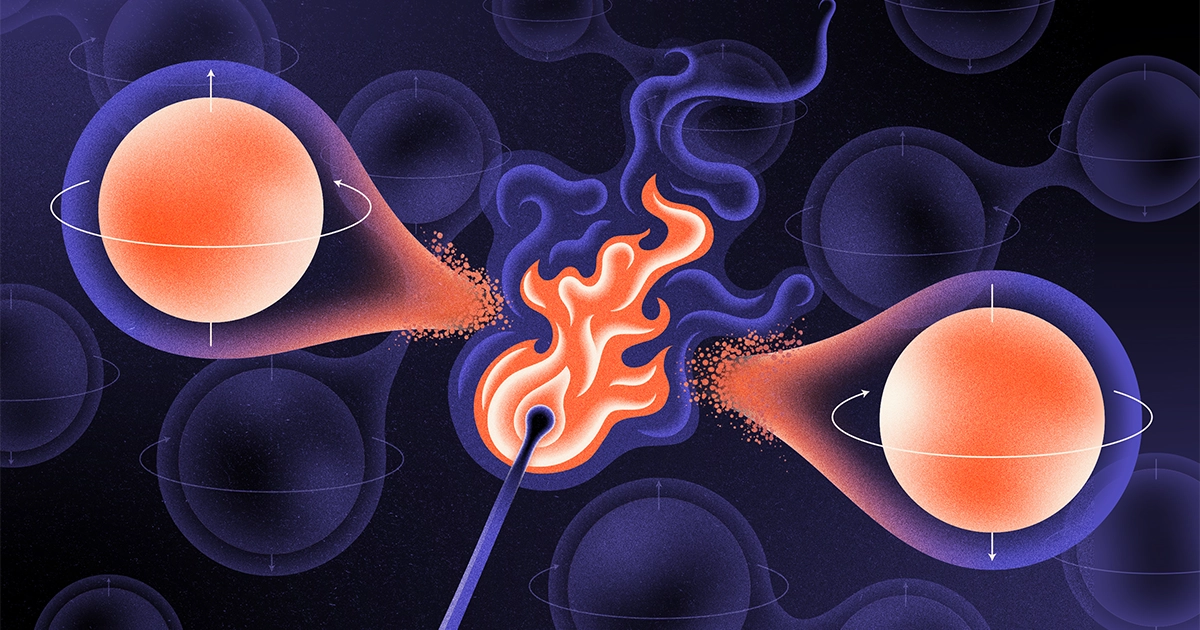
Quanta Magazine always impresses me with the illustrations for each article
The illustration matches the tone and content of the piece, while also being visually consistent with her other Quanta illustrations. Seems like Ms. Armitage is only 2 years out of college, but is literally (illustratively?) crushing it [0].
Knee-jerk criticism like this in response to someone putting out heart-felt praise is so, so unnecessary. There's a time for putting down AI-assisted work, maybe, but this isn't it.
0 - https://www.behance.net/moodboard/179460311/illustration
  "Why don't more physicists worry about
   the foundations of Quantum Mechanics?"
  "They first say they have no time,
   and it doesn't affect their work anyway."
  "Then they imply that if they stopped their work
   and thought hard for 20 minutes
   they could solve all the problems."
A thing technically impossible for flat earth 'model'. But they just started attacking each other as not reliable enough to go.
Anyhow they would claim time near the edges slows down the time or the whole thing was a virtual 3d future tech used to fool them
Got a link? That sounds hilarious but I couldn't find any articles about it (though I didn't search terribly hard).