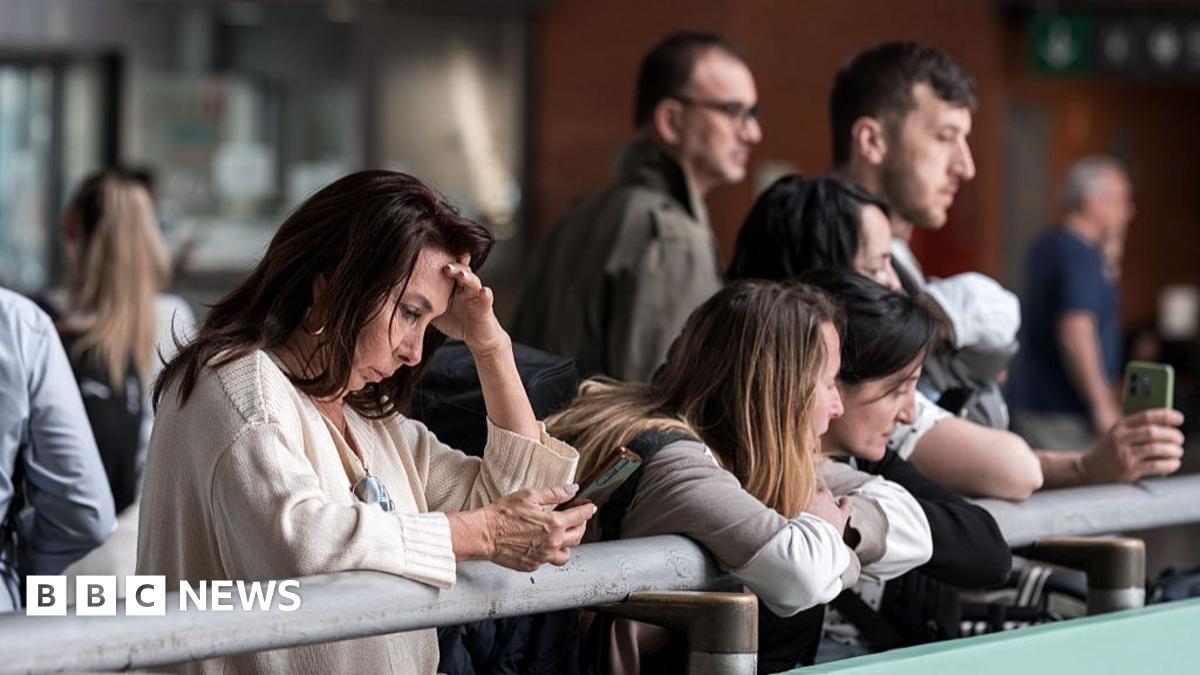
Spain will take 'all necessary measures' to prevent another blackout, says PM - live updates
Power has now been fully restored in Spain and Portugal, as officials continue to investigate what caused the outage.
BBC News
1560 points · by lleims · 1y ago · 1165 comments
If an entire nation trips offline then every generator station disconnects itself from the grid and the grid itself snaps apart into islands. To bring it back you have to disconnect consumer loads and then re-energize a small set of plants that have dedicated black start capability. Thermal plants require energy to start up and renewables require external sources of inertia for frequency stabilization, so this usually requires turning on a small diesel generator that creates enough power to bootstrap a bigger generator and so on up until there's enough electricity to start the plant itself. With that back online the power from it can be used to re-energize other plants that lack black start capability in a chain until you have a series of isolated islands. Those islands then have to be synchronized and reconnected, whilst simultaneously bringing load online in large blocks.
The whole thing is planned for, but you can't really rehearse for it. During a black start the grid is highly unstable. If something goes wrong then it can trip out again during the restart, sending you back to the beginning. It's especially likely if the original blackout caused undetected equipment damage, or if it was caused by such damage.
In the UK contingency planning assumes a black start could take up to 72 hours, although if things go well it would be faster. It's one reason it's a good idea to always have some cash at home.
Edit: There's a press release about a 2016 black start drill in Spain/Portugal here: https://www.ree.es/en/press-office/press-release/2016/11/spa...
A full grid black start is orders of magnitude more complex. You’re not just reviving one machine — you’re trying to bring back entire islands of infrastructure, synchronize them perfectly, and pray nothing trips out along the way. Watching a rig wake up is impressive. Restarting a whole country’s grid is heroic.
The words "it's a miracle it works at all" routinely popped up in those conversations, which is... something you don't want to hear about any sort of power generation - especially not nuclear - but it's true. It's a system basically built to produce "common accidents". It's amazing that it doesn't on a regular basis.
Funny thing is, those are the exact words I use when talking to people about networking. And realistically anytime I dig deep into the underlying details of any big enough system I walk away with that impression. At scale, I think any system is less “controlled and planned precision” and more “harnessed chaos with a lot of resiliency to the unpredictability of that chaos”
I wonder however how being part of the "continental Europe synchronous grid" affects this, and how it isolates to Portugal and Spain like this.
But yeah there are a lot of capacitors that want juice on startup that happily kills any attempt to restore power. My father had "a lot" of PA speakers at home and when we tripped the 3680w breaker (16A 220v) we had to kill some gear to get it back up again. I'm also very sure we had 230v because I lived close to the company I worked for and we ran small scale DC operations so I could monitor input voltage and frequency on SNMP so through work I had "perfect amateur" monitoring of our local grid. Just for fun I got notifications if the frequency dropped more than .1 and it happened, but rarely. Hardly ever above though since that's calibrated over time like Google handle NTP leap seconds.
I love infrastructure
I realized the tech must have been winding up a flywheel, and then the pilot engaged a clutch to dump the flywheel's inertia into the engine.
The engineer in me loves the simplicity and low tech approach - a ground cart isn't needed nor is a battery charger (and batteries don't work in the cold). Perfect for a battlefield airplane.
---
I saw an exhibit of an Me-262 jet fighter engine. Looking closely at the nacelle, which was cut away a bit, I noticed it enclosed a tiny piston engine. I inferred that engine was used to start the jet engine turning. It even had a pull-start handle on it! Again, no ground cart needed.
---
I was reading about the MiG-15. American fighters used a pump to supply pressurized oxygen to the pilot. The MiG-15 just used a pressurized tank of air. It provided only for a limited time at altitude, but since the MiG-15 drank fuel like a drunkard, that was enough time anyway. Of course, if the ground crew forgot to pressurize it, the pilot was in trouble.
Again, simple and effective.
And, despite the news reports, this is not a true blackstart. Some power survived.
Similarly, the US Navy maintains banks of pressurized air flasks to air-start emergency diesels. Total Capacity being some multiple of the required single-start capacity
Is that what Dr. Sattler is doing in this scene from Jurassic Park?
Nice attention to detail by the filmmakers.
Small diesels could be an option but they're harder to pull start for a given size.
Maybe there are other concerns for an oil rig.
Most vessels will experience a blackout periodically and the emergency generator start fine, normally on electric or stored air start, and then the main generators will come up fine. It's really not delicate, complex or tricky - some vessels have black outs happen very often, and those that don't will test it periodically. There will also be a procedure to do it manually should automation fail.
There are air starters on some emergency generators that need handling pumping. These will also get tested periodically.
The most complex situation during black out restoration would be manual synchronisation of generators but this is nothing compared to a black start.
In a real black start, the guys might very well grab a portable generator and just use that instead. But having the option to hand crank something rather than rely on batteries that might run flat is good.
And then phase will align itself a couple times a minute so what's difficult about that part?
A rare but sobering opportunity to reflect on something we usually take for granted: electricity.
We live in societies where everything depends on the grid — from logistics and healthcare to communications and financial systems. And yet, public awareness of the infrastructure behind it is shockingly low. We tend to notice the power grid only when it breaks.
We’ve neglected it for decades. In many regions, burying power lines is dismissed as “too expensive.” But compare that cost to the consequences of grid collapse in extreme weather, cyberattacks, or even solar storms — the stakes are existential. High-impact, low-frequency events are easy to ignore until they’re not.
That's 20 years without any significant problems in the grid, apart from small localized outages.
It's not hard to start taking things for granted if it works perfectly for 20 years.
Many people don't even have cash anymore, either in their wallet or at home. In case of a longer power outage a significant part of the population might not even be able to buy food for days.
Even if you have cash many shops would not sell anything in case of a mass outage because registers are just clients which depend on a cloud to register a transaction. Not reliable but cheap when it works.
So, what's really interesting is that these sorts of social collapses have happened. In fact, they often happen when natural disasters strike.
When they do happen, mutual aid networks just sort of naturally spring up and capitalism ends up taking a backseat. All the sudden worrying about the profits of Walmart are far less important than making sure those around you don't starve.
As it turns out, most people, even managers of stores, aren't so heartless as to let huge portions of the population starve. Everyone expects "mad max" but that scenario simply hasn't played out in any natural disaster. In fact, it mostly only ends up being like that when central authority arrives and starts to try and bring "order" back.
You can read about this behavior in "A Paradise Built in Hell" [1].
I often wonder if we should leave energy/telecommunications in a state where they can and do fail with some degree of frequency that reminds us to have a back up plan that works.
I had thought that the (relatively) recent lockdowns had taught us how fragile our systems are, and that people need a local cache of shelf stable foods, currency, and community (who else discovered that they had neighbours during that time!)
For something like this, a local electricity generation system (solar panels, wind/water turbines, or even a ICE generator) would go a long way to ensuring people continued to have electricity for important things (freezers)
And who's fault is that? Why did europe allow this?
Why will the US allow this, eventually?
Most of our modern economy and systems are built to reduce redundancy and buffers - ever since the era of “just in time” manufacturing, we’ve done our best to strip out any “fat” from our systems to reduce costs. Consequently, any time we face anything but the most idealized conditions, the whole system collapses.
The problem is that, culturally, we’re extremely short-termist- normally I’d take this occasion to dunk on MBAs, and they deserve it, but broadly as a people we’re bad at recognizing just how far down the road you need to kick a can so you’re not the one who has to deal with it next time and we’ve gotten pretty lazy about actually doing the work required to build something durable.
This is a solution that teenager put in management position would think of(along with hire more people as solution to inefficient processes), not a paid professional.
Systems like electric grid, internal water management (anti-flood) shouldn't be lean, they should be antifragile.
What's even more annoying that we have solutions for a lot of those problems - in case of electric grids we have hydroelectric buffers, we have types of powerplants that are easier to shutdown and startup than coal, gas or wind/solar(which cannot be used for cold start at all).
The problem is that building any of this takes longer than one political term.
We've had substantial disruptions, but they've not been particularly irrecoverable or sustained.
But I wonder from a reliability (or lack of cascading failures) point of view whether synchronous islands interconnected with DC interconnects is more robust than a large synchronous network?
I feel like to many technologists, the internet is still "the place you go to to play games and chat with friends", just like it was 20 years ago. Even if our brains know it isn't true, our hearts still feel that way.
I sometimes feel like the countries cutting off internet access during high school final exams have a point. If you know the internet will be off and on a few days a year, your systems will be designed accordingly, and if anything breaks, you'll notice quickly and during a low-stakes situation.
Also I suspect there is far more renewables on the grid now than in 2016.
This is potentially the first real black start of a grid with high renewable (solar/wind) penetration that I am aware of. Black starts with grids like this I imagine are much more technically challenging because you have generation coming on the grid (or not coming on) that you don't expect and you have to hope all the equipment is working correctly on "(semi)-distributed" generation assets which probably don't have the same level of technical oversight that a major gas/coal/nuclear/hydro plant does.
I put in another comment about the 2019 outage which was happened because a trip on a 400kV line caused a giant offshore wind farm to trip because its voltage regulator detected a problem it shouldn't have tripped the entire wind output over.
Eg: if you are doing a black start and then suddenly a bunch of smallish ~10MW solar farms start producing and feeding back in "automatically", you could then cause another trip because there isn't enough load for that. Same with rooftop solar.
The South Australia System Black in 2016 would count - SA already had high wind and rooftop solar penetration back then. There's a detailed report here if you're interested:
https://www.aemo.com.au/-/media/Files/Electricity/NEM/Market...
Non tied solar won't affect the grid at all. So this is a non-issue.
Grid tie requires the grid to tie to, otherwise it can't synchronize. So it stays disconnected.
Why would that prevent you from being grid-tie? I have 53 panels (~21kw) grid tied and pushing to the grid, but in the event of grid failure my panels will still operate and push into my 42kwh battery array which will power the entire house. ( The batteries take over as the 'virtual grid source). I can then augment the batteries with generator and run fully off grid for an extended amount of time ( weeks in my case ).
You need to calculate for it but I don't think this would be a problem
Does this really qualify as "black start" when they can rely on the bigger EU grid?
It really depends on the region though because almost all large hydroelectric dams are designed to be primary black-start sources to restore interconnects and get other power plants back up quickly in phase with the dam. i.e. in the US 40% of the country has them so it’s relatively easy to do. The hardest part is usually the messy human coordination bit because none of this stuff is automated (or possible even automatable).
* the load spike from everyone’s motors and compressors booting up at the same time
For Spain the external power and synchronization can come from France rather than generators which will help, but the process and complexities are still mostly the same. Call it a dark start, perhaps.
If Portugal (on the West) had to wait for that, it would probably have taken even longer.
> A black start is the process of restoring an electric power station, a part of an electric grid or an industrial plant, to operation without relying on the external electric power transmission network to recover from a total or partial shutdown.[1]
Only the first power plant in a black-start (like a hydroelectric dam or gas plant started by a backup generator) is truly "black started." The rest don't fit that definition because they depend on an external power source to spin up and synchronize frequency before burning fuel and supplying any energy to the grid. If they didn't, the second they'd turn on they'd experience catastrophic unscheduled disassembly of the (very big) turbines.
Only the first power plant can come online without the external transmission network.
Then again they might be less prepared precise because of the euro grid is available
It's far more problematic for the UK because all the interconnects are DC.
The UK keeping its own time just makes things easier for it IMO.
If your Factory uses too much power, theres not enough energy to run the power plants generation, which decreases your power production. Death spiraling until theres no power.
You have to disconnect the factory, and independently power your power plants back up until you have enough energy production to connect your factory up again.
Another "trick" is those burner inserters are black start capable. They can pick up fuel and feed themselves to keep running without an electrical network.
I also tend to put Schmitt triggers in low priority areas. They've got a battery on the main grid next to them and if the battery drops below 50% power they remain off until it goes back above 75% power.
As for 50%/75% triggers--the game doesn't model start/stop problems, only fancy circuit setups would give a hoot about being fed by flickering power. (But as a human....I was out adding to a big accumulator bank at twilight. Far away the bugs had a base close enough to my laser turrets that they kept attacking. The sun was powering my base but didn't have enough for the turrets. The whole bank would flicker for every bug. Usually the electrical indicator on the accumulators is a good thing.)
Man I need to go play some more.
- Cause of event not known yet.
- They noticed power oscillations from the Spanish grid that tripped safety mechanisms in the Portuguese grid. At the time, due to the cheaper prices, the Portuguese grid was in a state of importing electricity from Spain.
- They are bringing up multiple power systems and the Portuguese grid is able to supply 100% of needs if required. It was not configured in such a state at the moment of event.
- They had to restart the black start more than once, since while starting, noticed instabilities in some sectors that forced them to restart the process.
- Time for full recovery unknown at this time, but it will take at least 24 hours.
Would this suggest the grid hasn't snapped apart, or is it just not possible to tell from the data?
Coal, pumped hydro, and nuclear generation all went to 0 around the same time, but presumably that's those sources being disconnected from the grid to balance demand? https://transparency.entsoe.eu/generation/r2/actualGeneratio...
https://x.com/RedElectricaREE/status/1916818043235164267
We are beginning to recover power in the north and south of the peninsula, which is key to gradually addressing the electricity supply. This process involves the gradual energization of the transmission grid as the generating units are connected.
I see load dropping to zero on that graph, or rather, load data disappears an hour ago.
If the grid frequency goes too far out of range then power stations trip automatically, it's not an explicit decision anyone takes and it doesn't balance load, quite the opposite. A station tripping makes the problem worse as the frequency drops even further as the load gets shared between the remaining stations, which is why grids experience cascading failure. The disconnection into islands is a defense mechanism designed to stop equipment being too badly damaged and to isolate the outage.
Last actual load value for Spain at 12:15: https://transparency.entsoe.eu/load-domain/r2/totalLoadR2/sh...
Last actual load value for France at 12:00: https://transparency.entsoe.eu/load-domain/r2/totalLoadR2/sh...
It's not just about the power. System components cannot be brought to operating temperatures, speeds and pressures faster than mechanical tolerances allow. If a thermal plant is cold & dark, it can take days to ramp it to full production.
In some cases yes. Modern combined cycle plants can take as little as 30 minutes to ramp to full output. Older designs can take upward of 4-6 hours.
If you have steam as an indirection, that's when things take a really long time. Natural gas turbines are a more direct cycle.
1. The grid has to fully collapse with no possibility of being rescued by interconnection
2. As a result, a generation asset has to be started without external power or a grid frequency to synch to
3. An asset capable of this is usually a small one connected to a lower voltage network that has to then backfeed the higher voltage one
4. Due to the difficulty of balancing supply/demand during the process, the frequency can fluctuate violently with a high risk of tripping the system offline again
None of this applies in yesterday's case:
The rest of the European synchronous grid is working just fine.
News reports stated Spain restored power by reconnecting to France and Morocco.
By reestablishing the HV network first, they can directly restart the largest generation asset with normal procedures.
As they bring more and more load or generation online, there's little risk of big frequency fluctuations because the wider grid can absorb that.
I can only imagine the difficulty of bringing large parts of the grid back online, that rush current must be immense.
Or look at Apollo 13. The astronauts had turned off everything possible because they had lost their generator and only had their batteries. And it took a lot of furious planning by the guys on the ground to come up with a sequence of turning things back on that didn't cause the peak draw to go too high. Can't go too fast or it trips. Can't start too early because the power is limited, but can't start too late because the systems have to be up when they hit the atmosphere.
More than cash it was important yesterday to have the following in case it would have lasted longer:
- a battery powered am/fm radio with spare new batteries
- some candles and matches
- food reserves for a few days that don't need refrigeration: bread, anything in can, pasta, rice...
- some kind of gaz or alcohol stove, dry wood or bbq charcoal: you can always make a fire in the middle of the street where there is no risk of burning things around.
- water reserve (I always have like 24L of drinking water) and since I hate waste I regularly fill jerrycans when waiting for hot water in the shower that I use for manual washes (kitchenware or gears).
But with solar, how is the synchronization provided? In like a giant buck? Or in software somehow? Does the phase shift matter as much as in the electromechanical systems?
My intuition is that solar would make the grid harder to keep stable (smaller mass spinning in sync) but also may offer more knobs to control things (big DC source that you can toggle on/off instantly.. as long as sun is out). But I don’t actually know.
Currently the main driver of battery deployments is not so much energy price time arbitrage as "fast frequency fresponse": you can get paid for providing battery stabilization to the grid.
(for the UK not Spain: https://www.axle.energy/blog/frequency )
So if you have a smarter solar panel, or a smart battery, you can stabilize the grid. I’m assuming that all of the traditional software complexity things in distributed systems apply here: you want something a little bit smart, to gain efficiency benefits, but not too smart, to gain robustness benefits.
My intuition is that bringing the market into it at small timescales probably greatly increases the efficiency significantly but at the cost of robustness (California learned this “the hard way” with Enron)
> Phase matching is still required, wherever the phase difference is not zero there is a deadweight loss of power as heat
If the electronic controller is “ahead of” (leading) the grid, then that heat would come from the solar plant; if it is “behind” (following) then that heat comes from the grid. Is that right? And likely, solar plants opted for the simplest thing, which is to always follow, that way they never need to worry about managing the heat or stability or any of it.
I wonder if the simplest thing would be for large solar plants to just have a gigantic flywheel on site that could be brought up via diesel generators at night…
If you mean how does solar detect phase and synchronize to the grid: https://en.wikipedia.org/wiki/Phase-locked_loop
If you mean how does solar act to reinforce the grid: search for terms like "grid forming inverter vs. grid following inverter" though not all generators are the same in terms of how much resilience they add to the grid, esp. w.r.t. the inertia they do or do not add. See e.g. https://www.greentechmedia.com/squared/dispatches-from-the-g...
Low Grid frequency & voltage can cause an increase in current & heating of transmission lines and conductors and can damage the expensive things, this is why these systems trip out automatically at low frequency or low voltage, and why load shedding is necessary
I'm not saying you're wrong, but this isn't obviously correct to me.
Since solar going to a grid is completely dependent upon electronic DC->AC conversion, I would expect that it could follow a lot greater frequency deviation for a lot longer than a mechanical system that will literally rip itself apart on desync.
The main difficulty is that the software of grid-following inverters tend to make them trip out very suddenly if the grid parameters get too far out of spec (they will only follow the grid so far), but once the grid is good they basically instantly synchronise.
But all large solar farms are likely to be mandated to switch from grid following to grid forming inverters eventually which will make them beneficial for grid security because they will help provide 'virtual intertia' that looks exactly the same to the rest of the grid as spinning mass does.
"Luckily", France is at an historically high level of production capacity at the moment and the connection between the two countries was reestablished fast.
According to RTE (French network manager), the interconnection was maxed yesterday at around 3GW of power.
Sadly, while Spain is part of CESA, it's not very well connected. I wouldn't be surprised if one the takeaway from the whole incident is that more interconnections are needed.
Here's why generators were running here despite the grid being available. A generator has a very short lifetime and in order to prolong it, some owners learned to run those in the very optimal schedule. Which sometimes requires a minimum amount of time to run in a single cycle. Thus if you started it you are committed to run for X hours.
Ukraine went through many black starts in the first winter of Russian strikes against energy. I guess they built a skill of recovering it quickly enough that it started happening faster and easier every next time.
I took down the servers though, so you probably can't easily try it. I don't know if I added a way to configure the lobby server. I should have! It's open source though. And there is a video about that thing on my YouTube: https://www.youtube.com/watch?v=6TPgfa7LbiI
The game is bad and nothing of what we planned on doing actually made it into the game. The video is long and boring too. But maybe someone finds this cool and is inspired by this and makes a game like this.
The first 15 minutes of the game were actually about getting the ship moving, first by reading the manuals of half a dozen different ship systems and then following some procedure outlined in those manuals (parts of which were simply incorrect), maybe having to do some things in sync with your other players and stuff like that. I think it would have been cool to add multiple reactors and start them up in sync and stuff. The different ship systems were actually Lua programs that interacted via a message bus. So kind of a unknown computer architecture?
> have some cash at home
For maybe the first 24 hours at a grocery store, and then not so sure. Would your neighbors sell you supplies and food? Maybe not? And so many places now depend on cashless transactions and doubtful they have pen, paper, lockbox, and safe as a contingency plan.
The entire EU runs on one synchronised grid so from that perspective a single 'province' went offline, not the grid.
The complex process of configuring the transmission network to bring grid power to each power plant in succession is the same.
https://en.wikipedia.org/wiki/Continental_Europe_Synchronous...
That said, lots of people hit the cafés and had to resource to cash payments. There was also lots of people buying bottled water at the shops.
So basically, you could divide people in two groups. Those that took it like an extra Sunday, and those that took it like the beginning of a war or something :-D
Most places are so dependent upon electricity that they can't even take cash during a blackout. And they don't even have the mechanical machines to take a credit card imprint anymore.
If you try to connect another generator to the grid, it needs to be at the same point (phase) in the sine-wave cycle, so that its power contribution is added, not subtracted.
If it's not in sync, huge currents can flow, causing damage. Sort of like connecting jumper cables backwards.
There is precedent for major power outages, a huge majority of which are not malicious: https://en.wikipedia.org/wiki/List_of_major_power_outages
I remember the day when the Swiss railway power network went down for a day (in 2005) because one power line was down for maintenance and someone pressed the wrong button and produced a short circuit somewhere else. It's a bit like the incidents in planes were one engine has a problem and the crew shut down the other one by mistake.
https://edition.cnn.com/2025/02/13/asia/sri-lanka-power-outa...
Trying to stay on the facts, this incident is likely accidental but some people even the very workers at energy companies could send a message for, I don't know. A pay raise?
In Texas, the electric providers cut staff and maintenance to maximize shareholder value. They will not have redundant systems and redundant plants out of the goodness of their hearts. The Texas marketplace actually allowed them in the odd event of an outage to charge astronomical spot prices thinking this will incentivize them to have redundant systems. This was a foolish fantasy.
Now in Texas, discussion of how to cost share redundancy have taken place. But no one wants to pay for it. https://www.texastribune.org/2023/03/01/texas-power-market-p...
If you want a no fail grid you need to incentivise a no fail grid.
So frequent it even has its own wikipedia page: https://en.wikipedia.org/wiki/Category:Airliner_accidents_an...
Solar PV/thermal + wind: ~78%
Nuclear: 11.5%
Co-generation: 5%
Gas-fired: ~3% (less than 1GW)
This is (a) incredibly impressive to achieve and (b) definitely the point at which the battery infrastructure needs to catch up in order to reduce the risk of such incidents.
Makes the case for favouring flywheels over batteries.
See also: https://en.wikipedia.org/wiki/Aeolian_harp
Edit: might be a completely different kind of oscillation than I was thinking of. https://news.sky.com/story/spain-portugal-power-outage-lates...
So I would also like to understand how this works :)
They already became a laughing stock once for promising the "strongest possible response" for the Nord Stream 2 sabotage [1].
[1] https://www.reuters.com/business/energy/eu-sees-sabotage-nor...
I only have a layman's understanding of power grids, but I thought they were incredibly hardened, with backups and contingencies in depth
Are the grids at this scale really this brittle? Would there be a death toll from this?
I also wouldn't blame malice without corroborating evidence
Some are harder than others, and some have random flaws which nobody can really predict.
Spain seems in the transition to renewables, so it's possible that they have some flaws because they are still in the process, or because it's something which never happened before and is unknown territory. Also, Spain had some economic problems in the last decade, maybe someone build to cheap or was even cheating somewhere.
> Are the grids at this scale really this brittle? Would there be a death toll from this?
Hospitals should have backup-systems. Traffic should be able to stop in time. I guess the most problematic parts are people stuck in elevators and other spaces which only open electrical, as also the loss of cellular phone-connections for calling helpers.
All the mobile phone installations that I saw had power for at least 24-72hrs depending on how far from civilization they were. The carriers have backups and everything.
The problem in these kind of situations is the saturation of the mobile network, not its availability.
In reality this means you might lose, say, 1GW due to a transmission line failing, have a big frequency dip as a result, and then have 14GW drop offline like dominoes because they sense a grid frequency outside of safe operating parameters; disconnect as they go into safety mode; cause the frequency dip to worsen; and pull even more plants offline with them. If you're not careful, a small outage can quickly cascade into an entire grid going offline.
I think we should prepare for the worst though. It's wrong to assume it's not an attack too, and until we can conclude it's not an attack we should be prepared to deal with the possible consequences and act accordingly.
Very poorly explained right now by Space Weather News. I am waiting for an updated explanation.
We're a remote business so it seemed like I'd just rudely dropped off the call, but as everything was down I couldn't let people know what'd happened.
Apparently it was caused by botched maintenance work affecting 30,000 houses, but the timing was so perfect I can't help thinking it was because our AGI overlords really didn't want me to deliver that talk for some reason.
Three quarter of the production disconnects from the grid between 12:30 and 13:00, with only a bit of solar and onshore wind sticking around.
I don't think we're able to tell from the data if one is the cause of the other, are we? Since if production was lost, load would have to be shedded to balance the grid, and if load was lost (e.g. due to a transmission failure), production would have to be disconnected to balance the grid.
That started from a combination of a lightning strike and generator trip, but turned into a local cascade failure as lots of distributed generation noticed that the frequency was under 49Hz and disconnected itself. I suspect the Spanish situation will be similar - inability to properly contain a frequency excursion, resulting in widespread generator trips.
(I suspect this is going to restart a whole bunch of acrimony about existing pain points like grid maintenance, renewables, domestic solar, and so on, probably with the usual suspects popping up to blame renewables)
Renewables were a factor in the blackout here in Brazil a couple of years ago: the models used by the system operator did not correspond to reality, many solar and wind power plants disconnected on grid disturbances quicker than specified. That mismatch led the system operator to allow a grid configuration where a single fault could lead to a cascade (more power was allowed through a power line than could be redistributed safely if that power line shut off for any reason), and that single fault happened when a protection mechanism misbehaved and disconnected that power line. The main fix was to model these solar and wind power plants more conservatively (pending a more detailed review of their real-life behavior and the corresponding update of the models), which allowed them to correctly limit the power going through these power lines.
If you want an excruciating level of detail, the final 614-page report is at https://www.ons.org.br/AcervoDigitalDocumentosEPublicacoes/R... (in Portuguese; the main page for that incident is at https://www.ons.org.br/Paginas/Noticias/Ocorr%c3%aancia-no-S...).
[1] https://transparency.entsoe.eu/load-domain/r2/totalLoadR2/sh...
[1] https://transparency.entsoe.eu/transmission-domain/physicalF... [2] I'm not necessarily blaming the engineers, but the politicians who force those engineers to put square pegs in round holes. For example, I can imagine politicians making a short term decision to skimp on energy storage while increasing renewable penetration. Surely renewable systems must be less reliable without storage given the lack of rotational inertia?
[1]: https://www.spiegel.de/wissenschaft/stromversorgung-in-spani...
For instance, one reporter asked one of the government flunkies whether it could be a cyberattack and they turned his noncommittal “maybe, we don’t know” into “government says cyberattack may be ongoing”.
Be careful of idiot reporters out there.
Edit: I’m listening to another radio interview where they are outlining the plans to bring online Portuguese dams and thermal generators over the next few hours, progressively unplugging from the Spanish supply (fortunately we have enough of those, apparently).
It should take 3-4 hours to get everything balanced with only national supplies, and they will restore power from North to South.
Key points that started it were (you can see the chain of events in the doc):
2.4.1. At 16:52:33 on Friday 9 August 2019, a lightning strike caused a fault on the Eaton Socon – Wymondley 400kV line. This is not unusual and was rectified within 80 milliseconds (ms)
2.4.2. The fault affected the local distribution networks and approximately 150MW of distributed generation disconnected from the networks or ‘tripped off’ due to a safety mechanism known as vector shift protection
2.4.3. The voltage control system at the Hornsea 1 offshore wind farm did not respond to the impact of the fault on the transmission system as expected and became unstable. Hornsea 1 rapidly reduced its power generation or ‘deloaded’ from 799MW to 62MW (a reduction of 737MW).
In my head, I'm thinking of generators/plants, connected by some number of lines, to some amount of load, where there are limited disconnection points on the lines.
So how do grid operators know what amount of load will be cut if they disconnect point A123 (and the demand behind it) vs point B456?
Is this done sort-of-blind? Or is there continual measurement? (e.g. there's XYZ MW of load behind A123 as of 2:36pm)
This has changed a lot though, as even home batteries afaik will start discharging if they start noticing the frequency dropping to provide some support on generation. But if it's dropping too fast and too quickly it won't help.
But yes they do have very granular info on all the HV sources and how much load is on them.
In this case, we are dealing with a widespread grid incident. The various grid protection mechanisms have been triggered to prevent interconnection overload. In addition, the generators are trying to correct the grid frequency to exactly 50Hz. At 49Hz, more power must be generated; at 51Hz, less power must be generated. However, if the frequency varies too much, there are also protection mechanisms to prevent the turbines from overspeeding or amplifying frequency variations.
The grid is complex, and normally this type of incident is limited to one cell of the electricity distribution grid. A blackout is a domino effect, when a minor event triggers a chain reaction that disconnects more and more elements from the grid.
Th grid operator will have to restart or reconnect the power plants one by one, restore power to stations and sub stations. All of this must be done in a specific order before power can be restored to consumers. All of this takes time, requires resources (you need men on the ground), and the slightest error can lead to further outages.
Some consumers are prioritised, such as hospitals, transport infrastructure, telecoms and water networks. Many critical pieces of equipment have UPS systems, but these are not always designed for such long outages or have not been tested for years. There are patients with home equipment who will struggle.
This is why rotating load shedding is preferable. The outages are not too long and vital infrastructure is not affected (or less so).
When yhe time comes, you just shed enough "buckets" to stabilize. Load shedding is not a precise task, when you're at that point, you'd rather load a few more megawatt and be safe, than play with the limits and be sorry.
> So how do grid operators know what amount of load will be cut if they disconnect point A123
Opening a line within the grid isn't used to shed load, as the grid is mainly redundant. It's used 1) to protect the line itself (either by letting it trip, or by opening it preventively), or 2) to force power to flow differently through the network, by modifying its impedance. Opening a line from the transport network is not a way to load shed.
In this totally random example [1], opening the line A-B increases impedance in the right part of the network, forcing power to re-route through the left part, and reduces the load on another line in the right path that was overloaded.
[1]: https://excalidraw.com/#json=5l8OS96Wdke6l9YEClQt8,NJ-r2PtiE...
> Or is there continual measurement? (e.g. there's XYZ MW of load behind A123 as of 2:36pm)
The network is, indeed, monitored continually, and we do have potential network equipments failure simulations every few minutes, with contingency plans also simulated to make sure that they work in that particular case. This way, when shit hits the fan, we at least have a recently tested plan to start from.
(apologies for singling out these specific groups of people - my point is that it might be worth to put down news sources like xitter, and read AP/translated local Portuguese news)
News travelled extremely slow: phone coverage was just barely enough to receive a couple text messages every 15 minutes or so. News spread on the street, I even saw a group of 20 people hunched around someone owning a hand-held radio in the streets.
Just before power was restored, things started to get worse, as the phone coverage went completely out (presumably batteries were depleted). People were in between enjoying the work-free day, and starting to worry about how tomorrow would look like if power didn't come back.
I stopped by a friends house and we then went on a walk. Some stores were open and cash was accepted. We hung out later that night and had a few beers. The sky was amazing as there was next to no light pollution. Next day was totally in the dark as well and again, no panic. More beers were enjoyed.
The choice to move to electronic everything without having to give a shit about reliability is a failure of modern government. Move fast and break society for a dollar.
Yeah, they don't need to do that anymore. Around me, enough towers have battery backups that I can count on 2 hours of coverage when utility power goes out (if it goes out late at night or early morning, there's usually coverage until 6-7 am when people start waking up and use up the rest of the power). I don't have a real landline, but the telco DSL would drop instantly with utility power so I don't have big hopes and I wasn't willing to pay $60/month to find out.
Around when I moved, stores would pull out the credit card imprint machines, but those don't work anymore because cards are flat. Cash might work, and I've got some, but I don't think many people in my community do; people don't have cash for the snack shack we run at my kid's sports, so I doubt they have it for restaurants and stores either. And we get frequent 2-4 hour power outages, at least one, usually two or three per year; and ~ 24 hour outages every few years. The snack shack runs during summer where electricity is most reliable, but I doubt people stock up on cash in the fall and use it all up before spring/summer; they probably just don't have any.
It's the other way around: Cards are flat because a carbon imprint doesn't afford the merchant any payment guarantee by the card issuer anymore anyway. (In other words, the "floor limit" above which cards require electronic authorization is now zero.)
Maybe it depends on the country, but my memory of 2003 is almost every non-elderly adult I knew (in my own upper-middle class milieu) already had a mobile phone. Not a smart phone as we understand the term today, but a lot of phones back then had primitive smarts that are now largely forgotten, such as WAP/WML browsers (which maybe not many people used, but I certainly remember using one), JavaME applets (vaguely remember using them too-maybe post-2003, but higher end 2003 phones definitely could run them), vendor-specific mobile app formats such as Symbian
It's interesting to think about and realize how much things have changed now though, and how reliant people are on everything, and especially their tiktoks etc. working all the time.
Some of the panic is likely related to the war in Europe too, and especially the general talk about war
We were just two years removed from 9/11 so terror talk was the first thing that happened. We got that news from AM radio in our cars. Still no panic.
Electricty went down (something kind of frequent). My UPS kept PC up, and alarm system with sim and small UPS mantained wifi up for an hour or so.
Scary moments started when people I was in a call with in Portugal texted 'Grid is out'. Later no phone signal nor data.
At first, it might seem people running towards supermarkets an overreaction on being without TikTok for a couple of hours, but you have to live how scary it is to experience this in Europe's current political status to know 60 million people (plus industry) in three countries are out of the grid.
If you see Snowden's film (this might not be the most trustworthy source) it is exactly how CIA's agent describes the feasable attack towards these countries. Again, not a valid source, but I'd love to understand if that could be feasable.
All gas stations closed because they could not sell gasoline/diesel. Today there are lines on all gas stations, people filling their car tanks and bottles..
Oh, let me tell you about electric cars! Many people had to spend the night somewhere away from home because they could not charge their cars.. My sister (with her job's electric car) had to stay the night some 200km away from home, and since the ATMs (Multibanco) didn't work, she didn't have physical money to pay for food. Luckily a stranger paid for the food (yogurt and some cookies). Petrol cars, because of their range, had better luck!
Pure fear and panic..
I can only blame the authorities (Portuguese/European) for not having contingency plans for keeping people informed, and thus letting fear spread like wildfire.
Toilet paper is cheap and bulky, so stores only stock what they absolutely need. If a store is supplied once a day, it'll have something like two day's worth of toilet paper on its shelves.
Some incident happens, and people start to panic. By sheer coincidence one brand of toilet paper happens to be out of stock. The shelf space is huge, so as you walk past it you immediately notice it and think "geez, wouldn't it be awkward if that were to run out". You don't know how much you've got remaining at home so you grab a pack, just to be sure. Ten people do this, and because the packs are so massive another brand has just run out - making even more people consider picking up toilet paper.
You normally buy toilet paper maybe once every month, so if only 1 in 15 people pick up toilet paper during their panic shopping, those two day's worth of stock will quickly run out!
https://www.youtube.com/watch?v=Xs8ayvLzqxY
At the point where the catastrophe has already started, it's too late to be taking up cardio, but rule #3 is one of the rare ones under your control.
I wonder what similar solutions exist in the iOS ecosystem.
I lost some years today.
My son is fine, thanks to a random person (“the man with a rabbit”) who just decided to give a lift to my son and his friend to the edge of Barcelona.
I hope this comes back ASAP.
I've got to give massive props to Antena 1 too, which is the national broadcaster's main radio station, who stopped all normal programming and did an all-day massive report on this situation to keep people informed. From what I could tell they didn't even run any ads during that period, just all-day reporting continuously repeating key information for people who'd just tuned in.
Indeed, visited the local hardware store and some bigger stores like Decathlon, and they were out of all batteries, gas-powered stoves and anything else related. Seems they ran out of it just hours after the power was cut too.
> I've got to give massive props to Antena 1 too
RNE did a great job, and together with the response of the previous crisis of Covid, I feel relatively safe as a Spain resident during a crisis. People around you are so caring as well, like when I tried to figure out how to open my garage door without power, a young guy stopped while passing by to ask if I needed help. Simple stuff, but gives a larger feeling of that we'll survive together no matter what.
The atmosphere was quasi-festive and most people were quite relaxed, enjoying an unexpected afternoon off. Younger people filled the bars which were serving everything they could. There were long lines at supermarkets and an occasional fellow toting a box of supplies, but mostly there were just huge numbers of people in the street and completely collapsed traffic flow (the police were out in force almost immediately, directing traffic). In the part of Madrid I was in about 1/4-1/3 of the population is from South America and I suspect most of them have seen this all before anyway. The only real stress I saw was from people that need a train to get home (because the trains weren't running) and a had a walk of more than 2-3 hours.
I got cell phone signal when I was near two hospitals which were fully operational.
It was interesting that almost immediately, while I was still at work, everyone said power was out in Portugal and France too. After an hour or two some were claiming problems in Germany, but this seemed already to be unfounded rumors.
Some younger people couldn't walk home because they didn't have google maps ...
REN said: “Due to extreme temperature variations in the interior of Spain, there were anomalous oscillations in the very high voltage lines (400 kV), a phenomenon known as ‘induced atmospheric vibration’. These oscillations caused synchronisation failures between the electrical systems, leading to successive disturbances across the interconnected European network.”
https://www.theguardian.com/business/2025/apr/28/spain-and-p...
https://www.euronews.com/my-europe/2025/04/28/spain-portugal...
The similarity between that event and this early-on report is striking.
[es language]: https://www.lavozdegalicia.es/noticia/espana/2021/07/24/aver...
I suppose it makes sense that it was an automatic shutdown rather than infrastructure failing on such a wide area. And then once it's shut down, a black-start is a logistical challenge as other comments have explained.
I'm also seeing some reports about it being more likely that something happened on the east side, somewhere like the Ebro valley or north across the Pyrenees. Catalonia seems to have been particularly affected, and it's on the path of important lines coming from France. High heat at noon could have caused a line to fail and short against a tree, which would be similar to the 2003 nation-wide outage in Italy.
In theory [a flawed one] you've had enough spare capacity to survive N failures and N+1 failures are statistically unlikely because p^(N+1) is close to zero.
On practice [or with a better theory] you can't multiply probabilities in a grid system because random variables aren't independent. 30% spare capacity can go to -100% in a second.
"Le gestionnaire français souligne par ailleurs que cette panne n’est pas due à un incendie dans le sud de la France, entre Narbonne et Perpignan, contrairement à des informations qui circulent."
Called N-1 criterion. See https://en.wikipedia.org/wiki/Contingency_(electrical_grid)#...
And it depends. During https://en.wikipedia.org/wiki/2006_European_blackout N-1 criterion was supposed to be holding, in practice not even N-0 was holding and network crashed.
Few years ago nearly entire day European network was sitting on N-0 due to multiple issues in Poland, caused by a heat wave and deeper root causes. There are many power plants and power lines where any further issue would cause Europe-wide blackout.
https://radar.cloudflare.com/es?dateRange=1d
https://radar.cloudflare.com/pt?dateRange=1d
Portugal nearly reached zero.
There's a map at [2]
> The Spanish electricity system is currently connected to the systems of France, Portugal, Andorra and Morocco. The exchange capacity of this interconnection is around 3 GW, which represents a low level of interconnection for the peninsula. The international interconnection level is calculated by comparing the electricity exchange capacity with other countries with the generation capacity or installed power.
[1] https://www.ree.es/en/ecological-transition/electricity-inte...
https://www.rte-france.com/eco2mix/les-echanges-commerciaux-...
https://transparency.entsoe.eu/transmission-domain/physicalF...
There seems to be some kind of recurrent daily pattern where the French - Spanish interconnect switches from Spain -> France imports to France -> Spain exports at around that time, and then back again in the late afternoon.
To me this indicates that in many energy markets where renewables are sufficiently built out, the only factor for why we aren't using them more is the storage capacity and grid infrastructure to handle their variability -- and instead just running stable but dirty energy systems.
There are a lot of cool mechanical grid systems like gravity batteries (e.g. weights on a pulley system) [2] or compressed or liquid air storage systems [3] which provide cheaper storage at higher capacities and durations than electric batteries
1. https://reneweconomy.com.au/a-near-100-per-cent-renewable-gr... 2. https://www.youtube.com/watch?v=trA5s2iGj2A 3. https://www.youtube.com/watch?v=fjERw-Ol-_s
https://gridradar.net/en/blog/post/underfrequency_january_20...
https://www.linkedin.com/pulse/day-europes-power-grid-almost...
https://www.acer.europa.eu/news/continental-europe-electrici...
I remember it because power went out in at least 1/3 of Romania back then.
Definitely felt surreal to first lose power to the degree that even traffic lights were no longer working, and then to hear it's also happening across the region just before mobile networks also went offline.
https://www.reuters.com/world/europe/power-blackout-hits-mon...
~90 page report: https://eepublicdownloads.blob.core.windows.net/public-cdn-c... (beware: PDF)
I was an an adjacent area at the time and iirc we were saved by our nuclear operator releasing some insane amount of steam to bring the supply down and avoid more overloading.
The first night, we had 2 grills with 10ft high flames roaring but I would say in a controlled fashion. The cops quickly asked us to not do something dumb like that anymore and we agreed.
Memories of the local party stores selling 40oz's for pennies on the dollar, as the outage would last days but the booze would not. It didn't really turn into anything bad for us in SE Michigan other than a fun story I can tell my internet pals about 20 years on.
If I recall correctly, we were also somehow the first house in the neighborhood to get power restored...I remember playing a Dreamcast with a hacked NES emulator running Rampart 2 player. I never made good on it, but I always said I wanted to make a shirt that read "I blacked out in the black out of '03"...which is probably for the best.
https://www.youtube.com/watch?v=0ccTzHBUsYQ
> In January 1998, Montreal and the region surrounding it was hit by the most disastrous ice storm ever recorded: more than four inches of ice entombed an area larger than the State of Florida, causing trees and power lines to collapse on an unprecedented scale, leaving millions in the dark without heat (some for up to four weeks). 35 people died and damages totalled more than $5 billion making it the worst natural disaster in Canadian history.
4 out of 5 power lines to Montreal went down
Full grid failures are almost certainly never down to a single cause.
(No relation to the other infamous Signal chat :))
There should be 4-8 hours of battery backup on every site - at least.
It's always fascinated me during disasters how independent telecomm can be. Kudos for all the engineering that went into it!
I.e. even when any other conceivable dependency is down, the networks keep running.
The telephone network was designed from the ground up to be completely independent of _everything_ except fuel deliveries. If grid power is up, that's convenient, but it's totally not required.
In many places, that's because telegraph and telephone lines got there before the power grid did. Lines running along railroads connected communities that had no centralized power generation. Delco-light plants at individual farms might be the only electric power for miles, aside from the communications lines themselves. Even if the only phone was at the rail depot, it still had to power itself somehow. As those communities sprouted their own telephone offices and subscriber lines branching throughout town, the office had its own batteries for primary power, and eventually generators to recharge them. (Telegraph networks largely ran from just batteries, recharged chemically rather than with generators, for years.)
Fast-forward a century and there was just never a need to depend on anything else. As long as the diesel bowser can get down the driveway, the office can run indefinitely.
Among old AT&T/Bell/WECo hands, the devotion to reliable service goes far beyond fanatical. Many offices built during the cold-war have showers in the basement and a room of shelf-stable food, though these are no longer maintained. The expectation was that whoever was in the office when the bombs dropped, would keep things running as long as they could. And when they couldn't anymore, well, there was probably nobody left to call anyway.
Spain's demand: https://transparency.entsoe.eu/load-domain/r2/totalLoadR2/sh...
Spain's generation: https://transparency.entsoe.eu/generation/r2/actualGeneratio...
Spain's import/export with France: https://transparency.entsoe.eu/transmission-domain/physicalF...
The filters can be used to see similar data for Portugal
I definitely had no problems with electricity all of today (on the eastern side). And there was nothing in the news about local outages either.
Funny enough, there were news before the Easter holidays that they're preparing for extremely reduced demand by shutting down facilities.
In any case, if I recall correctly from a Youtube video I can't find (it was either Wendover or Real Engineering), if the grid is fully down, it takes quite a lot of effort and time to bring it back online because it has to be done in small steps to avoid over/under loading/using.
Very good video. Very good channel.
I mean, what else are you gonna do without power?
Sex. At least that's what everyone believes
The legend is that hip hop and sampling started after the blackout in NYC. Some electronic and music stores were looted and the recording equipment eventually ended up in the hands of musicians looking to make a new sound: https://www.rollingstone.com/music/music-features/new-york-c...
All essential infrastructure has to. Heck, if you have a landline you can probably siphon off some power from the DC component.
It’s funny to think how the moment is goes off you feel nothing, but hearing that many people produce noise and express happiness makes your body notice instantly, a sensation we often describe as electric.
Is a grid built on renewables and batteries somehow more resilient? Solid state things tend to be less fiddly, hence my question.
I remember reading at one point in the past that renewables were actually worse for the grid due to less predictable power generation or something, but that was a long time ago, certainly pre-battery storage.
Yes, if it is sunny or windy, they can be scaled in minutes, but only if conditions are met. The inverse is true for nuclear/coal - they cannot be scaled up & down in minutes.
So this is a complicated subject in itself, and a full answer won't fit inside this textbox. Some bullet points:
- Grid stability is maintained by batteries, but not literally. The "batteries" in question are typically rotating generators, i.e. turbines, wind, literally anything where you have an electrical coupling to a lot of physical inertia. That's what keeps the grid running second-to-second; while a power plant might pretend it's outputting a constant 4MW, it actually shifts noticeably from moment to moment. The kinetic energy of the generator helps balance that out.
- Going up from the sub-second range, an overload of the generator obviously would cause the shaft to slow down, dropping the frequency and causing brownouts. Brownouts are bad and can damage the grid, so typically breakers will disconnect if it falls below 49Hz; a 2% drop.
- Baseload plants can't cope with this, as they take multiple minutes to spool up. Minimum; for something like a coal power plant, where you have to shove in additional coal and wait for it to catch fire, it's going quite a few minutes. This is what defines 'baseload'.
- Peaker power plants can increase (or decrease) their mechanical power production in a matter of seconds. These days that typically means gas turbines, though hydroelectric power is even better, and nuclear power could be used for peaker plants -- but isn't; most nuclear reactor designs outside of the navy is a baseload design. France does have some load-following designs, and we need more of those.
- Wind turbines can't increase their output, flat out, but they can decrease it (by feathering, or by using brakes). This is good enough, except this would turn them into 'peaker plants' that can't help with peaks. If we had enough wind turbines to cover 100% of the load then we'd technically be fine, but economically speaking that doesn't work; they'd be at less than 10% power most of the time.
- Wind turbines have rotating shafts, but a lot of the time they produce DC power, linked through inverters, which removes that benefit and makes them act like solar panels in effect. However, this is a purely economic issue; they can trivially be upgraded to support grid stability if the pricing scheme will pay for it.
- Solar panels are worse: They have no inertia! There is no rotating shaft there to cover sub-second usage spikes. That's where complaints about 'renewables causing reduction of grid stability' come from, along with issues like domestic solar needing to backfeed power through distribution lines and transformers that aren't necessarily designed for that.
- But batteries can absolutely help. The kinetic energy of a rotating turbine isn't actually that big; it's not that expensive to pair a solar panel with a battery to build a grid-forming system that acts the same way a kinetic power plant would.
Some wind turbines are also internally a hybrid design that can dynamically adjust the frequency difference angle both for minimal losses in production, but also to provide frequency shifting and even artificial demand (i.e. essentially using wind power as brake)
I believe (but I am 0% expert) these are mostly but not exclusively used for adding inertia to the system, rather than real energy storage.
Growing up in Spain I've never experienced anything like this (not there at the moment, but friends have told me over WhatsApp).
The whole Europe power grid are somewhat interconnected I wont be surprise if this knock on effect start knocking out other surrounding countries.
[1] https://en.wikipedia.org/wiki/Continental_Europe_Synchronous...
    Mon 28 Apr 2025 07:22:00 EDT
    Mon 28 Apr 2025 11:22:00 UTC
* https://www.bbc.com/news/live/c9wpq8xrvd9t (rolling updates)
* http://archive.is/https://www.bloomberg.com/news/articles/20...
* https://www.rte.ie/news/world/2025/0428/1509881-spain-portug...
The Spanish national operator:
So some or most cellular towers will have generators, and their fibers will backhaul through repeaters, some or most of which will have their own generators. When it gets back to the MTSO, that will definitely have large diesel turbines on site and at least 24 hours of fuel with priority refueling contracts.
I'd expect there to be a lot of outages, for instance where all the towers in a region end up backhauled through a site where the generator fails or was never installed for some reason. But there will also be a lot of places that stay up in some capacity because, more or less by happenstance, all the fuel tank permits got approved and all the equipment actually worked.
Data, cellular etc everything kept working. But at some point I guess the generators and batteries started to fail and capacity degraded.
Sounds like a major infrastructure risk given that it is possible for more than one country to experience a full loss of power.
EDIT: Andorra is also affected, so that is three.
[0] https://www.lavanguardia.com/vida/20250428/10624908/caida-ge...
Not something that's easy to test for.
Things like Air Crash investigations don't take a year because of paperwork FFS. Investigating things takes immense time.
For that incident, an expert panel was set up in July, the interim report was published in November, and the final report in Feburary 2025: so it'll take a few months.
> A fire in the south-west of France, on the Alaric mountain, which damaged a high-voltage power line between Perpignan and eastern Narbonne, has also been identified as a possible cause.
Monero is the favorite payment coin when ordering real cyber attacks.
It is common to use Monero as reward for specific groups performing cyberattacks. Please inform yourself on the topics and reflect afterwards on what was written.
the talk discusses further aspects of the European energy grid which are relevant for the current situation.
No conspiracy or whatever, just thinking about the complex system which is also vulnerable for some parts.
You don't think the omission of encryption and lack of authentication imply a criminal absence of due diligence.
I guess some huge contracts are in the offing fix those necessary features which should have been built-n in the first instance.
An estimated 305 million USD of monero were purchased this morning before the grid shutdown. That was a +50% increase on the monero price, something that never happened before in the last 11 years of the coin.
Quite a record. Quite a coincidence.
According to local newspapers metro network, airport and traffic lights are all down
Maybe a tech company with servers will pay extra for full backup, but it’s not typical.
Without fail, during every grid outage, some will fail to start and there will be elevator rescue calls throughout the city.
It's crazy how momentum can carry a business.
To use a potentially controversial example, Microsoft products (Office, Windows) are still extremely entrenched despite the overwhelming majority of knowledgable people agreeing that they're on a steep downward trajectory and the alternatives have long since surpassed them.. leading to this[0] recent video from Pewdiepie...
Would be interesting to see if it will register here.
I know it may be rare but I think some day we really need to move or mandate every single flat / home / apartment / living places to have a 12 - 24 hours backup battery included. Something that has 10K+ Cycles, durable and non-flammable. Not only does it make sure our modern lives without sudden interruption, it also solves the renewable energy problem.
And even if we do want to invest in large amount of grid storage (which we would need to anyway, if we want to transition to renewables), I'm not sure pushing this down to the individual house is sensible. Its a great way to limit economies of scale and make maintenance/inspection harder.
In a longer outage it'd be a massive benefit to have even just a few houses here and there that retain power.
why not? Having distributed buffers ought to make the system more resilient in most cases wont it? Not to mention that these home level batteries can be used to smooth out power usage and lower peak loads.
In fact, having an EV car act as this same battery would be an even more efficient use of resources.
I'd prefer for the power coming to my house to just not go out. The grid operator can install batteries in places other than my home. The grid operator can maintain them for me. The grid operator can get cheaper loans than I can for installing them, they're staffed with supposed experts in this stuff, just have them handle it on their premises.
You could distribute this capacity at each house and feed it back to the grid during peak times. But is TCO of 1000 * 100kWh same price as 100MWh worth of capacity?
If you're going to have the battery anyway(a car) its hard to compete with, but once you need more capacity, I'm not sure it makes sense to distribute it quite as much.
I bought a generator for just this situation.
[1] https://www.wedistrict.eu/interactive-map-share-of-district-...
The thing you said doesn't really make sense to me; I'm not sure it's an apt analogy.
That is just shifting someone else's mistake into being my responsibility.
I know so many people who invested in overly expensive battery storage systems for their solar. Power in Germany is expensive, but even with that expensive power many of those battery systems will never hit a positive ROI. But they’re still happy for the feeling of being „independent“.
I’ll turn 26 in a few months. The first time I experienced a power outage in my life was two weeks ago when a construction worker in our basement drilled into the wrong wall…
I predict that home batteries will become a "no brainer" from a financial perspective (for anyone who has the upfront capital to purchase them) within the next 10 years.
Like it or not but we are a species of social animals, you cannot live without relying on others. That's just delusional.
If electricity is that important to you, buy your _own_ resilience. Tesla powerwalls and non-tesla equivalents have been available for ages.
power cuts affect more than just your home.
And then he chooses the one big corporation which has a guy in the government.
- "The risks posed to electrical systems by big variations in atmospheric temperatures are well known in the industry, even if it is rare for problems to manifest on this scale."
- "“Due to the variation of the temperature, the parameters of the conductor change slightly,” said Taco Engelaar, managing director at Neara, a software provider to energy utilities. “It creates an imbalance in the frequency.”"
https://www.theguardian.com/business/2025/apr/28/spain-and-p... ("Spain and Portugal power outage: what caused it, and was there a cyber-attack?")
https://news.sky.com/story/large-parts-of-spain-and-portugal...
The wording in the article makes it look like Seville, Barcelona and Valencia are in France.
Just a typical cascade failure because it means everything's now running with lower tolerances.
> If emergency calls go unanswered, go to the police and the fire stations in person
That's not a statement I expect to see in relation to a developed city
"In an update, Spanish power grid operator Red Electrica says it's beginning to recover power in the NORTH and SOUTH of the country."
I'd imagine something similar applies here. You'd have some number of deaths specifically attributable to lose of power, plus countless other deaths caused or prevented in non-obvious ways. This might be visible at a high level as a statistical outlier in the total number of deaths during the time period of an outage.
https://www.euronews.com/my-europe/2025/04/28/spain-portugal...
Edit: BBC reports it now also https://www.bbc.com/news/live/c9wpq8xrvd9t
OP I think is joking La Liga got the power turned off to protect their revenues.
Ex Electronic Engineer interest.
These things have relatively small costs, but make the system much more resilient.
You should probably just keep some cash on hand. And keep an FM radio and a few batteries on hand.
It happens every winter. When I was a kid, we once went 2 weeks without electricity.
Wood stove becomes an obvious necessity. Not just for staying warm. For cooking.
Chickens in the backyard too.
Those moments show you that being self-sufficient is an extremely important skill, and while we're not totally self sufficient in those moments, we get pretty darn close.
Really makes you appreciate the pre-electric era.
People cut down forests with axes. Pulled the stumps out with oxen. Cut the lumber with hand saws. Chiseled foundations with pickaxes. Etc, etc.
With the constant threat of Nuclear War, there's a sword of Damocles hanging over our heads that we will return to this era.
That makes it all the more important to learn these skills.
Calling attention to how fragile many of our critical systems are is almost certanly a net-positive in the long run.
https://www.neso.energy/energy-101/balancing-grid-interactiv...
Not the best news source, but it’s the only one I’ve found so far. HN moderators, feel free to replace it later with a better one.
Supposedly also France is affected (unconfirmed)
Translated version: https://elpais-com.translate.goog/economia/2025-04-28/apagon...
Also, there are currently four different submissions re this on the front page. I'd suggest we dont need any more.
Should have paid the extra €€ to put the solar panels in backup mode…
EDIT:: typos
Ouch, that sucks. Bet their technicians are on overtime already too :/ I'm guess you've already tried the true-and-tested "Turn off, wait five minutes, turn on again"?
Usually we've had lots of issues with our fiber from Vodafone (like random ~70% packet drops from time to time) but happy Vodafone seems to have recovered quickly in this case, no GPON issues here as far as I can tell.
The postal services are worse now. Railway is more expensive and a disaster. Energy prices are sky high and apparently now we also see unreliability.
https://www.elconfidencial.com/espana/2025-04-28/directo-cor...
Edit
However, I can't get the energy provided outage map to load, maybe too many people accessing it
The sunny weather is very inviting outside for someone with the day off :-)
I guess news networks don’t have comparable access to live metrics
Would have been a very different story if it were a week rather than a day, but I was left with a sense that this complex community of locals and foreigners is stronger than I previously suspected.
Global warming/climate change strikes again
Using twitter has the huge advantage that spikes in users in Spain for checking this stuff is a rounding error in the normal traffic so is very unlikely to take down the status page.
This should show people just how powerful network effects are. They are legitimately a force of nature.
That said, twitter should allow for official profiles and organizations to have their tweets (xs?) made public.
"115 batshit stupid things you can put on the internet in as fast as I can go by Dan Tentler" - https://youtu.be/hMtu7vV_HmY
from: https://news.sky.com/story/large-parts-of-spain-and-portugal...
This is literally the whistleblowers about cashless society have been warning everyone about for well over a decade now.
This is how humans are with all catastrophes–there isn't enough money until after something really, really bad happens and suddenly there is enough money to fix the issue.
NYC is extremely vulnerable to a 9/11 style attack on the fresh water aquaducts. Fuller wrote about this all the way back in the 60s in Operating Manual For Spaceship Earth:
Thus under lethal emergencies vast new magnitudes of wealth come mysteriously into effective operation. We don’t seem to be able to afford to do peacefully the logical things we say we ought to be doing to forestall warring-by producing enough to satisfy all the world needs. Under pressure we always find that we can afford to wage the wars brought about by the vital struggle of "have-nots" to share or take over the bounty of the "haves." Simply because it had seemed, theretofore, to cost too much to provide vital support of those "have- nots." The "haves" are thus forced in self-defense suddenly to articulate and realize productive wealth capabilities worth many times the amounts of monetary units they had known themselves to possess and, far more importantly, many times what it would have cost to give adequate economic support to the particular "have-nots" involved in the warring and, in fact, to all the world’s ’have-nots."
Indeed but it stands to reason that this outage will last maybe a few hours until the grid has recovered. A nationwide full blackout is a scenario that's on a "once a quarter century" level, and the last one in 2006 was resolved after two hours. It's Europe, not the US - our grids operate on much, much stricter requirements and audits on resiliency, hell since last year we got an active warzone in the ENTSO-E grid and it hasn't been too much of an issue!
Not much of value will have been lost in the meantime. The only ones who are truly and beyond screwed by such events are large smelters and similar factories where any prolonged downtime leads to solidification of the products which, in extreme cases, require a full reconstruction.
As for "I can't buy eggs in a supermarket now"... lol. People need to learn to chill down a bit. You won't die from having to wait a few hours to be able to buy the eggs.
I think you've left out a few things, I remember doing on site work at a pharma company that required some downtime on one of their lines and if we went over the allotted time, they would be charging us up to 2 million EUR an hour. Hospitals and critical services SHOULD have backup generators etc, but depending how long this lasts a lot of things can become a major problem.
The majority of the cases will be fine, but when there's mass confusion and interruption like this, there's always horrible stories that come out.
edit: and europe has almmost always atleast half a year of whole country supply of natural gas in caverns and other storage.
None of that changes the difficulty of a black start. If there is a full outage, it will take a while to get going.
That's the beauty of the European grid: it is not a black start event for Spain, at least as long as even a single link to any of the neighbouring countries is available.
But honestly dark starts are the kind of boomer self-made problems that'll just have to work around
Whoever built a solar grid inverter without the capacity for dark start needs a stern talking to
Talking about "national" in the sense Spain (pop. 48M, 506,030 km²) is roughly equivalent to a few US states. A similarly (population/area) sized outage occurred a couple of decades ago:
* https://en.wikipedia.org/wiki/Northeast_blackout_of_2003
North America is organized in regional grids:
* https://en.wikipedia.org/wiki/North_American_power_transmiss...
It’s is a known fact that in general the US power grid is orders of magnitude less reliable than in Europe. And the excuse of “the weather is more extreme” is just that: a lame excuse.
Just count the number of American households that have generators and/or batteries vs the Europeans if you really have an honest desire to know anything about anything.
CA of course has rolling blackouts for other reasons.
As was pointed out, the USA has three independent grids (east, west, and Texas) and EU countries are roughly comparable to states (except with less federal power). The equivalent of a European nationwide blackout would be a US statewide blackout, and those HAVE happened, definitely within your lifetime if you're old enough to use Hacker News, mostly in Texas.
The cash registers, though, had backup power, so the store could still take their money.
Apparently when this had been done in the past shoppers were generally honest & relatively accurate.
This is actually exactly the case that I had in one trip to Andorra: the power was down for 2 hours while we were choosing equipament for skiing. The shop had no issues getting our orders done though, because they just manually filled the orders with pen-and-paper and did the payment with a credit card terminal connected to a smartphone.
I know someone who works at a supermarket, and (some of?) their point of sale (POS) systems have a small UPS that can run for a couple of hours to ride through smaller outages.
PoS systems aren't particularly power-hungry, but store owners never want to spend an extra cent, so they go with the smallest UPS they can manage. (And arguably if they went with a big overkill UPS, its after-outage recharging power would be larger so you'd be able to put fewer registers on a single circuit, so it's not as simple as just dropping in a bigger UPS.)
That's insane to me, in the EU anyway it's not permitted to only accept electronic payments..
> Retailers cannot refuse cash payments unless both parties have agreed to use a different means of payment. Displaying a label or posters indicating that the retailer refuses payments in cash, or payments made in certain banknote denominations, is not enough.
That's not the case. There are individual laws in each country that govern this.
https://fullfact.org/online/UK-not-only-europe-country-legal...
No need for imaginary scenarios.
(Samurai wallet is defunct, but the principle holds up)
Sure you can transfer the private key from one device to another, but (a) you can't know the other person didn't retain a copy of it and (b) you would be limited to spending the exact amount you have in an existing transaction because you couldn't send a transaction to the chain that splits it.
When the power is out one cannot pay with cash either - because the cash register is offline.
It’s not like you can (could?) keep a block „just in case” and thus many shopkeepers wouldn’t even bother in case of outages.
Depending where you live a good old trust can be a currency. Humans are great when it comes to adaptation, I bet I could just write on paper name, CC number and leave it on a paper for shopkeeper and everything would resolve just fine..
Most retail workers are GenZ and struggle to understand what this would even look like because they’ve never conducted any transaction without POS computers (for looking up prices, for tallying them, for figuring tax and total, and computing change), so even if a dusty manual in the stockroom technically spells out a method of ringing sales using nothing but pen and paper and maybe a solar calculator, I would be surprised if any of the clerks working any given day would have the initiative to initiate an offline protocol. Most likely the store manager would usher customers out, lock up the store, keep the staff for 30 minutes to see if it came back on, and then go home.
(And in many cases you cannot legally pay large amounts of money in cash, it has to be electronic)
Cash registers can be connected to small UPSes to ride through smaller outages. You wouldn't need a larger battery if all you want to do is ride through a few-hour outage, or even a whole business day (8-12 hours?).
Parks were full of people. Literally chilling, walking dogs. Most weren't on their phones either (no service).
Maybe just my perception, but power outages seem to be getting rarer with time, though when they do happen they seem to be far larger.
But a whole country’s grid can go down like this in an instant?
On top of that, Ukraine inherited a lot of nuclear power plants, and despite losing the largest one in Zaporozhie region, still operates all the other as Russia doesn’t attack them in any serious way.
No miracles, just pumping money non stop.
This is the absolute worst thing to do when there is a shortage of power - you immediately make the shortage worse and more grid disconnects.
The real fix is a grid with second by second pricing based on system frequency, and every individual user allowed to set a daily 'spend cap' of euros/dollars, letting them choose how much they are willing to pay for reliability.
Such an market has a huge stabilizing effect on demand, meaning a major incident would probably only have fairly small impacts on system frequency and embedded solar wouldn't disconnect.
Solar PV is great but is mostly grid-following so cannot operate on it's own. As I understand it you need a minimum fraction of power generation to be large spinning turbines.
I think this problem can be mitigated with add-on rotational mass style kinetic energy batteries or something like that. I don't think variable energy pricing will help if it's an issue with over-demand the grid managers can do rolling blackouts to manage while fixing the supply problems. The grid is just broken at the moment and the solar can't maintain the grid alone.
Only "small stuff" IBRs need a leading frequency from the grid and disconnect outside their safety corridor because those usually aren't controllable from some central grid authority. Thus the stupid-but-safe behaviour mandated for them.
We do not have a solid understanding of how inverter-based fast frequency response works with an existing grid that uses physics-based inertia.
I've seen some papers saying that they help stabilise grids.
That made sense before technology became available for everyone to make their own choice - but that is no longer the case.
Let's skip the technical problems in your theory and focus on the social.
People need power to survive. You know, food, hot water, light, work, internet, mobile phones, entertainment, etc. This requires stability, not second by second pricing.
When you put a chicken in an oven, you want to cook that chicken and eat it, feed your family. Electricity price rising in the next few minutes would mean that you either have to risk disease (chicken staying in the dangerous temperatures until the electricity price drops) or being hungry and throwing food away. This is not how you want society to function.
Believe it or not, but maintaining an electricity grid is a massive undertaking, and the people in charge of it knows the topic much better than you do.
The problem isn't a market problem, it's a physics problem: having a synchronized grid of AC current with many producers over a wide area is a real challenge, even when the underlying issue is resolved it takes a lot of time to add the power plants (or renewable equivalent) to the grid because they must be synchronized.
Also, nobody in the field disagrees that in the more distributed grid we are seeing today, more endpoint communication and control could lead to more resilience. Whether pricing signals are the best path is a more open question, but they certainly appear to be a feasible option.
No it doesn't. The fact that it's being said in a comment full of nonsense tells me that they don't have “above-average understanding”. They probably have read something, once, and now thinks they are an expert, that's literally what Dunning-Kruger is about.
They seem to believe that the equilibrium of supply and demand is all that matters, when it's just one piece of the puzzle and among the easiest to manage. Large, nation-scale, failures like this one are very unlikely to be caused by a lack of supply alone and markets are nowhere near fast enough to help preventing these.
The bigger the grid, the more efficient and resilient it is (and managing electric grids on islands is a nightmare), but it comes with a significant complexity and means restarting from zero is harder.
I thank the heavens that the people who run the electricity system do not share your opinions.
https://www.wsj.com/business/energy-oil/spain-portugal-power...
The official investigation is not over yet, but the head of the Spanish power network has already said that this cannot be related to renewables: https://www.lavanguardia.com/vida/20250430/10632617/beatriz-...
If you look at the generation stats[0][1], everything from nuclear to gas to solar dropped. And it was solar and wind that kept producing most of the energy for hours after the failure.
If renewables were the cause of this blackout, then fine, but that's not what the WSJ article says. The guy who wrote the tweet you linked to was blaming renewables 2 or 3 hours after it had happened and the tweet contained wrong information, as pointed out by a different comment here. To me, it's not a good source.
Just to be clear, if renewables were the main reason behind this blackout, then let's blame them and point out their weaknesses and see what we can do to mitigate them (batteries?). What we shouldn't do is jump to conclusions before we know what the heck happened.
---
[0] https://i.imgur.com/J375gbQ.png
[1] https://transparency.entsoe.eu/generation/r2/actualGeneratio...
That’s why you still need a strong diesel/diesel-electric locomotive fleet, imagine if Spain had been right in the middle military mobilization and military materiel transport, an event like this one would have stopped then dead in the tracks had they been relying only on electric locomotives.
https://www.outono.net/elentir/2021/10/23/the-spanish-army-r...
> For journeys outside the base, *the Army uses Renfe locomotives*.
which, in my understanding, means that in order to move military materiel (to the borders with France, let's say, or to the closest sea-ports most probably) and tens to hundreds of thousands of mobilised men the Spanish Army does indeed rely on Renfe locomotives, i.e not on their own.