PCIe 8.0 Announced by the PCI-SIG Will Double Throughput Again
PCIe 8.0 has been announced by the PCI-SIG, and it is set to double bandwidth yet again, with a targeted 2028 specification release
ServeTheHome
170 points · by rbanffy · 1y ago · 222 comments
Actually the RapsberryPi (appeared 2012) was based on a SoC with a big and powerful GPU and small weak supporting CPU. The board booted the GPU first.
PCIe is a standard/commodity so that multiple vendors can compete and customers can save money. But at 8.0 speeds I'm not sure how many vendors will really be supplying, there's already only a few doing serdes this fast...
The ip companies are the first to support new standards, make their money selling to intel etc. Allowing intel or whomever to take their time to build higher performance ip.
https://www.servethehome.com/micron-socamm-memory-powers-nex...
At 50-100W for IO, this only leaves 11W per Core on a 64 Core CPU.
How do you do that, if each GPU expects to be its own backplane? One CPU daughterboard per GPU, and then the CPU daughterboards get SLIed together into one big CPU using NVLink? :P
For other use cases like GPU servers it is better to have many GPUs for every CPU, so plugging a CPU card into the GPU doesn’t make much sense there either.
Maybe the GPU becomes the motherboard and the CPU plugs into it.
Would push performance further. Although companies like intel would bleed the consumer dry with, a certain i5-whatever cpu with onboard memory of 16 gigs could be insanely priced compared to what you'd pay for addon memory.
An example, This is storage instead of GPU's, but as the SSD's were PCIe NVMe, it's pretty nearly the same concept: https://www.servethehome.com/zfs-without-a-server-using-the-...
PCI-e Networks and CXL are the future of many platforms... like ISA backplanes.
That said my experience in this field is more with storage than GPU compute, but I have done some limited hacking about in the GPGPU space with that tech as well. Really fascinating stuff (and often hard to keep up with and making sure every part in the chain supports the features you want to leverage, not to mention going down the PCIe root topology rabbit hole and dealing with latency/trace-length/SnR issues with retimers vs muxers vs etc etc etc).
It's still a nascent field that's very expensive to play in, but I agree it's the future of at least part of the data infrastructure field.
Really looking forward to finally getting my hands on CXL3.x stuff (outside of a demo environment.)
But you are right, there's no hierarchy in the systems anymore. Why do we even call something a motherboard? There's a bunch of chips interconnected.
Kinda like RAM - almost useless in terms of “upgrade” if one waits a few years. (Seems like DDR4 didn’t last long!)
I feel like I’ve been hearing about people selling five-to-ten-year-old GPUs for sometimes as many dollars as they bought them for, for the last five years; and people choosing to stay on 10-series NVIDIA cards (2016) because the similar-cost RTX 30-, 40- or 50-series was actually worse, because they’d been putting the effort and expense into parts of the chips no one actually used. Dunno, I don’t dGPU.
Also CPUs are able to make use of more space for memory, both horizontally and vertically.
I don't really see the power delivery advantages, either way you're running a bunch of EPS12V or similar cables around.
A total computer all-in-one. Just no interface to the world without the motherboard.
GPU RAM is high speed and power hungry. So there tends to not be very much of it on the GPU card. This is part of the reason we keep increasing the bandwidth is so the CPU can touch that GPU RAM at the highest speeds.
It makes me wonder though if a NUMA model for the GPU is a better idea. Add more lower power and lower speed RAM onto the GPU card. Then let the CPU preload as much data as is possible onto the card. Then instead of transferring textures through the CPU onto the PCI bus and into the GPU why not just send a DMA request to the GPU and ask it to move it from it's low speed memory to it's high speed memory?
It's a whole new architecture but it seems to get at the actual problems we have in the space.
Then that became unnecessary when L2 cache went on-die.
It'll be interesting if consumer devices bother trying to stay with the latest at all anymore. It's already extremely difficult to justify the cost of implementing PCIe 5.0 when it makes almost no difference for consumer use cases. The best consumer use case so far is enthusiasts who want really fast NVMe SSDs in x4 lanes, but 5.0 already gives >10 GB/s for a single drive, even with the limited lane count. It makes very little difference for x16 GPUs, even with the 5090. Things always creep up over time, but the rate at which the consumer space creeps is just so vastly different from what the DC space has been seeing that it seems unreasonable to expect the two to be lockstep anymore.
so indeed the parent commenter would be correct that everything is Gen5 right now.
Faster lanes = more cost
More faster lanes = lots more cost
The chipset also strikes some of the balance for consumers though. It has a narrow high speed connection to the CPU but enables many lower speed devices to share that bandwidth. That way you can have your spare NVMe drive, SATA controller, wired and wireless NICs, sound hardware, most of your USB ports, your capture card, and some other random things connected over a single x4 to x8 sized channel. This leaves the high cost lanes for just the devices that actually use them (GPU and primary, possibly secondary, storage drive). I've got one consumer type Motherboard with 14 NVMe drives connected, for example, just not at full native speed directly to the CPU.
You're just SoL if you want to connect a bunch of really high bandwidth devices simultaneously (100 Gbps+ NICs, multiple GPUs at full connection speed, a dozen NVMe drives at native speed, or similar) because then you'll be paying for a workstation/server class platform which did make the "more faster lanes" tradeoff (plus some market segment gouging, of course).
True. And yet, if you buy an RTX 5090 today, costing $2400 and released in January this year, it's PCIe 5.0 x16
how you use those today is twofold:
- Gen5 x32 via two x16 slots (this is how most people use them)
- use actually the CX8 as your PCIe switch directly to your GPUs: https://www.servethehome.com/this-is-the-nvidia-mgx-pcie-swi...
I believe only next Gen Intel and AMD Zen6 will get PCIe 6.0.
I am hoping Nvidia officially move into Server CPU market not only for their CPU but for wider Web Hosting as well. More competition for Server Hardware.
Contrast this with the wild west that is "Ethernet" where it's extremely common for speeds to track well ahead of specs and where interop is, at best, "exciting."
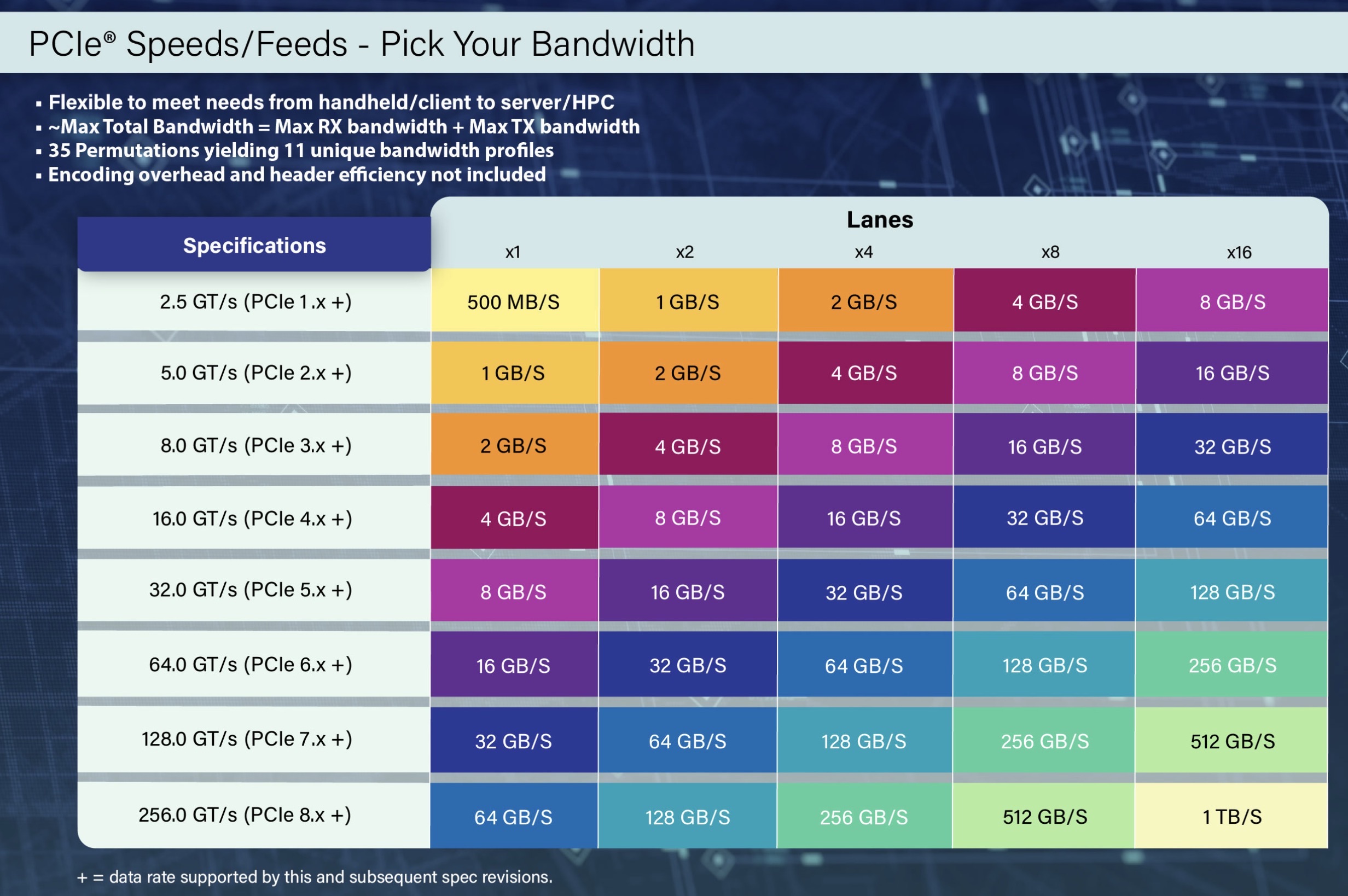
802.3dj is maybe finishing up soon and has 200gbps lanes. Which is more or less about what pci-e 8.x is supposed to be. The table in the article sums both directions of a lane, which leads to confusion. People want faster ethernet in fewer lanes, so no doubt a 400gbps per lane standard will be starting up soon for pci-e to leverage as pci-e 9.
> not in a format I would normally call Ethernet
Why, because it doesn't use ether, or vampire taps?
Ethernet works over many media, and that's been pretty consistent throughout its life. It started from or at least was inspired by AlohaNet a wireless system, then you had thick and thin coax, then twisted pair and fiber, now twinax and board level interfaces are common, too.
I wonder what modulation order / RF bandwidth they'll be using on the PHY for Gen8. I think Gen7 used 32GHz, which is ridiculously high.
That's an interesting thought to look at. PCIe 3 was a while ago, but SATA was nearly a decade before that.
> I wonder what modulation order / RF bandwidth they'll be using on the PHY for Gen8. I think Gen7 used 32GHz, which is ridiculously high.
Wikipedia says it's planned to be PAM4 just like 6 and 7.
Gen 5 and 6 were 32 gigabaud. If 8 is PAM4 it'll be 128 gigabaud...
baud seems out of fashion, sym/s is pretty clear & unambiguous.
(And if you're talking channel bandwidth, that needs clarification)
> 16GHz square wave
Is it for PCIe 5.0? PCIe 6.0 should operate on the same frequency and doubling the bandwidth by using PAM4. If PCIe 7.0 doubled the bandwidth and is still PAM4, what is the underlying frequency?
for gen6, halve all numbers
Obviously PCI is not just about gaming but...
If you're using a new video card with only 8GB of onboard RAM and are turning on all the heavily-advertised bells and whistles on new games, you're going to be running out of VRAM very, very frequently. The faster bus isn't really important for higher frame rate, it makes the worst-case situations less bad.
I get the impression that many reviewers aren't equipped to do the sort of review that asks questions like "What's the intensity and frequency of the stuttering in the game?" because that's a bit harder than just looking at average, peak, and 90% frame rates. The question "How often do textures load at reduced resolution, or not at all?" probably requires a human in the loop to look at the rendered output to notice those sorts of errors... which is time consuming, attention-demanding work.
I don't know how many games are even capable of using lower resolutions to avoid stutter. I'd be interested in an analysis.
Some games may be doing that. I expect that in others, the lower-resolution or missing textures are a result of the texture streaming system catastrophically failing to meet its deadline to load in the relevant textures and giving up. It's my understanding that "texture pop-in" is the too-late replacement of a low-resolution "placeholder" texture with a high-resolution texture. If the high-resolution texture doesn't load in time, then you're stuck with the low-res placeholder.
Commentary on textures that fail to load are in the "Monster Hunter: Wilds" section, starting at ~11:35 in [0], and the "Space Marine 2" section starting at ~00:14:40 in [1], which also mentions "Halo: Infinite" and "Forspoken" as other games that have the same sort of behavior. Missing textures are mentioned in the "Star Wars Jedi: Survivor" section starting at 21:21 at [1]. And -while not mentioned- if you look not-that-closely at the first ~5 seconds of that section, you can see the textures (most obviously the ground texture) go from "the same as the 16GB model" to "something you'd expect to see in a bad PS3 game".
Also in that first video, you can see some head-to-head demonstrations of the performance problems having a slower PCI-E link gives you when running out of VRAM starting at ~04:52 in the "The Last of Us Part II" section of [0] and also at ~17:00 in the "F1 25" section of that same video.
I expect there are a few other videos out there that do this sort of analysis, but I can't be arsed to find them.
Being less sarcastic, I would ask if 6.0 mobos are on the horizon.
One would think they get sizeable traffic as-is.
this would solve the biggest issue with non-server motherboards: not enough PCIe lanes.
What you're saying is possible though, you just need something a little heavier like a PCIe switch do the lane count + mixed-speed conversion magic. That's exactly what the chipset is, but for various reasons it's still only PCIe 4.0, even on the latest generation chips. I wouldn't be surprised if that changed again next generation. The downsides of this approach are switches add cost, latency, and can consume a lot of power. When they first upped the chipset to be a PCIe 4.0 connection in the 500 era, most motherboards capable of using the bandwidth of the chipset actually had to add chipset cooling.
Ideally they'd just add alternative options with more lanes directly from the CPU, but that'd add competition to the bottom of the Threadripper line.
Is that a problem?
These days, you don't need slots for your sound card and network card, that stuff's all integrated on the motherboard.
Plenty of enthusiast motherboards support 1 GPU, 3-4 nvme drives, 4 SATA drives, and have a PCIe 1x slot or two to spare.
Is anyone struggling, except folks working with LLMs? Seems to me folks looking to put several $2400 RTX 4090s in one machine ain't exactly a big market. And they'll probably want a giant server board, so they have space for all their giant four-slot-wide cards.
For example, motherboards with multiple nvme drives often have 1 drive with dedicated lanes and the remainder multiplexed through a PCIe switch embedded in the chipset.