Frying Eggs and Air Quality Tests
Equipment To Test Air at Home!
chillphysicsenjoyer.substack.com
72 points · by crescit_eundo · 1y ago · 142 comments
My one wish is the west adopted Chinese style kitchens. Even in new condo builds the kitchen will be isolated in a room you can close off, with an exterior wall and powerful exhaust vents. I always found it perplexing how ok folks are with what feels like cooking food in their bedroom.
The air quality depends on exactly what you are cooking. Close the door if your cooking involves high heat, open it otherwise. And incidentally I don't understand why the author would do testing while frying an egg. Frying an egg does not involve high heat. High heat means getting close to or past the smoke point of your oil. I would not close the door when frying an egg.
If you feel the need to condescend to the point that you're explaining what a door is please ask yourself if you're underestimating the intelligence of the person you're speaking to.
A lot of people seem to like to knock a lot of holes in their kitchen walls making doors and shutters complicated and rarely used.
The chef breathes in the kitchen.
Food cooked in high heat often has additional related risks.
Biggest generator of pwm during cooking is when things actually burn. Which can be just a very tiny portion of the food, like one black speck that came off and heated extra. This produces more pwm than the mass of oil and food.
In France too, most kitchen are optimized for looks with an island and fully opened to the living room. If you use noisy equipment, it makes both places uncomfortable. But I think that's the point, it doesn't happen that often.
There are not a whole lot of people who actually cook anymore and those who do deal with the annoyance or have their house choice influenced by that requirement.
I think complex home cooking is a vestige of the time when there were middle class housewives with a lot of time to actually do that. Nowadays with both parents working, cooking has been relegated to an activity that has to be fast, easy and efficient; which is why those multifunction cooking appliances are so popular. You never get something great out of it but it works decently enough to have the person responsible take care of some other errands simultaneously.
So right off the bat, you're down $20k at least to remodel the kitchen so it has proper ventilation, assuming you cook.
Forget the health effects and whatnot, but are people not bothered by cooking smells pervading the house?
Personally I would prefer a Chinese style kitchen with a fully enclosed cooking space (sliding glass doors to leave open if desired) and exterior ventilation. It keeps the worst of the aerosolized oil contained and away from the rest of the home.
Being very honest, no, not really. From all the issues I can encounter in a house the smell of a meal cooking is not one of them.
On the flip side I am thinking about anything with high heat, meats and oil. The food will be delicious and the smell of the food is great but the smell from the cooking process is miserable and will linger.
- Most days when cooking PM2.5 doesn't exceed 5ppm.
- I accidentally burned some vegetable oil this week, and PM2.5 shot up to around 70ppm.
- I fried up pancetta a little too hot a few months ago, rendering the fat entirely, and both PM2.5 and PM10 went up to >999ppm.
My instinct is that it should be less toxic from vegetable oil, if it's just vaporised... past the smoke point maybe the chemistry changes enough to make it more toxic. The body has mechanisms to remove foreign matter from the lungs, but how easily and how much it clogs up your lymph nodes seems to depend on what it's made of.
Try measuring PM2.5 in that room and log it as you turn on the fan for a while without cooking anything.
Aside from studio apartments, where space is at a huge premium, I'm having a hard time understanding what you mean by this. Can you elaborate?
I also don't think "you cook and the whole house smells" fits the analogy of "cooking in your bedroom". The key feature of the bedroom is that it's where you sleep, get dressed, etc., not the smell.
This works if there is a designated member of the household (whether family or employee) who prepares food away from everyone else.
It doesn't for a social setting. Fortunately, the only thing you need to reach the health benefits of the former in an open kitchen is a good vent. If you have a multi-story home, the motor doesn't even have to be in the kitchen, allowing for quiet designs.
The socializing part feels like an edge case but I guess it depends if you are cooking to entertain or cooking for your daily food. The daily food only a small portion of the cooking requires closing up the kitchen.
Try cooking with oil and you'll see PM levels go to enormous heights.
When I start cooking downstairs, within a minute or so I hear the purifier upstairs ramp up to full speed.
But who knows, maybe those pans are even more dangerous than currently known.
That's not to say you should go out and buy everything coated in PTFE. It generates tons of pollution when it's synthesized. I'm just saying there's no need to rush to throw away the ones you may already have at home - that might be counter-productive as you're now generating waste unnecessarily.
But it pretty consistently sets off the Coway air purifier in my kitchen when I do it...so I would assume frying with oil to the point of smoking does adversely affect air quality.
.... That should be obvious though, right?
Does your extractor fan vent to the outside, or just recirculate through a filter? In my experience, people often overestimate how much protection ventilation provides. It mostly dilutes contaminants rather than removing or isolating them. For example, with moderately hazardous compounds, a fume hood works fine under normal use, but in the event of a spill it can’t bring levels back down quickly enough to protect the operator. In that kind of situation, an isolator makes far more sense or adding PPE, though that can be burdensome.
What really surprised me is how high the values get from just a single pan. It makes me wonder what it’s like in a commercial kitchen with multiple pans at higher temperatures, especially if the extractor fan fails and there’s no time to shut down operations to fix it.
Do you have references to back this up that I could read? Assuming the same fan size, ventilation would act like a perfect filter and remove everything out of the room that the fan pushes, whereas a filter will allow some particles to pass and recirculate. Especially useless if it is those metal fiber filters that are in a range hood that just remove some grease.
A quick search brings up the CDC guidance, where they discuss air changes per hour for a room. This will be for HVAC units, which operate on a completely different magnitude of airflow compared to a kitchen extractor fan.
https://www.cdc.gov/infection-control/hcp/environmental-cont...
This also matches my experience in industrial applications, you only need a single failure point such as a spill or a large enough leak and ventilation alone is no longer enough to keep people safe. This is why it's worth considering a glove box/isolator. You could make the argument that a glove box can also leak and I'm starting to sound like a safety engineer. Anyway at home either will be fine with outside ventilation being superior if done right.
Also, cooking of all kinds spikes PM levels in my experience. Maybe eggs in a 100% clean non-stick pan are an exception, but I doubt it if you can smell it.
Surprisingly, making the bed, shaking out the sheets, or vacuuming doesn't make it change color.
But farting in the room makes it red for minutes.
An ever amusing phenomenon that makes my girlfriend and I chuckle on a weekly basis.
Some other air purifiers like Coways measure particle pollution.
  For consumers looking for a way to remove VOCs in their homes and offices,
  Kroll adds, “air cleaning using activated carbon filters, a tried-and-true
  technology that doesn't rely on chemical reactions, is still the way to go.”
Were they talking about gas hobs? Surely that's much worse than the electric/induction one you appear to be using.
It produces CO2, NO2 and some CO. But it's not going to show anything on a PM2.5 meter.
The particles when frying come from the oil turning into smoke, as well as just aerosolization even well below the smoke point. These are what send PM2.5 levels skyrocketing.
When I sear a steak in cast iron, my PM2.5 levels go from their baseline of ~2 ug/m^3 to ~200–400. And course you can smell it in the air.
If there should be a cohort that would be the canary in the coal mine, it would be professional chefs, who day-in and day-out cook for a living over several hours per day. Yet, I have not heard of any studies raising alarms for the profession.
Cheers
What i like about this device that they give a very precisce and clear physical definition of each metric and explain by what quantitative factors the metric is influenced.
incl. potential measurement error sources and ability's to reset sensors.
Definitely recommend this over other air quality devices that try to simplify all the measurements into good/bad..
(Note: Just a happy user no affiliation whatsoever with the company)
I suggest frying some bacon and report back.
0. https://www.co2meter.com/blogs/news/co2-carbon-dioxide-detec...
1. https://en.wikipedia.org/wiki/Gas_chromatography%E2%80%93mas...
> PM2.5 peaks at 11 ug / m^3 and then comes down once I stop frying.
? Just saying "Contrary" doesn't give away much information.
It doesn't come down when you stop frying? It peaks at a different number? It never goes up at all? It actually goes down when you start frying?
Now if we're cooking with gas (as the east Germans use to say in the 80's), that generates quite some PM2.5 in an of itself.
Also, anyone cooking eggs without getting to the Maillard reaction (or for that matter, with oil instead of butter) should never again legally allowed to approach a frying pan :D
As a side effect, I now have a collection of very well seasoned cast iron.
Where the device is relative to the pan and fan would clearly matter. It should be across the room to get a better estimate of the net effect. Not right next to the pan.
Man, I wish I had the confidence to just disregard science and research done by professionals.
People forget your breathing in the exhaust of burning a fossil fuel.
If we had stoves with a source of gaseous or liquid oxygen, then the NOx emissions would be greatly reduced.
Was it one of those useless microwave ones?
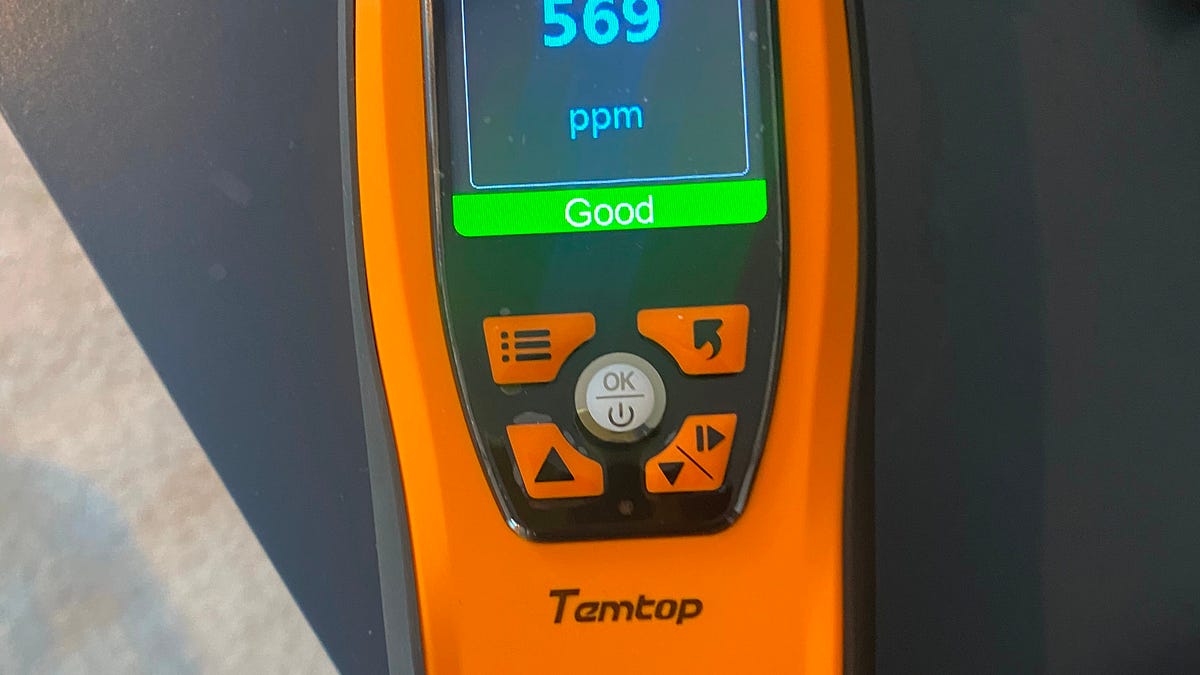
That said, I personally use the Breathe Airmonitor Plus [1] - I kept having issues with calibration with the temtop unit. Mostly decided on this one since it uses an NDIR sensor similar to my Aranet which I carry with me all the time.
If I ran my stove for more than 15 min my carbon monoxide / fire alarm would go off.