First Shape Found That Can’t Pass Through Itself | Quanta Magazine
After more than three centuries, a geometry problem that originated with a royal bet has been solved.
Quanta Magazine
547 points · by fleahunter · 1y ago · 163 comments
Rupert's snub cube and other Math Holes - https://news.ycombinator.com/item?id=45261566 - Sept 2025 (10 comments)
Rupert's Property - https://news.ycombinator.com/item?id=45057561 - Aug 2025 (23 comments)
I watched a pretty neat video[0] on the topic of ruperts / noperts a few weeks ago, which is a rather fun coincidence ahead of this advancement.
So if he proves that the snub cube doesn't have the Rupert property, he could still be the first to prove that not all Archimedean solids have it.
It's pretty easy to brute force most shapes to prove the property true. The challenge is proving that a shape does not have the Rupert property, or that it does when it's a very specific and tight fit. You can't test an infinite number of possibilities.
And I thought that the paper http://arxiv.org/abs/2508.18475 had also been discussed but can’t find it so could be wrong
Paper was posted twice:
Rupert's snub cube and other Math Holes - https://news.ycombinator.com/item?id=45261566 - Sept 2025 (10 comments)
Rupert's Property - https://news.ycombinator.com/item?id=45057561 - Aug 2025 (23 comments)
The article does say straight through and most analyses has been done with variation of the shadow technique, which has to be straight through. But the original bet. The thing that started this whole line of thought just said you had to get one through its copy, I think rotating is is an acceptable technique in this problem.
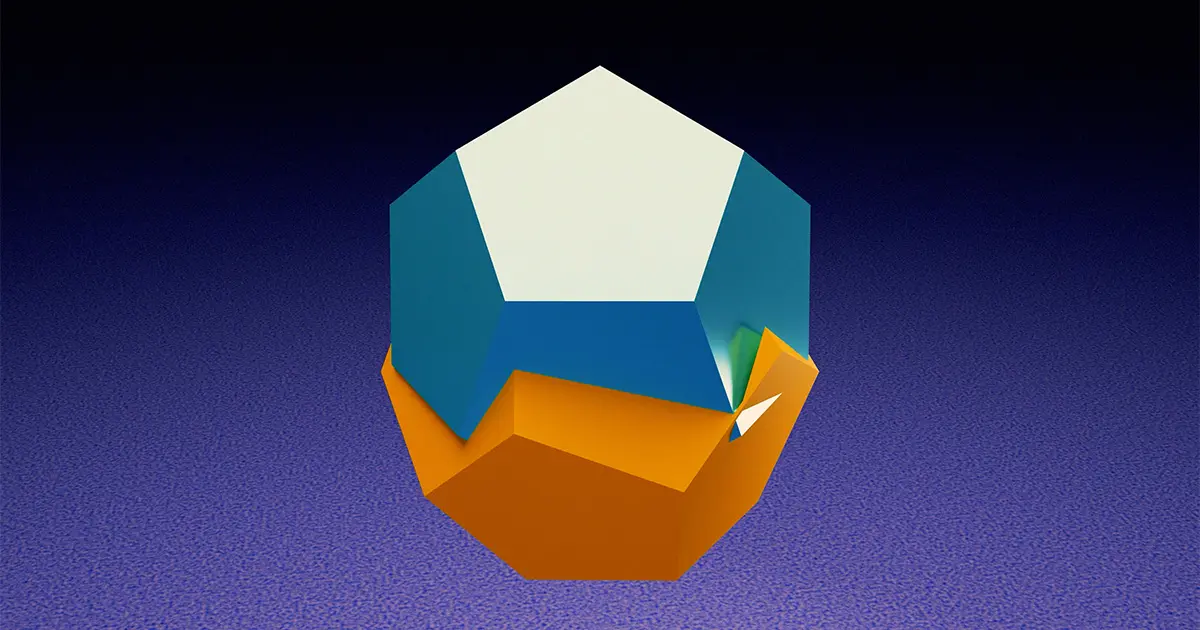
Note the egg shape in the article. specifically the widest band around the equator. now imagine one passing straight down through the other. one edge ring would pass through the shadow if it has a slight rotation offset but it is blocked by the next edge ring up, which could also fit but requires a different offset, so if you could change that rotational offset while it is passing through would it fit?
The challenge is that it gets computationally intensive the more sides that you add if you don't have shortcuts like ruling out entire blocks of orientations in their parameter space (they figured out that if one shadow, projection, protrudes significantly, then you'd need a large rotation to get that protrusion into the other shadow, thus removing all of those rotational angles and reducing the number of orientations needed to check). More sides and more symmetry make it much harder to test a candidate, but you have an interesting idea.
He released a video about the Ruperts problems and his attempt to find a Nopert on just Sept 16th!
https://www.youtube.com/watch?v=QH4MviUE0_s
With this and the Knotting conjecture being disproven, there are have some really interesting math developments just recently!
Tom regularly releases wonderful videos to go with SIGBOVIK papers about fun and interesting topics, or even just interesting narratives of personal projects. He has that weird kind of computer comedy that you also get from like Foone, the kind where making computers do weird things that don't make sense is fun, the kind where a waterproof RJ45 to HDMI adapter (passive) tickles that odd part of your brain.
Highly recommend all of his videos!
Googling says Quanta is online only. Anyone know of similar publications that print?
That said, researching something solely for the sake of curiosity can be a valid endeavour. Many profound scientific discoveries have been made by researching topics with no obvious application.
Austrian transport companies research this stuff?!?
I’m both impressed and confused
A soccer ball is a sphere. It has decorative polygons projected onto its spherical surface, but having a color scheme doesn't stop it from being a sphere.
Perhaps that knot that has a none additive “unknot” from a recent Stand-up Maths episode as well…
All Easter-eggs from our universe we found so far.
> The full menagerie of shapes is too diverse to get a handle on, so mathematicians tend to focus on convex polyhedra
The phrase "tend to focus on" suggests it's not an exclusive thing. However, you're right -- it appears that the Rupert property only applies to convex polyhedra, so the article title and text is at the very least incomplete given that a sphere is a shape.
The computer-assisted component of the Noperthedron proof is a reasonably small sagemath program that was (as far as I know) written by humans: https://github.com/Jakob256/Rupert
Perhaps you have confused this article with a recent unrelated announcement about a vibe-coded proof of an Erdos conjecture? https://borisalexeev.com/pdf/erdos707.pdf
Tangentially I'll have to reconsider my position on long but lossy context LLMs.
A good sense of humor to go with the math.
relevant video: https://www.youtube.com/watch?v=QH4MviUE0_s
less relevant, but I think my favorite: https://www.youtube.com/watch?v=ar9WRwCiSr0
The reason I find this so interesting is that Mandarin Chinese portmanteaus take a different standard form: instead of combining all of one word with half of the other word, they combine half of one word with half of the other word.
Think about how much you'd need to know about the structure of an arbitrary language before you'd feel confident predicting how it creates portmanteaus.
(but your point about the title is valid)
Can you pass the T-shaped tetromino through itself?
From their About page: Quanta Magazine is an editorially independent online publication launched by the Simons Foundation in 2012 to enhance public understanding of science.
  - "Researchers Discover the Optimal Way to Optimize"
  - "Origami Patterns Solve a Major Physics Riddle"
  - "A simple way to measure knots has come unraveled"
  - "The Hidden Math of Ocean Waves Crashes Into View"
A sphere is a surface of constant width, which the polyhedron approximation is not.
> The projected shadow has the same size as its diameter
Thus this is exactly why the sphere doesn't have the Rupert property.
The "pass through itself" criteria is the same as "has one shadow that fits entirely inside another shadow". If you allow "one shadow equals another shadow" then it's trivially true for every shape because a shadow equals itself.
Note that this "shadow" language assumes a point light source at infinity, i.e. all the rays are parallel.