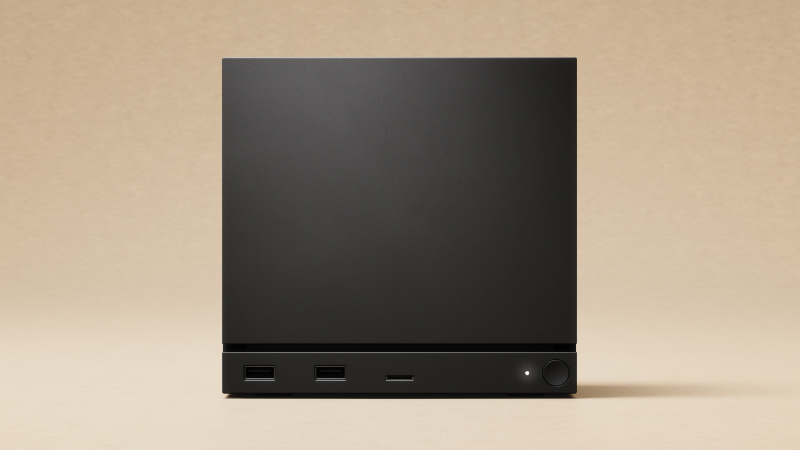
Steam Machine
Your games on the big screen
store.steampowered.com
2928 points · by davikr · 1y ago · 1514 comments
I don't pretend to have any insight into whether this theory is correct beyond that it seems to track with what they've been doing lately, or any expertise to make claims about whether it will work or not. In a lot of ways, this might just be a projection of my desires as a gamer who enjoys not having had to boot into Windows to play something for quite a few years at this point. I do hope that maybe they're just crazy enough to not only try this, but pull it off though!
A lot of people are missing the fact that the Steam Frame is Valve's attempt at staking a position in the wide-open and malleable VR space.
With Google, they identified that Microsoft developing their own search engine as an existential threat. Additionally, Internet Explorer being the only bottleneck for the web as a platform was a problem. And thus they broke it wide open, developing web technologies, investing in Firefox initially, releasing Chrome, and ultimately delivering Android.
In mobile, Microsoft came too late to respond to Apple and Google.
Meta and Apple have identified that VR is one of the next gold-mines in terms of a similar app-store and experience rich ecosystem potential comparable to PCs, web, and mobile, and have poured billions into development of hardware and software. It's documented that Meta attempted to create a proprietary OS for their VR headsets (and has debatable success).
Valve, while having fewer resources than any of the behemoths above, decided to hedge their bets with Linux and entering the market first through their well established brand built with video games. It would not surprise me if the Steam Frame begins their entry into other entertainment experiences and app opportunities. Microsoft has reasonable success weaving their ecosystem together (PC + Xbox), but they're foolish to think that their dominance would continue into VR because they have the PC space... They made that mistake with Windows Phone.
It is their third attempt.
I don’t really see much momentum in that space, and the consensus among my friends is that it’s a gimmick to try a few times - with their vr headsets collecting dust since.
That story ended up with Google supplanting Microsoft as the top market abuser. So I'm holding all my fingers crossed that it doesn't turn out the same with Valve, especially since by the time they get to have a shot at that top position Valve will very likely be under different leadership and maybe with different ideals.
Fun non-sequitur: the other speaker at that talk went on to become the finance minister of Greece.
Microsoft also had Games for Windows Live at the time, which provided similar functionality to parts of Steam (friends, multiplayer, voice chat, achievements), so with that plus the App Store, one could easily see it as Microsoft coming for their market.
> Mr Newell, who worked for Microsoft for 13 years on Windows, said his company had embraced the open-source software Linux as a "hedging strategy" designed to offset some of the damage Windows 8 was likely to do.
> He said the success of Valve, known for its Half Life, Left4Dead and Portal titles, had been down to the open nature of the PC.
> "We've been a free rider, and we've been able to benefit from everything that went into PCs and the internet," he told the conference. "And we have to continue to figure out how there will be open platforms."
> "There's a strong temptation to close the platform," he said, "because they look at what they can accomplish when they limit the competitors' access to the platform, and they say, 'That's really exciting.'"
No shareholders. No dopey stock market magazine articles. No quarterly “did you make the line go up? why not?” reports. You can execute on a 10 or 20 or 50 year vision when youre beholden to only your customers, your staff, and yourself and not a pack of rabid wolves.
SteamOS was released in that year as well: https://github.com/ValveSoftware/SteamOS/commit/0aad7085a1a9...
All of their hardware released since then seems to be aligned with this concept and they have clearly put a huge amount of R&D and funding into this approach.
It's already happening. Lenovo released a SteamOS variant of the The Lenovo Legion Go S.
The main issue with modern games is the lack of gpu, but gpus in laptops are never great.
Of course, Wine was very lackluster in those days, and for a while I was worried they'd eventually give up with the monumental effort that would be involved in getting it up to snuff.
It's now over a decade later and they're still at it and have made monumental leaps. Valve truly was and still is playing the long game here.
Imagine if Microsoft had never threatened their business with the Windows 8 store and the anxiety of Microsoft locking down their platform.
It’s a shame the connotations are negative because this ironic comment otherwise works quite well: This large wooden horse is such an extravagant gift, it has to have some subversive purpose, right?!
I think linux graphics were only good when paired with the right version of red hat and nvidia drivers on a supported workstation dedicated for running proprietary 3d/vfx software packages as an alternative to the aging SGI workstations. Every other use case was pretty rough... until about 2017 when things began to change massively, and finally now, where you can actually get better experiences than freaking windows on most use cases.
The weak link in your theory is that Microsoft is in control of the future of the DirectX API, not Valve, and it is Microsoft who is working with nVidia and AMD and game studios to evolve DirectX to take advantage of the latest GPU features. SteamOS can at best follow closely behind but can never take the lead without Valve developing their own games API that games developers an GPU makers are willing to target.
it would be interesting to see how or if they were punished for it in the current political environment or even the next one, but i hope we don't find out
i suspect long term it would just be a foot gun that drives vulkan's popularity anyway though
Though not necessarily the case since selling steam devices also will make steam the default even more which could also be a primary reason it could also be both, who knows.
why else would Valve spend so much time and money on Proton? To eliminate the dependency on Windows. Windows is still the OS for gaming. Valve doesn't like that and they are successfully slowly changing that.
Now, if they would just build their 1st party titles for arm64 macOS. I would love to play Portal 1, Portal 2, and Half-Life 2 et al on my decked out MacBook Pro, but I can't. Why can't I? Well, MacBooks are such a slim slice of the market. Yeah well it would be slightly more of the market if I could play Team Fortress 2 on this thing.
Because while Proton is nice there are many things in KDE that fall down because of how contribution works.
I'm so happy to read this
This is not that - Steam has to compete on the free market, there is a reward for making the product everyone else refuses to make. In a post-Deck world, it's hard to believe that moral obligation plays a bigger role than the overall hatred of Windows for seamless gaming experiences.
The Gaben house is building a secret army, using a technique unknown to us; a technique involving steam.
What universe do you live in?
- Broken games still pre-ordered
- marginal updates sold at full price
- double/triple-dipping with microtransactions and battle passes
- DRM still [predominant and still hurts performance
- every publisher with more than one game has their own launcher (usually shitty and brings no value)
- rootkit as anti-cheat
- offline game that require online connectivety
- online services get shutdown
- LAN multiplayer is a thing of a past
What did games exactly won?
- Paid skyrim mods? It's back.
- MS game sharing thing that rendered GameStop business model useless? IMO a mistake, MS was onto something there.
DRM is everywhere so gamers have clearly lost
That’s an imaginary issue.
Can you expand on this? I'm not a massive gamer, I thought xbox was doing well?
That's the same Valve that doesn't let me play the games I paid it for unless they are running on its platform? That's how it "respects" me?
What exactly does that mean, for you?
That's really the saddest thing about capitalism, if everything around us wasn't getting enshittified in the exact same way at least the future would be more alluring.
DRM is the publishers choice, worth noting.
You think you own the Silmarillion because you have a paper copy? Hah! No, you have a transferrable license to read it.
Every hard copy movie you have starts with a big green FBI warning reminding you that having that disc does not means you own the movie, it means you have a transferrable license to play it for yourself and small groups on small screens.
Digital media with DRM allow content distributors to remove the "transferrable" part of the license if they want, which often allows them to sell for cheaper since they know that each sale represents only one person recieving the experience. The license comes with less rights (no transferrance), so it can be priced lower.
Most media for me is a one and done. A book, a movie, a computer game. Granted a computer games version of "done" might mean "played on and off for a year".
There are exceptions to this - books I read again, shows I'd watch again, but games seem to age poorly by comparison. Original Syndicate or Deus Ex - while playable - is not what I remember it to be and I'd rather keep the nostalgic memories than shatter them with a replay.
This rarity of exceptions means that I wouldn't lose much if my Steam account disappeared - mainly just "whatever I'm playing now". Create a new account and go again, or buy off GOG or something.
However in return for using Steam I get a lot of convenience - updates, propogated save files, easy chat and "Right click -> Join Game" with friends. That "Right click -> Join Game" is almost worth it on it's own for ease of social gaming.
There is no such thing as "owning" a game unless you're the company that developed the game (or bought the company that did).
the last few in years in tech have been depressing, like no one cares to make something that's actually better for the consumer, it's made me into a cynic and I hate it
One day, Gabe Newell will die. Maybe his racer son will inherit the job, or maybe he'll delegate the job. Maybe this new CEO will take Valve public to ensure they get a centi-million dollar payout.
Then all the good times end. This is the halcyon for Steam customers.
In many public companies there is the added level of investor interest, and it can often be a challenge for the C levels to remain in power during periods of slow or even negative growth. Challenges that companies like Valve simply don't have as long as the CEO is fine with it. On the flip side, I'm happy with my own stock portfolio so there is that.
Their shareholders are not in it for the long term. Investment managers tend to look at anything more than two years as "long term", and they are conscious of their position in annual league tables.
Even private equity and venture capital are usually going to be thinking about the value at which they can exit reasonably soon.
The management of the company will be thinking about bonuses and options they get between now and when they move to the next job.
A private company can often take the view that what really matters is how much they will be making in five or ten years time. Maybe even how much it will be worth when the current shareholder’s kids inherit it. The management are often either owners, or are closely monitored by the owners.
tldr; GTFO!
The more interesting point is that if you aren't driven by investors to care about short term financial stuff (stock prices) then you can make long term decisions. Caring about your customers is a classic one for this - costs you money in the short term, but in the long term gets you a great customer base.
What they don't care is the endless growth that MBA guys always try to achieve, and the quarterly profit driven decision making that ultimately destroys their customers loyalty, for short term profit.
A business can be very profitable without being exploitative. It's the people in Wall Street who can't seem to understand this. For them a hundred million dollars of profit is good if last year it was only fifty million dollars, and a dying business if last year it was also a hundred million dollars. It really makes no sense.
I'm honestly surprised nobody else tried a "boot to game library" PC, but then, you also need the name and reputation for it. Microsoft could've done it, but they chose to make a console. Which is mostly a PC, but you need xbox games, a separate ecosystem.
Since Valve owns the library it makes sense that people will trust their solution and it has more chance for succcess
Microsoft used to have Windows Media Centre, which was a version of Windows designed for HTPC use that booted straight to the media centre control screen. The last version of that was in Windows 7.
It is actually possible to replace the desktop in Windows, window management (but not chrome, that's part of Aero and/or individual "owner draw" applications), Explorer etc. Nobody's really bothered with that.
Microsoft are just too used to not having to compete, so they don't provide lots of variant SKUs for different uses. Even "point of sale" and LTS are somewhat neglected.
Steam deck is "just a PC" as well, which can be turned on to immediately play video games.
Thanks to its reputation, the masses will trust the Steam Machine to do this much.
Valve know what they're doing.
>Microsoft could've done it, but they chose to make a console.
Missed the one, they did try with the rebranding of 'xbox'
Anything that makes the PC gaming experience more like a console is good. This is the first gaming PC that I could actually justify putting in the living room.
Microsoft, Sony, Nintendo, Atari, Sega...
They intentionally choose to brand their personal computers poorly to coerce their customers into giving up control of their computers. That doesn't make their computers any less personal, unless they are using it to serve other people.
In like, what way? You can "just" boot up a new Windows PC, install some games and play them straight away. Do you mean the fact that you now have to log into a Microsoft account first? Because if yes - SteamOS also requires you to log in before you can use it.
https://collection.sciencemuseumgroup.org.uk/objects/co80944...
Might also help to slow down enshittification by a bit if there was a popular alternative. Maybe something like Waydroid could even ease with transition.
It just needs my banking apps, and and I'll be happy to pay for it.
Some banks might even be up for putting children's banking apps on the steam deck to start with.
But also, phones don't seem to be the best hardware to play PC games which is kinda the whole deal.
I maybe would see first a smaller ARM based device (like those retro consoles).
That was the desktop mode, showing KDE Plasma (a linux desktop environment).
Also, Blender on the left screen and Godot on the right screen!
I just hope Google & Apple read, understand and follow this.
it rings hollow from a company whose entire bedrock for existence is DRM procedures.
does Steam still disallow accounts from playing more than one independently owned game at a time without special procedures?
I'm not judging them "by comparison" because it's hard to look bad next to Sony, Microsoft, Nintendo, etc. Just looking objectively at the situation, even if Valve was alone on the market.
You still cannot play a game C from my library while I play the game A from my own library.
The only way to be able to play any game you want would be to create a separate account for each game.
Yes. I just tried launching one game on Steam Deck and another one on my desktop and it showed a message:
> Error - Steam: You are logged in on another computer already playing Railbound. Launching Clutchtime™: Basketball Deckbuilder here will disconnect the other session from Steam.
I can run rimworld and quasimorph via steam at the same time, as an example.
However, there is still a huge difference between buying hardware that literally "jails" you and force feeds you DRM and a system where even in the marketing says you can completely tear away all of that without jailbreaks, etc. and without stuff being super fiddly.
> Steam Frame is a PC, and runs SteamOS powered by a Snapdragon® 8 Series Processor. With 16GB of RAM, Steam Frame supports stand-alone play on a growing number of both VR and non-VR games without needing to stream from your PC.
So Steam + Proton works on aarch64? Is this something already available/supported, or is this an announcement?
[1] Steam Frame, which is the VR Headset releasing alongside the Steam Machine. Dedicated discussion here https://news.ycombinator.com/item?id=45903325
https://www.tomshardware.com/peripherals/gaming-headsets/han...
This is fun, just found this issue from 2018 which was closed with this comment:
> Hello @setsunati, this is not a realistic objective for Proton. As @rkfg, mentions wine for ARM does not magically make x86 based games work on ARM cpus.
> Even if Steam were brought to ARM, and an x86 emulation layer was run underneath wine, the amount of games that could run fast and without hitting video driver quirks is small enough not to entertain this idea any time in the near future.
It's mentioned in this issue https://github.com/ValveSoftware/Proton/issues/8136 which was closed Oct 2024 with this comment by kisak-valve:
> Hello @Theleafir1, similar to #1493, this is not a realistic objective for Proton any time in the near future.
I don't think it's ever likely to return any time soon, but it'd be cool if it did. Valve seemingly have very little interest in macOS at the moment.
CodeWeavers work closely with Valve and the Wine project to improve compatibility with games, and Apple's own Game Porting Toolkit is based on CodeWeavers work on Wine too. So all the pieces are there in theory.
The new thing Proton is adding is translation from x86 to ARM.
Macs already have Wine, an x86 to ARM translation layer (Rosetta), and an Apple provided translation layer from Microsoft's DirectX to the Mac's native Metal graphics API (D3DMetal) which is integrated into upstream Wine.
For more demanding games it's designed to stream from a PC.
Edit: foveated streaming, not rendering
> Passthrough - Monochrome passthrough via outward facing cameras
This is an outright bone-headed move that I can't believe Valve is making. Only having monochrome cameras means augmented reality is basically a non-starter.
AR has a lot of potential. I literally bought a Meta Quest 3 just for PianoVision [0] when I already had a Valve Index. I would love to see some sort of AR-based game you could play outdoors. But with only monochrome vision, that's gonna be awful.
That's plenty to support color passthrough as a physical addon, which in turn makes me think that, like with the OLED Deck, we'll see a Frame with built-in color-passthrough later as a different premium SKU when/if they justify it.
1: https://www.uploadvr.com/valve-steam-frame-official-announce...
When it's light & small enough to be a pair of glasses and more than just the expensive but limited gimmick that the form is currently, then it'll be world-changing. It's close, but it's not there yet.
PianoVision sounds like a really bad way to learn the piano. There are already pianos/midi controller that have the abilities to light up the keys you are supposed to play if you really needed that. But that is a gimmick that you might use the first few sessions and then never again. Same with PianoVision.
Generally, is is so much better to start with music notation from day one. I regret starting with all the piano learning apps because they only have been holding me back.
Name one that has to do with with this box competing with xbox and playstation in people's living room.
Install Plex, JellyFin, FreeTube et.al. to it and you have a nice open source TV box.
You also get 4k gaming from Steam, GOG, Epic etc. and you get emulators. I've been wanting to build a computer like this, but CEC is hard to find and the adapters that exist don't support full 4k resolution.
I recently replaced a shield with an Ugoos Am6b+ running coreELEC, which works okay and supports some stuff the shield doesn't but I miss being able to run some android apps easily. I wonder if the new steam machine will support DV.
But if it's a very easy plug-n-play type deal to run SteamVR games (and on Linux!), that's a huge ergonomic improvement. Don't have to think too much about whether everything is running correctly or what-have-you.
Streaming VR content is just so sensitive. I have a good cabled network but even a simple switch introduced noticeable lag spikes. In the end I have a separate router that I just connect straight to my PC, and then I share my wifi connection through my PC to that network. A whole silly setup just to minimize latency and packet loss. If that could be replaced with a simple USB dongle I'd be amazed.
Looks like a very competent headset indeed though! Nice combo of fast streaming that can prioritize well with foveated encoding, and hopefully a pretty nice malleable capable standalone headset too.
discussed here: https://youtu.be/b7q2CS8HDHU?t=1074
"For foveated rendering, [the developers] have that option, but it's not compulsory"
And now I'm curious if the Steam Frame allows inserts or fits well with glasses on.
CodeWeavers just announced[0] CrossOver on ARM a couple of days ago, so yes.
[0]: https://www.codeweavers.com/blog/mjohnson/2025/11/6/twist-ou...
Doesn't really mean much to Valve as SteamOS vendor:
- linux kernel supports aarch64 just fine
- user space supports aarach64 just as fine
- Valve provides runtime for games (be it via proton or native linux), so providing aarch64 builds is up to them anyway
The main point of ArchLinuxARM is providing compatible binaries, which isn't something hard to do in-house.
[0]: https://lists.archlinux.org/archives/list/arch-dev-public@li...
If Valve pivoted into making a well-supported laptop with good hardware that ran Linux and played games...
ProtonDB is a goldmine when a game doesn't work. Oh, and switching from Nvidia GPU to AMD GPU seems to have worked great to get games to "just work".
love to see more and more users realize they can game just fine on linux
To have HellDivers run in borderless window on Debian 14. It required me to manually compile gamescope (wasn't that difficult but Valve's instructions are out of date), and use the backports on Trixie to upgrade the kernel to 6.16, and update wireplumber and pipewire (sound was flakey on some games). Kernel 6.16 performs much better than 6.12 just generally.
All the Arkham games work perfectly. Doom Eternal has some weird latency in the mouse and aiming doesn't feel right.
I could never get my Xbox One bluetooth controller behaving with Linux. I ended buying a 8bitdo Xbox style controller which works perfectly. It is much better made than the Xbox controller and roughly the same price.
Some of the latest shooters, will get you banned because anti-cheat.
That said, there's nothing in my library (180 games!) that doesn't run in Linux, and I have a number of games that you can't even get to run in Windows at all anymore.
I think the gaming community should all send Gabe Newell a Valentines Day card, or maybe a Christmas gift, or something. Seriously, the man has done so much for gaming, think of where we'd be without him. Windows App Store, Sony Game Store, walled gardens...
I have to install a two year old AMD driver to get Helldivers to recognize my GPU.
No issues using the system as my daily driver for personal things. I have dual monitors, one oriented vertically and one 144hz. All works great! I'd recommend it to anyone
It should work with some tinkering.
The screen is a little small, though, or my eyes are too old. Maybe both!
SteamDeck is out since February 2022 and does all that. You can use a BT mouse&keyboard, plug a USB-C screen or dongle for HDMI. I did live presentations with that quite a few time. It's just a computer with another form factor.
It's not "dangerously close", it's been there for years now.
Basically only competitive gaming with kernel level anti-cheat are problematic.
I could see a setup with a case for the deck gives it a laptop form factor, but that doesn't seem like what you're suggesting. I might also ask how often you move your setup? My schedule requires I do so at least 8 times/week.
That said. Fortnite. Yes, I still play it with friends and cannot play it on Mac or Linux. :(
I'm sure others have similar examples. Also there are just simple things like playing with friends and streaming on Discord. Anybody streaming from Windows always comes across smooth and HD to the other participants while anybody on Linux seems to consistently be received (I don't know where exactly in the chain the problem exists, so just "received", as it may not be a broadcasting or encoding problem, I'm not an expert in this) with a lot of artifacts and lower framerates.
If I could travel back in time and prevent my kids and nephews from ever learning about Fortnite, I might do it. Instead I'm out here trying to keep from getting sniped by a Simpson character.
Fortunately, it seems like the rest of the family is getting tired of COD's ceaseless churn, and might be willing to pick up something else.
Imagine not supporting the latest releases that all your friends are playing.
Edit: Fair enough to the other ones though. This comment wasnt meant to be inflammatory or argumentative, but clearly someone else believed it was.
I do have more random crashes on certain games even on steam deck, but not as bad as Kerbal Space Program on my old (12 yr) desktop.
Factorio seems to work better on Linux. Which is both good and bad (since it's so addictive).
Basically all the games I play regularly with my friends.
if you have an AMD GPU, Linux Mint does everything 'gaming' - on top of installation, bluetooth and printing(!) better than Windows
No need to mess around building a gaming PC anymore.
Does it promise that? It seems like the hardware might do it, didn't see that anywhere
NOTE: it's not "4k60 at ultra detail", which seems to be implied in the minds of some PC gamers =)
if you have an AMD GPU, Linux Mint does everything - including installation, bluetooth and printing(!) better than Windows
Overall barely ever in Windows anymore and a happy Linux gamer.
If I could have a machine like this instead, I'd happily buy it instead. Windows has zero use for me other than playing games
The Steam Deck is kind of close to this although the screen isn't the best. I think the closest you can get to this right now is adding a graphics card module on a Framework laptop.
Unless they remove fans, or have limited hardware, but that's already a steam deck: just add a keyboard and a larger screen.
The battery swelled, so I contacted them and they don't sell the battery anymore. I tried ordering one from, literally, half a dozen places online and was refunded each time because it simply does not exist.
Everything is kinda a dumpster fire, but they nailed steam games.
Also updates regularly break my KDE session and I have to restart my display server.
Sometimes I have to switch to a tty and back to my graphical console to get my display back.
It is a mess all around.
I haven't managed to get my GPU working in Docker, ugh.
That said, it does work. Mostly.
Coming out of sleep is hit or miss. It works more often than I expected but sure as heck isn't 100%.
Graphical corruption slowly sets in with QT based apps over several days and then I have to restart my display server again.
(This actually seems to have gone away with the an update a month ago!)
Not knowing if I'll be able to sit down at my machine and have it boot up I consider buggy as hell.
Oh and certain items in pop shop, just clicking on them crashes the entire app. Every time, 100% reproducible.
Some apps have 2 listings, one of which crashes pop shop to look at, the other of which typically works.
Some apps just cannot be installed through pop shop, just nope, not going to happen.
System76.com/pop/pop-beta
I realize this may not be practical, but it's kind of weird that PCs have been more or less stuck with a protocol designed for XBox 360 controllers for 2 decades now, while the locked-down console space is seeing much more experimentation and innovation around input. The original steam controller at least hinted at being sort of an open platform for this sort of thing, although it didn't really take off. Fingers crossed for the new version.
It's extremely complicated however (like many things USB), which is probably why everything just emulates an XBox 360 controller like you said.
Especially if you supported both XBox and Windows.
So the only complex HID game controllers are for very much enthusiast setups, which are rare enough to trip things like absurd assumptions in HID drivers in some systems (the joystick+throttle I have used to break linux HID driver because someone decided to statically allocate possible amounts of joystick buttons per device...)
Hell, configuring my own controls for a game is one of my least favorite things to do. I haven't even played the game yet, I don't know what button should do what!
The way it is, the devs know what kind of controller everyone will likely be using, they can figure out their ideal mapping for how the buttons should be used, and we all have an easy time using our controllers.
Microsoft really did it right with the XSX controller. They took the old X360 / Xone design (perfect for large and medium hands) shrunk it slightly and then added cut-outs and and angled button surfaces (perfect for medium and small hands). The Elite is similarly good, with the back buttons being elongated and thin, meaning everyone can reach them comfortably without them getting in the way.
Failing to better communicate the proper grip for the steam controller was a real fuck up on valve's part though. They should have tried to communicate it through design, making it harder to hold wrong.
I am kind of concerned about the size of the new controller, but valve seems to have decided there's no place in the market for a controller without sticks.
Steam Controller weight: 292g.
Nintendo Switch 2 controller: 235g.
Sony Playstation 5 DualSense controller: 280g. DualSense Edge: 322g.
Xbox Wireless controller: 280g. Wireless Elite series 2: 345g.
https://docs.handheldlegend.com/s/sinput/doc/sinput-hid-prot...
I don't think Steam has ever published specs for their protocol. And without Steam, their old controller would fallback to a mouse/keyboard mode. The Linux kernel drivers (that didn't require Steam) were reverse engineered. Hori released a Steam Controller recently. Even that still had an XInput fallback switch.
I used that to set things like boost in rocket League and it felt super intuitive.
Like you, I also used this for boost on Rocket League and it was surprisingly intuitive. You can map it to the triggers lowest threshold to emulate it but without the tactile bump to rest against it just won't work.
Also set rotate left and right to the grip triggers (roll in aviation terms I guess).
And at the same time, if you just plug in your controller while holding the right trigger, it acts as a usb drive where you can just replace (and grab it's original) firmware, so there have been some efforts.
I at least want that from the new one, at the very least.
They should have put them just above the joysticks, like the PS5 controller
Better, they should have made them detachable with a magnet, similar to the Switch JoyCon's system, what a missed opportunity
I don't understand how that would be in any way ergonomic. The new Steam Controller's layout has a proven track record with the Steam Deck, which is essentially identical. It allows you to play KB&M games like Alpha Centauri on the Steam Deck without any external peripherals. It would be utterly unplayable if the trackpads were in the same place as the PS5's pad, which is basically just used to open a menu or map or for gimmicky in-game gestures.
It forces everyone to make the same controller, so the developer knows what the user will have.
On the surface the lack of popular multiplayer titles that require a kernel-level anti-cheat is a heavy downside, but gaming is extremely fragmented these days. In 2004 everyone, save for the casual players, at least tried DOOM3 and Half-Life 2. In 2025 Fortnight has an all-time peak of 12M players, but at the same time there are many millions of Minecraft players who never even launched Fortnight. And DOTA2/LOL players who've never launched either of those 2. And then you see a bunch of indie titles selling tens of millions of copies, and their player base is completely unrelated to those above.
The days of the gaming mono-culture are long gone, and inability to play a limited number of Game As A Service titles is not as severe of a handicap anymore, especially since people who play those kinds of games aren't typically as interested in any other titles. For better or worse, peer pressure doesn't work as heavy these days, as it used to
I feel like it was when Minecraft took off that people started investing in gaming PCs, kids were asking their parents for them, etc.
Point taken, it really is marvelous! When I was running Gentoo Linux, and Windows 2000 back then I never thought things would be so portable and simple!
I guess HL2 release?
Steam launch was late 2003 and first non-valve Steam games appeared in 2005, so "thereabouts" can be a reason as well for "Valve era"
It's a downside if all you want to do is play those games. But it's an upside if you're hoping they someday ditch all that nonsense. This puts more pressure on those publishers.
"Casual player" is very poorly defined.
You are comparing concurrent players with unique players (IIRC half a billion for Fortnite ?)
"Many millions" hardly means anything when you use it to cover 3 orders of magnitude.
And so on and so forth...
Computer vision based cheats using an external machine that records the game's final rendered frames, process them with specialized YOLO models, and control "mices" and "controllers" to aim for you already exist.
If the aim for kernel level anti-cheats was to combat cheating, they have failed and are completely worthless.
I hate kernel level anti-cheats but they do provide friction and reduce cheating.
It has to be no more than 800€ then if it also wants to compete against the console market.
Even 800€ is too much imo because looking at the specs it's already not a "future proof" build, more like a previous gen gaming laptop
0, https://www.theverge.com/tech/818111/valve-steam-machine-han...
The console makers have avoided these price increases by mass producing the same sku for a while now. If stocks last into 2027 they will likely remain the same price. If they don't I imagine the console prices might jump a bit too.
I really like the controller, I think I'll pass on the device and just stream from my PC to TV.
Honestly I'd love to see the trashcan come back, perhaps an entirely new design but still paying homage.
For me, I'm looking at this like a nice micro itx build, and I'd probably pay up to a grand for it. (pending final specs and performance reviews, because it's kind of hard to compare it's custom chips on paper.)
Only downside is you have to install Windows of course.
- 2 USB3-A on the front
- 2 USB2-A on the back
- 1 USB-C on the back
If you want to plug an external USB hard drive or SSD at full speed, you'll need to plug it at the front? Or use up the only USB-C port...
I suspect most joysticks sold today come with a USB-C to USB-C cable, so if you want to charge your controller you either need to plug on the back, use an adapter, or get a USB-A to USB-C cable?
Also the single USB-C port isn't Thunderbolt/USB4, and they're only including gigabit ethernet, which is disappointing but perhaps understandable if they're trying to keep it at a low price.
The USB interface is used for initial pairing and charging, in which case the port location doesn't matter nearly as much.
Current Xbox and PS5 controllers charge with a USB-C port on the controller end but a USB-A port where the plug into the console.
For PC's people are used to adapters. And USB-C is superior in every way.
A self declared general compute device should have a least two USB-C outs that can drive displays.
For 2026 (12 years into USB-C spec) I would expect a minimum of 2 3.2 capable fully wired USB-C ports.
Even better something newer that could do near 40GBpS or better. Like USB Gen 3×2
(Written on usb keyboard connected to 4k monitor that also charges the MBP it's plugged in)
I’m all about the USB-C lifestyle but PC gaming peripherals are still pretty dominated by USB-A.
I think not having a 2.5 gigabit port at least is a poor choice.
Are you talking "4k streaming" as the current streaming providers do it, with trash bitrate, or "4k streaming" as you would do it if you had ripped your own blu-ray disks and you want to stream it from a NAS somewhere else in your house to your living room?
https://www.tomsguide.com/tvs/forget-streaming-services-here...
As for gigabit fewer and fewer people have ethernet routed to their office/TV area much less >1gig networking to take advantage of anything better than a 1 gig.
Most people can't or wont retrofit their homes with wired networking. Those that did in the last couple decades likely used cat5/e.
The demand in the consumer space definitely favours advances in wifi.
I wired my whole place with 10Gb - couldn't do it in the wall (as in, hidden) so I have flat cables around the door frame and wall corners. I was willing to accept the cables, just to get 10Gb.
And, IMHO, it's worth it.
I'm personally planning on going through the pain to get ethernet run (luckily I have both a basement and an attic so it should be fairly easy) in my house and if I ever build new there will be whatever is the best standard at the time in the walls (and maybe some dark fiber but I'm less sure on that) but I also know I'm a vast minority of users at the same time. I'm also in a pretty big minority having a >1 gig symmetrical pipe into my house to make a 10 gig connection to my devices actually worth while.
For APs sure, do copper for POE, but not for computers. I doubt APs will need >1G in practical places for the next decade, and I don't think 10g does poe anyway (maybe 2.5g does)
However, you can charge it from things that aren't USB ports. Charging bricks are cheap and most people have one for their phone now, except some unfortunate old iPhone users
I have a Y-splitter for my PS5 controllers and if I didn't, I would have had some sort of controller dock. I assume I would do the same for this. Either way, TV is too far from my couch for a cable, so I wanted to keep playing and charging I'd use a powerbank from my coffee table.
Gigabit Ethernet...that's sad, I'd take 2.5G, so I can better stream my legally ripped Blu-rays. I assume most people don't care because they would use Wi-Fi or their switch only goes to 1G. Better than JBL making android TV sound bar with 100mpbs.
I think it purposely designed, so you don't try to build a NAS on it.
C to A converters for devices are technically verboten since they would allow an enduser to make a A to A cable, which can fry hosts if you plug them into eachother if they don't support USB OTG. You can lose certification if you try to ship a device with a C to A converter.
Because of that, USB-A devices with an optional A to C converter (or neater devices that have both plugs on them natively) are what makes a lot of sense for a lot of people for the kinds of devices that live on a key chain. So it makes sense for that to be the default on the front of a desktop, IMO.
although I own a bunch of those usb-a->c attachments you plug on the end, so it wouldnt make much difference
I imagine this has decent Bluetooth support out of the box even if not mentioned? Its hard to find a WiFi chipset these days that doesn't have some kind of Bluetooth support.
Maybe proprietary headset dongles, but if its just bluetooth its probably not needed.
Gigabit Ethernet is definitely a bummer when I'm close to having fiber all the way to my PC.
while things can be charged with USB-C cables, the only thing I've ever received A C-to-C cable is... a USB-C wall charger. Granted I haven't gotten a USB-C iPhhone yet and I gotta imagine that one is C-to-C.
Generally lots of pack-in cables I've seen in the wild for charging devices continue to be USB-A-to-C. Switch 2 ports are USB-A, PS5 front port is USB-A... we're still getting there.
Yes, the controller is charged through usb-c, but you can just use any charger around to charge that. I mean, the battery should last for 30+ hours so you only need to charge it on a weekly or biweekly basis with heavy usage.
Edit: I specifically use a gaming-only PC. The hardware is used for nothing else. Hence, discussions of rootkits don't really bother me personally much and on balance I'd really rather see fewer cheaters in my games. I think it would be the same with any of these machines - anything Steam-branded is likely to be a 99% gaming machine and their users will only care that their games work, not about the mechanisms of the anti-cheat software.
There's also been numerous userspace ACs that work well and also run in userspace (EAC, Battleye, etc.) that have been enabled for Linux/Proton users (including by EA with Apex Legends at one point). A lot of the support for Linux mostly comes down to the developer/publishers not wanting to and not because of technical reasons.
It's a crazy arms race that IDK even kernel mode can compete with at the end of the day.
I think this shift away from community-led multiplayer is approaching a dead-end with respect to this hacking arms race.
Player bans and votekicks used to be so easy to do. And while there were some badmins, I argue it still resulted in an overall healthier multiplayer ecosystem.
OF course we know this shift is so the developer can control the game more tightly for monetization purposes. But i think the end result of this is more harm than good.
Or deliver the game as a container format, like snap or appimage to bypass most of the system.
Or demand the installation of a kernel driver like they do on windows.
or just give up on kernel level aticheat since they're been breached all the same, just as windows are restricting their power too.
easy-anticheat has a linux version. Developers have to disable the support intentionally.
I boot my own signed bootloader (grub) from which I can also boot Windows. Windows shows it is in secure boot mode and it works fine with BF6 for me.
But I have a feeling this allows users to run some bootkit/rootkit and bypass any of those kernel level anti-cheats. Maybe I'm wrong and EFI handover to Windows clears all the memory, but I somehow doubt it.
I think Valve said something about working with anti-cheat developers to find a solution for the Steam Deck, but nothing happened. Perhaps they will do something this time.
With a TEE, you could scan the system or even completely isolate your game, preventing even the OS from manipulating it. As a last resort, you could simply blacklist the machine if cheats are detected.
There would probably still be some cheaters, but the numbers would be so low as to not be a problem.
> ... a discrete semi-custom AMD desktop class CPU and GPU.
> Yes, Steam Machine is optimized for gaming, but it's still your PC. Install your own apps, or even another operating system. Who are we to tell you how to use your computer?
There is no adapting without a proper solution for securing game integrity.
Valve does not require a Kernel Level Anti-Cheat for "first party" tournaments. It is not stipulated anywhere in the Major Rulebook: https://github.com/ValveSoftware/counter-strike_rules_and_re...
The reason third-party anti-cheats are commonplace at these events is because most tournaments opt to use Faceit or similar for game scheduling. This was the case before VRS (with RMRs) and the TO could choose an anti-cheat of their choosing. This always ended up being Faceit AC or whatever platform the matches are scheduled via (For example, PGL used Challenger Mode, which used Akros Anti-Cheat). ESL of course uses Faceit because (ESL Faceit Group).
You do not understand how Majors are run. It is very hands off from Valve. Only recently, with the introduction of VRS has Valve started controlling and implementing dedicated rules into the ecosystem for TOs.
The more likely outcome is that developers would segment matchmaking into people with kernel-level anti-cheat, and people without it. This seems fair to me.
When it comes to anti-cheat on Linux, it's basically an elephant in the room that nobody wants to address.
Anti-cheat on Linux would need root access to have any effectiveness. Alternatively, you'd need to be running a custom kernel with anti-cheat built into it.
This is the part of the conversation where someone says anti-cheat needs to be server-side, but that's an incredibly naive and poorly thought out idea. You can't prevent aim-bots server-side. You can't even detect aim-bots server-side. At best, you could come up with heuristics to determine if someone's possibly cheating, but you'd probably have a very hard time distinguishing between a cheater and a highly skilled player.
Something I think the anti-anti-cheat people fail to recognize is that cheaters don't care about their cheats requiring root/admin, which makes it trivial to evade anti-cheat that only runs with user-level permissions.
When it comes to cheating in games, there are two options:
1. Anti-cheat runs as admin/root/rootkit/SYSTEM/etc.
2. The games you play have tons of cheaters.
You can't have it both ways: No cheaters and anti-cheat runs with user-level permissions.
You could make a Linux distro with a signed boot chain and a kernel anti-cheat, then you'd mostly need to get developers on board with trusting that solution. Nobody is doing that today, even Valve.
Funny enough, macOS of all things is maybe "best" theoretical platform for all this because it does not require you to trust anyone beyond Apple. All major macOS programs are signed by their developers, so macOS as an OS knows exactly where each program came from. macOS can also attest that it is running in secure mode, and it can run a process at user-mode level such that it can't be interfered with by another process. So you could enforce a policy like this: if Battlefield6.app is launched, it cannot be examined by any other process, but likewise it may run in a full sandbox. Next, Battlefield6.app needs to login online, so it can ask macOS to provide an attestation saying it is running on genuine Apple hardware in secure mode, and then it could submit that attestation to EA which can validate it as genuine. Then the program launch is trusted. This setup requires you to only trust Apple security and that macOS is functioning correctly, not EA or whatever nor does it require actual anti-cheat mechanisms.
(and yet still have a problem with cheaters, see all the bans following the Desert Perpetual raid race)
- No price
- No indication for whether the CPU/GPU/RAM/SSD are upgradable or all soldered together on the board.
- "4K gaming at 60 FPS with FSR" but doesn't mention what kind of games it can run at that quality.
- No performance benchmarks, or mention of what the equivalent retail CPU/GPU to their custom one is.
At face value this seems like a $500-600 PC, and that's also the price it would be able to compete with consoles at.
With 99.9% certainty this box is carrying on the legacy of the Deck and the Deck OLED, which means that it has a 100% custom crafted SoC with soldered components. Which also means they also could perform some trickery not found in "normal" PCs, like UDMA and custom interface.
> "but doesn't mention what kind of games it can run at that quality."
According to the specs it has a custom RDNA 3 chip w/ 28 CUs and boost clock at 2.45Ghz. The Playstation 5 has a custom RDNA 2 chip w/ 36 CUs @ 2.23 GHz and the Xbox Series X has a custom RDNA2 2 chip w/ 52 CUs @ 1.83Ghz.
Given the optimizations AMD made in RDNA 3 (the "budget" 9070XT can easily keep up with the prev gen "enthousiast" 9700XTX) I could make a safe bet it's on the same level of performance as a Playstation 5
> "No performance benchmarks, or mention of what the equivalent retail CPU/GPU to their custom one is."
~7600X, ~RX7700, but like I noted earlier that's meaningless because the overall architecture of the hardware in this box is likely completely incomparable with a generic PC (just like with XBX and PS5, by the way)
* 16GB DDR5 SODIMM (upgradeable)
* M.2 2230/2280 NVMe SSDs
[1] https://www.eurogamer.net/steam-machine-everything-we-know-a...
9070XT is RDNA4 not RDNA3 and steam machine has 28CU’s on RDNA3 which is same as RX7400 the bottom of the range RDNA3.
The 7900XTX has 84 and 24GB of VRAM.
This is a strictly entry level last gen GPU, don’t expect miracles.
The hardware is not good unless the price is very cheap.
As for the 7900XTX been enthusiast only in the sense it it was the top of the line from AMD it’s about 4080 in some areas and loses badly in others (ray tracing), price wise it wasn’t far of the 9070XT price wise at launch.
I have a 7900XTX I like it a great deal but the 4090/5080 and 5090 crush it and the 90’s are enthusiast both on price and perf.
I ended up with a 7900XTX because nvidia pissed me off on Linux one time too many otherwise I’d have gotten the 4090 but between kernel installs causing pain (nothing insurmountable) and them straight breaking power management for nearly a year on mature hardware, nah, AMD deserved the sale, they really do support Linux better.
Here are some of their results:
> In Cyberpunk 2077, running at 4K, it’s a surprisingly stable 60fps, albeit with the caveat of that using FSR 3 upscaling on Performance mode with Medium quality settings. But, also: basic ray tracing, something the Deck can’t even think about enabling outside of very specific games.
> The next game I tested, Black Myth: Wukong, is best run with its own RT effects switched off. Still, it also averaged around 60fps on otherwise similar settings: Performance-level FSR 3 upscaling to 4K, plus the Medium quality preset. And, in an almost unnerving repeat performance, Silent Hill f ran close enough to a solid 60fps (with most drops owed to Unreal Engine 5’s signature stuttering) on the Performance-level graphics settings and, once again, FSR 3 running on Performance mode.
[0] https://www.rockpapershotgun.com/hands-on-with-the-new-steam...
So it's not running at 4K nor 60fps. I wish people would stop calling 1080p upscale through some dogshit filter as "4K"...
The AI-upscaled image is technically 4K though, looks pretty sharp with FSR/DLSS, and also significantly better than 1080p or even QHD.
My initial thoughts were that this thing would cost considerably more, but I'm looking at the specs and it might not be too bad. Maybe it'll start at $499 or $599 and go up $749 or $849. I'm guessing SoC and not easily upgraded. It says Zen4 so it won't be Strix Point/Halo, but maybe some bastard variation with a Zen4 core and newer GPU than the Deck.
I have no qualms about couch gaming with a KB+M if I can do it with my friends and my already extensive Steam library. Unless they completely drop the ball on this, I'm in.
The beauty of a PC is you can build whatever you want. It doesn't need to be large, and doesn't need to have LEDs. There are plenty of small form factor cases on the market with the same footprint as this one.
And enthusiast cases like this are often quite expensive and not easy to get. Then you need to think about thermals, and find hardware that actually fits.
You can approach it form another angle and treat it more like a NUC and get a SoC but then you're probably not going to get close in terms of gaming performance.
So long story short: I disagree that it would be straight forward to build something like this on your own, at the same price point.
And then you get your case and mobo and PSU and maybe CPU and your budget is already at over 1000€ and you still need a GPU.
It will all come down to the price.
PS5 is too expensive long term and is not usable for anything else. And when Steam Machine becomes obsolete, I'll probably just use it/gift it as a mini pc/home-server to someone in the family.
And for that, assuming a reasonable price, it looks like a nice attempt. Certainly much better than last time.
For casual games even the steam deck can run most of them at 4k 60fps
If this little box is roughly PS5 power and reasonably priced (we shall see) then that might hit just right.
Almost certainly. This is the direction the industry is heading, and the perverse unavailability of high-end discrete graphics cards is the nail in the coffin.
See also the Framework PC.
Every time I've looked at upgrading a part in my PC it's been the case where the CPU socket has changed, memory has changed to the next number of DDR, etc so it's basically just buying a new one of everything but the storage, psu, and case.
There are absolutely cases where I've wished I could upgrade the storage in devices though.
Frame becoming a mainstream device (compared to any random combination of components) might make a difference that way.
SSD and RAM are user replaceable, CPU and GPU are soldered
SSD and RAM are upgradable, source:
https://www.theverge.com/tech/818111/valve-steam-machine-han...
According to a video by Digital Foundry, the main limitation will be the 8 GB of VRAM (some new games may require more), which definitely can't be upgraded.
I wish they could sell at $300-$500, that's really going to make this a must have for this year.
Hmm. Not that it is big deal, but I would be somewhat worried about true longevity with the VRAM. Not sure if SteamOS helps there, but on PC some new titles are going over the 8GB VRAM.
I've played many games with 8GB VRAM* and will do so for the forseeable. If that's not enough, I am not a customer. Simple as.
The truth is, there is going to be a massive motivation with the likes of Steam Deck/Machine to actually make titles that are optimised and perform well within their hardware parameters. It's money you won't want to ignore.
*One example was Silent Hill remake on PC, which used the unreal engine. It was optimised beautifully and ran without visual glitches and stutters even with the highest graphic demands on a 8GB RTX
It will be a while before there is ps6 or new xbox.
All game development should follow Nintendo model: there’s a fixed hardware and game devs should go out of their way to optimize to the spec, not consumer shelling out thousands every years because someone can’t be bothered to optimize their cashgrab.
If Steam Machine gains enough foothold, it will be treated like a console. It won't run the latest title in 4K@120, but the title will still run great on default settings.
There's absolutely no reasonable way to use more than 8GB of VRAM on this card.
More importantly, FSR4 (currently) doesn't support RDNA3, so you'll be limited on upscaling too.
8 GB is good enough for most everything, and can you stream on an exception basis, if something truly demanding catches your eye.
    Minimum PC System Requirements

    OS: Windows 10 (Proton, maybe, probably anti-cheat issues)
    Processor(AMD): AMD Ryzen 5 2600 (Yep √ )
    . . .
    Memory: 16GB (Yep, 16GB of system RAM √ )
    Graphics Card(AMD): AMD Radeon RX 5600 XT 6GB (8 GB of RAM √ )
Game developers better start preparing to optimize their shit, then.
Are you talking about VRAM or system RAM? Steam machine has 16GB of system RAM and is expandable. VRAM is limited to 8GB.
Runs pretty poorly on a RTX 4080 with 5800X3D @ 1440p.
It also legitimately looks worse than the Battlefields that predate it, even up to Battlefield 1, which is over a decade old now.
A better example is Arc Raiders.
From your mouth to Tim Cook's ear, friend.
- almost every classic console is easy to emulate
- most modern consoles are, less-legally, emulatable
- we have thorough archives of Flash games and ofc almost all non-flash web games are still functioning
- cross compatibility across OS's has never been better
And, best of all, almost all of this is achievable on Linux! You can also plug in almost any controller, VR headset, or monitor/projector. Remote gaming has also made incredible progress allowing gamers to access their expansive libraries while not even at home.
In fact, I can't think of a single thing a console can do that a PC can't
Play current Nintendo game cards (and run the eShop etc.) without headaches or workarounds of dubious legality?
Run your whole PSN library reliably, without headaches or workarounds?
Full game system (with decent 4K in the case of PS5) for the price of a GPU?
Work out of the box without messing with it?
But think about it this way. A PC can run PS3 games but a PS4 can't. A PC can run xbox 360 games but an xbox one can't.
I think all the console-exclusives out there are more than made up for by PCs being the ultimate backward-compatible gaming system
Can your ps5 run all ps1, ps2, ps3 and ps4 games?
> Full game system (with decent 4K in the case of PS5) for the price of a GPU?
Not with current gen AAA, but older titles - yes.
> Work out of the box without messing with it?
Absolutely, yes. SteamOS/Bazzite literally just works.
While I personally very much enjoy all of the things I can do on PC and Steam Deck, I can definitely understand why my wife - who's not as technically inclined - prefers the PS5.
wheres the PS4 or like, any xbox emulator?
It's just Nintendo that has modern, usable emulators for most of the games you'd want to play. xbox never got lucky for basically any of their consoles and Sony never got anything usable after PS3.
- early days, but ShadPS4
> any xbox emulator
- OG XBox: xemu
- XBox 360: xenia
- XBox 1: early days but WinDurango and XWine1
There are probably 10 exclusives combined on PS4 and Xbox, even less worth emulating. Everything else is already available on PC.
Maybe software is just a link in the chain to subscriptions.
So to summarize: Valve provides source code for what they distribute, in compliance with the GPL, but this person went on a personal crusade to demand they open up their private GitLab to the world?
There appears to be some interesting history here, but this takes the cake as the weirdest README I've ever seen in a git repo.
The writing is impenetrably wordy and filled with excessive bolding and parentheticals. It goes completely off track and turns into an extremely long rant that implores the reader to "abstain from procreation", among other things. There are hundreds of links and hundreds of quotes mixed into long-winded sections about the author's self-importance.
Does anyone have a link to a more down to earth, less self-important, and more importantly concise explanation of what's going on?
This sure reads like it's private
The sources of the packages are here: https://steamdeck-packages.steamos.cloud/archlinux-mirror/so...
And for the record most packages come directly from Arch Linux, unmodified.
Many of us have been waiting for a proper release for a LONG time. Bazzite is nice but I want to see what valve does next.
Worth noting that this is a dig against the other consoles which do not allow this, not Apple who (in part) does.
Valve is not like Apple, they treat UEFI as a default.
- no loss
- but small profit margin anyway, to max reduce the price, to max increase adoption/reach
for Valve people using Steam on non Windows platforms is more important then making a big buck from Steam Machines (because this makes them less dependent on Windows, MS has tried(and failed) to move into the direction of killing 3rd party app stores before, and Windows has gotten ... crappy/bloated/ad-infested which is in the end a existential risk for Valve because if everyone moves away from PC gaming they will lose out hugely)
However, that ignores R&D costs which presumably have to be amortized, largely through game sales and platform fees. The same is true for other platforms like iOS.
https://store.steampowered.com/app/1118310/RetroArch/
Even if you didn't want to use the Steam versions. Steam OS is essentially a customised Arch Linux and you can install stuff as you would on other Linux distros e.g. via packages and flathub. Basically it is a regular computer underneath. That is why I am very excited about this Steam box.
https://www.gamingonlinux.com/guides/view/how-to-install-ext...
Valve is even borrowing some of the work done for the Mac version of Linux to add support for Proton on ARM hardware.
> Gaming on Linux on M1 is here! We’re thrilled to release our Asahi game playing toolkit, which integrates our Vulkan 1.3 drivers with x86 emulation and Windows compatibility.
That certainly isn't thanks to Apple
Applying the security settings per partition instead of per device is much more flexible, and you don't have to worry about Microsoft controlling which OS signing keys are valid.
It can also depend on how much effort the developer has put into a particular platform. Macs have not historically had a reputation as being a big market for games, not even in a relative sense, so some developers may not much effort into a Mac port.
[0] https://support.apple.com/guide/security/rosetta-2-on-a-mac-...
[1] https://discussions.apple.com/thread/256079635?sortBy=rank
Interesting that it uses KDE Plasma for the desktop
SteamOS on the Steam Deck already used KDE Plasma for the desktop.
They've been doing it since Steam Deck launched, or even since they started to contribute to Proton/Wine (depending on exactly what you see "OS" to be). They seem to have grips on it more or less already, Deck upgrades are a breeze and the machine and software itself is open enough for a Linux hacker like me to be very comfortable on it, and also closed down enough for my nieces to not be able to brick theirs by just tapping around.
If you're ok with running work stuff in a separate VM within SteamOS, that works great. Using Geekbench I saw only a 5% cpu performance penalty. Io takes a bigger hit, but that wasn't a blocker for me as I was intending to run VMs with encrypted storage anyway (which adds even more latency) but still a good experience for my work.
It can run just about everything I want to play, but yes, there are plenty of things that don't work yet. Doom Dark Ages, for example.
It's something that doesn't get headlines, but a real barrier for enjoyment for a console-like PC. Hate being stuck with 'guest 1' and 'guest 2' or whatever. Many games want each player to progress and without true multi sign on, it just doesn't work. Hence games dropping local multiplayer on PC.
When I last looked into it, it seemed like Steam gets installed into the user's space of the linux user that did the installation.
As in, you have two Linux accounts and each would not only have to install their own Steam client. They would also have to download their own copy of the games they play into their own steam library.
And if the game is like 100GB in size that would mean you would have to se aside 200GB if both linux accounts would buy this game.
I feel like having to muck about with symlinks and stuff just to get both steam installations to believe this path is their library seems like a bit cumbersome.
Especially since I dont know how steam generally reacts when "someone else" aka not them makes changes to that library. I'd hate having to "repair" the library everytime I play just because my steam detected the changes from my brothers steam to that library as suspicious.
Windows does a lot of things wrong. So much that I would love to switch but the way it handles two windows accounts with their own steam account and one steam installation/library is at least working the way i would expect it to.
We have been using 3-4 controllers on the Steam Deck lately : Steam Controller, Xbox One gamepad, Switch 1 Joy Pads (together or separate).
There are some quirks with the first time game setup sometimes, but we've never noticed any issues after that ?
(Or, to put that another way: fundamentally, I want a game console — a piece of well-integrated consumer electronics that lives unobtrusively in my entertainment center, hooked up to my TV, requiring no maintenance, controlled entirely with a Bluetooth gamepad. But I want it to enable me to run both 1. current-gen games at at-least-equivalent fidelity to the console ports of those games; and also 2. "all the games a Windows PC can run." So, anything on Steam, yes; but also, all the weird little indie games on itch.io that never make it to Steam; and old DOS/Win31/Win95 games (either as polished ports from GOG, or through various forms of virtualization/emulation I'd set up myself); and even the little freeware games floating about on the "old internet", that someone made in Game Maker or RPG Maker 2000 or even as a standalone Flash projector executable, way back when.)
The closest thing I had found to that description so far, that even might work for the use-case, was the ROG NUC.
I wonder how this compares to that?
If I had known this was finally releasing, I would have waited though.
In a world of locked bootloaders and ever more locked down device, valve is pushing the envolope with a linux based gaming console.
This one simple thing is the only thing that makes my SteamDeck+Dock feel like a second class console. So far they only claim it's for the Steam Controller, but I'd be great if it worked with the handful of 8bitdo or Switch controllers I've been using.
Earlier this month SteamOS had a release: "Temporarily re-disabled experimental wake-on-bluetooth support for Steam Deck LCD while issues with spurious wake-ups are investigated"
I use my SteamDeck as a streaming device too, and since my TV is connected via HDMI, waking the console also wakes the TV. So I can start playing/watching anything by just turning on my PS5 controller (which is not ideal because the PS5 controller has terrible battery life and is often dead when I need it, but that's a different issue)
Edit: Now that I think about it, this might have been a feature added to the OLED model.
This makes me wonder if they're still using the same protocol.
Seeing as the Steam Machine feels like a way to get traction for SteamOS just as much as it is a venture for selling hardware, a partnership between them selling Framework laptops/desktops verified for SteamOS seems like exactly the type of thing Valve would want.
i'm having a hard time describing the feelings this makes me feel. like i've been stressed, bedraggled and worn down, and suddenly there's a moment where i can just rest
it's nice to be excited about something for once instead of the baseline expectation of a horrible adversarial experience, which is the case for most tech in 2025
it is somewhat depressing that it's this novel to expect a piece of hardware to actually exist to make my life nicer vs the default of being an abomination that tries constantly to extract money and information from me like a fucking vampire
(and i guess, not having used this yet, this also speaks to valve being one of the last companies that i have any trust in to be capable of making a business decision that makes them less money in the short run in order to deliver a better product)
Valve is also not publicly traded and they have a succession plan of some sort in the event that gaben kicks it, I can only assume whatever he's come up with is sound, he's done a great job of running the place so far.
To play games i use UMU Launcher which is basically Proton minus Steam (or Wine plus DXVK, etc, depending on how you look it at). I use the "raw" UMU Launcher with its own command-line utility, though it can be used as part of Lutris for a GUI-based experience.
Steam's near-monopoly was earned by simply being the best store. Other stores like Epic don't even include basic features like a shopping cart to buy multiple games at once.
I could go on and on about why Steam is so much better than any other store, but this isn't the place.
That said, I can understand being nervous. Steam is great because it's privately owned and GabeN is happy with the money he makes from it and doesn't feel the need to enshittify it in order to get more money. But eventually he will die or retire, and someone else will be given control. Supposedly, he's already vetted some people to take the job, but what's to say they weren't merely playing the part and will take it public as soon as they can?
I was also personally resistant to the new thing and to this day have "only" a five digit Steam ID rather than maybe a four or even three digit one.. Haha!
Since then I can say that PC gamers have only benefited greatly from Valve's benevolent dictatorship compared to the alternatives.
Coincidentally also the only launch in 2025 people appear genuinely excited about.
But indeed, I'd think Phil Spencer's days are numbered now.
There's no reason anymore for the xbox to be a different platform or hardware than PCs. An Xbox that is just a PC with fixed specs (or varying specs with some way to measure what spec you're compliant with) and which can use the Xbox store is probably all that people really want anyway.
Considering how big GPU silicon is, when you have both integrated and custom, it'd have made sense to integrate them.
We don't know price yet, but if it's like the deck they'll be trying to keep it as cheap as possible. The deck supposedly was so off-the-shelf that it re-used a design for another AMD customer, leftover elements and all - https://boilingsteam.com/an-in-depth-look-at-the-steam-deck-...
Unless Valve took a big risky bet, the Steam deck is going to be again re-using existing hardware and excess hardware. I'm presuming there are leftover unsold Zen 4 and RDNA 3 dies - and nothing competitive that AMD could offer from Valves perspective, at least when they locked the design some months ago.
I hope that if this is a success, they'll have the numbers to justify a Strix-Halo like APU with a smaller CPU but keeping the big GPU for the next generation of the device.
Why? Desktop PCs, especially gaming PCs, have nothing to gain and everything to lose by oversubscribing system memory with GPU workloads. The memory bus typically isn't fast enough anyways, and a modern PCIe x16 can easily handle the bandwidth of a gigantic GPU. The only advantage to unifying everything is latency, which isn't relevant at any framerate under 1000hz.
> when you have both integrated and custom, it'd have made sense to integrate them.
Sometimes, sometimes not. AMD's mobile packaging technology is not world-class like Apple and Nvidia's is. Valve had the experience with the Steam Deck to make the call if a mobile architecture was the right choice, and they decided against it.
Valve doesn't have to make a Mac. This is a gaming device, it's designed accordingly.
How are SOCs going to replace full-fat ATX cards when they can't even beat the thermally-throttled version? The SOC isn't even more energy-efficient, here.
1 - https://en.wikipedia.org/wiki/Bazzite_(operating_system)
I'm going to be buying the box though for the faster AMD chip, as I wasn't able to play some like Resident Evil 2 remake. While the Silent Hill 2 Remake played decent enough.
If this thing can get me a console-like experience and allow me to play my extensive library of games (most of them classic/vintage games you can’t get on modern consoles) hassle-free, then I’m (probably) sold!
And on top of that it runs Linux. Awesome, just absolutely fantastic!
It’s just that for the game publishers, the Steam Deck is an afterthought right now. And Xbox is a first class citizen.
Still, it’s pretty great.
Running x86 PC games on higher end Android devices already works better than you might expect via gamehub/gamehub lite/winlator, but it requires much random trying of different driver and runtime versions for every game and even then a lot don't work or have issues.
Like Steamdeck with Proton, developers have a tangible target and can ensure their stuff works on it.
Exactly! It legitimizes ARM as a PC platform for both games and apps, and this helps the adoption of the architecture even on Windows.
Holy shit, it's the Year of The Linux Desktop, for real this time. It's happening. It's actually happening.
A standard Arch Linux/KDE[0] PC for every home, in a polished, vendor-supported package. Like Apple, it's a single standard hardware/OS pair, so, FOSS' fatal hardware-support hell might well be made obsolete. The vendor is a household name corporation. There's an incredibly fortuitous (for Linux) market dynamic at this point in time, of "commoditize your complement"—the dynamic that Valve has incentives to invest massively in giving away a nice thing for free, because that does bad things to its competitors. And Steam is... the killer super-app to end all killer apps.
[0] https://en.wikipedia.org/wiki/SteamOS
This is real life!
Linux has been a great platform for devs for a long time. This is exactly why WSL exists, and why MacOS has a native Linux container[1] tool.. because Linux was eating their lunch in this user segment.
OrbStack has solved all the issues I had with running containers on macOS. It's just a wonderful piece of software that just works. (Not arguing vs container, just specifying another option)
Logitech finally got their USB-C dongle out last year I think ? Keychron only offers USB-A as far as I know. And many other keyboard and mouse brands are in the same boat. Depending on your setup that's already 2 USB-A ports needed. You can put an adapter, but you're then dongling a dongle.
PS: just realized Valve's own VR to PC adapter is also USB-A.
Many new computers (including this Steam Machine) have exactly two USB-2-only USB-A ports (the rest of the USB ports being more capable). It's not hard to guess what they're for: the keyboard and the mouse.
Compact and looks nice, no qualms about displaying it in the living room, with customizable front panels.
Optimized to just barely hit 4K 60 fps as cheaply as possible.
Controllers designed to avoid stick drift, easy to charge, and featuring low-latency wireless connections.
Stream from a Steam Machine to a Steam Deck or a Steam Frame if you have one; the Steam Machine enhances your other purchases further.
Instantly supports everyone's libraries of dozens, if not hundreds, of games acquired over the years.
And you can just use it as a desktop computer if you like?
Give me the Gabecube!
I'd look up game review youtube videos and search stuff in between games from my couch. No complaints.
The only downside to SteamOS being linux is the lack of easy mod support. It's either a PIA or not supported.
As a result, I can open Spotify in the background and have it play music while I game, from the primary SteamOS interface.
I tried to do something similar to you without a cable (controller --bluetooth--> deck --wifi & steam play--> TV) but it had ghastly latency, yet I didn't isolate which leg of the trip was responsible.
I do have a USB wireless dongle for my xbox controller which apparently is faster than bluetooth. I also now use wireless dongles for my mouse/keyboard but mostly just for ease of use. All 3 USBs are connected via dock.
Mac Mini m4: 127 x 127 x 50 mm = 0.8 L
Steam Machine: 156 x 162 x 152 = 3.8 L
That's 4.76 times more volume.
Mac Mini will throttle itself after sustained full load, especially with the GPU engaged.
A Mac Mini will start throttling well before the end of a 30 minute online gaming match.
A larger volume for better cooling was a good choice for a machine designed to run the CPU and GPU at full load for hours.
95 x 197 x 197 mm = 3.7 L
PS: I know its custom Arch Linux under the hood, I'm talking about mass market nomenclature.
For gaming, Steam OS fixes that. You can't target "Linux", but you can target Steam on Linux.
What a refreshing thing to hear in 2025... :D
W shadow drop.
I's say max ~800€ at this point
0, https://www.theverge.com/tech/818111/valve-steam-machine-han...
Isn't that what the ROG Xbox Ally devices have? At least that's what it looked like to me. Something like a SteamOS's gaming mode counterpart for Windows.
I am skeptical about this, especially streaming. I assume the steam box will be running steam os aka Linux with iirc kde and leveraging game scope.
I have my steam deck docked to the living room tv and regularly try to stream from my gaming rig running manjaro and hyprland, to mixed results. Moonlight/sunshine has only ever crashed, and steam's native solution will often crash on the deck side immediately, leaving the game running on my PC. Or the game will play but no video will be sent. Or the controller input won't be sent.
They still as of last week have a bug where native steam streaming simply doesn't work if you have the deck docked with Ethernet but also have wifi on. You gotta switch off wifi for it to work or unplug Ethernet.
I've tried to keep a thread going listing options for streaming and the problems with each but valve locked it https://steamcommunity.com/discussions/forum/11/382078096812...
I e-mailed GabeN directly this morning...
It might be easy to forget, but most gamers are not using the higher-end hardware that enthusiast discussions tend to focus on.
https://store.steampowered.com/hwsurvey
Perhaps an 8GB limit will encourage game studios to allow more time for optimization, which seems to have fallen out of fashion in recent years.
I imagine this will also help keep the price down, which is always nice.
And thus the Steam Hardware Survey was born. The specs automatically sounded a bit anemic to me, too, but seeing them placed on the hardware survey I don't think they're making an outright mistake, per se.
If they are selling this for $300-400, it will be a hot item and I cant fault them at all. If it sells for $500+, its hard to recommend over a PS5 for most users.
1080p is already a struggle for some games with 8GB of VRAM in 2025, and this will probably be expected to have a service life of 5+ years.
The steam machine will be a very good upgrade!
With how PC part prices have exploded after AI data center buying, I think we will see developers suddenly discover that you don't actually need half these specs to run games.
>Valve won’t necessarily sell any of those extra panels, but says it’ll release the CAD files so you can design and 3D print your own.
Remember that the majority of users doesn't use anything other than the default steam store ui. This case works like charm. I use with my tv, or standalone, my 10 year old uses, and we love it. I just make sure to play games announced as supported.
With custom things, desktop mode, non-steam software installation it's a typical customization story. It is amazing that you can do it at all but nobody will be supporting you on this journey.
The difference is they let you if you want to.
You say this, but talk about the difficulty of 3rd party stores and installing ISOs. A console like experience means using Steam alone, and not even considering desktop mode.
I also purchased a Steam Link and Controller a few years ago. Still works like a charm.
I was planning to build my own PC in 2026 to be the new Family gaming system. I don't plan to purchase game consoles, now. However, after seeing the new steam machine, I will wait to see the costs before I make a decision.
Seems like the Steam Machine.. if powerful enough and decent price.. can still be used as a PC. Otherwise, I will just build my own and stick Debian on it.
Be interesting to see how the Steam Machine does against XBox and PS. Seems like Microsoft may lose this battle unless they do something different with their next-gen. By different I mean that gets people excited.
Honestly, I think this is a good thing for Games Consoles. Lets me honest.. Games Consoles have not been proper "Games Consoles" since the GameCube, PS2 and first XBox. Since then, they are been more PCs than anything.
Playstation/Xbox know you're locked in because you've already sunk money into the console, and they use this pricing power against you.
Please don't buy games from g2a and the likes. In the best case, g2a make money and the developer doesn’t . in the worst case you're buying bogus keys or stolen accounts.
Please, just pirate games instead.
Maybe this is just a hole in my knowledge but I don't see how this could be the case.
Regarding stolen accounts: Once I activate a Steam key, I can't deactivate my copy to get my key back (I don't think anyways). How would a stolen account generate steam keys?
Regarding bogus keys: If the keys primarily didn't work I suspect that we would see deplatforming of the site by payment processors. They generally don't like when all their customers issue chargebacks.
I think there is some risk that keys sold in a grey market are purchased by stolen credit cards but I can't imagine that this is too prevalent. I would think that the credit card owner would dispute the charge and Steam would deactivate the key.
A good number of these sites sell accounts, not keys. You buy an access to an account that you log in to, with the key enabled on it. Again, best case it’s a region swapped key between 5 people and g2a get paid and the devs get nothing. Worst case it’s a stolen credit card purchasing a single key.
> I would think that the credit card owner would dispute the charge and steam would deactivate the key.
Yes. Chargebacks are painfully expensive for the vendor. One chargeback for a $10 game likely undoes 4/5 sales.
https://www.tinybuild.com/single-post/2017/04/28/g2a-sold-45... This story did the rounds a few years ago explaining how much it cost a small publisher
There's a real issue for both Valve and the game dev if this happens. The public isn't going to take this key doesn't work or worse my game stopped working after I bought it and blame nebulous credit card fraud, they're going to blame Valve and/or the dev
With how often Steam games are on sale, you may ass well wait a little longer and buy directly through Valve.
The beauty of PC is that you can also buy games through GOG and Epic if they offer a better price.
Isn't it just a relief to see a product announcement where this is a proudly announced selling point.
It could also just be a cost issue.
The HDMI Forum yet again rearing it's ugly head by continuing to block GPU manufacturers from implementing HDMI 2.1 in the Open Source drivers
I realize the Xbox Series X is beleaguered at this point, but apart from playing games that are on Steam but not Xbox, I can’t see why I would prefer the Steam Machine.
I quickly tested this by connecting my PC running Linux with a RX 6800 to my TV (LG C4). 120Hz, VRR and HDR were all available.
Also why announce it without a price?
I expect to see this and the Deck try to follow locked hardware revisions every few years, just like a console, to allow the verified program to work effectively.
This product is so not aimed at those of us already building our own gaming boxes, but I'm guessing more a way to tempt those who have only ever owned gaming consoles into the Steam ecosystem.
> https://www.steamdeck.com/en/verified
FWIW some early access previews note the box does have a socketed M2 SSD and what looks like upgradable RAM.
This may backfire if valve does not come clean with this technical support.
They are very upfront about it.
One unfortunate patch (past the "refund" time limit), valve proton side or game side, and compat is gone. And those patches do happen.
BTW, that's why I play only F2P games (without paying for any micro-transaction) via proton. Yep, PROTON = 0 BUCKS.
Valve won't provide that support: there is no way valve is going to hire tens to hundreds of advanced system devs in order to QA 100% of the "verified games" and fix their proton and/or contact the game devs to work on game patch fixes, that until those games go EOS. The other side is the game devs doing QA of their game on a linux box with proton anyway (which is 101 retarded if their game engine has already everything linux since they could build their game native linux distribution just there)... and I tell you as a system dev: fixing bugs on linux + proton is hell since there is the additional ultra-complex layer which is proton on top of the video game core software of elf/linux. This diarrhea of software engineering is what we can experience with enshitified corporate software.
And so, proton is a ton of fun. I last played Catherine with it, on the Deck. The game had bugs, sometimes it crashed to desktop. And it only ran via one specific proton config, which I had to download myself. Did I have fun? My god, best game ever. Best €5 I ever spent.
I think this machine will be decent for most people, but it's no-one with a 3080 is going to be looking at this and thinking "this is worth it", as it's probably coming in at about $750. The question is whether it'll have power parity with whatever the next Xbox is.
I agree about RDNA3 holding it back; given its specs I’m hoping its significantly cheaper than $750.
You happen to know if the same is true for the RAM? Video seems to mention soldered CPU and GPU only, I skimmed the video but didn't see it mentioned.
Unfortunately that's quite a logical jump...
Steam specifically pitches this as a console+PC so I thought asking clarifying questions about the PC part of the product made sense.
Is there a reason there couldn't be non-regulation copies of games that don't do anti-cheat but are otherwise fine. Like metal baseball bats, oversized golfballs, etc. Official, but not allowed in competitions?
I'm confused...
I've never seen marketing embrace southern culture like this.
I love it, y'all!
Truly the only litmus test for any gaming system released from now until 2027.
Now people will need to give Steam real money to buy their new devices.
Depends on the game. I get 70fps with many games on 4k with old RX 5700 XT (e.g Path of Exile).
Black Desert runs 70fps with FSR on 4k.
Two companies, both (quasi) monopolies in their field.
Company A built its fortune by exploiting people.
Company B built its fortune by building (somewhat) decent products.
Company A developed a very advanced approach to hiring: specific questions to assess a candidate’s psychometric profile, screens to weed out bad choices, and a laser focus on the "top 0.1%".
Company B made it very public that hiring well is vital and encouraged every employee to think about it and participate. They even published an Employee Handbook years ago [0]
Today, many startups copy Company A’s playbook: crafting advanced questionnaires, trick questions, and trying to detect behavioural traits in their candidates.
No startup (that I know of [1]) has adopted Company B’s strategy.
Take your pick on who Company A is. Company B is Valve.
[0]: http://media.steampowered.com/apps/valve/Valve_Handbook_LowR...
[1]: I kjnow of one that <<pretends>> to
> Company B built its fortune by building (somewhat) decent products.
It's the same thing.
The support experience was so bad that I got really soured on Valve, and can't even get excited for these announcements now.
What would make the console players consider paying effectively twice (compared to the current ps5 prices) to play the same games? I think such a device would have to be priced competitively with ps5 for me to even consider having a separate gaming device/replace the console in the living room.
the desktop is also x86, the VR headset (Frame) is ARM
EDIT: I mean the VR googles.
The one issue I see is that it only has one HDMI port, so you couldn't connect two screens without a dongle.
But for all intents and purposes, its a prebuilt pc in a tiny form factor.
Stretching the definition of a "dongle", but the page does specifically say "Ready for all the peripherals and monitors you can throw at it" so I'm assuming some amount of USB-C daisychaining is supported
I'd prefer that. It's easier for developers, easier for me, and only harms the already-negligible market of curmudgeonly native pundits that probably don't use Steam in the first place.
Don't build castles on kingdoms ruled by other overlords.
If anyone was scared by that, native software wouldn't exist anywhere.
Seems you're still butthurt about the low adoption rate of... well, alternative API vendors. Truly a shame, I wish Linux could help.
Not being able to play these huge titles on Linux really sucks!
Valve can not solve it. The only way it can be solved is if game studios create anti cheat software, which are effective and can be used within a Linux environment. This will only happen if companies see a profit motive to do this, which will happen if the market is large enough.
Majority of gamers really don’t care about indie games. (unless they are exceptional)
Or maybe I've just gotten used to it?
Are you having issues with yours?
I think I’ll wait for the gen2.
With some luck it would be easy to upgrade ourselves.
Anything above $600 is DOA and that's with accepting the fact that the most popular games will be not available on the platform
All other consoles are much more limited in terms of games available you know?
Great! Extremely great!
Like in some contexts it sounds like a single APU with both.
But then it has normal and graphics RAM?
So is it 2 SoC? Or one connected to two kinds of RAM? Does the GPU have direct access to the non graphic memory?
The dedicated RAM makes it looks like 2 chips, but number of CU and similar make it look like an APU/integrated graphics???
I mean even with FSR 8GiB of graphics RAM is a bit tight for 4k60fps. But on the other hand recent consoles (e.g. PS5 Pro) do promise similar things and have 16GiB for _both_ the CPU and GPU which in effect also means only roughly around 8GiB dedicated to the GPU. So it still is viable. And if the GPU could directly access the non graphic RAM then it could easily outperform a classical 8GiB RAM GPU????? But I guess it's probably nothing fancy like that.
One good thing about it not having a AMD Max SoC or similar is that it probably will have console pricing. I mean for Valve Steam devices are about making sure Windows can't kill Steam and Steam staying relevant even if Windows decides to suicide themself with ads. So I would guess the price concept is similar to the Steam Deck, no loss, but also not a huge profit margin.
Netflix and Spotify could live as a 'game' application in the store. Spotify also is fairly easy to plug into Steam's overlay music control (currently via Decky plugins).
Discord just needs integration with the Steam Friend List. I know Valve wants Steam Friends to compete with Discord, but that ship has sailed every since 2020 (and frankly, the entire decade before that when they let it languish).
the asus rog nuc is extortionate pricing, and beelink are constantly raising their prices too now
Two weeks ago I got tired and built a mini-ATX gaming PC with a RTX 5080.
Way to go Steam nonetheless. I can get 100% behind a Windows-less gaming future. I may even buy this for a 2nd screen or for the kids.
> GPU Semi-Custom AMD RDNA3 28CUs 2.45GHz max sustained clock, 110W TDP
> RAM 16GB DDR5 + 8GB GDDR6 VRAM
All of those seem a little low (at least judging by power usage) when compared to your average tower gaming PC build, but modern parts are pretty power efficient and given the form factor (and hopefully reasonable price) it seems like it's gonna be a pretty good device - definitely enough for most indie titles, all e-sports titles, even AA/AAA games with some upscaling/framegen, although I predict that your average UE5 slop game will wipe the floor with it. That doesn't reflect badly on the hardware, just how the devs use the engine in some cases, but at the same time being able to use it as a regular SFF PC is nice as well, actually a good reason to buy it compared to most consoles.
A Snapdragon would be perfect for a handheld. Hope the "machine" goes well and they change their mind.
Oh, and of course you're presenting greek text, as awful as it is, but didn't think to check if the font you're using supports greek at all.
I'm sure it's the same for lots of other languages. sigh
This looks similar. Kinda like a mid-ranged PC case quality.
For a controller, I don't care how it looks at all. All that matters is how it feels.
This is the same - you can put it somewhere people can see it and it's not an eyesore.
I think Sony would disagree:
We wanted to do something that was bold and daring almost. We wanted something forward facing and future facing, something for the 2020s [...] The PS5's design is meant to demonstrate Sony's belief that the technology inside and the games that run on it are as eye-catching as the outside you see [...] that the form factor of [...] the PS5 is meant to "grace" your living room.
The PlayStation sits in the living area of most homes, and we kind of felt it would be nice to provide a design that would really grace most living areas. That's what we've tried to do. And, you know, we think we've been successful in that.
https://www.gamespot.com/articles/sony-boss-explains-why-the...
I bought a new tv (samsung s90d) and I haven't found have a great way to watch my jellyfin media. This tv doesn't have a jellyfin client in the samsung app store.
I feel like I'm being stupid here, would love some suggestions :P I've got a local jellyfin server running on a home server in the basement.
I am old and never into controller/couch gaming after the Atari era. I prefer either keyboard/mouse or gameboy for those nintendo exclusives.
I also travel a lot and a console or desktop PC just doesn't make sense in my life.
Maybe soon!
So no 4K 120 Hz ?
This is really the part a lot of people don't understand and not a qestion you even have to ask when you buy/download a game for a console.
Some of the biggest games right now like BF6, COD, or Fortnite, League of Legends, chinese gacha games won't run on this. That excludes a massive part of the market, many of whom would be the exact audience for a simpler, more console-like PC experience. There's also no guarantee that future AAA games will be compatible with this day one (8GB VRAM is very limiting already).
Yeah yeah indies but if people want to play X then offering them Z is not an option.
This will be DOA anything over $500
That's also debatable. Switch 2 sold 10m units in 6 months compared to the Steam Deck's 4 million in 3 years ¯\_(ツ)_/¯
The Steam Deck is niche even among the gaming crowd.
>COD, Fortnite, LoL players can stay on windows. I’m happy to play newest indie game on my Linux machine
This is the mindset that makes the Steam Machine DOA if not priced correctly. No one will pay $800 just to play Hollow Knight in 4k
People buy Nintendo products to play Nintendo games.
> This is the mindset that makes the Steam Machine DOA if not priced correctly. No one will pay $800 just to play Hollow Knight in 4k
I will pay that money to finish up my backlog of games on Steam. I already pay that much for Steam Deck anyway.
I'm fully aware of that. Imagine sideloading mobile applications on the steam machine. It's very hard to get a platform that reasonably respects your privacy. Smart TVs and boxes like Roku go out of their way to invade privacy. I'm not sure about Apple TV. It would be nice to be able to use the steam box as a replacement _officially_. I have no doubt there will be some sort of community effort.
NOTHING
EVER
HAPPENS
15 or so years ago, Microsoft started making moves in that direction and Valve immediately started trying to build and sell Linux based gaming machines in order to try and protect themselves somewhat from Microsoft. Those Linux gaming machines (Steam Machines 1.0) were a massive failure because they were expensive, and had very very limited game support.
Valve then spent around a decade improving Wine, building Proton, and designing the SteamDeck, which was a great success for them and is now making lots of people take Linux seriously for gaming. Now they're moving up the value chain and trying to make Linux the go-to place for PC gaming.
They've still got a big battle ahead of them, but already Linux users are around 4% of active Steam users, and the Linux experience is rapidly improving. Meanwhile, Microsoft seems to be bleeding goodwill, and is actively pissing off a huge amount of their Windows audience while simultaneously giving up on Xbox, so this is really perfect timing for Valve now.
Add to that, Windows isn't usable on 10ftUI or really anything that is not fully-controlled (think ATMs) or desktop with kb/m.
That's not true. In the 2025 SO survey, both Windows is the most used OS for developers, for both professional and for personal use.
https://survey.stackoverflow.co/2024/technology#1-operating-...
I’m afraid that this steam machine is so underpowered that it is no better if not much significantly slower than a MacBook Pro with a M4 Max.
The specs appear to be from late 2019. Might as well get a PS5 instead.
No thanks and No deal.
Isn't that one of the fastest laptops money can buy?
Even with specs from 2019 - 2020, it already lost to the consoles on arrival and still can't even play the DRM'ed games on Day 1 as long as it is on SteamOS.
You might as well get a Macbook M4 Max or an equivalent Windows gaming laptop as the Steam Machine is too underpowered for PC gamers and as long as it runs SteamOS (Linux) is unable to play the same games as those on Windows on day 1.
So 16 GB in this case, for running the same games and outputting to the same displays, seems entirely reasonable.
> The specs appear to be from late 2019. Pass
Probably more accurate to say the specs are from 2020, which is when the PS5 and XSX launched.
> it is no better if not much significantly slower than a MacBook Pro with an M4 Max
Does the M4 Max run SteamOS and your Windows steam games very well? I guess this Steam Machine is going to be embarassingly underpowered if it also costs $3500.
On the other hand, if it is a mass-market 'console' PC priced at ~$500-750 then I think it's okay if it's 'no better...than a Macbook Pro with M4 Max'.
In 2026, those specs are significantly underpowered and close to outdated.
> Does the M4 Max run SteamOS and your Windows steam games very well?
Even if it does with Asahi Linux [0] it would still run over the Steam Machine in performance alone, especially with 2024 specifications.
We both know that neither of them can run DRM'ed games on Linux on Day 1 on Steam.
> I guess this Steam Machine is going to be embarassingly underpowered if it also costs $3500.
Not even the original Steam Machine sold well even though the lowest priced model was at ~$450 with the highest priced one was at $1,110 and was still also behind the state of the art console specs at the time.
> On the other hand, if it is a mass-market 'console' PC priced at ~$500-750 then I think it's okay if it's 'no better...than a Macbook Pro with M4 Max'.
Then there would be no point for Windows PC gamers or console players at all to switch. It only appeals to hardcore Linux users and at least competes against a Framework laptop running steam which is a very low bar to beat.
[0] https://asahilinux.org/2024/10/aaa-gaming-on-asahi-linux/