135 points · by tomelders · 13y ago · 64 comments
When you maintain both an HTTP site and an HTTPS site, it's nearly impossible to toss state back and forth between them without exposing yourself to at least one of these problems. Even if you do everything perfectly, people will complain that they get logged out when they visit HTTP URLs. The only solution is to treat HTTP, from now on, as if the only response it could produce were:
HTTP/1.1 301 Moved Permanently
Location: https://www.example.com/remainder/of/url
That's it. If you handle personal information, never send "200 OK" responses over plain HTTP, ever.Need more server resources? Maybe. And this is probably why 99% of websites that have the problem the author mentions resist making changes. But the "HTTPS uses more server resources!" complaint is so 20th-century it's not even funny anymore. If you're not going to invest in 10% more server resources (or 5%, or 25%, or whatever) to protect your users' personal information, I seriously doubt that you deserve anyone's business in the first place.
Problem number 4 is actually also relevant for HTTPS-only websites. That is, if the website doesn't use HSTS, and most don't.
Also a 301 only works for one page. Consider this: You go to example.com (typed in address bar), it redirects you to https://example.com via a 301, then you load your favorite news website, I inject an iframe in the news website that loads http://example.com/pwnd, and the browser happily sends the cookie (if it wasn't set to secure-only).
The HSTS header is what you need to do, not only a 301.
You're right, but I was thinking along the lines of: The reason why they don't set secure cookies is probably because they want to share state between their HTTP site and their HTTPS site.
> Also a 301 only works for one page.
You can make it work on every page. Even the query string will remain intact. POST requests are more complicated, but they are usually triggered by forms and JS on your own pages, so you have more control over that.
RewriteEngine on
RewriteCond %{HTTPS} !on
Rewrite (.*) https://www.example.com/$1 [L]
Of course, this doesn't solve the insecure cookie problem. But again, I'm assuming that not being HTTPS-only is the root of all evils.AWS does this for (almost) free - load balancing includes optional SSL termination. really simple to set up, all HTTPS traffic just forwards to port 80 on your instance.
If a visitor goes to http://domain/some/url they should not redirect to https://domain/some/url - it makes it harder to catch pages that use the wrong protocol.
Better to redirect http://domain/some/url to https://domain
Edit: if you're logging referrers from your own domain with non https:// urls AND using secure cookies, ignore my comment!
Why not just do the redirect that you know is right, but log it (with referer, so you know what needs fixed)?
For example, let's suppose you have a secure page that's referencing some JavaScript resource via a plain-text connection. Because of the redirection, the browser will ultimately fetch the required file, but only trying plain-text HTTP first. That one plain-text request can be hijacked by a man-in-the-middle attacker and abused to take over the victim's browser (and account).
Further, if your users have bookmarks to plain-text pages, their first access to your web site is always going to be insecure, which means that they can be attacked via sslstrip.
These problems are solved with Strict Transport Security, but it will probably take some time until we can fully rely on it.
In the meantime, the plain-text URL can be preserved, and the redirection carried out via an intermediary page that explains why links to plain-text pages are dangerous. It's ugly, but I don't think there's a better (safer) way.
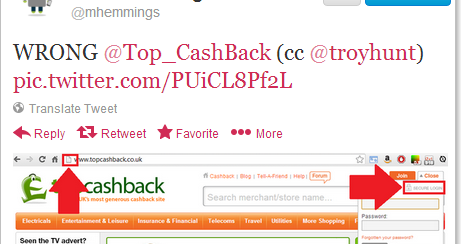
What annoys me is I'm a very young developer, and I've only really just become interested in security (12 months ago I didn't even know what hashing was!!!), yet there's developers out there with years and years of experience making huge sites for the likes of Tesco and TopCashBack for vast sums of money and they don't think about incorporating even the simplest foundations of internet security a novice like me would implement without even thinking! How is this possible?! If I'm doing it in tiny little php sites with 1 unique visitor ever, why are these 'experts' not in there huge corporate sites with hundreds of thousands of users a month?!
Vast sums of money? Yes, at least the outsourcing vendors who churn this sort of thing out.
Unfortunately you're the exception Mark so good on you for that. Well I mean unfortunate for the greater web using population, but very fortunate for you!
The government only contracts to companies on a particular whitelist, which we weren't. They paid a company something in the region of £300,000 for the website.
That company then outsourced 100% of the work to the tiny (single digits employee count) company I was at.
They paid us £40,000.
My share of that works out at about £2,000.
The fact something cost half a million dollars in no way implies any kind of quality, or that the people working on the software will know what they're doing. (Really: another horror story involved a website that only needed to work in IE6... and had been built and tested purely in Firefox)
Something positive like a site redesign perceived as increasing customer appeal or negative like an expensive legacy server upgrade often trumps security unless it clearly poses a future risk – this is also why many large companies tend to follow the trailing edge as the main concern is usually avoiding a lawsuit alleging that they were significantly worse than everyone else in their industry.
This is not always the case. Lots of marketing/PR companies started off in the pre-Internet days, and simply added websites to their list of services and rely solely on the experience of their devs to handle the rest. I was a contractor for such a company and to cut costs (read: to save on paying me), they hired a junior developer with no formal education, who specialized in copy-paste programming to do many of their large sites. He's since left, but the damage he's done still lives on in the countless sites he built for their clients, which are full of horribly insecure code (especially #1 on the HTTPS no-no list).
The good news is that, following his departure, I got plenty of work doing clean-up jobs on all the sites he built. :)
In any sufficiently large organization, the people who make the decisions and the people who enact those decisions are separated by distance, background, experience, or other reasons. This is why you see so much dysfunction in large organizations, and it extends to politics and other things that affect you as well. Look for it and you'll start seeing it everywhere.
Why on Earth these companies are given free advice, but think they (or their PR folks) know better is beyond me. Take the advice! You've now got a security flaw, documented, waiting for Joe Hacker to take your customer's data and shoot a hole through your business, and its reputation.
[1] http://www.troyhunt.com/2012/07/lessons-in-website-security-...
I have absolutely no expectation that it is going to be fixed either.
That said, you should have seen my face when my ISP emailed me my very password for online access, in plain text. It was something like 123456. Unforgivable double offense.
[0] And possibly normalise their length/character set, something that comes for free with hashes.
Secondly, users will reuse passwords. An attacker with access to the plaintext password and the user's email address can use this to try to gain access to other services.
Thirdly, the attacker in the first example could be a disgruntled employee. You don't want a disgruntled employee causing trouble.
Lastly, I like to protect myself. A user of your services may claim you or your employees are signing in as them. It is convenient to be able to honestly state that this cannot happen.
However,
> Lastly, I like to protect myself. A user of your services may claim you or your employees are signing in as them. It is convenient to be able to honestly state that this cannot happen.
sounds odd, since the user transmitted their password in clear text to the server at least once when registering, unless you use browser-side hashing/salting, in which case this hash would then take on the role of a password (i.e. wouldn’t help at all). Furthermore, anyone with database access could overwrite the hash in the database, log in with the password matching the new hash and then put the old hash back in place.
Never design for what people are supposed to do. Design for what people actually do.
Thanks.
If someone has read-only access to the database (e.g. a junior developer) they can do absolutely nothing with a hashed password
I never used https on my sites because there are some giant warnings ("dangerous") in browser when you go to a website that is self-signed. No warnings on plain http.
I do agree that the extreme mistrust of browsers towards self-signed certificates is an odd thing.
No, not at all; it's the whole point of SSL. The guy MITMing an SSLed website can create a cert for that site himself, but he can't get it signed by a CA. So he has to sign it himself. Thus, from the browser's perspective, all self-signed certs are possible instances of "there used to be a CA-signed cert here, but now you're being MITMed."
Now, that's not to say something like self-signed certs wouldn't be nice--given some sort of distributed pin cache, we could have something closer to an SSH/PGP model where everyone's current self-signed cert "fingerprint" is on file, and alarm bells go off if you see a cert different from the one you're supposed to see. But without that, self-signing is literally no more secure than no SSL at all: anyone else can also self-sign to MITM you.
I strongly doubt that.
Ideally, browsers would store the certificate presented on the first visit to a website and compare the certificate presented on following visits to that stored certificate to warn the user on mismatches – so far, I have not yet found a usable implementation thereof, and especially not one more widespread than CAcert.
[0] Among them such trustworthy companies as DigiTrust, TÜRKTRUST or CNNIC.
Edit: Besides that problem #1 is offtopic since it has nothing to do with https and that 3/4 other points are captain obvious, #4 is actually a good one. It's so obscure that many will forget to enable it ("all pages are secured anyway"), but whenever a user visits any http page, an attacker can inject a small frame loading the http version of my website, and even if I redirect, the cookie was already sent and read by the attacker. Only an HSTS header or enabling the secure-cookie option protect against this.
1 is very on-topic - there's no way that data should be sent in the clear.
HSTS is good, but unfortunately only partially supported. Agree on the secure cookie, but of course you need to drop the dependency on accessing it over HTTP before you do that.
It's not about security here, it's about privacy.
https://willnorris.com/2012/12/all-https-all-the-time
> This blog isn’t terribly controversial. But if only the "controversial" stuff is private, then privacy is itself suspicious. Thus, privacy should be on by default.